- The paper proposes DeepCORD, which adaptively tunes solver parameters using a learned feedback policy for distributed factor graph optimization on matrix Lie groups.
- It integrates Riemannian dynamics with deep unfolding, achieving superior convergence and robustness in multi-robot SLAM and submap alignment tasks.
- Experimental results demonstrate that DeepCORD outperforms fixed-parameter solvers, maintaining near-optimal performance under noise, delays, and varied conditions.
Learning Adaptive Solvers for Distributed Factor Graph Optimization on Matrix Lie Groups
Introduction
Distributed factor graph optimization over matrix Lie groups underpins scalable multi-robot SLAM, multi-session mapping, and geometric perception. While consensus and distributed optimization algorithms leveraging Lie group structure have matured, their empirical performance and robustness have been impeded by brittle hand-tuning of solver parameters and the lack of adaptability to different topologies, noise regimes, and communication constraints. The paper "Learning Adaptive Solvers for Distributed Factor Graph Optimization on Matrix Lie Groups" (2607.08735) introduces DeepCORD, a learning-augmented framework that addresses these limitations by deploying adaptive solver parameterization within a principled distributed Riemannian optimization setup.
The work considers distributed optimization in factor graphs with variables taking values in general matrix Lie groups, such as SE(3) for pose graphs in SLAM or SL(4) for projective submap alignment. The factor graph is partitioned across multiple robots, where each robot only optimizes its local variables and a subset of boundary variables received from its neighbors. The cost function consists of local edge costs involving noisy relative group measurements, with each robot maintaining local costs based on its assigned edges and subset of variables. This framework encapsulates canonical problems such as multi-robot SE(3) pose graph optimization (PGO) and feed-forward SLAM submap alignment in SL(4) encountered in dense 3D reconstruction with projective ambiguity.
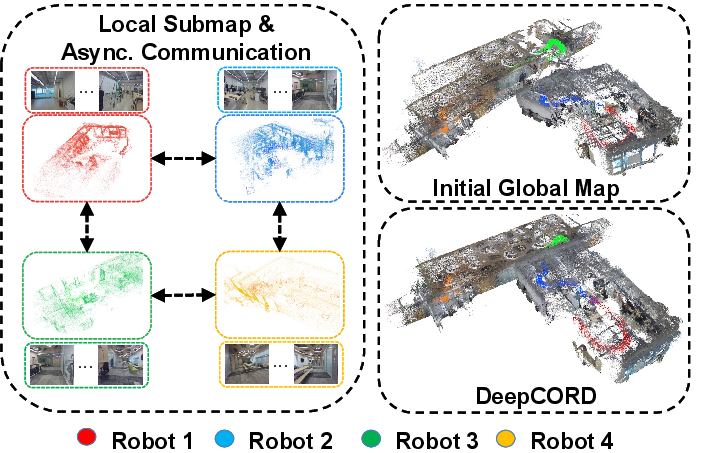
Figure 1: DeepCORD aligns feed-forward SLAM submaps from four robots through distributed SL(4) optimization, producing a globally consistent map of a 100m-scale environment.
DeepCORD: Methodological Contributions
Unfolding Riemannian Geometric Dynamics
DeepCORD builds upon CORD, which models distributed manifold optimization using Euler–Poincaré Riemannian dynamics. Local solver parameters—physical analogues of mass, damping, and integration step size—critically determine convergence behavior and robustness to model and communication noise. However, prior methods required hand-tuned constants, leading to poor transferability and brittle deployments.
Adaptive Neural Feedback Policy
DeepCORD replaces manual parameter tuning with a learned local feedback policy πθ, implemented as a graph neural network with a global positional self-attention (GPS) backbone. This policy adapts parameters (mki,dki,Δtki) per robot and per iteration, based on a local two-hop augmented subgraph enriched by multi-level attributes: gradients, velocities, edge residuals, communication delays, and topological encodings. The architecture enables adaptive, context-aware adjustment of solver dynamics driven by the current optimization phase and asynchronous communication state.
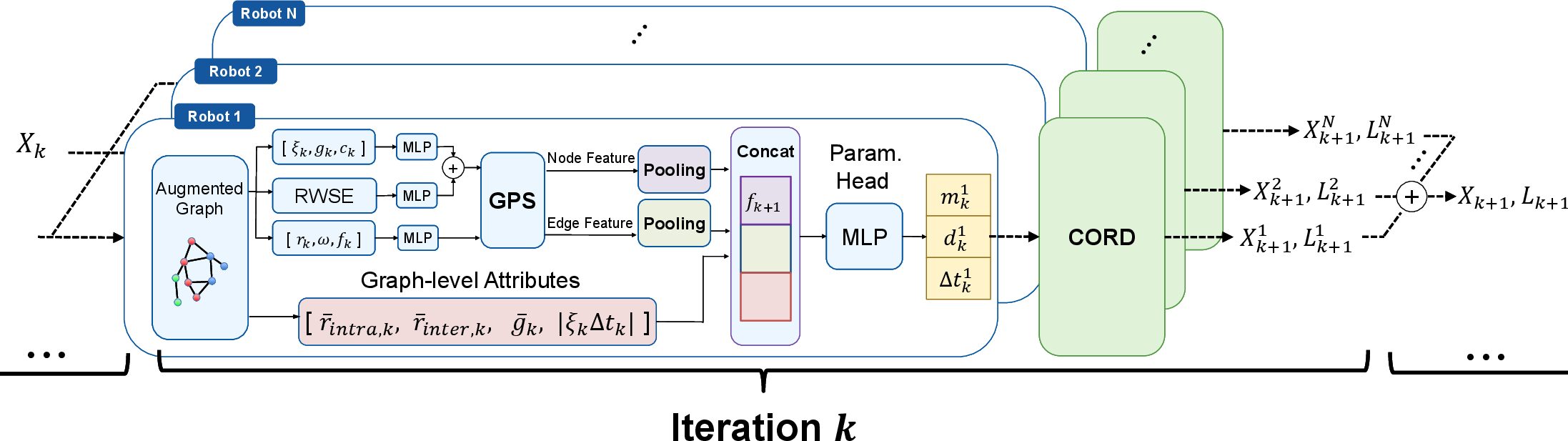
Figure 2: The adaptive feedback policy πθ architecture in DeepCORD, leveraging GNN and GPS layers to ingest multi-scale graph/context features and output per-robot adaptive solver parameters.
Self-Supervised Deep Unfolding
Training proceeds via deep unfolding: unrolling the distributed optimizer for K=50 iterations and minimizing a composite loss comprising the averaged normalized local objective, monotonicity regularizer, and a decay constraint on damping. Critically, the setup is self-supervised and does not require reference minimizers—policy weights are updated purely by differentiation through the unrolled solver given the objective landscape. Implicit differentiation is used for memory-efficient backpropagation through the conjugate gradient-based Hessian solves.
Experimental Results
Multi-Robot Pose Graph Optimization (SE(3))
DeepCORD is evaluated against state-of-the-art distributed PGO methods (including AMM-PGO, ROBO, CORD, and Distributed Jacobi) on large-scale synthetic and real-world datasets (e.g., S3E, CampusRoad, Rim, Garage). Notably, test graphs are generally larger than those seen during training, with up to 10k nodes. Both synchronous and asynchronous settings are investigated, with the latter including randomized inter-robot delays and packet drops.
DeepCORD achieves lowest or second-lowest objective value in 21 of 26 scenarios after a fixed iteration budget, and particularly distinguishes itself when initialization is poor or under significant asynchrony. The adaptive parameter schedule yields better robustness to varying communication regimes and initialization perturbations than fixed-parameter solvers.
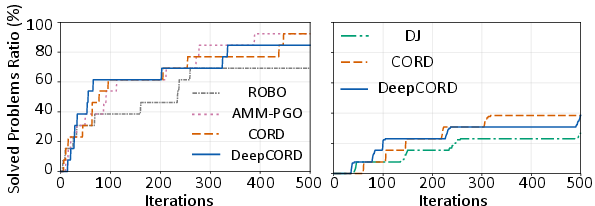
Figure 3: Performance profiles on 13 benchmarks: DeepCORD achieves superior early and overall convergence rates in both synchronous and asynchronous distributed PGO.
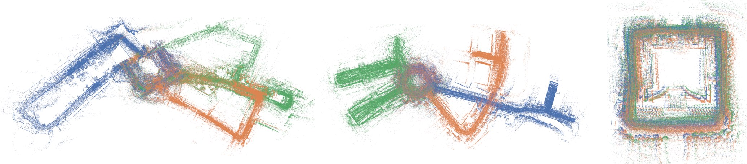
Figure 4: Fused global maps after PGO on S3E CampusRoad1, Dormitory1, and Library1: DeepCORD reconstructs consistent global structure by aligning multi-robot submaps.
Projective Submap Alignment on SL(4)0
The framework is extended to challenging dense projective submap alignment, as in VGGT-SLAM, on TUM RGB-D datasets. Here, each robot reconstructs a submap at the session level, resulting in a multi-session graph requiring projective alignment via SL(4)1 transformations. Initializations are highly ambiguous and perturbed, and the optimization landscape is nontrivial due to projective ambiguity.
DeepCORD consistently outperforms CORD and first-order baseline DJ, both in the recovered cost and in downstream Chamfer/accuracy metrics for reconstructed maps, demonstrating the effectiveness of adaptive learning-based parameterization in high-dimensional matrix Lie group settings.
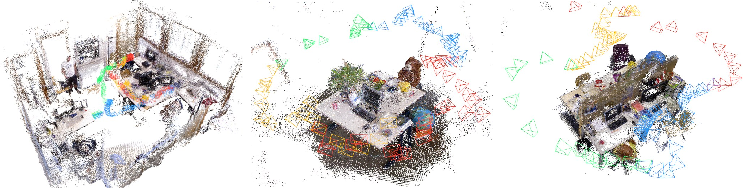
Figure 5: Fused maps from DeepCORD on TUM1, TUM2, and TUM3, showing smooth cross-session projective alignment of RGB-D reconstructions under distributed asynchronous communication.
Empirical Analysis of Adaptivity and Robustness
A key feature is DeepCORD's empirical insensitivity to initialization perturbations. Across multiple levels of added relative pose noise, DeepCORD maintains consistently small optimality gaps, in contrast to the rapidly degrading behavior of CORD with fixed parameters.
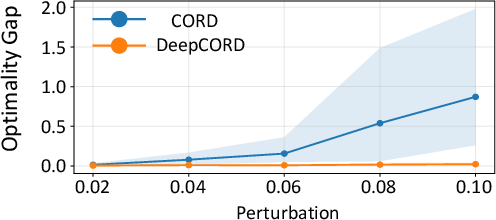
Figure 6: Optimality gap on the Rim dataset versus increasing initialization perturbation: DeepCORD remains near-optimal, highlighting robustness to initialization.
Analysis of the learned adaptive schedules reveals that DeepCORD dynamically attenuates mass and accentuates damping in early, high-delay settings to achieve stable progress and transitions to more aggressive, accelerated updates as convergence nears—a form of context-aware, data-driven schedule that is state-of-the-art in distributed nonconvex geometric optimization.
Implications and Perspectives
The self-supervised adaptive parameterization paradigm demonstrated by DeepCORD provides several critical theoretical and practical implications:
- Practical Deployability: Adaptive parameter schedules directly address deployment brittleness in real-world multi-robot, multi-session, and heterogeneous environments, especially under asynchrony and with severe communication constraints.
- Scalability: The demonstration of effective generalization from small graph training to large benchmark problems points to the viability of amortized L2O strategies in non-Euclidean, distributed, and nonconvex geometric estimation.
- Extensibility: DeepCORD establishes a foundation for L2O applied to generalized matrix groups, enabling broader classes of SLAM modules (projective, affine, etc.) and supporting foundation model back-ends.
- Theoretical Generalization: While DeepCORD maintains energy dissipation properties in the unfolded dynamics, the absence of asymptotic convergence proofs motivates future research on explicit stability and Lyapunov constraints for adaptive, data-driven discretizations in Riemannian contexts.
- Modular Integration: The approach is compatible with modular multi-robot frameworks and could be extended with dual certificates or global-features for optimality gap estimation.
Conclusion
DeepCORD advances the state of distributed geometric optimization on Lie groups by integrating learned local feedback for adaptive solver parameterization within a distributed Riemannian framework. Empirically, DeepCORD surpasses hand-engineered solvers across communication regimes and problem scales, and robustly generalizes to challenging projective and multi-session alignment tasks. This work demonstrates that well-structured deep unfolding of geometric optimizers with local neural feedback policies yields a new class of adaptive, robust, and scalable solvers ideally suited for future distributed robotic perception and SLAM systems.
References
For full attribution and further technical context, see (2607.08735).