Low-Rank Matrix Recovery via Heavy-Tailed Quadratic Sampling
Published 9 Jul 2026 in math.ST and cs.IT | (2607.08671v1)
Abstract: The problem of recovering an (approximately) low-rank Hermitian matrix M<em>0∈C<sup>n</sup>×n of rank r from quadratic sampling matrices of the form akak<sup>∗</sup></em>k=1<sup>m arises in a variety of applications, including phase retrieval. To obtain rigorous recovery guarantees, the sampling vectors a<em>k</em>k=1<sup>m are typically modeled probabilistically. However, most existing theoretical results rely on Gaussian or sub-Gaussian assumptions, which may not accurately capture practical data models. In many applications, sampling vectors exhibit heavier tails, while theoretical understanding in such regimes remains scarce. In this paper, we bridge this gap. We show that two widely used convex approaches, nuclear norm minimization and semidefinite-constrained empirical risk minimization, achieve uniform, stable, and robust recovery under the mild assumption that the entries of the sampling vectors have only finite $4+δ$ moments, with the optimal sample complexity m=O(rn) up to moment-dependent constants. The two main ingredients of our analysis are moment estimates for quadratic forms established via decoupling, together with recent advances in covariance estimation in heavy-tailed settings. As byproducts, we also establish the optimal sample complexity for low-rank matrix recovery under complex projective $4$-design sampling, thereby improving upon previous results, and obtain stability guarantees for phase retrieval under similarly weak moment assumptions.
The paper establishes that robust low-rank recovery is achievable via nuclear norm and PSD minimization even with heavy-tailed quadratic sampling.
It leverages advanced tools like the rank null space property and Mendelson’s small ball method to derive near-optimal sample complexity bounds of O(rn).
Empirical results validate the theory, showing comparable phase transitions and noise robustness to Gaussian sampling in applications such as imaging and quantum tomography.
Low-Rank Matrix Recovery under Heavy-Tailed Quadratic Sampling
Introduction
The paper "Low-Rank Matrix Recovery via Heavy-Tailed Quadratic Sampling" (2607.08671) addresses the recovery of approximately low-rank Hermitian matrices from quadratic measurements, focusing on scenarios where the sampling vectors exhibit heavy-tailed distributions rather than classical Gaussian or sub-Gaussian models. The motivation arises from practical domains such as quantum tomography, phase retrieval, signal processing, and imaging, where acquisition systems often generate sampling patterns with heavier tails than those assumed in traditional theory. The authors rigorously analyze nuclear norm minimization and semidefinite-constrained empirical risk minimization under weak moment assumptions, providing robust guarantees with near-optimal sample complexity.
Analytical Framework and Main Contributions
The paper studies recovery from measurements of the form yk=⟨akak∗,M0⟩+ωk, where M0∈Cn×n is of low rank and {ak}k=1m are sampling vectors. The typical convex approach involves nuclear norm minimization, whereas, for positive semidefinite targets, empirical risk minimization over the cone of PSD matrices can be used.
The strong claim of this work is that uniform, stable, and robust recovery is feasible with the same order-optimal sample complexity (m=O(rn)) even when the entries of {ak} are independent, normalized, and possess only finite 4+δ moments. This result holds for both aforementioned convex recovery programs and is derived under near-minimal distributional requirements. Additionally, the work extends these guarantees to complex projective t-design sampling with t=4, removing logarithmic oversampling requirements in previous literature.
Technical Approach
The analysis leverages several advanced tools:
Rank Null Space Property (NSP): Recovery guarantees are established through the robust rank-NSP, which quantifies the recoverability of low-rank matrices under the imposed measurement operator.
Mendelson’s Small Ball Method: This framework replaces classical concentration arguments with lower bounds for the probability that measurements are above a certain threshold, critical in heavy-tailed settings.
Decoupling-Based Moment Estimates: The authors directly estimate higher moments for quadratic forms of heavy-tailed vectors, circumventing Gaussian-dependent arguments (e.g., Hanson-Wright inequalities).
Covariance Estimation for Heavy-Tailed Distributions: Recent results on sample covariance matrix concentration (e.g., [tikhomirov2018sample], [abdalla2024covariance], [jirak2025concentration]) are adapted to control deviations in empirical quadratic operators, enabling robust bounds on empirical process terms.
Uniform Recovery and Robustness
The main theorems articulate explicit recovery bounds:
For nuclear norm minimization, the Frobenius error is bounded by rC∥M0r,c∥∗+C′m1/qη, where moment-dependent constants are controlled by the moments of the sampling distribution.
For PSD-constrained minimization, analogous bounds hold with an additional requirement on the empirical measurement matrix being positive definite, achieved with high probability under the stated sample complexity.
Notably, these results hold under finite (4+δ)-th moment assumptions, with explicit moment-dependent constants.
Complex Projective Designs and Sample Complexity
The study extends recovery guarantees to sampling via complex projective M0∈Cn×n0-designs, establishing that optimal sample complexity (M0∈Cn×n1) suffices, eliminating the logarithmic factor seen in previous work [kueng2017low], [kabanava2016stable]. The authors utilize the exact moment structure of complex designs to achieve this result. Extensions to approximate M0∈Cn×n2-designs and lower M0∈Cn×n3 values (e.g., M0∈Cn×n4) are discussed.
Stability for Phase Retrieval
The paper delivers robust stability guarantees for phaseless operators (M0∈Cn×n5), showing that stability holds under similarly weak moment assumptions, and for projective M0∈Cn×n6-designs with sample complexity M0∈Cn×n7. The bound is uniform over all input pairs, ensuring resilience to adversarial perturbations—a significant advance for practical phase retrieval in heavy-tailed regimes.
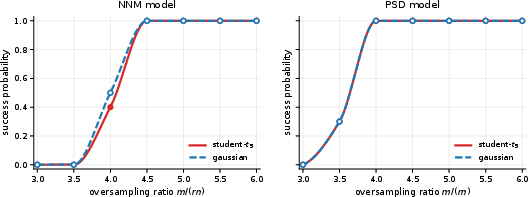
Phase transitions: Both Student-M0∈Cn×n8 and standard complex Gaussian ensembles exhibit comparable sample complexity thresholds for successful recovery.
Figure 1: Phase transition for the Student-tM0∈Cn×n9 and Gaussian ensembles with both nuclear norm and PSD recovery, demonstrating similar sample complexity behavior.
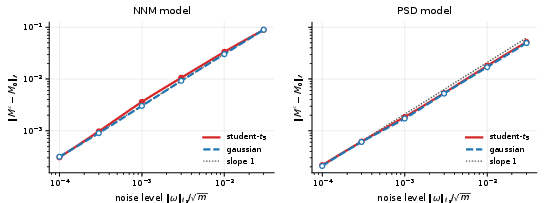
Noise robustness: The Frobenius recovery error grows linearly with noise level for both ensembles, with the heavy-tailed Student-{ak}k=1m0 performing equivalently to the Gaussian case.
Figure 2: Noise robustness under the Student-t{ak}k=1m1 and Gaussian ensembles, highlighting stable error growth as a function of normalized noise level.
Practical and Theoretical Implications
This work significantly relaxes the statistical assumptions required for robust low-rank recovery from quadratic measurements, broadening the applicability to real-world systems characterized by heavy-tailed acquisition. The methods employed are highly relevant to uncontrolled imaging, quantum state tomography, and robust phase retrieval in physics and engineering. The moment-based framework provides a general blueprint for extending convex recovery to broader classes of non-Gaussian and adversarial settings.
From a theoretical perspective, the results show that optimal scaling in sample complexity is achievable under nearly minimal assumptions, pointing to potential generalizations for more structured or corrupted measurement models. The decoupling arguments and covariance estimation techniques could inspire further advances in non-asymptotic analysis for heavy-tailed random matrices in high-dimensional statistics and machine learning.
Conclusion
The paper establishes that low-rank matrix recovery via convex programs is robust to heavy-tailed quadratic sampling, with optimal sample complexity and explicit stability bounds. Strong numerical evidence supports these claims, and the general analytical machinery developed is poised to influence both future applications and theory in non-Gaussian inference, phase retrieval, and high-dimensional signal recovery.
“Emergent Mind helps me see which AI papers have caught fire online.”
Philip
Creator, AI Explained on YouTube
Sign up for free to explore the frontiers of research
Discover trending papers, chat with arXiv, and track the latest research shaping the future of science and technology.Discover trending papers, chat with arXiv, and more.