- The paper presents triangulene diradicals with a well-separated triplet ground state (~0.5 eV gap), analogous to NV– centers, as promising quantum systems.
- It employs multireference quantum chemistry and spin-vibronic simulations to reveal spin relaxation dynamics with predicted T1 times from 1 ms to 27 ms.
- Results highlight optical addressability and isotope engineering that improve T2 coherence, guiding molecular design for robust qubits.
Overview
The paper "Triangulene-based diradicals as a blueprint for molecular quantum platforms with optical addressability and long spin coherence times" (2607.08634) presents a unified ab initio theoretical foundation for triangulene and its derivatives as candidate molecular quantum systems. Leveraging multireference quantum chemistry, relativistic spin-vibronic simulations, and state-of-the-art decoherence modeling, the authors demonstrate that these organic diradicals possess electronic structures, optical dynamics, and spin coherence properties closely paralleling those of solid-state defects such as NV− centers, with practical implications for quantum information processing, sensing, and single-molecule spin-photon interfaces.
Electronic Structure of Triangulene Diradicals
The study investigates three molecules: triangulene (1), its aza-cation derivative (2), and the crystal of 2,6,10-tri-tert-butyl-4,8,12-trimesityl-triangulene (3). Multireference CASSCF methods with NEVPT2 corrections are utilized, revealing a triplet ground state distinctly separated (∼0.5eV) from the first singlet excited state, analogously to NV− centers. The diradical nature arises from delocalized, singly occupied π orbitals in the triangulene core, with marked differences upon N+ substitution that stabilizes the LUMO and reduces the triplet-triplet energy gap in (2). Bulky functionalization and crystal packing in (3) diminish symmetry and alter singlet-triplet separations, crucial for practical device implementation.
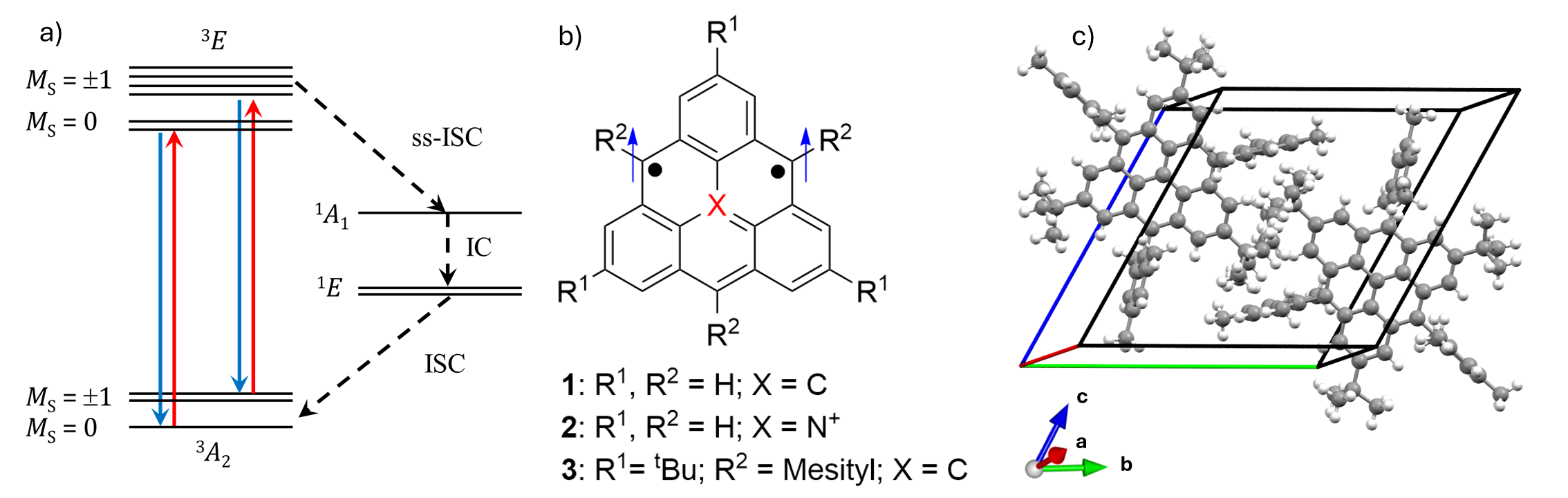
Figure 1: Schematics of electronic processes and triangulene-based diradical structures; triangulene and its derivatives exhibit energy-level arrangements reminiscent of NV− centers.
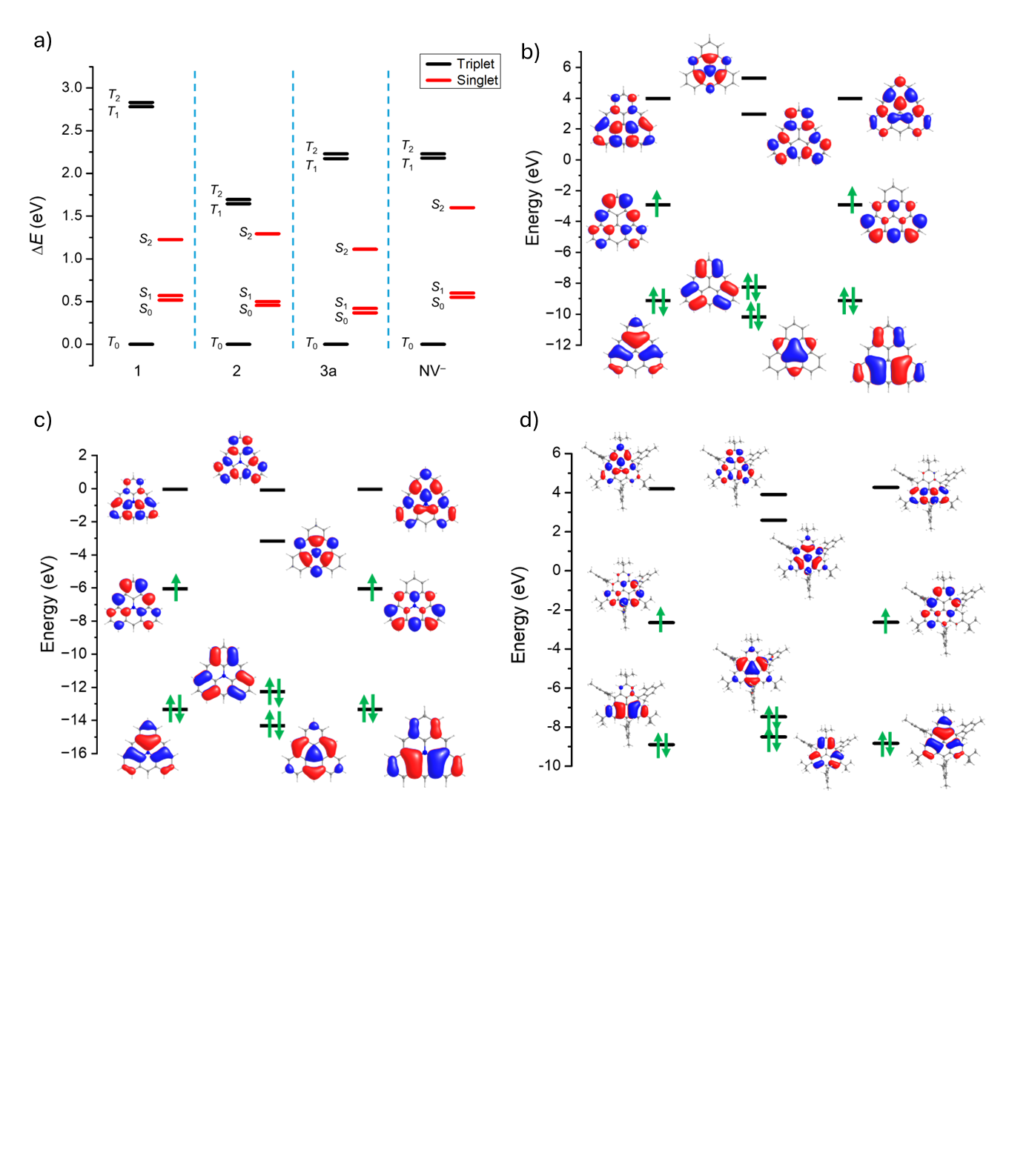
Figure 2: Vertical Excitation Energies for compounds 1–3, showing triplet and singlet state separations; comparing these molecules' VEE to NV− centers underscores the electronic similarity.
Spin-Vibronic Coupling: Computational Insights
Through spin-vibronic coupling analysis utilizing relativistic Hamiltonians, the authors decompose vibronic contributions (J and K terms). The dominant contribution originates from spin-free Coulomb interactions modulated by nuclear displacements (in-plane distortions), while relativistic (spin-orbit/spin-spin) modulation is minor and primarily active for out-of-plane displacements. Spin selectivity is observed: transitions are favored depending on ΔMS and vibronic mode orientation, with in-plane modes coupling ∼0.5eV0 transitions and out-of-plane modes facilitating ∼0.5eV1 transitions. Quantitatively, the ∼0.5eV2 term is largest for molecules with strong multireference character, while substitution (N∼0.5eV3 in (2)) reduces coupling and enhances coherence.
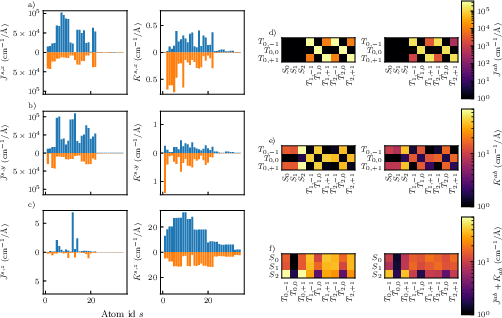
Figure 3: Vibronic coupling decomposition in atomic and Cartesian contributions, highlighting the selectivity and relative magnitude of ∼0.5eV4 and ∼0.5eV5 across triangulene-based compounds.
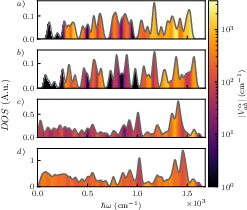
Figure 4: Phonons' density of states and vibronic coupling spectrum, revealing energy windows critical for spin relaxation and emphasizing the impact of functionalization on phononic structure.
Spin Relaxation and Decoherence Mechanisms
The interplay between spin-phonon and spin-spin decoherence is modeled via quantum master equations and cluster correlation expansion (CCE). Organic triangulene derivatives (1,2) manifest exceptionally long predicted relaxation times (∼0.5eV6 for (1), ∼0.5eV7 for (2) at ∼0.5eV8). In contrast, functionalization and crystalline environments introduce low-energy phonons detrimental to ∼0.5eV9 (dropped to −0 for (3)), implicating molecular and lattice vibrations of tert-butyl and mesityl substituents.
Decoherence dynamics are further probed under various nuclear spin environments. Deuteration proves especially potent; in (3), −1 increases from −2 (hydrogenated crystal) to −3 (central deuterated molecule in a nuclear spin-free environment at −4), demonstrating practical strategies for noise suppression.
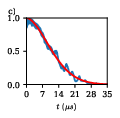
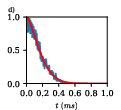
Figure 5: Hahn-echo decoherence profiles for deuterated and hydrogenated triangulene crystals, illustrating drastic improvements in −5 with isotope engineering.
Optical Dynamics and Inter-System Crossing
Radiative lifetimes are computed (−6) for the excited triplet state, in good agreement with experimental data for the luminescent triangulene cation. ISC rates are modeled via two-phonon processes; spin-selectivity is strongly energy-dependent and can favor either −7 or −8 channels depending on molecular geometry and electronic structure. This property enables optical read-out and initialization of spin states via ODMR, paralleling NV−9 center protocols. Theoretical rates align with known organic ISC benchmarks; spin-selectivity is tunable through chemical and structural engineering.
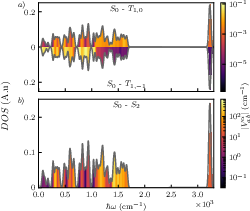
Figure 6: Vibronic coupling intensity versus phonon frequency, illustrating ISC pathways between singlet and triplet states for the triangulene cation and the role of virtual phonon transitions.
Implications, Chemical Design, and Future Directions
Triangulene-based diradicals are established as a chemically tunable platform for molecular quantum technologies. The study quantifies the effects of functionalization, substitution, and host environments, providing actionable design rules for optimizing quantum properties. Practical realization faces hurdles: maintaining long π0 and π1 in device environments necessitates suppression of internal and environmental vibrational noise, potentially via rigid functionalization or integration into covalent organic frameworks.
Theoretical advancements unify spin-phonon relaxation and excited-state dynamics under a first-principles framework, revealing intricate, spin-selective multidimensional pathways for electronic transitions—all critical for engineering molecular color centers. These ab initio methods are extensible to other conjugated systems, including nanographenes and arenes, and will be essential as quantum technology continues its integration with molecular chemistry, promising robust, optically-addressable, highly coherent qubits.
Conclusion
This work rigorously establishes triangulene-based diradicals as promising, optically addressable molecular quantum platforms, achieving millisecond-scale spin coherence and high optical fidelity via chemical and environmental engineering. The theoretical framework enables quantitative prediction and decomposition of spin relaxation and excited-state ISC processes, guiding molecular design for future qubit technologies. The implications extend to scalable quantum sensors, single-molecule spin-photon interfaces, and molecular quantum devices, with future developments likely focusing on vibrational noise suppression, tunable spin-selectivity, and integration within functional molecular frameworks.

