- The paper establishes that a momentum-dependent identity term actively reshapes the GBZ, inducing topological phase transitions and altering edge state properties.
- The authors derive exact edge state criteria and energy spectra using a polynomial formulation, providing clear phase boundaries and analytical benchmarks.
- The findings demonstrate that non-Hermitian topological phases can emerge without traditional symmetry, with implications for photonic, metamaterial, and cold-atom systems.
Non-Hermitian Topology Driven by a Momentum-Dependent Identity Term: An Exactly Solvable Paradigm
Introduction
The work "Non-Hermitian Topology driven by an Identity Term: An Exactly Solvable Paradigm" (2607.08469) introduces a comprehensive analytical framework for understanding topological phenomena in non-Hermitian two-band models, with a focus on the role of a momentum-dependent identity term. Departing from the standard Hermitian or chiral-symmetric classifications, this study addresses a previously overlooked mechanism: how an identity term that depends on momentum—thus not simply providing a trivial energy shift—actively reshapes the topological properties, boundary states, and generalized Brillouin zone (GBZ) geometry of the system. The authors provide exact solutions for energy spectra, wavefunctions, edge state criteria, and GBZ construction both for canonical and fully generic (symmetry-agnostic) systems.
Model Definition and Analytical Solution
The primary model under study is a spin-orbit (SO) coupled non-Hermitian Hatano-Nelson (HN) chain with SU(2) phases and both intra- and inter-cell SO couplings. The real-space Hamiltonian, under open boundary conditions (OBC), contains generic asymmetric hoppings, SU(2) phases, and complex SO couplings:
\begin{align}
\hat{H}=\sum_{n=1}{N}\left{t_{L}e{i\alpha_L\sigma_z}\hat{c}{n}{\dagger}\hat{c}{n+1}
+t_{R}e{i\alpha_R\sigma_z}\hat{c}{n+1}{\dagger}\hat{c}{n}
+\delta_1\hat{c}{n}{\dagger}(\boldsymbol{b}\cdot \boldsymbol{\sigma})\hat{c}{n}+\left[\delta_2\hat{c}{n}{\dagger}(\boldsymbol{b}\cdot \boldsymbol{\sigma})\hat{c}{n+1}+h.c.\right]\right}
\end{align}
In momentum space, the Hamiltonian features the central object of interest: a momentum-dependent identity term, $d_0(\beta)\mathds{1}$, with β=eik. This term substantially modifies the GBZ and, consequently, the bulk-boundary correspondence.
The authors derive a closed-form solution for the entire OBC eigensystem, reducing the spectral problem to a compact $2N$-degree polynomial in energy for system size N. The eigenfunctions and boundary coefficients are expressed analytically in terms of the β roots of the characteristic equation.
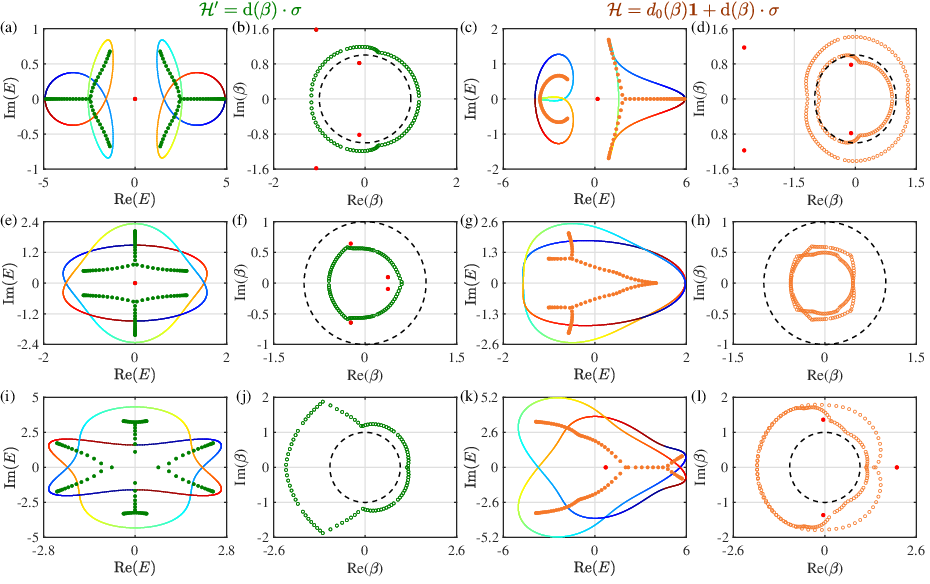
Figure 1: Parameter-dependent deformation of GBZ and topological edge state emergence and annihilation due to the momentum-dependent identity term, compared between the reduced and full model.
Decisive Role of the Momentum-Dependent Identity Term
Contrasting with standard intuition, the momentum-dependent identity term does not merely affect the spectrum by providing an overall energy shift. Instead, it actively deforms the GBZ, thereby altering the very topology of the system and leading to the creation, annihilation, or transformation of edge states.
Comparative analysis (see Figure 1) demonstrates that, depending on parameters, the term can:
- Leave edge states unchanged but alter their symmetry provenance.
- Induce topological phase transitions by creating or destroying gap-localized boundary states.
- Drive deformation of the GBZ from trivial one-loop to multi-loop or twisted contours.
These findings establish that the standard symmetry-based classification fails when a momentum-dependent identity term is present, as such a term is topologically active, not inert.
Exact Bulk-Boundary Correspondence and Generalized Phase Diagrams
Through a Chebyshev-polynomial formalism, the authors provide exact edge state criteria and explicit energy formulas in the thermodynamic limit. The conditions for edge state existence—given by algebraic inequalities involving the system parameters—define intricate phase diagrams with multiple disconnected regions (so-called "topological islands") absent in conventional models.
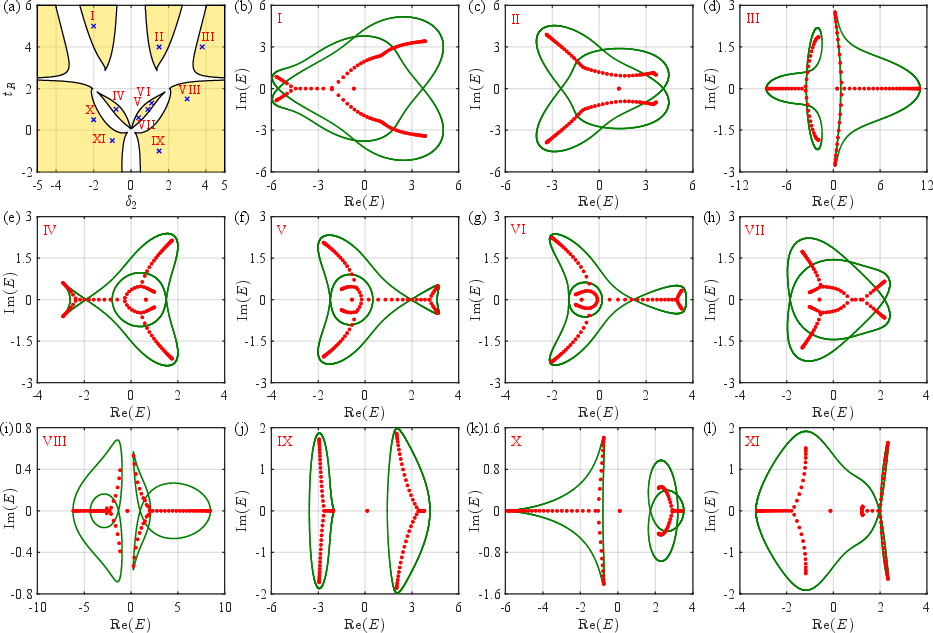
Figure 2: Distinct OBC spectral morphologies across parameter space, highlighting the dichotomy between topological islands and non-island regimes in connection with GBZ topology.
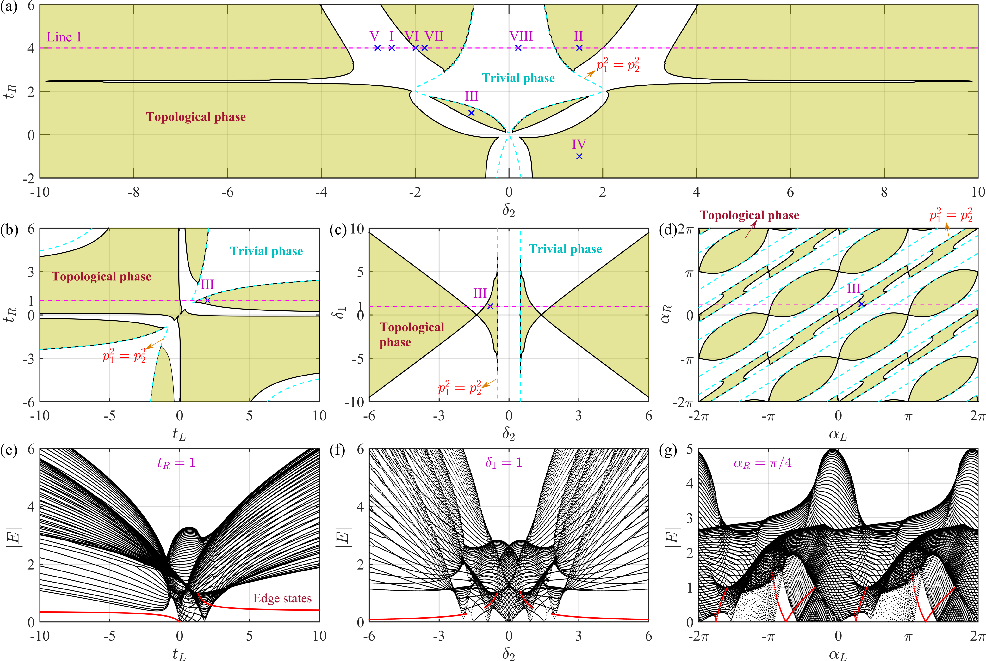
Figure 3: Multi-parameter phase diagrams revealing the fragmentation of topological regions into disconnected islands governed by the enforcement of the exact edge-state criterion.
Notably, the existence and character of these islands can be traced to the nontrivial synergy of the momentum-dependent identity term and SO couplings, leading to GBZ fragmentation and unexpected edge-state phases that lack symmetry-based protection.
Non-Hermitian Skin Effect and Topological Distinction
The study draws a sharp distinction between edge states protected by GBZ topology and the non-Hermitian skin effect (NHSE), which is governed by point-gap topology and the spectral winding number over the Brillouin zone (BZ). Through explicit computation and scaling analysis, the authors show that NHSE and edge states are physically distinct—skin modes are dictated by bulk winding (global, thermodynamic), while edge states arise from local wavefunction topology on the GBZ (pointwise, robust for all N).
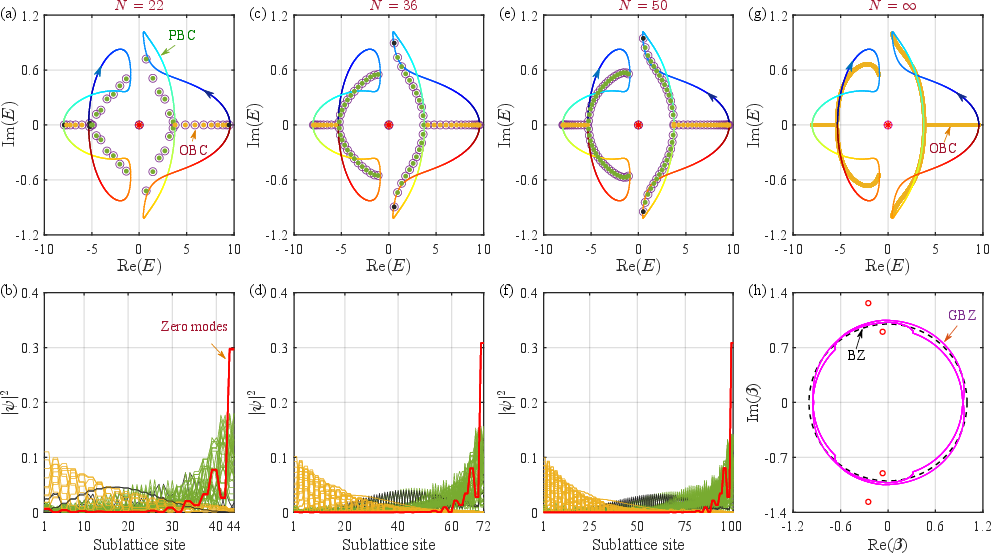
Figure 4: OBC spectra and localization profiles showing convergence of discrete OBC eigenvalues to GBZ-continuous spectra in the thermodynamic limit, and robust zero-energy topological edge states regardless of system size.
Symmetry-Free Topological Invariants and Analytical Benchmarks
Recent symmetry-free topological invariants (notably the invariant from Zhong et al.) are tested against the exact analytical results and phase diagrams from this work. The symmetry-free winding number successfully predicts the number of edge states in regimes where the GBZ contour remains non-self-intersecting. However, in parameter regimes with self-intersecting or multi-loop GBZs, the analytic approach of this paper continues to provide well-defined phase boundaries and edge-state counting, whereas the current invariant becomes undefined.
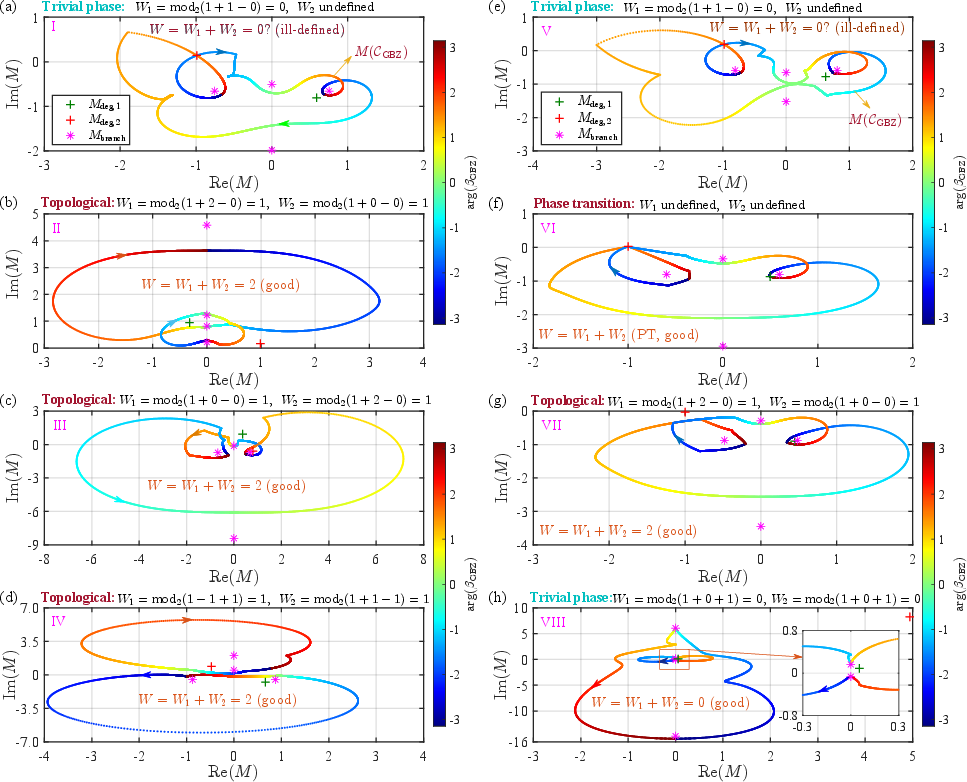
Figure 5: Topological invariant calculation illustrating agreement with analytical phase boundaries where well-defined, and highlighting breakdown in self-intersecting parameter regimes.
Robustness Against Disorder
Numerical tests under both diagonal (onsite) and off-diagonal (hopping) disorder confirm that both finite- and zero-energy edge states remain robust and sharply localized as long as the bulk gap persists. Energy splitting of edge states is negligible and localization survives even for disorder strengths comparable to or exceeding the energy gap, underscoring true topological robustness in a fully non-Hermitian and symmetry-free context.
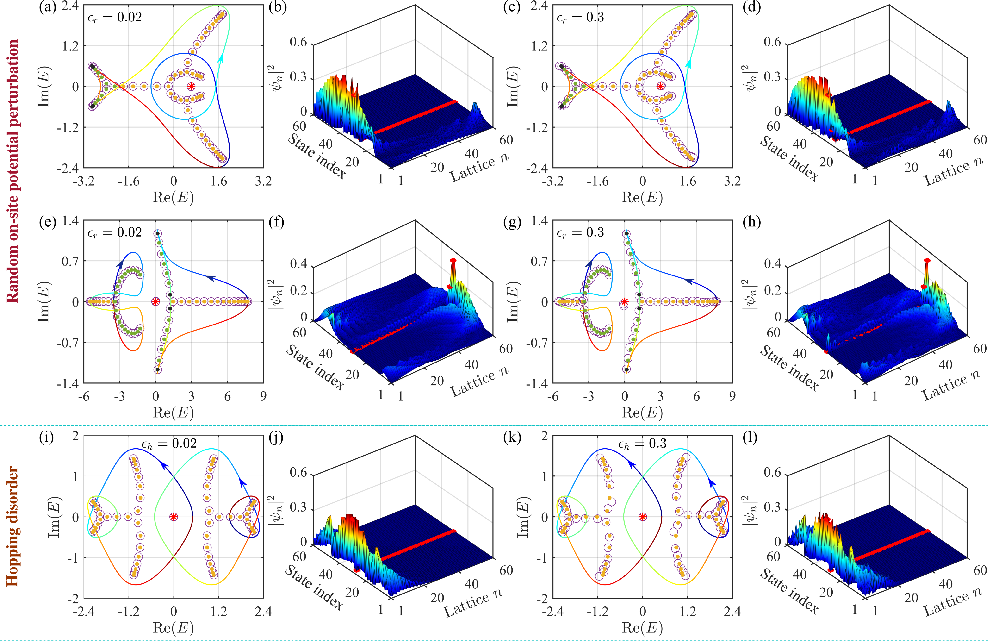
Figure 6: Persistence and sharp localization of edge states under strong onsite and hopping disorder.
Exact GBZ Derivation and Generic Two-Band Extensions
A rigorous derivation of the GBZ is provided via an eighth-order polynomial root-finding construction, returning exact OBC spectra and GBZ contours in the thermodynamic limit. This construction naturally extends to the most general two-band model with arbitrary parameter-dependence and no assumed symmetries, demonstrating the universal applicability and exact solvability of the present analytical framework.
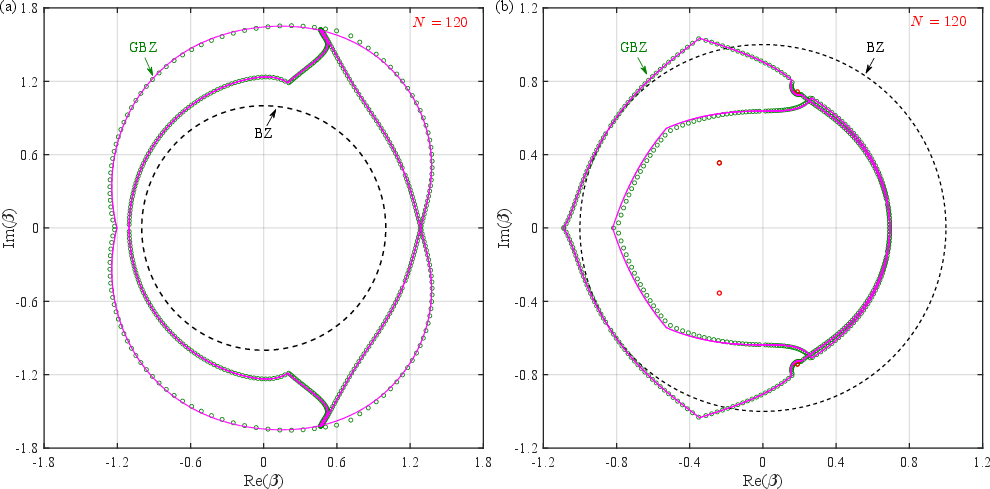
Figure 7: Numerical and exact analytical GBZ for representative parameters, confirming quantitative agreement.
(Figure 8, Figure 9)
Figure 8: Schematic Hamiltonian for the fully generic model.
Figure 9: Exact analytical versus numerical OBC energy spectra and wavefunctions for the fully symmetry-free model, showing non-degenerate topological edge states.
Implications and Future Directions
This study demonstrates that topological phenomena and robust edge states can arise in non-Hermitian systems lacking any conventional symmetry, and that the class of models with a momentum-dependent identity term features richer phase diagrams, edge state behavior, and bulk-boundary correspondence than previously recognized. The analytical machinery developed here provides a new benchmark for testing topological invariants and constructing solvable models in non-Hermitian quantum matter.
Practically, this understanding informs the design of metamaterials, photonic, and cold-atom systems where tunable non-Hermitian couplings and synthetic gauge fields are accessible. Theoretically, these results urge a refinement of classification schemes and strengthen the case for generalized, symmetry-free topological characterizations in non-Hermitian physics.
Conclusion
By providing a fully exact analytic solution for a family of non-Hermitian two-band models with a topologically active, momentum-dependent identity term, this work establishes a paradigm in which topological edge states and NHSE both survive and interleave without symmetry protection. The approach yields closed-form criteria for edge-state quantization, phase boundaries, and GBZ construction, and serves as a foundational reference for analytical, numerical, and experimental studies of non-Hermitian topological phases extending beyond the traditional symmetry-based framework.

