EVIS: A Physics-Grounded Event Camera Plugin for NVIDIA Isaac Sim
Abstract: Event cameras offer microsecond temporal resolution, low latency, and high dynamic range, making them attractive for robotics. However, labeled event-camera data for a specific robot and scene is scarce and expensive to collect, which slows the development of event-based perception and control. We present EVIS: a physics-grounded event camera plugin for NVIDIA Isaac Sim that generates high-rate, fully labeled event streams directly inside a physics simulator. The plugin implements a faithful log-intensity contrast event model with per-pixel asynchronous reference updates; it migrates from a normal RGB camera with few changes and integrates into any Isaac Sim / Isaac Lab scene, inheriting the simulator's physics and frame-perfect ground truth. It is fully configurable, and offers an interpolation option that renders only sparse keyframes and synthesizes the in-between frames through bidirectional motion-vector warping, making real-time generation on a single GPU possible. Optional sensor noise and motion blur further narrow the gap to real cameras. The generated streams are directly usable by pretrained event networks for downstream tasks. Code repository: https://github.com/spikelab-jhu/isaac-sim-event-camera-plugin
Paper Prompts
Sign up for free to create and run prompts on this paper using GPT-5.
Top Community Prompts
Explain it Like I'm 14
What this paper is about (overview)
This paper introduces EVIS, a software add-on (a “plugin”) that lets a popular robot simulator, NVIDIA Isaac Sim, act like it has an event camera. Event cameras don’t capture normal pictures. Instead, each tiny pixel reports only when the brightness at that spot changes, and it does this extremely fast—thousands of times per second. EVIS creates realistic, high‑speed, fully labeled event data inside the simulator so researchers can train and test robot vision and control systems without needing lots of hard‑to‑collect real recordings.
What questions the authors wanted to answer
The authors set out to solve three big problems that make event‑camera research hard:
- Fidelity: Can we simulate events in a way that closely matches how a real event camera works?
- Physics consistency: Can those events come from a true 3D physics world (not just a pre‑recorded video), so we get perfect “ground truth” labels like exact positions and motion?
- Speed: Can we generate events fast enough—ideally in real time—on a single graphics card?
How they did it (methods and approach)
Think of the simulator as a realistic video game world for robots, with exact control over lighting, motion, and objects. EVIS plugs into this world and acts like an event camera looking at it. Here’s how it works:
1) A faithful event camera model
- Everyday analogy: Imagine a stadium full of tiny light sensors (pixels). Instead of taking a group photo every second, each sensor “whispers” only when the light at its seat changes enough. That’s how event cameras behave: they report changes, not full images.
- In EVIS, every pixel remembers its last brightness. If the current brightness gets brighter or darker than a set “change amount” (a threshold), that pixel fires an event with a sign: ON for brighter, OFF for darker. Each pixel updates independently and can fire at different times, just like a real event camera.
- The simulator handles all pixels together on the GPU (a fast graphics processor), which keeps it efficient.
2) Speed via motion‑vector interpolation
Rendering every single high‑speed frame is expensive. EVIS uses a trick:
- The simulator draws only occasional “keyframes.”
- It also provides motion vectors—little arrows that tell how each pixel’s content moved between keyframes.
- Using these arrows, EVIS “warps” the keyframes to synthesize the in‑between frames. Think of sliding stickers along the direction of those arrows to create the missing pictures between two snapshots.
- With both directions of motion and some smart blending, EVIS fills gaps smoothly, feeding the event model at kHz rates while actually rendering much less. This makes near–real‑time generation possible on one GPU.
3) Optional realism: noise and blur
Real sensors aren’t perfect. To make simulated data look more like the real thing, EVIS can add:
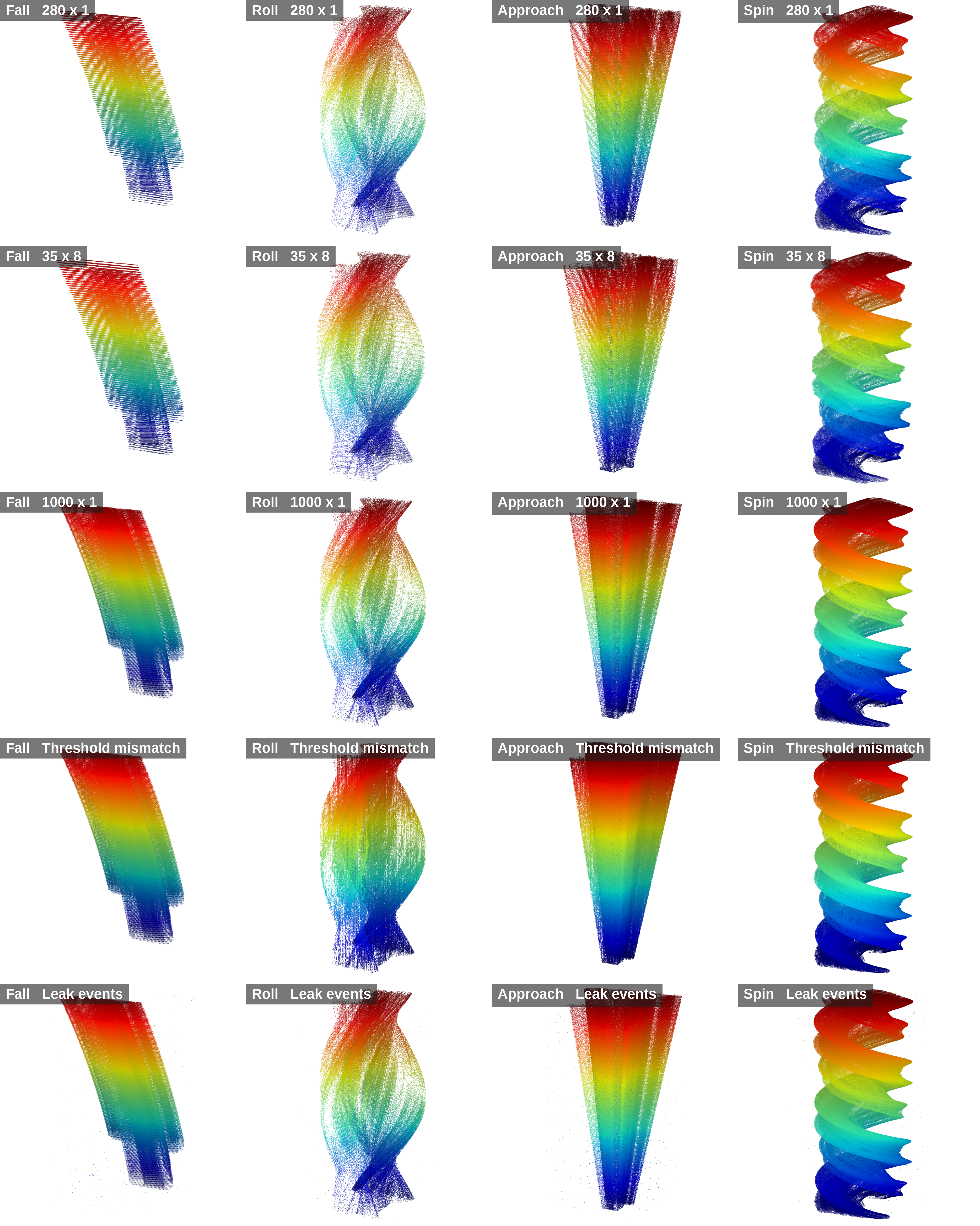
- Slightly different thresholds per pixel (like tiny manufacturing differences).
- A brief “cooldown” time after a pixel fires.
- Rare random events (leaks/shot noise), a few “hot” pixels that fire too often, and slower response in the dark.
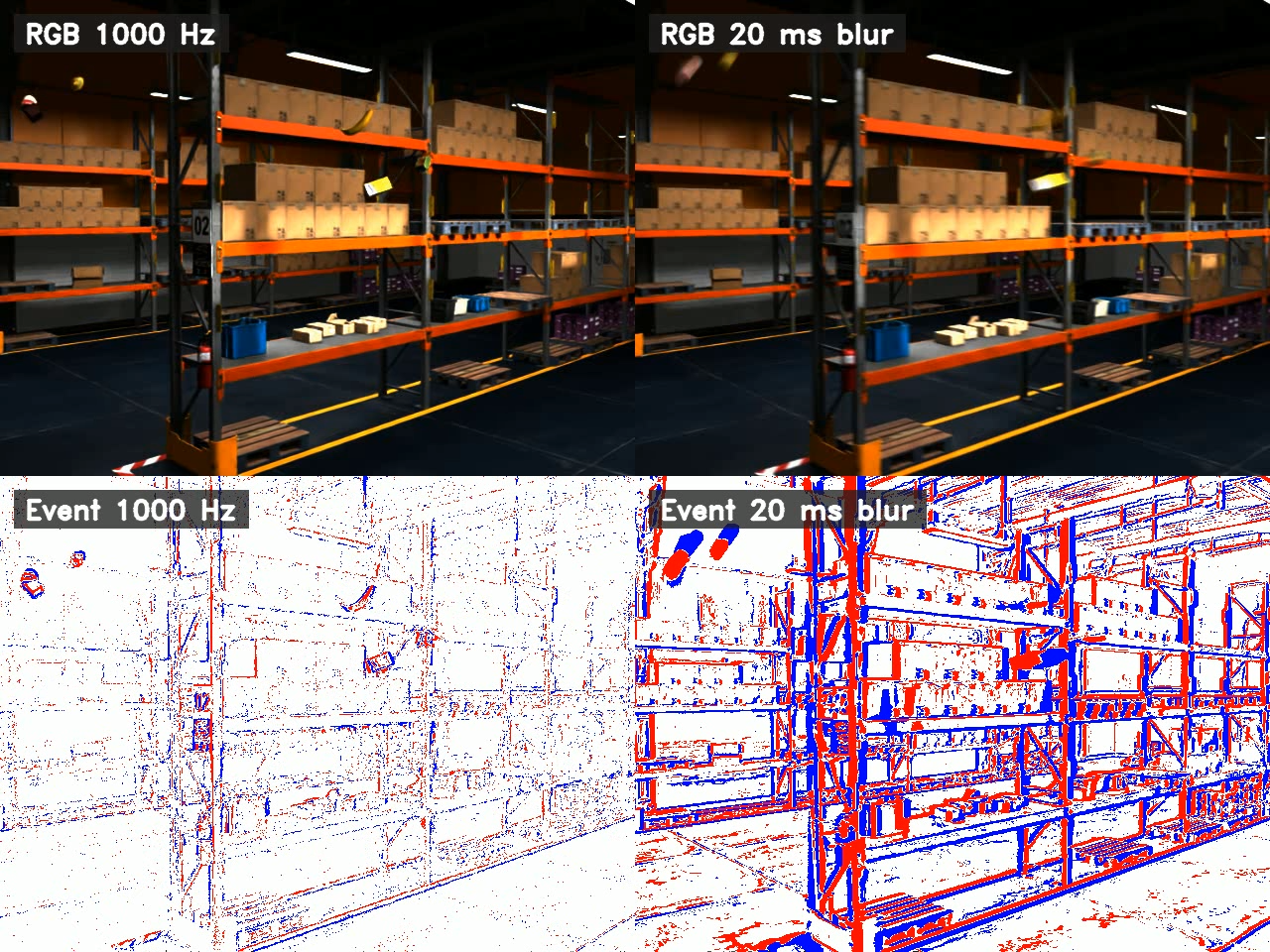
- Motion blur for normal frames by averaging many fast frames during a pretend camera “exposure,” like what a real shutter does.
4) Tight integration with Isaac Sim / Isaac Lab
- You can swap a normal camera for an event camera with only a few configuration changes.
- Everything stays synchronized with the physics engine, so labels like object positions, depth, and true motion are exact and “frame‑perfect.”
What they found (main results)
- Real‑time or near‑real‑time on one GPU: By rendering sparse keyframes and using motion‑vector warping to fill the gaps, EVIS can generate high‑rate event streams fast enough for real‑time robot experiments in many settings.
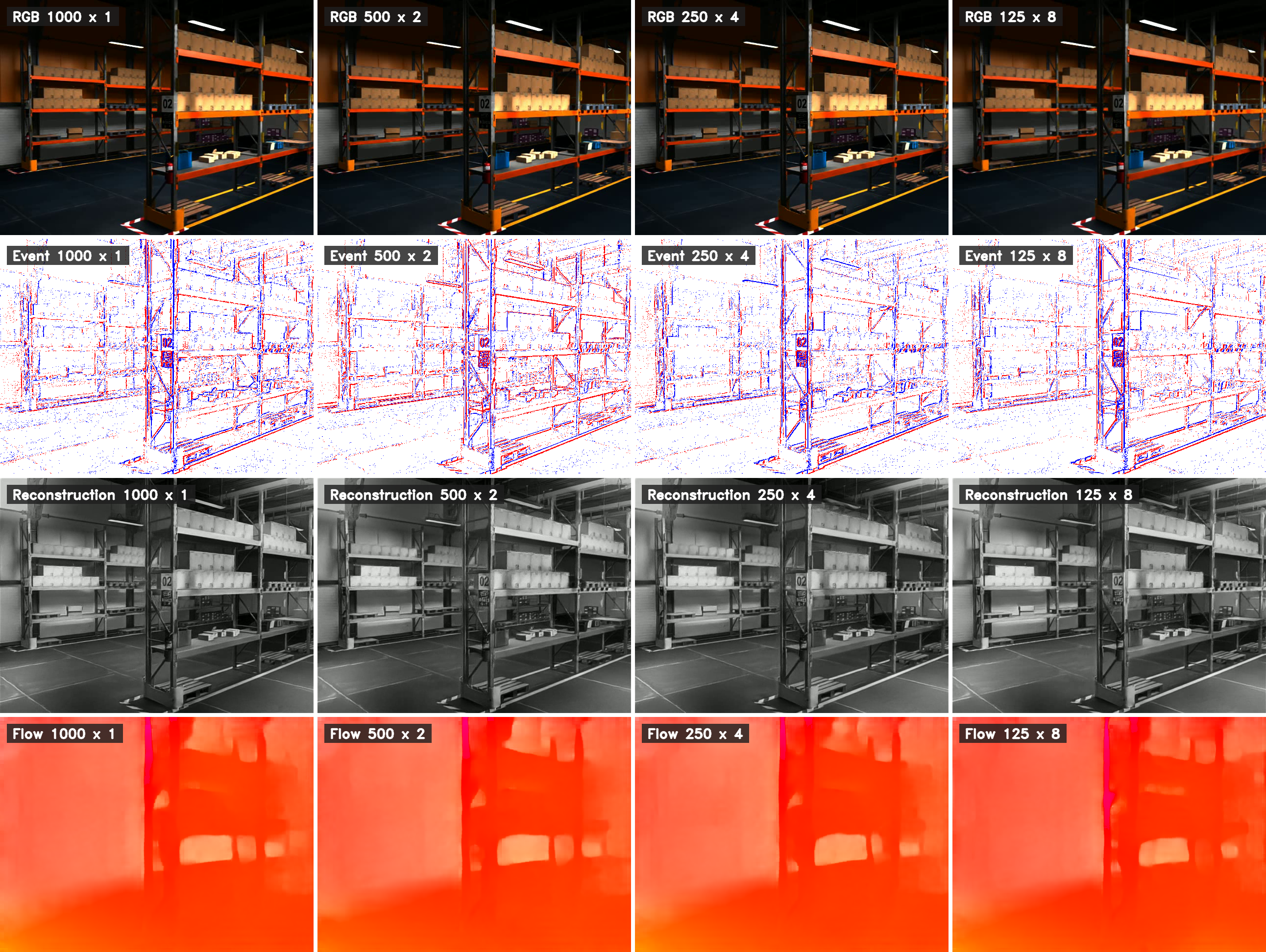
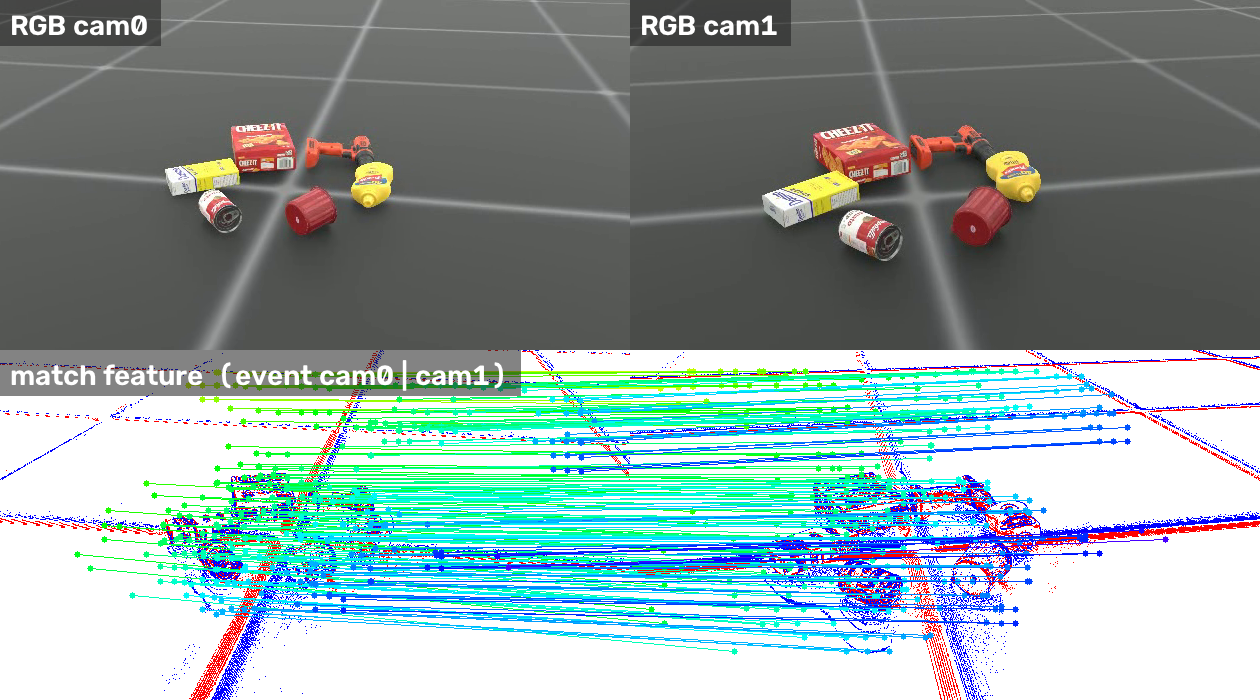
- Works with real pretrained networks out of the box: The authors fed EVIS data into three popular event‑based tools—E2VID (reconstructs video from events), E‑RAFT (estimates optical flow—how things move), and Match‑Any‑Events (matches features between two views). These models were not retrained on EVIS data, yet they still performed well, showing the simulation is realistic.
- Trade‑off knob: More aggressive interpolation (fewer keyframes, more warping) makes the pipeline faster but slightly lowers accuracy for tasks like image reconstruction and feature matching. Optical flow stayed strong because the warping follows the simulator’s true motion.
- Clear guidance: For very fast motion or heavy occlusion (when parts of objects become visible or hidden), increasing the base render rate (more keyframes) reduces artifacts like faint banding and keeps events more faithful.
Why this matters (implications and impact)
- Faster research: Collecting real event‑camera data with perfect labels is slow and expensive. EVIS generates unlimited, labeled event data in many robot scenes quickly, letting researchers train and test algorithms at scale, just like they already do with regular RGB cameras.
- Better robot vision for tough situations: Event cameras shine in high speed, high contrast, and low light. EVIS helps build and test the next generation of robot perception and control systems that need to react in milliseconds.
- A practical bridge to the real world: Because EVIS is physics‑grounded and includes realistic noise/blur, methods developed in simulation are more likely to transfer to real robots without major surprises.
In short, EVIS makes event‑camera research easier, faster, and more realistic by bringing a high‑quality event camera straight into a modern physics simulator—and by doing it fast enough to keep up with today’s robot learning workflows.
Knowledge Gaps
Knowledge gaps, limitations, and open questions
Below is a concise list of concrete gaps and open questions that remain unresolved and could guide follow-up research.
- No validation against real hardware streams: the paper does not quantitatively compare EVIS-generated events with recordings from physical event cameras under matched scenes/motions to assess photometric/temporal fidelity and domain gap.
- Missing calibration pipeline to a target sensor: there is no method to fit simulator parameters (per-pixel ON/OFF thresholds, refractory constants, bandwidth, background activity, timestamp quantization) to a specific event camera via short calibration sequences.
- Discrete-time event synthesis: events are generated at kHz “frame” steps (even with interpolation), not at true microsecond asynchronous resolution; continuous-time threshold crossing, multiple firings within a step, and timestamp jitter are not modeled.
- Timestamp quantization and clock characteristics: the simulator does not emulate hardware timestamp granularity, jitter, clock drift, or per-pixel arbitration/serialization latencies that affect event timing statistics.
- Motion-vector interpolation assumptions: forward motion vectors are approximated from the previous step; non-linear motion, rotations with acceleration, deformable objects, and multi-body occlusions can break the constant-velocity assumption without a remedy or error bound.
- Occlusion/disocclusion handling: newly revealed surfaces have no source samples and remain hole-filled or black; there is no inpainting, geometry-aware re-render, or learned completion to reduce keyframe-rate banding.
- Anti-aliasing incompatibility: interpolation requires disabling anti-aliasing, trading photorealism for warp consistency; there is no motion-consistent AA or edge-aware solution that preserves both.
- Limited photometric realism and calibration: the mapping from RTX-rendered HDR radiance to sensor log-response is not photometrically calibrated (e.g., absolute luminance, spectral sensitivity, tone curves), and the Rec. 709 luminance weights may not match event sensor spectral responses.
- Optics not modeled: lens distortion, vignetting, depth of field, point spread function, and stray light/blooming are not simulated, though they influence brightness-change patterns and event statistics.
- Incomplete sensor non-idealities: dynamic bias/threshold adaptation, temperature/bias drift, pixel-to-pixel correlated noise/crosstalk, polarity asymmetries beyond fixed thresholds, and per-pixel refractory variability are not modeled.
- Bandwidth/throughput limits and event loss: real sensors drop or thin events under extreme rates; the simulator lacks a configurable output bandwidth model and on-chip filtering emulation.
- Physically questionable “motion blur for events”: applying exposure-time averaging to frames before event generation produces smeared event bands that are not physically representative of event sensor operation; there is no empirical justification or alternative to model finite temporal response without simulating frame-like blur.
- Lighting dynamics not evaluated: no tests for flickering lights, high-frequency illumination changes, hard shadows, or specular highlights and their impact on event fidelity.
- Ground-truth consistency under shading changes: flow ground truth is derived from renderer motion vectors; it remains unclear how intensity-change-induced flow from events aligns with motion vectors when shading/BRDF changes dominate.
- Downstream evaluation scope: benchmarks use a single warehouse scene (reconstruction/flow) and one stereo setup (matching); there is no systematic coverage across textures, lighting spectra, motion regimes, occlusion severity, or nonrigid scenes.
- No sim-to-real transfer study: although pretrained networks run on EVIS outputs, there is no evidence that models trained in EVIS transfer to real sensors (or vice versa), nor an analysis of which noise/photometric settings minimize the domain gap.
- Parameter sensitivity and ablations: the paper lacks controlled studies on how each noise component, contrast threshold, and interpolation factor K affect downstream metrics and event statistics across scenarios.
- Adaptive keyframe scheduling absent: K is fixed; there is no mechanism to adapt keyframe rate based on motion magnitude, rotation, occlusion detection, or scene complexity to maintain fidelity while maximizing throughput.
- Interpolation error bounds: there is no quantitative model linking base render rate, motion acceleration, depth variation, and interpolation error in event timing/content, nor guidelines for selecting f_render and K to meet accuracy targets.
- Multi-camera synchronization realism: the simulator does not emulate inter-sensor time skew, jitter, or synchronization drift among multiple event cameras (or with IMUs), which are important in robot systems.
- Scalability and I/O constraints: performance is reported for one camera/env and HDF5 output; memory footprint, GPU-CPU transfer costs, write bandwidth limits at high event rates, and scaling to many cameras/environments/resolutions are not characterized.
- Scene diversity and deformables: interpolation and event fidelity are not validated on deformable bodies, articulated hands, cloth, fluids, or heavy particle effects where per-pixel motion vectors may be unreliable.
- Missing evaluation of high-speed edge cases: only qualitative mention of temporal quantization and rotation artifacts; no tests at extreme angular/linear velocities or micro-motions to probe limits of the event model and interpolation.
- Lack of public procedures for photometric and temporal alignment to real datasets: no scripts or protocols to align simulator units (radiance, exposure, timestamps) with specific public event datasets for reproducible comparison.
Practical Applications
Practical, real-world applications of EVIS (Isaac Sim Event Camera Plugin)
EVIS enables physics-grounded, high-rate, fully labeled event streams directly inside NVIDIA Isaac Sim with real-time-capable generation via motion-vector interpolation and configurable sensor non-idealities. Below are actionable applications derived from its findings, methods, and integrations, grouped by immediacy and mapped to sectors, tools/workflows, and feasibility considerations.
Immediate Applications
- Synthetic, fully labeled datasets for event-based perception
- Sectors: robotics, software/ML, AR/VR, autonomous systems
- What: Generate event streams paired with exact ground truth (e.g., motion vectors/optical flow, depth, instance/semantic segmentation, poses, contacts, 3D state) for tasks like reconstruction (E2VID), optical flow (E-RAFT), feature matching (Match-Any-Events), tracking, detection, and SLAM.
- Tools/workflows: Isaac Lab environments, HDF5 event export (x, y, t, p), scripted scene generators, domain randomization.
- Assumptions/dependencies: NVIDIA Isaac Sim/Isaac Lab, RTX-class GPU; interpolation assumes locally linear motion and accurate motion vectors; anti-aliasing disabled during interpolation; noise parameters may need calibration to specific camera models.
- Rapid prototyping and benchmarking of event-vision algorithms
- Sectors: software/ML, robotics R&D
- What: Drop-in camera config to turn any Isaac scene into an event camera; run pretrained networks unmodified on simulated streams for sanity checks, ablations, and regression testing.
- Tools/workflows: CI pipelines that synthesize events per PR, metric dashboards (SSIM/MSE/LPIPS, EPE, matching AUC), parameter sweeps over thresholds/noise/blur.
- Assumptions/dependencies: Runtime scales with rendering and interpolation factors; results degrade with aggressive interpolation under occlusion/fast rotation.
- Robot-specific perception data at scale without physical data collection
- Sectors: industrial automation, logistics/warehousing, mobile robotics, manipulation
- What: Customize sensor placement (wrist/head/stereo rigs), scenes, lighting, and dynamics to produce robot- and task-specific event datasets with perfect labels, reducing costly data capture.
- Tools/workflows: Isaac scene builders, scripted trajectories (e.g., figure-8, object throws), automatic labeling from simulator state.
- Assumptions/dependencies: Fidelity to deployment conditions requires careful scene and noise modeling; gap remains for rare effects not captured by the simulator.
- Training and evaluating event-based policies in closed-loop simulation
- Sectors: robotics (manipulation, legged, aerial)
- What: Use events as observations in RL/IL pipelines within Isaac Lab, stress-test under HDR lighting, fast motion, and contact-rich scenarios.
- Tools/workflows: Isaac Lab RL tasks with event observations; curriculum/domain randomization across lighting/motion noise; real-time generation at moderate rates on single GPU (e.g., 240 Hz effective at 30×8).
- Assumptions/dependencies: Observation preprocessing and network architectures must handle asynchronous/event-window inputs; policy transfer requires sim-to-real strategies.
- Sensor-noise and motion-blur robustness testing
- Sectors: robotics, ML safety/QA
- What: Enable threshold mismatch, refractory periods, leak/shot noise, hot pixels, finite bandwidth, and exposure blur to probe algorithm robustness.
- Tools/workflows: Robustness suites sweeping noise/blur parameters; failure-mode visualization (e.g., spacetime point clouds).
- Assumptions/dependencies: Parameterization approximates real sensors; calibration to hardware required for high-fidelity matching.
- Stereo and multi-view event pipeline development
- Sectors: robotics, AR/VR
- What: Build stereo/multi-camera rigs to develop event matching, triangulation, and depth estimation; evaluate with exact simulator poses and motion fields.
- Tools/workflows: Two-view matching (MAE) with epipolar metrics, synchronized event windows, synthetic baselines and baselines under varied baselines and lighting.
- Assumptions/dependencies: Interpolation banding under occlusion; ensure sufficient keyframe rate for fast rotations.
- HIL-style software bring-up before hardware arrival
- Sectors: robotics product engineering
- What: Feed simulated, time-stamped event streams into embedded/edge inference stacks to validate throughput, memory, and latency budgets.
- Tools/workflows: Replay tools that emit live event streams from sim; logging and latency profiling; drop-in swap with real sensor later.
- Assumptions/dependencies: Clock and transport emulation needed for faithful HIL; event-rate/format matching to target hardware.
- Education and training materials for event vision
- Sectors: education, community/hobbyist
- What: Hands-on labs for event formation, reconstruction, flow, and matching; visualizations (e.g., colored spacetime clouds) to teach asynchronous sensing.
- Tools/workflows: Self-contained Isaac scenes; parameter knobs for contrast thresholds/noise; notebooks demonstrating downstream models.
- Assumptions/dependencies: Access to RTX-capable machines (labs/cloud); simplified scenes suffice for learning objectives.
- Safety and edge-case testing under HDR and extreme motion
- Sectors: robotics safety, QA
- What: Systematically test perception under glare, flicker, and high-speed motion that saturates frame cameras, leveraging the event camera’s HDR/latency advantages.
- Tools/workflows: Lighting scripts; fast-motion trajectories; ground-truth comparisons to quantify failure modes and mitigation strategies.
- Assumptions/dependencies: Scene realism (lighting/materials) drives validity; aggressive interpolation may hide rare artifacts—use higher base render rates for critical tests.
- Internal tools/products that can be built quickly
- Sectors: software tooling
- What:
- Dataset generator CLI/GUI for Isaac event scenes with recipes/templates.
- Parameter-sweep runner for noise/warp configs with metric reports.
- Isaac extension that toggles event/RGB cameras and exports synchronized packs (events+RGB+depth+flow+segmentation).
- Assumptions/dependencies: Packaging and CI integration within existing Omniverse/Isaac workflows.
Long-Term Applications
- Digital twins with event sensors for high-speed processes
- Sectors: advanced manufacturing, logistics, AMRs
- What: Incorporate event cameras into factory/warehouse digital twins to monitor fast tooling, conveyor lines, or HDR zones (e.g., welding), enabling predictive maintenance and anomaly detection where frame cameras fail.
- Tools/products: Event-enabled monitoring modules; real-time dashboards; model-based alerting.
- Assumptions/dependencies: High-fidelity plant models; validated noise/lighting models; IT/OT integration and time sync.
- Co-design of event-camera hardware and algorithms
- Sectors: semiconductor, sensor OEMs, robotics
- What: Simulate threshold distributions, bandwidth effects, pixel geometry, and firmware logic to evaluate algorithm performance and guide sensor/hardware design.
- Tools/products: Parameterized sensor simulacra; design-of-experiments frameworks; closed-loop optimization.
- Assumptions/dependencies: Access to device-accurate models; validation datasets; potential need for differentiable or surrogate models.
- Event-based foundation models and large-scale pretraining
- Sectors: software/ML, research platforms
- What: Generate massive, diverse, labeled event corpora across robots/scenes for self-supervised and multi-task pretraining (reconstruction, flow, detection, VIO/SLAM).
- Tools/products: Data pipelines, curricula, and evaluation suites; multimodal RGB+event model training.
- Assumptions/dependencies: Scale-out rendering/synthesis on clusters; coverage of real-world variability; licensing and standardization for benchmarks.
- End-to-end high-speed manipulation and interception policies
- Sectors: robotics (dexterous manipulation, bin picking, catching)
- What: Train policies that exploit events’ microsecond latency for contact-rich or projectile-interception tasks; deploy on real systems.
- Tools/products: Event policy libraries; reflex controllers; task-specific datasets (e.g., EV-Catcher-like scenarios).
- Assumptions/dependencies: Sim-to-real transfer with latency-matched pipelines; tactile integration; calibrated dynamics.
- Event-based navigation for legged/aerial robots in HDR/dynamic scenes
- Sectors: field robotics, search-and-rescue
- What: Develop VIO/SLAM and obstacle avoidance leveraging events for low-light, flicker, and motion blur resilience; validate in complex synthetic terrains and lighting.
- Tools/products: Event VIO/SLAM stacks; planning modules tuned to asynchronous updates.
- Assumptions/dependencies: Terrain/lighting realism; integration with dynamics engines for drones; sensor fusion with IMU/LiDAR.
- Standardized evaluation suites and certification protocols
- Sectors: policy/standards, safety certification
- What: Use physics-consistent ground truth to define reproducible benchmarks for event-based perception/control; propose certification tests for safety-critical deployments.
- Tools/products: Public leaderboards; scenario packs; reporting templates.
- Assumptions/dependencies: Community consensus; traceability from sim scenarios to operational design domains (ODDs).
- Mixed reality and wearable tracking under extreme motion
- Sectors: AR/VR, spatial computing
- What: Prototype low-latency head/body/hand tracking algorithms robust to rapid motion and HDR, using simulated event streams for system design.
- Tools/products: Event-based tracking SDKs; sensor fusion with IMUs; occlusion-robust evaluation.
- Assumptions/dependencies: MR scene realism; eventual port to mobile/low-power hardware; integration with rendering pipelines.
- Differentiable training loops with event outputs
- Sectors: research/ML
- What: Couple EVIS-like models with differentiable renderers/physics to enable gradient-based training (e.g., policy or perception co-optimization).
- Tools/products: Hybrid differentiable simulators; surrogate event renderers.
- Assumptions/dependencies: Differentiable Isaac or tight integration with differentiable engines; stability of gradients through asynchronous event generation.
- Neuromorphic computing pipelines
- Sectors: edge AI, embedded systems
- What: Use simulated events to train/test spiking neural networks or neuromorphic accelerators for ultra-low-latency inference.
- Tools/products: SNN training datasets; deployment toolchains; power/latency benchmarks.
- Assumptions/dependencies: Hardware availability; conversion/quantization methods for event data; consistent timing semantics.
- Automotive/night-driving R&D with events
- Sectors: automotive ADAS/AV
- What: Explore HDR/low-light sensing stacks for glare, headlights, and flicker where frames saturate; pretrain and evaluate in simulated urban scenes.
- Tools/products: Event-enabled ADAS perception modules; sensor fusion with RGB/radar/LiDAR.
- Assumptions/dependencies: Access to automotive-grade scenes/vehicle dynamics (e.g., Omniverse Drive Sim); strict synchronization; regulatory constraints.
- Cloud services for “event data as a service”
- Sectors: developer platforms, ML ops
- What: On-demand generation of labeled event datasets for custom robots/scenes; API to specify camera rigs, motions, lighting, and noise.
- Tools/products: Scalable rendering backends; job schedulers; dataset registries with provenance.
- Assumptions/dependencies: Cost/performance at scale; licensing for assets; privacy/security for customer scenarios.
Notes on feasibility across applications
- Performance: Real-time on a single high-end GPU is achievable at moderate effective rates via interpolation (e.g., 30×8 ≈ 240 Hz faster than real time on RTX 5090). Very high effective rates or severe dynamics may require higher base render rates or multiple GPUs.
- Fidelity vs throughput: Interpolation assumes approximately linear motion between keyframes and uses renderer motion vectors; artifacts can appear under fast rotations or disocclusions—raising base render frequency mitigates this.
- Realism: Sensor non-idealities are configurable but generic; matching a specific physical camera requires calibration (threshold distributions, bandwidth, leak/shot rates).
- Integration: Isaac Sim/Isaac Lab is the substrate; benefits extend to any domain whose scenes/robots can be represented in Isaac or Omniverse.
Glossary
- alpha-composited: In computer graphics, blending a foreground pixel with a background pixel using an alpha (transparency) value. Example: "alpha-composited with the background."
- anti-aliasing: A rendering technique to reduce jagged edges by smoothing or filtering pixel colors at boundaries. Example: "Isaac Lab enables anti-aliasing by default."
- asynchronous reference latching: An event-camera mechanism where each pixel independently updates its intensity reference upon firing, reflecting non-synchronous sensor behavior. Example: "per-pixel asynchronous reference latching,"
- bidirectional motion-vector warping: Interpolating intermediate frames by warping from both earlier and later keyframes using motion vectors. Example: "synthesizes the in-between frames through bidirectional motion-vector warping,"
- bilinear kernel: A 2D interpolation kernel formed by the product of two linear kernels in x and y for resampling. Example: "is the bilinear kernel"
- CLAHE: Contrast Limited Adaptive Histogram Equalization; a method to normalize image contrast while limiting noise amplification. Example: "we histogram-equalize both frames before scoring (CLAHE) so the metrics measure structure rather than global tone."
- compositing: Combining multiple warped or rendered images into a final image based on coverage rules or weights. Example: "by forward-warping , backward-warping , and compositing the two."
- contrast threshold: The minimum log-intensity change required to trigger an event at a pixel. Example: "exceeds a contrast threshold , an event fires:"
- disocclusion: Regions becoming newly visible due to motion, often requiring special handling during warping. Example: "The forward-warped only fills 's disocclusion holes,"
- dynamic neural radiance field: A learned representation of time-varying 3D scenes that models view- and time-dependent radiance. Example: "EvDNeRF renders events from a dynamic neural radiance field,"
- E2VID: A neural network that reconstructs intensity images from event streams. Example: "We reconstruct an intensity video from the events with the pretrained E2VID"
- E-RAFT: An event-based adaptation of the RAFT optical flow network for dense flow estimation from events. Example: "We estimate dense flow with the pretrained E-RAFT,"
- egomotion: The motion of the camera itself relative to the scene, as opposed to independent object motion. Example: "producing egomotion events over the whole frame,"
- endpoint error (EPE): The average Euclidean distance between predicted and ground-truth optical flow vectors, measured in pixels. Example: "EPE (px)"
- epipolar distance: A geometric error measuring how well a correspondence satisfies the epipolar constraint between two camera views. Example: "epipolar distance below "
- ESIM: A synthetic event camera simulator that renders events directly from 3D scenes. Example: "ESIM adaptively renders synthetic 3D scenes"
- event window: A time or count-based slice of events used as input to algorithms (e.g., for flow or reconstruction). Example: "feeding it two consecutive $20$\,ms event windows,"
- exposure: The duration a frame camera’s shutter is open, integrating light and potentially causing motion blur. Example: "Motion blur with a $20$\,ms exposure."
- finite bandwidth: A sensor limitation where response speed decreases with signal conditions (e.g., darkness), acting like a low-pass filter. Example: "Finite bandwidth. Darker pixels respond more slowly and lag the true signal."
- forward-warping: Mapping pixels from an earlier frame to a later time using motion vectors to synthesize intermediate images. Example: "by forward-warping , backward-warping ,"
- frame interpolation: Generating intermediate frames between keyframes to achieve higher effective frame rates. Example: "a motion-vector based frame-interpolation option"
- gamma correction: A nonlinear mapping applied to pixel intensities to account for display or perceptual characteristics. Example: "without gamma correction"
- GPU-batched: Processing many items in parallel on the GPU as batched tensor operations for efficiency. Example: "A faithful, GPU-batched log-intensity contrast event model"
- HDF5: A hierarchical data format used for storing large numerical datasets in structured groups and arrays. Example: "Events are written to HDF5 as tuples,"
- HDR: High Dynamic Range; rendering with a wide range of luminance to preserve detail in bright and dark regions. Example: "the renderer's HDR color buffer"
- hot pixels: Sensor pixels that produce spurious events at high rates due to defects or noise. Example: "Hot pixels. A fixed random subset"
- inverse depth: Representing depth as its reciprocal, giving more precision to closer objects and aiding ordering during warping. Example: "the normalized inverse depth"
- Isaac Lab: An NVIDIA framework that integrates with Isaac Sim for robot learning and simulation workflows. Example: "integrated through the Isaac Lab framework."
- Isaac Sim: NVIDIA’s physics-based robotics simulator with GPU-accelerated rendering and dynamics. Example: "NVIDIA Isaac Sim"
- leak events: Spurious ON events caused by pixel junction leakage in event sensors. Example: "Leak events. Spurious ON events from junction leakage:"
- log-intensity: The logarithm of image intensity used in event models to emulate sensor response to relative changes. Example: "a faithful log-intensity contrast event model"
- LPIPS: Learned Perceptual Image Patch Similarity; a deep feature-based metric for image similarity. Example: "LPIPS, the distance between the two frames in a pretrained deep feature space."
- low-pass filter: A filter that attenuates high-frequency components, modeling limited sensor response speed. Example: "we low-pass the log frame with an intensity-dependent time constant;"
- mean squared error (MSE): A pixel-wise error metric measuring the average squared difference between images. Example: "the mean squared error"
- motion blur: Image blur resulting from object/camera motion during finite exposure time. Example: "Motion blur"
- motion vectors: Per-pixel displacements between frames provided by the renderer to describe apparent motion. Example: "The renderer provides only one-directional motion vectors,"
- occlusion: When parts of the scene are hidden by other objects from a given viewpoint, complicating warping and matching. Example: "under occlusion (roll)"
- ON/OFF thresholds: Separate thresholds for positive (brightness increase) and negative (decrease) events in event cameras. Example: "per-pixel ON/OFF thresholds"
- over-render margin: Rendering extra pixels beyond the target image border to avoid artifacts after warping and cropping. Example: "the plugin supports an optional over-render margin:"
- Pearson correlation: A statistical measure of linear correlation between two variables (e.g., predicted and true flow components). Example: "the Pearson correlation between the predicted and ground-truth flow components."
- Poisson process: A stochastic process where events occur independently at a constant average rate. Example: "approximates a Poisson process with rate ,"
- RANSAC: A robust estimation algorithm that iteratively fits a model while rejecting outliers. Example: "computed over five repeated RANSAC runs"
- Rec. 709: A standard defining RGB-to-luminance conversion and color primaries for HDTV. Example: "using Rec.~709 weights:"
- refractory period: A minimum time after an event during which the pixel cannot fire again, modeling sensor dead time. Example: "Refractory period. After a pixel fires at $t_{\text{last}$,"
- softmax splatting: A differentiable image warping/resampling technique that aggregates multiple source contributions with softmax weights. Example: "softmax splatting"
- SSIM (structural similarity): A perceptual image quality metric comparing luminance, contrast, and structure between images. Example: "the structural similarity"
Collections
Sign up for free to add this paper to one or more collections.

