- The paper presents a model for IPL that links eigenstate localization and spin texture evolution via controlled phase gradients and spin-dependent hopping.
- It reveals how Fourier analysis shows a transition from bimodal to unimodal frequency distributions, marking the shift from localized to delocalized states.
- The study outlines experimental strategies for tuning quantum states in ultracold gases and engineered systems by modulating coupling strength and lattice structure.
Spin Textures and Eigenstate Evolution in Isospectrally Patterned Lattices
Introduction and Motivation
Isospectrally patterned lattices (IPL) present a framework for engineering energy spectra in quantum lattices via systematic manipulation of spectral degeneracies. By constructing IPL using isospectral cells parameterized by controlled phase gradients, one enables tunable transitions between localized and delocalized eigenstates, directly affecting spectral and spatial properties. This paper advances IPL research by providing a physical interpretation in terms of a single spin-1/2 particle subject to a spatially rotating magnetic field and spin-dependent hopping. The resulting composite band structures exhibit a wealth of phenomena related to eigenstate localization, spin texture transitions, and spectral rearrangements, thus opening avenues for experimental realization in ultracold quantum gases and engineered quantum systems.
Model Construction and Physical Interpretation
The IPL Hamiltonian is defined on a lattice of cells, each associated with a K×K isospectral block Am, constructed via orthogonal transformations of a seed diagonal matrix across the lattice. For the case K=2, the system is parameterized by a single phase ϕ, with open boundary conditions and a uniform phase increment, resulting in inversion symmetry centered at ϕ=4π.
The Hamiltonian admits a compact physical interpretation—a single spin-1/2 particle traverses the lattice under a spatially inhomogeneous, rotating magnetic field in the (x,z) plane with local magnetic field components Bx(m) and Bz(m). The hopping process is mediated by a spin-flip operator, with controlled coupling strength ϵ. This representation directly links the spectral and spatial structure of IPL eigenstates to the underlying spin dynamics.
Eigenstate Structure: Localization Patterns and Quasi-Nodes
The IPL admits energy bands partitioned into domains of localized and delocalized eigenstates, modulated by phase gradient and coupling strength ϵ. Low- and high-energy eigenstates near the band edges are localized with envelopes exhibiting oscillatory behavior and multiple quasi-nodes—points of near-zero amplitude. As the degree of excitation increases, the spatial spread and number of quasi-nodes grow. Delocalized states, residing within the band centers, extend across the lattice and lack this envelope structure.
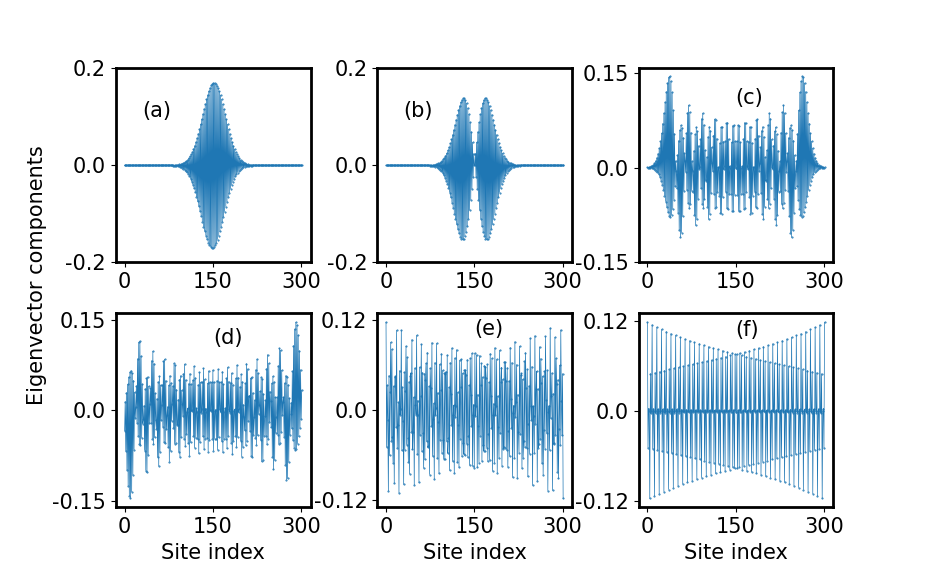
Figure 1: Profiles of selected IPL eigenstates demonstrating the envelope behavior and transition between localized and delocalized states.
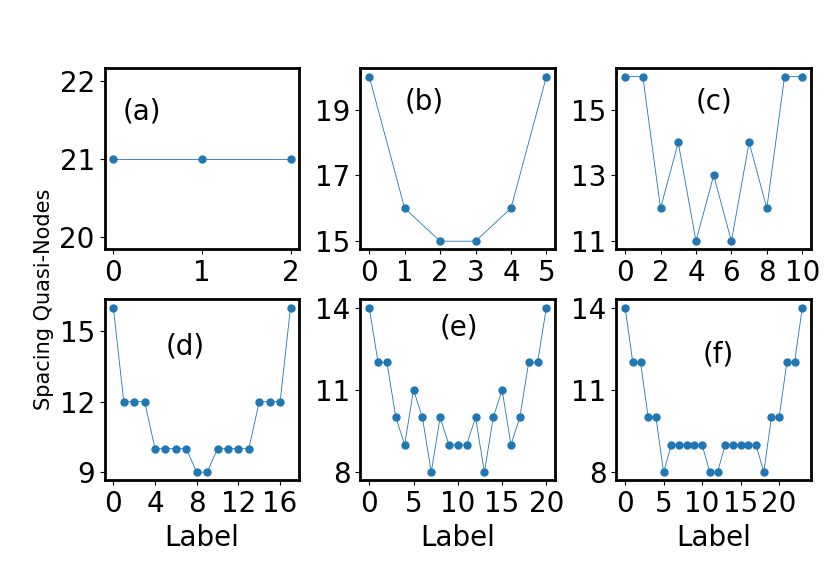
Figure 2: Lattice distances between neighboring quasi-nodes for eigenstates, revealing underlying inversion symmetry and characteristic spacing patterns.
This localization pattern is strongly tied to the systematic variation of the phase parameter, underpinning the tunability of the IPL's spectral structure.
Evolution via Fourier Analysis: Spectral Rearrangement
Investigating the eigenstate Fourier spectra across the band reveals a robust structural rearrangement as excitation increases. Localized eigenstates exhibit bimodal frequency distributions—well-separated peaks near the minimum and maximum frequencies—responsible for both short-range oscillations and long-range envelope behaviors. As the degree of excitation increases, these distributions broaden, shift toward the center of the frequency window, and eventually collapse into a single, narrow peak for the central band eigenstates.
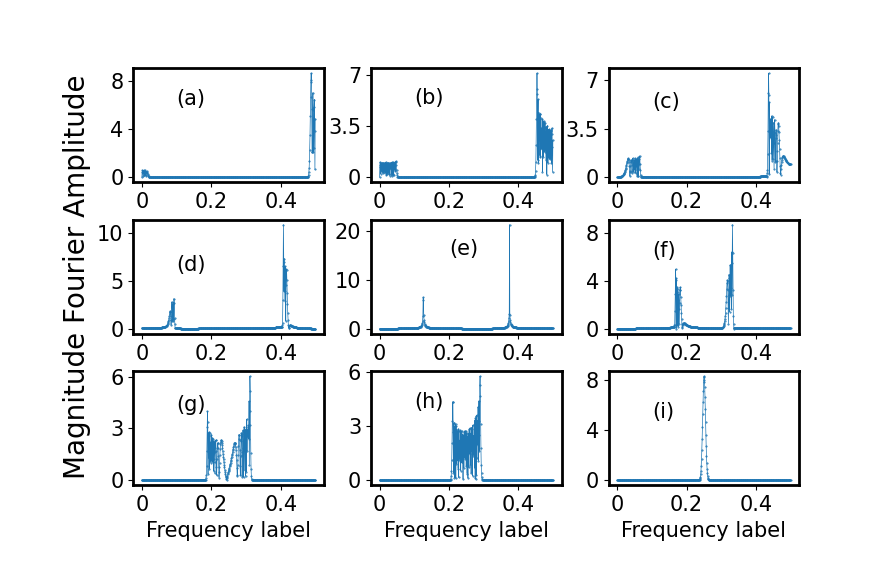
Figure 3: Absolute amplitude distributions in frequency space for a representative sequence of eigenstates, mapping the bimodal to unimodal transition.
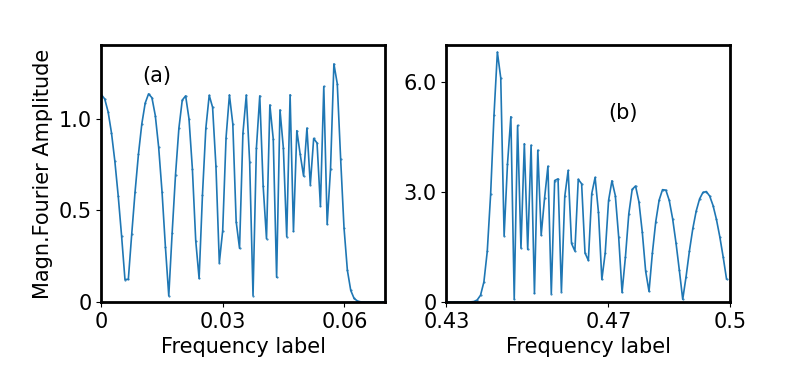
Figure 4: Detailed frequency distribution windows for an eigenstate at the localization-delocalization crossover, illustrating chirped structure and peak progression.
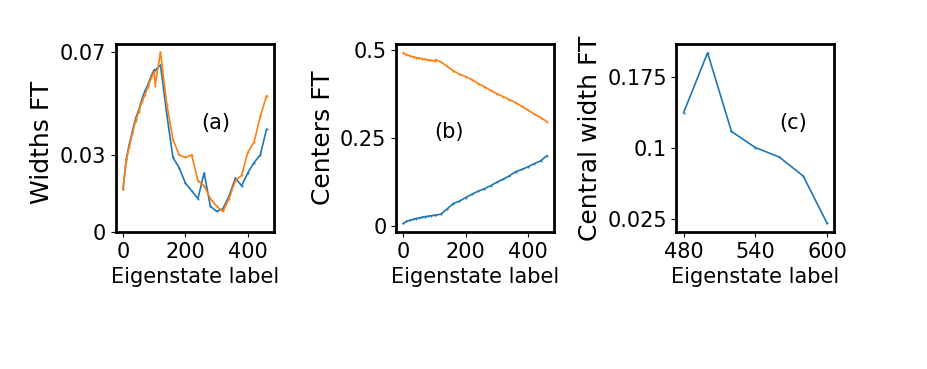
Figure 5: Quantitative analysis of the evolution of frequency distribution widths and centers across isolated eigenstates, highlighting non-smooth transitions and rearrangement dynamics.
This spectral evolution signals a transition from regular (localized) to irregular (delocalized) eigenstates, supporting spatial and spin texture rearrangement.
Spin Texture Analysis and Spin-Spatial Correlation
The IPL's spin interpretation enables detailed investigation of spin textures—local expectation values of Am0 and Am1—across the eigenstate spectrum. In the weak coupling regime (Am2), localized states exhibit spin peaks sharply localized at quasi-nodes; the sign and amplitude of these peaks vary according to excitation and envelope structure. Delocalized eigenstates and band-center states manifest highly regular and staggered spin configurations, reflecting the underlying Fourier spectrum narrowing.
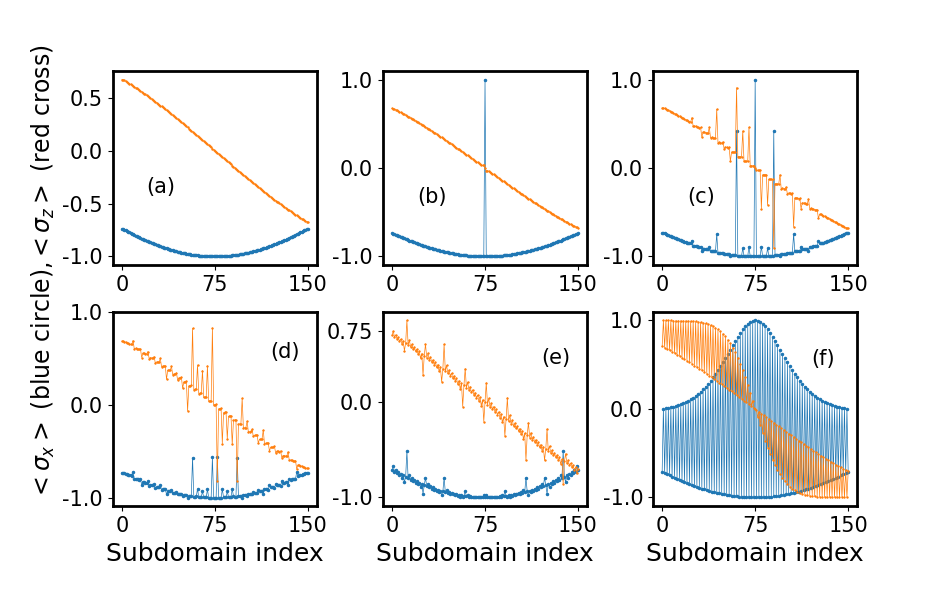
Figure 6: Local spin expectation profiles for selected eigenstates, highlighting the correspondence between spin peaks and quasi-nodal structure.
Quantitative analysis via total variation of spin expectation values across eigenstates demonstrates pronounced oscillations, with central band states showing maximal fluctuations:
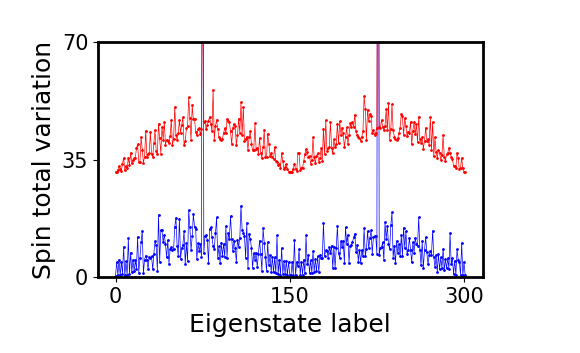
Figure 7: Total variation in local spin expectation values across the eigenstate spectrum, with maximal peaks at band centers and oscillatory envelope behavior.
Detailed scatter plots confirm that spin peaks occur at spatial locations where the eigenstate amplitude is minimal (quasi-nodes):
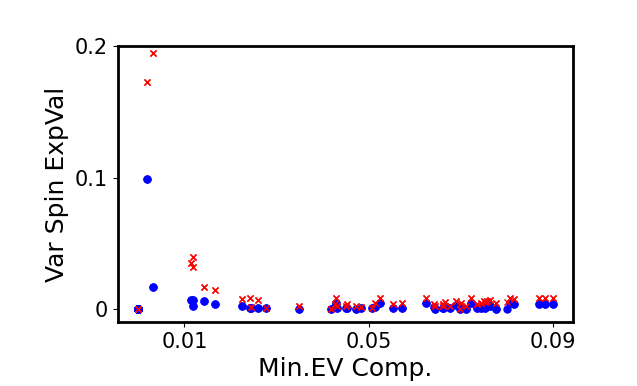
Figure 8: Spin-space scatter plot for a localized eigenstate, showing strong correlation between extremal spin variation and minimal eigenvector components.
Strong Coupling Regime: Enhanced Spin Modulation
For increased coupling (Am3), the core features persist but are magnified. Spin peaks become more pronounced and nearly equidistant across the lattice, with TVS envelope oscillations acquiring larger amplitudes and reduced relative fluctuations. The rearrangement pattern remains, but the impact of coupling strength is manifested via sharpened spin features and robust spatial modulation.
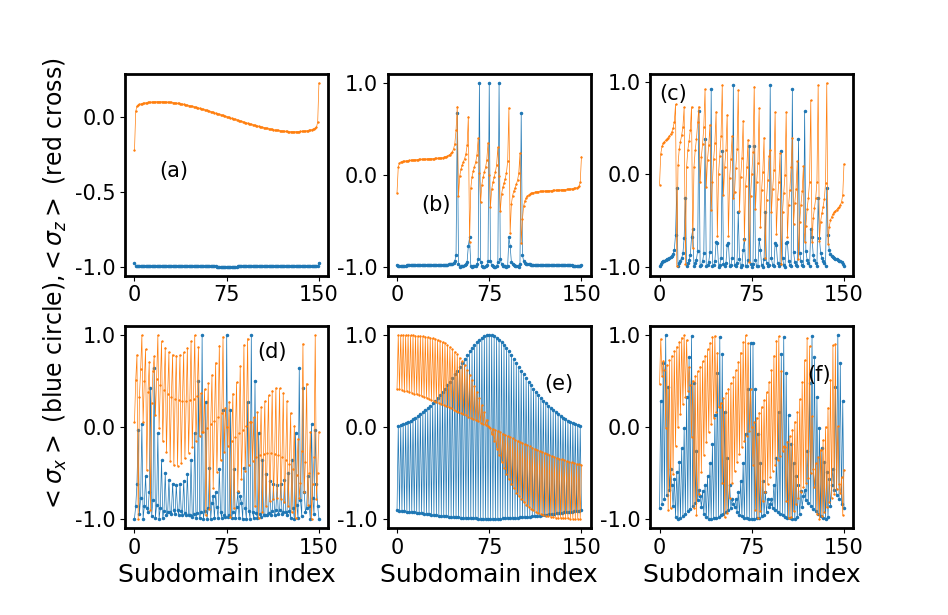
Figure 9: Local spin expectation profiles in the strong coupling regime, demonstrating intensified and regularized spin peaks.
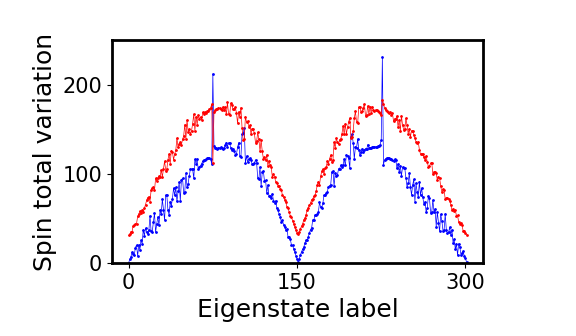
Figure 10: Total variation of spin expectation values in the strong coupling regime, showing substantial envelope amplitude and main hump dominance.
Practical Implications, Theoretical Impact, and Future Directions
The physical picture established in this work proposes IPL as a platform for exotic quantum state engineering with controlled spectral and spin properties, readily implementable in ultracold atom systems and spin-orbit coupled quantum devices. Experimental realization can leverage optical lattices, current-carrying wires for magnetic field synthesis, or tunable superlattice structures, with modern quantum gas microscopes offering site-resolved diagnostics.
Theoretically, the interplay of spin textures, spectral rearrangements, and tunable localization in IPLs establishes a blueprint for degenerate subspace control, with implications for quantum transport, information processing, and correlated quantum phases. Extending IPL concepts to higher dimensions and multi-level systems will likely reveal further phenomena, such as multi-center localization, topologically nontrivial band structures, and enhanced symmetry-breaking-induced states.
Conclusion
The study provides an authoritative characterization of isospectrally patterned lattices, elucidating their tunable eigenstate localization, intricate spin texture evolution, and nontrivial spectral rearrangements in both weak and strong coupling regimes. The unique correspondence between spatial quasi-nodes and localized spin peaks, quantified by total variation and Fourier analysis, foregrounds IPL as a versatile tool for designing quantum states with precise spectral and spatial features. The physical interpretation connects directly to experimental platforms, and future research targeting increased cell dimensionality and higher lattice dimensions is expected to uncover novel quantum behaviors and application potential in engineered quantum matter.