- The paper proposes MR-DCoT to explicitly regress off-manifold features toward class prototypes, achieving robust object detection under severe domain shifts.
- It integrates dual visual-text chains that simulate stylistic and structural degradations, addressing the infinite variability of real-world conditions.
- Empirical results across adverse weather, artistic domains, and semantic segmentation benchmarks validate the effectiveness of the prototype-anchored manifold regression approach.
Prototype-Anchored Generalized Manifold Regression for Unknown-Domain Object Detection: An Authoritative Synthesis
The paper addresses the problem of single-domain generalized object detection (Single-DGOD), which aims to train detectors on a single labeled source domain and enable robust adaptation to multiple, entirely unseen target domains marked by diverse and significant domain shifts. Distinct from multi-source or access-to-target paradigms, Single-DGOD is severely under-constrained: detectors must generalize to infinite target conditions (e.g., adverse weather, synthetic-to-real shifts, real-to-artistic styles) through only one source dataset.
Traditional approaches rely on simulation-driven paradigms—using data augmentation, style transfer, or static, one-step vision-language prompts to simulate out-of-domain samples. However, these strategies are fundamentally limited: finite simulations cannot enumerate the infinite and complex real-world variations, and overfit easily to synthetic artifacts rather than true, semantically consistent object features. The central thesis of the paper is a shift away from distribution expansion via simulation, and toward learning an explicit geometric rectification—rooted in the manifold hypothesis for high-dimensional vision data. That is, source and robust semantic concepts lie on a compact, low-dimensional manifold; robust generalization requires a stable feature correction operator capable of rectifying arbitrary off-manifold inputs back towards semantically consistent regions.
The MR-DCoT Framework: Architecture and Components
The proposed MR-DCoT (Manifold Regression with Visual-Text Dual Chain-of-Thought) framework operationalizes this simulate-to-regress paradigm. Its principal components are:
- Disentangled Feature Embedding (DFE): The input visual features are decoupled into style and content components via dual encoders. Orthogonality regularization and a style-consistency loss (between style features and CLIP-based text embeddings) enforce disentanglement, providing independent semantic and stylistic axes Figure 1.
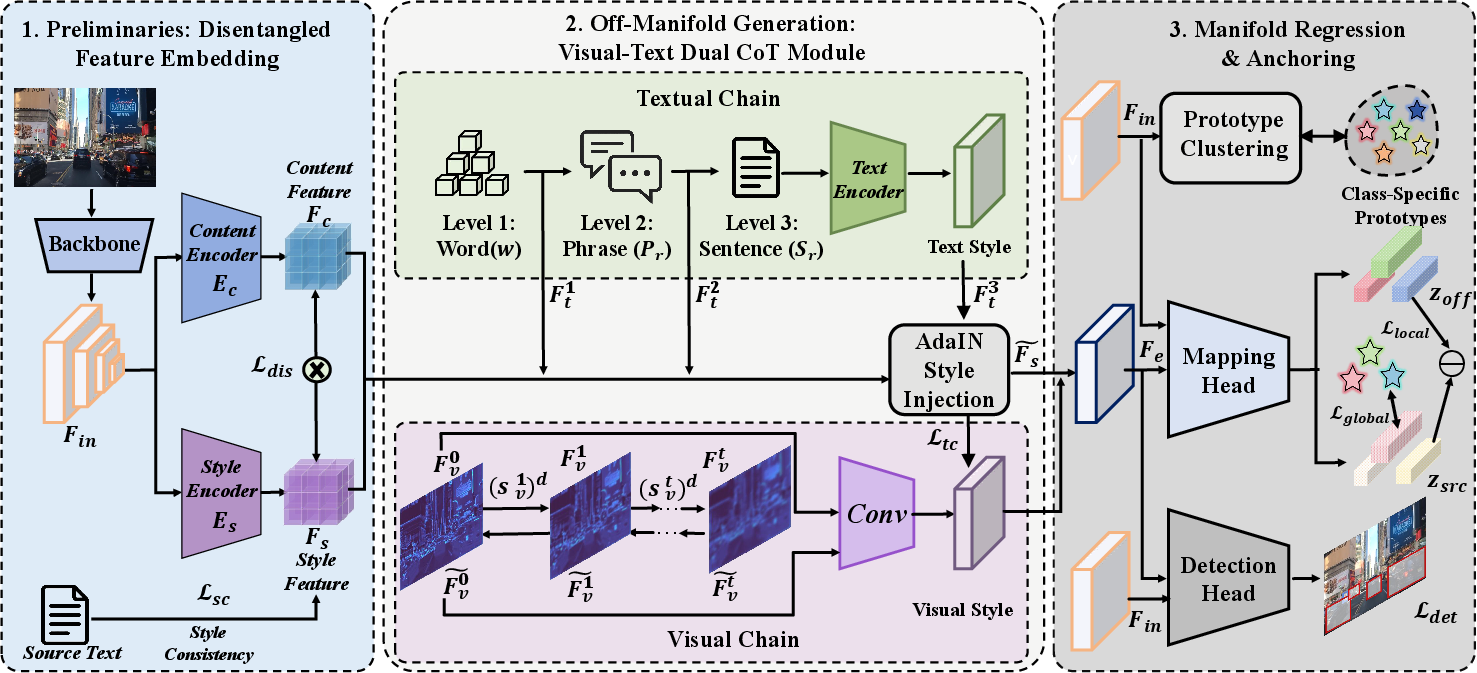
Figure 1: Overview of the MR-DCoT pipeline, with disentangled embedding, Dual-CoT outlier synthesis, and prototype-anchored regression.
- Visual-Text Dual Chain-of-Thought (Dual-CoT) Module:
- Textual Chain: Hierarchical, vision-language-model-driven (CLIP+GPT) guidance evolves style features along word->phrase->sentence granularity, simulating increasingly complex and context-aware semantic shifts Figure 2.
- Visual Chain: A diffusion-inspired process (using Gaussian blur and text-guided deblurring) simulates continuous local structural degradation, especially necessary for modeling non-global domain shifts such as weather-induced noise.
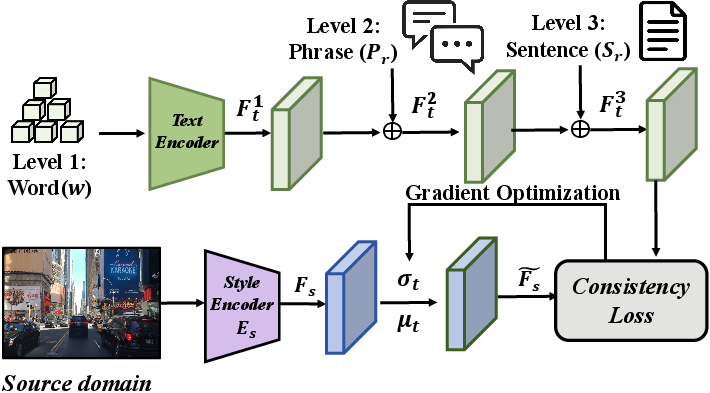
Figure 2: Textual chains progressively increase semantic richness and complexity, improving style simulation and domain shift coverage.
The two chains are integrated via AdaIN style injection on low-level features, producing off-manifold samples that combine global semantic structure (sentence-level prompts) and local degradation, yielding hard, structured outliers for robust regression training.
- Prototype-Anchored Manifold Regression:
- Semantic Manifold Construction: For each class, a prototype is computed via learnable, soft-assigned aggregation of instance features from the source domain, approximating the class's semantic region on the manifold.
- Rectification Objective: For each synthesized off-manifold instance, the regression operator H is trained to map it toward both its class prototype and its paired clean feature embedding. The objective combines a global (contrastive toward the class prototype) and a local (ℓ2) rectification loss, forming directional correction fields that explicitly move deviated features back within manifold boundaries.
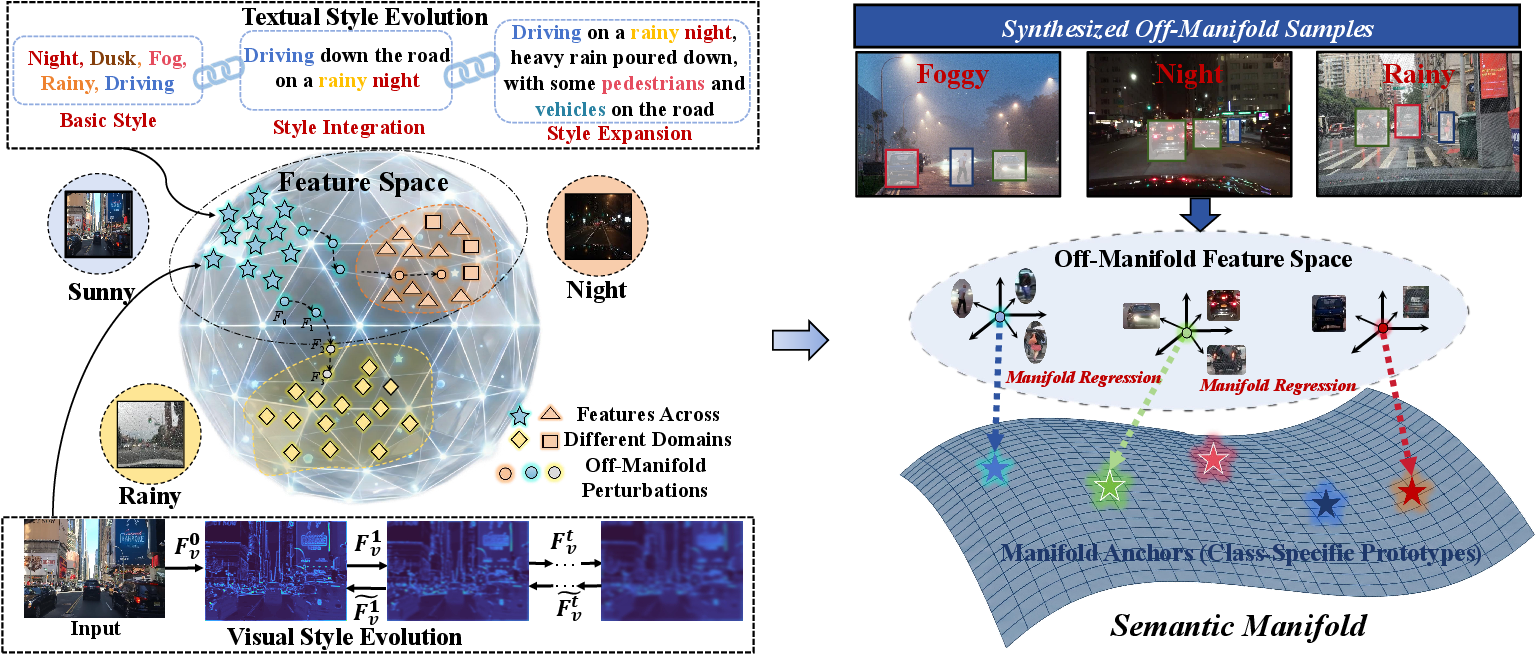
Figure 3: Duality of simulation (Dual-CoT) and rectification (manifold regression): off-manifold samples are synthesized and regressed back to the source manifold anchored by class prototypes.
Empirical Results and Quantitative Analysis
Experiments span three core regimes:
- Adverse weather driving datasets: Benchmarks with drastic domain shift between clear, night, rain, fog, and dusk scenes.
- Reality-to-Art generalization: From PASCAL VOC to Clipart, Watercolor, and Comic domains, capturing extreme stylistic changes.
- Zero-shot domain adaptation for semantic segmentation: From Cityscapes or GTA5 to severe, unobserved weather/synthetic domains.
Across all settings, MR-DCoT achieves consistently superior results relative to competing simulation- and alignment-driven methods. For instance, in night rainy object detection, MR-DCoT (with Swin-T backbone) attains 36.4% mAP vs. 33.7% (SE-COT) and significantly higher than prior prototype-free and strong augmentation alternatives (Table results). On the real-to-art benchmarks, improvements are consistently 2–4% mAP over the best prior text-driven models.
Crucially, ablation studies verify that:
- Both the textual and visual chain are necessary: removing diffusion or using trivial prompts reduces robustness notably (Table ablation).
- Disentanglement is critical: applying Dual-CoT and regression on entangled features results in strong performance collapse, especially under structured shifts (Table ablation).
- Prototype anchoring is essential for stability and class separability; instance-only L2 regression rapidly degrades on hard shifts.
- Sentence-level descriptions (three-level textual chains) achieve optimal guidance for robust feature simulation and regression Figure 4.
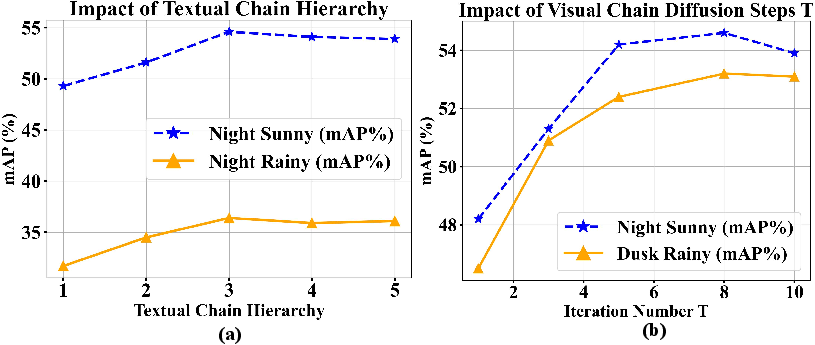
Figure 4: Sensitivity to Textual Chain hierarchy and Visual Chain diffusion steps; optimal performance at sentence-level and moderate step count.
MR-DCoT achieves this without notable inference overhead: since Dual-CoT and diffusion operate only during training, inference is performed with the standard detector plus lightweight prototype-enhanced features (Table complexity).
Analysis and Visualization of the Manifold Regression Paradigm
Feature visualizations provide qualitative evidence for the effectiveness of manifold regression. t-SNE plots show that Dual-CoT samples are indeed driven away from the source region (off-manifold), while the manifold rectification operator systematically regresses them back to source-proximal semantic regions Figure 5. Activation maps demonstrate focus on semantic objects and suppression of domain-induced distractors with regression enabled Figure 6. Hierarchical textual chains further enable progressive suppression of extraneous background content compared to one-step baselines Figure 7.
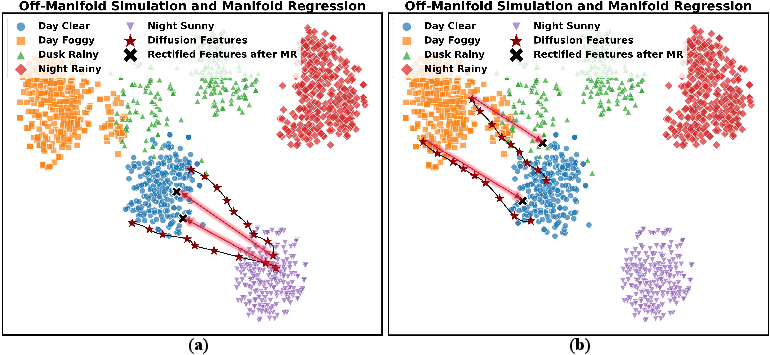
Figure 5: t-SNE visualization. Dual-CoT generates off-manifold trajectories; Manifold Regression consistently pulls features back to semantic regions of the source.
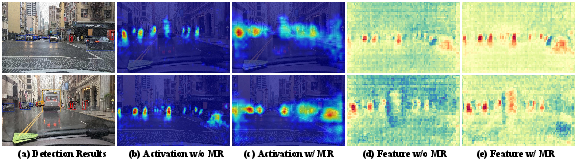
Figure 6: Manifold Regression suppresses background and highlights semantic object activations, even under severe degradation.
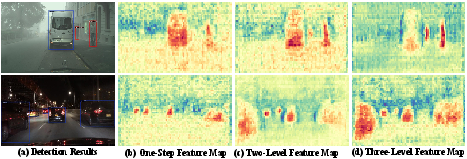
Figure 7: Hierarchical textual CoT sharply increases focus and suppresses background relative to static prompting.
Practical and Theoretical Implications
Practically, MR-DCoT demonstrates domain-agnostic, architecture-agnostic portability: it boosts robustness across CNNs (Faster R-CNN), transformers (DINO, Swin-T), diffusion detectors, and vision-LLMs, with no access to target data. This allows resource-constrained, privacy-sensitive, and real-time deployments in open-world settings without the need for domain adaptation or test-time training.
Theoretically, the paper substantiates a paradigm shift in DGOD research: reframing generalization as an explicit regression problem over the semantic manifold, not unbounded simulation or data expansion. The simulation-rectification closed loop, operationalized with structured, controllable outlier synthesis and geometric correction, suggests a general template for other robust modeling tasks (e.g., open-set recognition, domain-invariant segmentation). The approach also provides practical insights for future work in controlled outlier generation using cross-modal (visual-language) guidance, and in stable regression-based error correction over latent semantic spaces.
Future Directions
Potential research avenues include:
- Extending manifold regression to tasks beyond object detection, such as video understanding and 3D scene analysis.
- Exploring more adaptive or data-driven manifold parameterizations beyond per-class prototypes, possibly using subspace or non-parametric density models.
- Integrating sample selection or uncertainty-aware regression for incremental, online setting.
- Investigating the interplay of explicit manifold regression with unsupervised domain adaptation when limited target data becomes available.
Conclusion
MR-DCoT advances the state of the art by shifting the focus of Single-DGOD from augmentation-based simulation toward manifold-centric regression, anchored by class prototypes and driven by multimodal, structured outlier synthesis. Empirical and visualization evidence validates that robust generalization to severe, unobserved shifts requires both hard, semantically-guided off-manifold simulation and an explicit, prototype-anchored rectification mechanism. This paradigm provides practical, scalable robustness and new theoretical insight for open-world vision and representation learning.