- The paper presents a novel method where phase-controlled multipath interference in a two-giant-atom system yields efficient single-photon frequency conversion.
- It uses a local single-pole Fano resonance model to decompose the inelastic transmission spectrum, achieving conversion probabilities exceeding 0.97 under optimal phase configurations.
- Robust analytical and numerical validations indicate that the approach is practical for superconducting circuits and scalable to complex quantum network architectures.
Phase-Selected Single-Photon Frequency Conversion via Fano Resonance in Two-Giant-Atom Waveguide-QED
Physical Model and Analytical Structure
The paper formulates a waveguide-QED system consisting of a two-level giant atom (A) and a Λ-type three-level giant atom (B), both coupled to a common one-dimensional waveguide at spatially separated points. The Λ-type atom enables inelastic photon frequency conversion, while the two-level atom, through secondary coherent coupling, introduces multipath interference and additional degrees of phase control unavailable in conventional single-atom or small-atom systems. The real-space approach and Markovian regime yield exact analytic expressions for four-channel scattering amplitudes (elastic transmission/reflection, inelastic transmission/reflection), governed by multipoint coupling phases and decay rates.
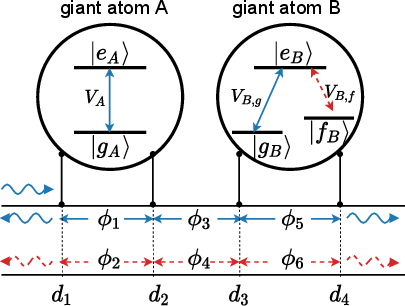
Figure 1: Schematic of the waveguide-QED system with two giant atoms coupled at spatially separated points.
The interaction Hamiltonian incorporates both direct and cross-coupling terms, leading to three complex resonance poles in the system's denominator, with the multipath phase accumulation controlled via propagation phases ϕ1,2.
Fano Resonance, Phase Selection, and Local Single-Pole Approximation
A critical result is the decomposition of the complex inelastic transmission spectrum into a local single-pole Fano lineshape within the target frequency conversion window. This emergence of Fano resonance is attributed to the coherent superposition of a background (direct output of the converted photon) and a discrete resonance (reabsorption/reemission by the secondary giant atom pathway). The internal waveguide phases ϕ1 and ϕ2 dictate the relative magnitude of background and resonance terms, allowing for phase-selective suppression of the background, effectively yielding a Lorentzian peak at optimal configurations.
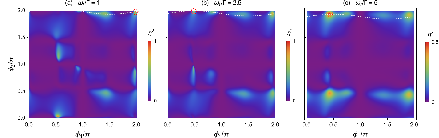
Figure 2: Distribution of single-pole resonance weight η2 in the phase-plane as a function of ωf; bright regions correspond to high-efficiency conversion windows.
The paper introduces the single-pole resonance weight η2=∣C∣2/γeff2 as an explicit phase-selection criterion. Analytical expansion yields conditions for background suppression and maximal resonance, highlighting the locus near Λ0 as optimal phase spaces for efficient conversion.
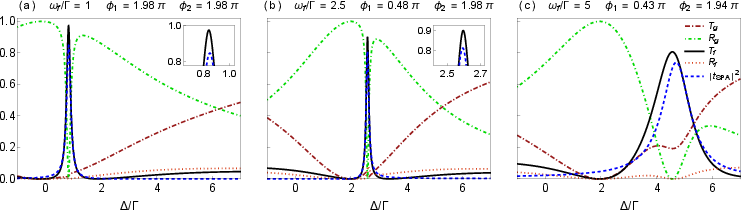
Figure 3: Exact four-channel scattering probabilities and local single-pole approximation for bright-region phases, indicating suppression of unwanted channels and strong target peak.
Numerical validation demonstrates that the single-pole approximation precisely captures the inelastic transmission peak in the target window when evaluated at phase values maximizing Λ1. Deviations outside bright regions indicate breakdown due to residual background and non-target resonances.
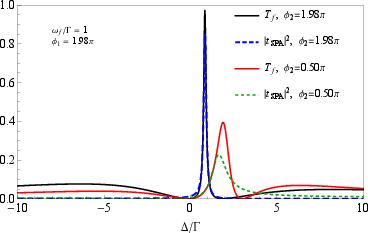
Figure 4: Comparison between exact Λ2 and single-pole approximation Λ3 for selected and reference phases.
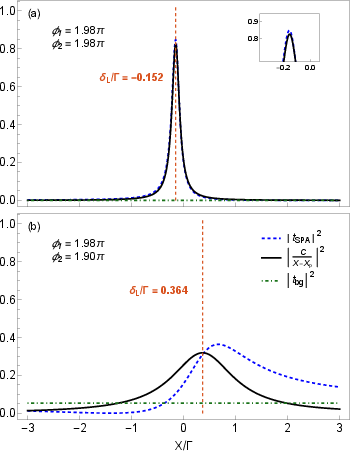
Figure 5: Fano decomposition illustrating the transition from Lorentzian (resonant-dominated) to asymmetric Fano lineshape as the local background varies with phase.
The two-giant-atom configuration achieves substantial enhancement in forward inelastic transmission compared to both the single Λ4-type giant atom and conventional small-atom models. For phase-selected conditions, the transmission probability Λ5 exceeds Λ6 for moderate conversion intervals (Λ7), substantially surpassing the theoretical limits in single-atom realizations (Λ8 for symmetric decay channels).
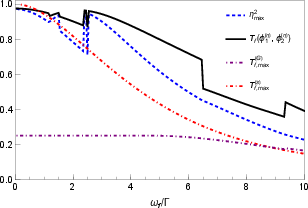
Figure 6: Advantage of the two-giant-atom scheme, showing similar trends for Λ9 and B0, validating the resonance weight as a phase-selection criterion.
The enhancement arises from cooperative phase-controlled secondary coupling, enabling constructive interference in the desired channel and destructive suppression elsewhere. Phase control in the giant-atom scenario also compensates for the universal B1 decay in transmission with increasing frequency-conversion interval, maintaining higher efficiency over a wider detuning range than small-atom implementations.
Robustness analysis incorporating non-Hermitian corrections (excited-state loss B2) yields high conversion probabilities even for realistic loss rates, e.g., B3 for B4, indicating practical feasibility.
Theoretical and Practical Implications
The phase-selected Fano resonance mechanism provides a versatile, tunable protocol for efficient single-photon interfaces in quantum networks bridging disparate frequency domains. The internal phase control enabled by the giant-atom architecture generalizes direct multipath interference principles, allowing for deterministic engineering of spectral response and channel selectivity in waveguide-QED, potentially extendable to more complex multi-atom chains and structured photonic systems.
Experimental realization is compatible with superconducting circuit platforms, where level structure engineering and spatial coupling are routine. Future directions involve relaxing equal-spacing or symmetric coupling assumptions, exploring non-Markovian effects, and extending the single-pole Fano paradigm to multipole scattering regimes and nonreciprocal conversion.
Conclusion
This work establishes how phase-selected giant-atom interference generates efficient single-photon frequency conversion in waveguide-QED through local Fano resonances. Analytical decomposition, phase-selection criteria, and exact numerical results demonstrate robust enhancement of target inelastic channels, outperforming standard atom-based models and maintaining efficacy across a broad conversion interval and in the presence of loss. These results provide a framework for coherent quantum interface engineering in structured photonic systems and inform future experimental and theoretical investigations into multipath interference phenomena.