A coarse block-cutvertex tree-decomposition
Abstract: We obtain a coarse version of the block-cutvertex tree-decomposition of a connected graph.
- Linked tree-decompositions into finite parts (2024)
- Non-branching tree-decompositions (2017)
- Two-connected graphs with prescribed three-connected components (2007)
- Refining tree-decompositions so that they display the k-blocks (2024)
- On the block number of graphs (2017)
- Canonical tree-decompositions of a graph that display its $k$-blocks (2015)
- The tree of decomposition of a biconnected graph (2014)
- Coarse tree-width (2025)
- A Structural Linear-Time Algorithm for Computing the Tutte Decomposition (2025)
- A coarse block-cut tree theorem (2026)
Summary
- The paper introduces a coarse block-cutvertex tree-decomposition that generalizes classical graph tools by replacing cutvertices with bounded-diameter separators.
- It establishes precise diameter bounds—such as adhesion sets with diameter at most 5d+2—and ensures each bag is (d,2d+1)-inseparable using a layered partitioning method.
- The decomposition is quasi-isometrically invariant, offering improved path-connectivity guarantees and extending applications to metric space analysis and algorithm design.
Coarse Block-Cutvertex Tree-Decomposition of Connected Graphs
Introduction and Motivation
This paper introduces a coarse analogue of the classical block-cutvertex tree-decomposition for connected graphs, extending fundamental graph-theoretic tools into the field of coarse geometry. The coarse approach is motivated by the desire for quasi-isometric invariance and applicability to metric spaces, following trends in coarse graph theory that aim to generalize classical combinatorial results to settings robust under local perturbations. The authors propose precise definitions for coarse blocks and separators, navigating the technical challenges posed by the overlap of separators and the dependence of inseparability on the ambient graph metric.
Main Theoretical Results
Coarse Block-Cutvertex Tree-Decomposition
The central result establishes that for any d∈N, every graph G admits a tree-decomposition (T,(Vt:t∈V(T))) satisfying:
- Adhesion Bound: Every adhesion set (intersection of adjacent bags in T) has diameter at most $5d+2$ in G.
- Bag Inseparability: Every bag is (d,2d+1)-inseparable; for any set S⊂V(G) of diameter at most d and any two vertices u,v in the bag, either G0 or G1 is within distance G2 of G3, or they are in the same component of G4.
This generalizes the classical block-cutvertex tree by replacing cutvertices with separators of bounded diameter and blocks with G5-inseparable subsets, where G6 is dependent on G7.
Intrinsic Metric and Outer-Torso Decomposition
A strengthened variant is proven: by expanding each bag to a bounded-distance neighborhood, the intrinsic diameter of adhesion sets is controlled, and each outer-torso (formed by contracting components outside a bag) is itself G8-inseparable. The identity mapping from each induced subgraph G9 to (T,(Vt:t∈V(T)))0 exhibits additive distortion at most (T,(Vt:t∈V(T)))1, ensuring that the bag metrics are similar to those inherited from (T,(Vt:t∈V(T)))2. This addresses unsatisfactory aspects of inseparability defined solely with respect to the ambient metric.
Strong Connectivity Properties
The decomposition ensures that for two sets of vertices (T,(Vt:t∈V(T)))3 with diameter at least (T,(Vt:t∈V(T)))4 and contained in a common bag, there exist two (T,(Vt:t∈V(T)))5--(T,(Vt:t∈V(T)))6 paths at distance at least (T,(Vt:t∈V(T)))7 apart in (T,(Vt:t∈V(T)))8, aligning with coarse (T,(Vt:t∈V(T)))9-path-connectedness.
Construction Techniques
The coarse decomposition leverages a layered partitioning strategy, employing annuli of width T0 centered at a base vertex. Boxes in the partition correspond to T1-near-components within annuli and components of the graph minus previous layers. This induces a coarse block-cutvertex structure in a graph T2, which itself undergoes a classical block-cutvertex decomposition. The tree T3 of the desired decomposition is then obtained from the cutvertex tree of T4 by contracting edges associated with wide separators (those whose intersections have diameter exceeding T5).
Overlapping separators and blocks are handled by defining block-classes as equivalence classes under an identification relation, ensuring that the resulting bags are T6-inseparable. Careful combinatorial arguments, dependent on the properties of the annular partition and near-components, underpin the proof that these constructs yield the required properties for all bags and adhesion sets.
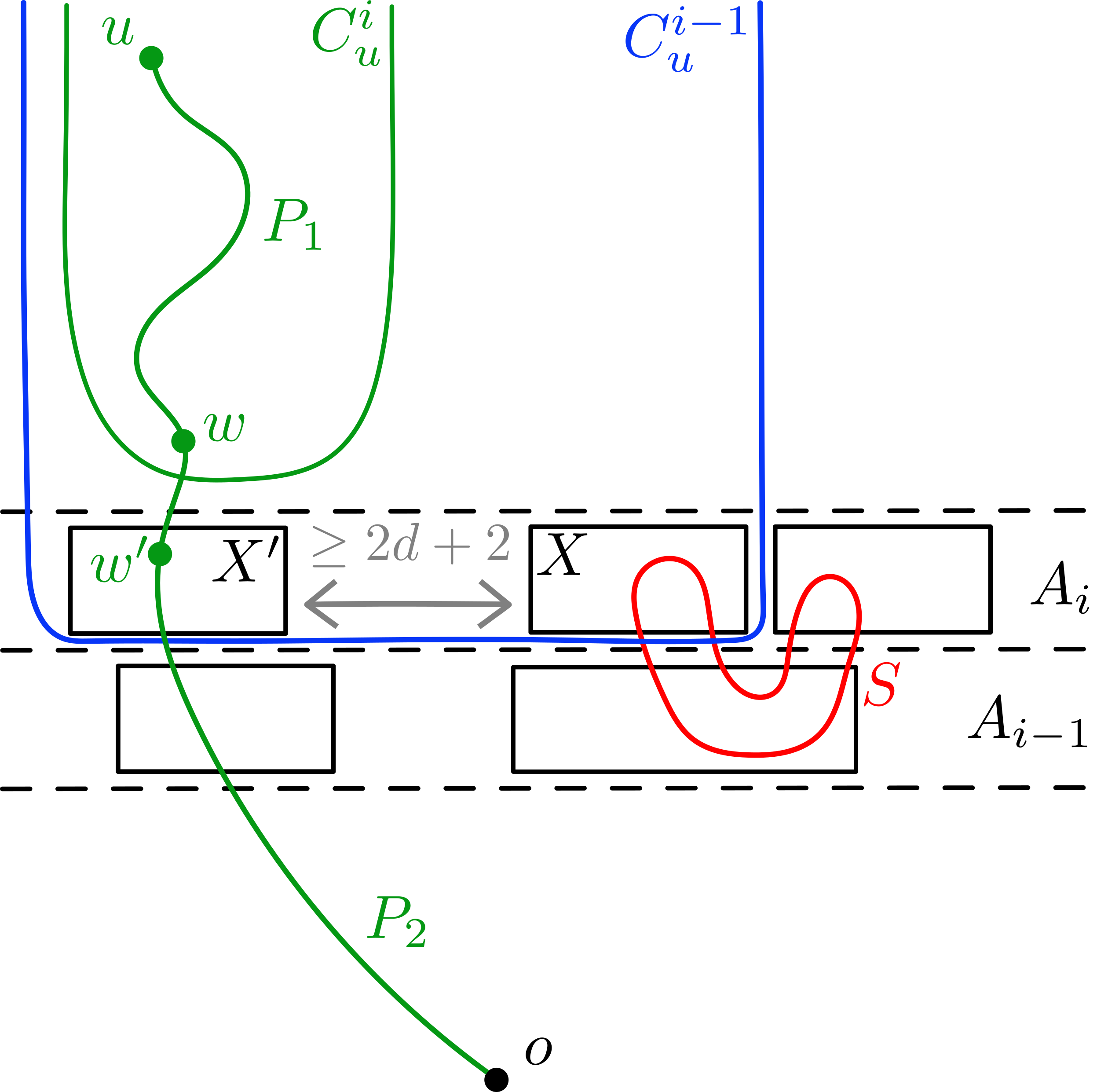
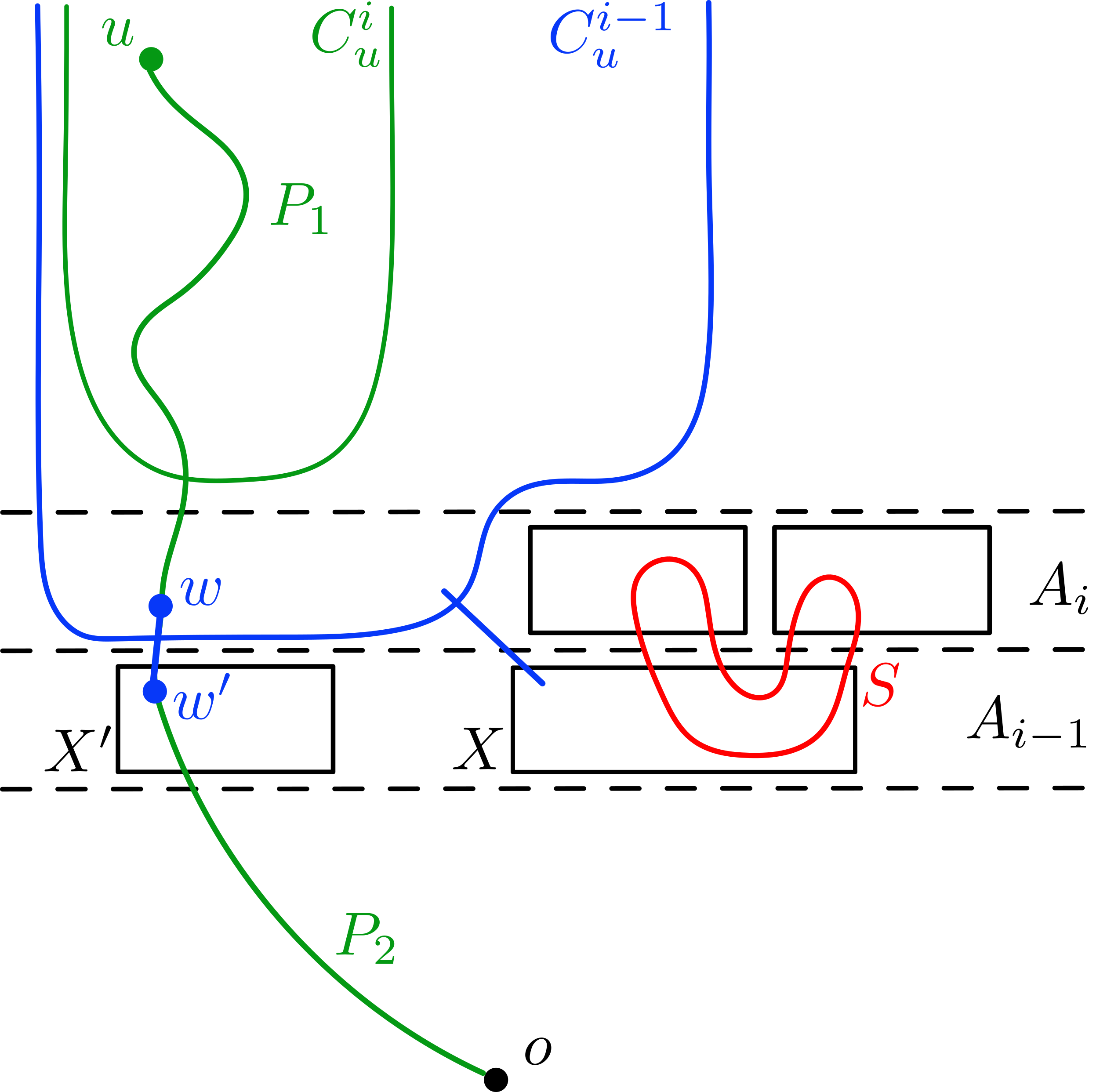
Figure 1: Case 2a in the layered partition construction, illustrating T7 and T8 in distinct near-components separated by a wide box.
Practical and Theoretical Implications
The development of a coarse block-cutvertex tree-decomposition transforms classical graph-theoretic tools into robust, metric-compatible forms. This yields several notable consequences:
- Quasi-Isometric Invariance: The decomposition is stable under quasi-isometries, facilitating transfer of connectivity properties between graphs and metric spaces.
- Metric-Space Applicability: The results become instrumental for analyzing metric spaces via graph analogues, expanding the reach of combinatorial topology and geometric group theory.
- Improved Path-Connectivity Guarantees: Bags within the decomposition exhibit coarse T9-path-connectedness, supporting applications in network reliability, coarse embeddings, and algorithmic graph partitioning.
The paper also raises the open problem of formulating a coarse analog for Tutte decompositions, seeking decompositions into torsos that are coarsely $5d+2$0-connected. Such a hierarchy of coarse decompositions would further bridge the gap between combinatorial and geometric graph theory.
Numerical Bounds and Comparison
The constants achieved in the decomposition (e.g., diameter bounds of $5d+2$1 and $5d+2$2 for adhesion sets, additive distortion bounds for bag metrics) are closely aligned with but distinct from contemporary results by Baligacs et al., who achieve slightly better constants. The guarantees on path separation within bags ($5d+2$3) are explicitly quantified, supporting rigorous applications of coarse connectivity.
Future Perspectives in Coarse Graph Theory
The methodology and results herein suggest fertile ground for further research:
- Coarse Hierarchical Decompositions: Extending the block-cutvertex approach to higher coarse connectivity levels, including coarse Tutte and even coarser versions of clique and cycle decompositions.
- Metric Embedding and Algorithm Design: Leveraging coarse decompositions for efficient approximation algorithms in metric spaces and for property testing in large graphs.
- Geometric Group Theory Applications: Utilizing tree-like coarse decompositions for studies of group actions, ends of groups, and structure at infinity.
The interplay between parameters $5d+2$4 and $5d+2$5, combinatorial and metric properties, and their impact on the robustness of decomposition algorithms will be of significant theoretical interest.
Conclusion
The paper establishes a formal and powerful coarse block-cutvertex tree-decomposition for connected graphs, setting the groundwork for quasi-isometric invariant graph theory and metric space analysis. It delivers detailed technical proofs, explicit numerical bounds, and points toward future coarse decompositions of higher connectivity. This work is positioned to serve as an essential reference for researchers seeking to translate classical graph theoretical concepts into the coarse geometric domain and beyond (2607.07030).
Paper to Video (Beta)
No one has generated a video about this paper yet.
Whiteboard
No one has generated a whiteboard explanation for this paper yet.
Paper Prompts
Sign up for free to create and run prompts on this paper.
Top Community Prompts
Open Problems
We haven't generated a list of open problems mentioned in this paper yet.
Continue Learning
- How does the coarse block-cutvertex decomposition enhance robustness under quasi-isometries compared to classical decompositions?
- What are the implications of the explicit numerical bounds on adhesion sets for graph partitioning algorithms?
- In what ways can the layered partitioning strategy used here be adapted for other types of coarse decompositions?
- What challenges need to be addressed to extend this approach to coarse Tutte or higher connectivity decompositions?
- Find recent papers about coarse graph theory.