- The paper introduces a squeezed polaron variational ansatz that incorporates Gaussian bath correlations to improve ground-state energy estimates and accurately identify critical points.
- The method captures both mean-field and non-mean-field critical exponents, effectively distinguishing between delocalized and localized phases in the spin boson model.
- The enhanced framework enables precise computation of observables like bosonic scattering phase shifts, offering actionable insights for experimental quantum simulation.
"Squeezed Polaron" Variational Wavefunction for the Spin Boson Model
Introduction and Motivation
Barberena and Cooper present a comprehensive revision of variational treatments for the spin-boson model, which describes decoherence and quantum dissipation of a two-level system (TLS) interacting with a bosonic environment. The canonical polaron-based variational approaches (Silbey-Harris, Chin, etc.) capture spin-bath entanglement via correlated coherent displacements but fail to encode critical Gaussian boson-boson correlations near the localization transition, especially in the sub-Ohmic regime (J(ω)∝αωs, s<1). These correlations dictate critical scaling and are analytically inaccessible to conventional polaron ansatzes, necessitating a more sophisticated wavefunction.
The authors introduce a "squeezed polaron" variational ansatz, generalizing the coherent-state polaron framework by allowing arbitrary Gaussian correlations in the bosonic bath. This ansatz not only enhances quantitative accuracy for ground-state energy and critical points but also captures mean-field and non-mean-field critical exponents, as well as emergent energy scales vanishing at the localization transition.
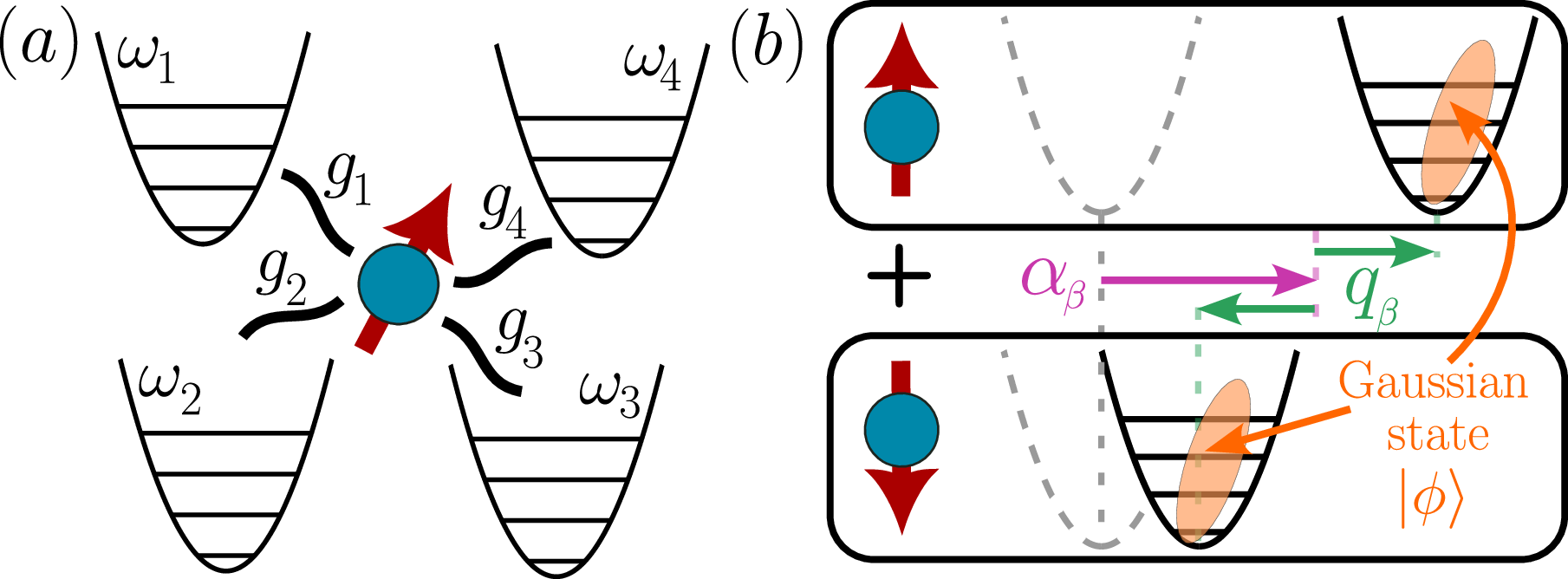
*Figure 1: (a) Schematic of the spin boson model and (b) depiction of the squeezed polaron ansatz, incorporating both correlated (qβ) and uncorrelated (αβ) bosonic displacements within a Gaussian state ∣ϕ⟩. *
Model and Variational Ansatz
The Hamiltonian is
H^=Δs^x+β∑gβ(a^β+a^β†)s^z+β∑ωβa^β†a^β,
where s^x,y,z are spin-$1/2$ operators, and a^β denotes bosonic bath modes.
Previous variational ansatzes exploit unitary transformations combining spin rotations and correlated displacements. The squeezed polaron approach extends this by taking the bosonic part to be a generic Gaussian state, fully parameterized by second moments. This captures bath-bath correlations via Wick's theorem, resulting in ground state energy and observables that depend on a self-consistent function m(y), which encodes collective bath mode squeezing.
The squeezed polaron exhibits two solution branches: delocalized (s<10) and localized (s<11). In both, the correlated displacement and squeezing amplitudes depend non-trivially on mode frequency through s<12, determined by an integral equation with coupling-dependent parameters.
Numerical Results and Critical Properties
The authors solve the resulting equations numerically (see SM for iterative methods and convergence criteria) and contrast their results against coherent-state polaron predictions and recent numerically exact approaches (Multiple Polaron Ansatz, VMPS, QMC, DMRG).
Figures demonstrate improvements in ground-state energy (second-order sensitive) and coherence s<13 over coherent-state polarons, particularly in the shallow sub-Ohmic regime (s<14). Coupling constants marking phase transitions (s<15) closely follow accurate numerical benchmarks for s<16; discrepancies and spurious first-order jumps appear for larger s<17, attributed to limitations in handling fluctuations near criticality.
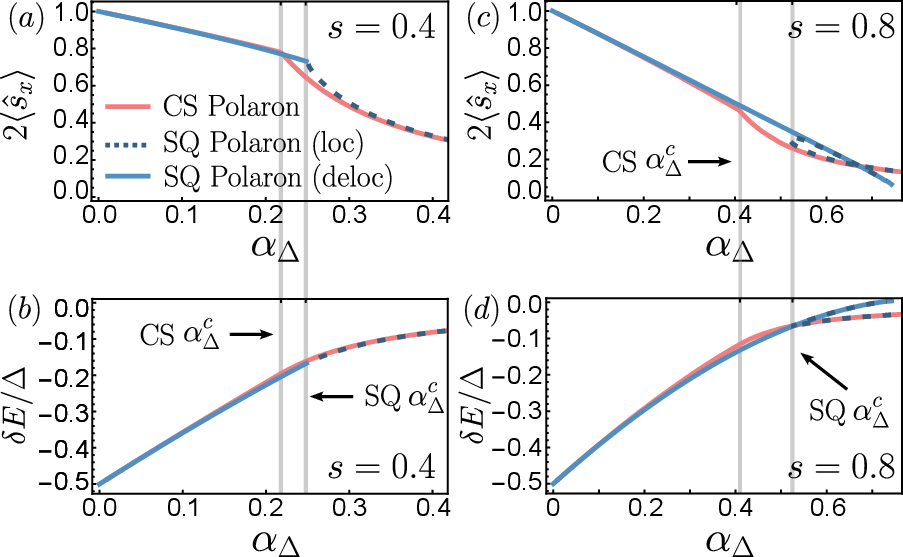
Figure 2: Coherence s<18 and ground state energy gain s<19 versus scaled coupling qβ0 for representative qβ1, comparing coherent and squeezed polaron branches.
Critical behaviour of observables derives from the low-frequency structure of qβ2 and its zero-frequency value qβ3. In the delocalized phase, qβ4 decreases monotonically with increasing coupling, vanishing at qβ5 that identifies the critical point for qβ6.
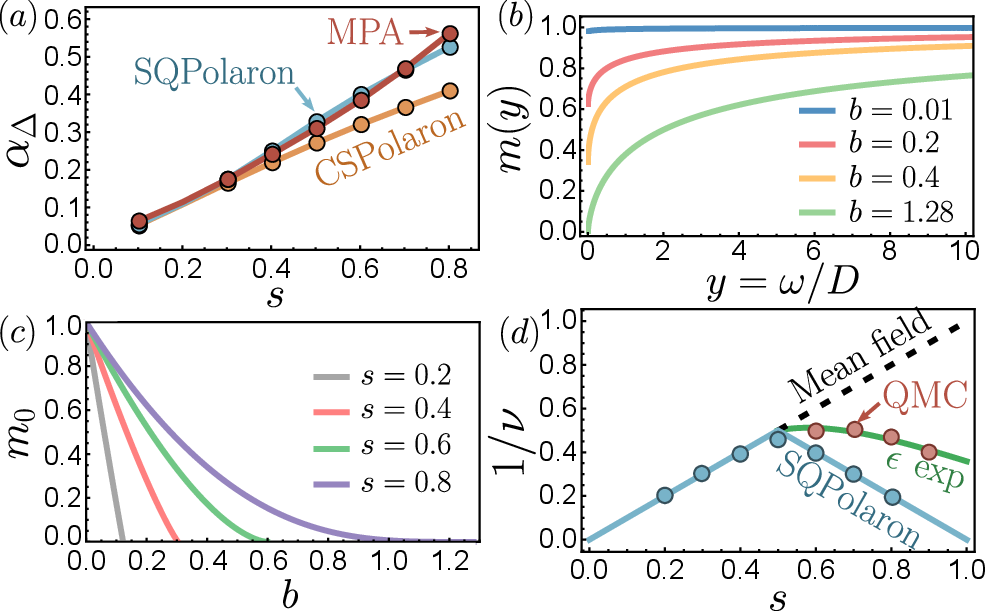
Figure 3: (a) Comparison of critical qβ7 values predicted by squeezed and coherent polarons versus numerics; (b) qβ8 profiles for varying qβ9; (c) αβ0 versus αβ1 for several αβ2; (d) Exponent αβ3 as a function of αβ4 from squeezed polaron, αβ5-expansion, QMC.
Analytically, at criticality, αβ6 as αβ7, ensuring proper scaling of spin-bath and boson-boson correlations. The squeezed polaron captures both mean-field (αβ8 for αβ9) and non-mean-field (∣ϕ⟩0 for ∣ϕ⟩1) critical exponents in the delocalized regime, mirroring field theory predictions. Quantitative agreement persists in deep sub-Ohmic; shallow sub-Ohmic remains energetically outperformed by the localized branch (see SM for finite-size and scaling analysis).
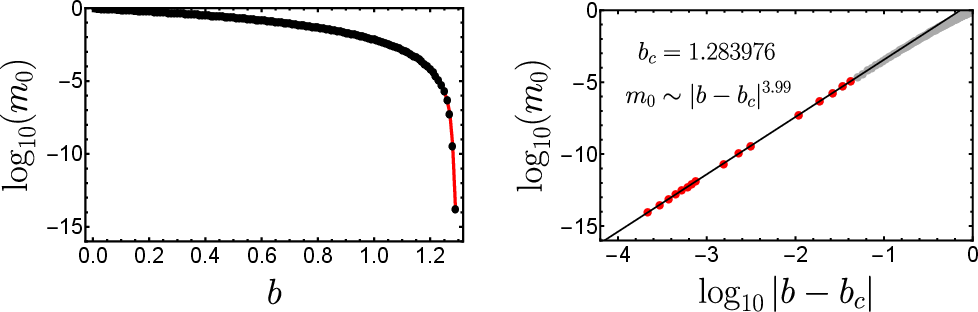
Figure 4: (Left) Approach of ∣ϕ⟩2 to zero as ∣ϕ⟩3 for ∣ϕ⟩4. (Right) Power-law scaling ∣ϕ⟩5 in log-log plot, confirming theoretical scaling.
Scattering and Environmental Probing
The squeezed polaron framework enables computation of bosonic scattering phase shifts from the impurity background, encoding the emergent vanishing energy scale (∣ϕ⟩6) near the transition. In the critical regime (∣ϕ⟩7), the full-line reflection coefficient ∣ϕ⟩8 achieves a universal plateau value ∣ϕ⟩9, fixed by conformal invariance. At frequencies below H^=Δs^x+β∑gβ(a^β+a^β†)s^z+β∑ωβa^β†a^β,0, phase shifts diminish rapidly, with analytical and numerical agreement on crossover behaviour.
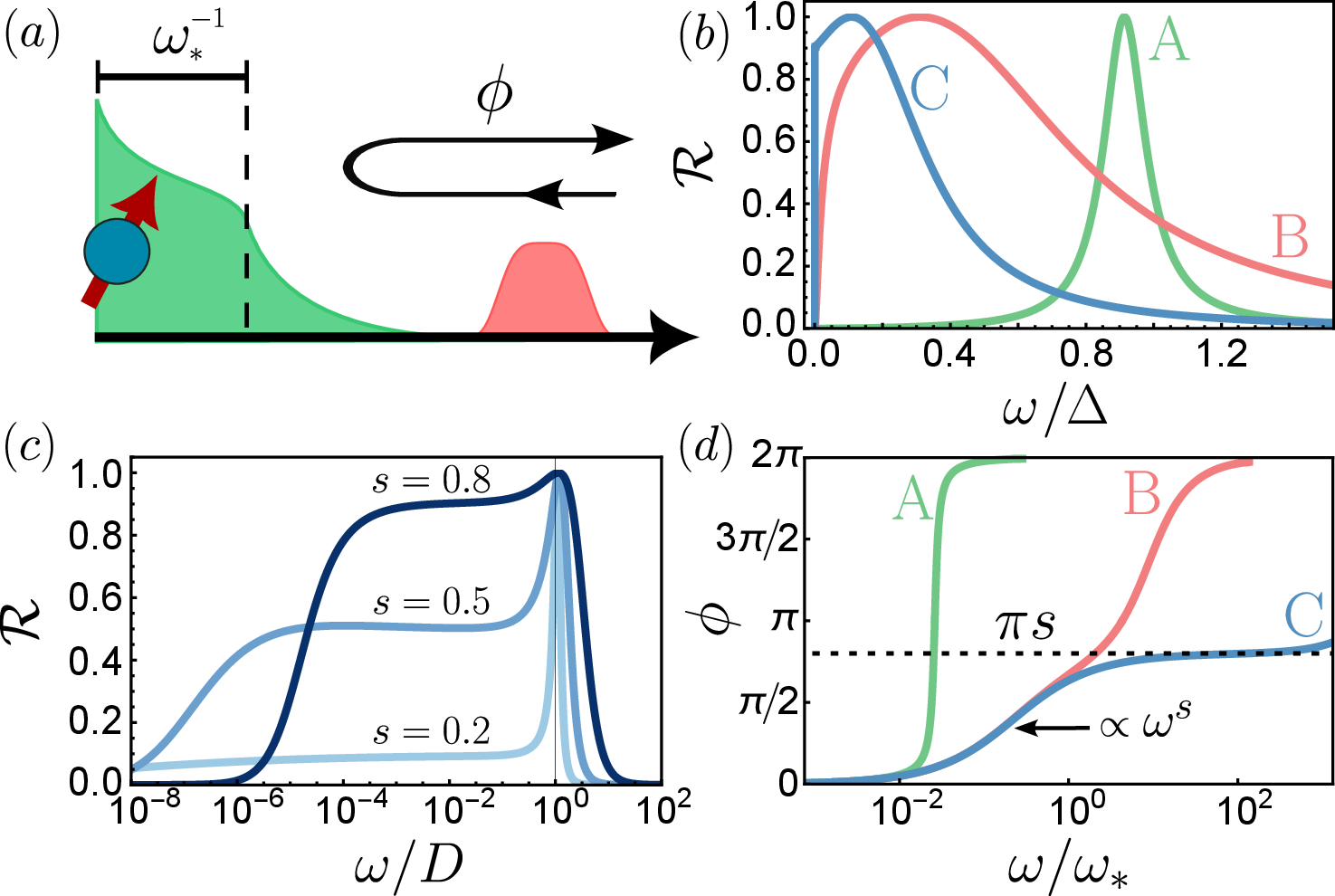
Figure 5: (a) Schematic of boson scattering on half-line; (b) H^=Δs^x+β∑gβ(a^β+a^β†)s^z+β∑ωβa^β†a^β,1 versus H^=Δs^x+β∑gβ(a^β+a^β†)s^z+β∑ωβa^β†a^β,2 for H^=Δs^x+β∑gβ(a^β+a^β†)s^z+β∑ωβa^β†a^β,3 at different H^=Δs^x+β∑gβ(a^β+a^β†)s^z+β∑ωβa^β†a^β,4; (c) Plateau values of H^=Δs^x+β∑gβ(a^β+a^β†)s^z+β∑ωβa^β†a^β,5 near criticality for different H^=Δs^x+β∑gβ(a^β+a^β†)s^z+β∑ωβa^β†a^β,6; (d) Low-frequency phase shift H^=Δs^x+β∑gβ(a^β+a^β†)s^z+β∑ωβa^β†a^β,7.
These scattering properties are directly linked to bath observables and could be probed experimentally in quantum simulators or through interference measurements (homodyne detection), enabling extraction of critical exponents and universality class.
Localized Branch and Limitations
In the localized regime, divergences in uncorrelated displacement for low-frequency modes manifest as effective H^=Δs^x+β∑gβ(a^β+a^β†)s^z+β∑ωβa^β†a^β,8-field tilting for the spin. The critical exponent H^=Δs^x+β∑gβ(a^β+a^β†)s^z+β∑ωβa^β†a^β,9 in magnetization scaling remains correctly captured in mean-field (s^x,y,z0) but is only qualitatively accurate for s^x,y,z1. The ansatz cannot fully resolve cat-like superpositions near criticality, explaining spurious discontinuities in the energy landscape. Further variational refinement (e.g., cat/bipolaron states) or numerically exact approaches are needed for sharpened quantitative predictions in the shallow sub-Ohmic phase.
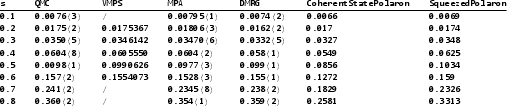
Figure 6: Critical s^x,y,z2 values compared across methods at s^x,y,z3.
Scaling, Exponents, and Crossovers
A scaling analysis reveals that as s^x,y,z4, s^x,y,z5 exhibits universal collapse for fixed s^x,y,z6 and variable s^x,y,z7, with crossover between critical (s^x,y,z8) and non-critical regimes (s^x,y,z9). Analytical expressions for the scaling function $1/2$0 interpolate between these limits, yielding scaling relations for $1/2$1 with respect to $1/2$2 and accordingly the critical exponent $1/2$3.
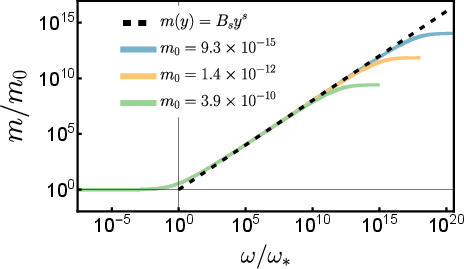
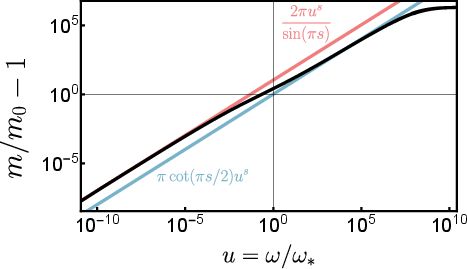
Figure 7: Scaling collapse of numerically determined $1/2$4 for $1/2$5 and varying $1/2$6, illustrating universal scaling function behaviour.
Implications and Future Directions
The squeezed polaron ansatz constitutes a systematic improvement for variational treatments of spin-boson-type models, bridging analytic and numerical gaps in the sub-Ohmic regime. The approach enables consistent treatment of critical scaling, provides accurate phase boundaries, and supports computation of observables relevant to experiments and theory (e.g., scattering, bath correlations, scaling exponents).
Theoretically, this methodology opens pathways for refined variational approaches: inclusion of Gaussian fluctuations in multi-polaron (bipolaron) models, treatment of Ohmic and super-Ohmic regimes, finite-temperature extensions, and incorporation of dynamical properties (e.g., feedback for coherence enhancement, driven/dissipative protocols).
Practically, squeezed polaron predictions for scattering, coherence decay, and critical scaling provide targets for quantum simulation platforms and could inform design and characterization of open quantum systems, quantum information hardware, and sensors subject to critical environmental coupling.
Conclusion
Barberena and Cooper's squeezed polaron variational wavefunction addresses key deficiencies in coherent-state polaron approaches to the spin-boson model, introducing explicit Gaussian bath correlations necessary for accurate description of critical phenomena and physical observables near the localization transition. The approach matches correct analytical scaling, improves ground-state energies, and delivers valid critical exponents in both mean-field and non-mean-field regimes. Extensions of this framework promise to enhance theoretical understanding and numerical accuracy in open quantum system models, with broad relevance to quantum information, condensed matter, and quantum technologies.