- The paper shows that applying a finite-width energy filter yields a state where local observables converge to thermal values at a rate proportional to √δ.
- It employs a cosine filter within Floquet dynamics to construct filtered states whose reduced density matrices display block-diagonal structures and distinct Rényi entropy scaling.
- The findings quantify simulation costs by highlighting that local thermalization can occur without full volume-law entanglement, marking a decoupling between local and global thermal properties.
Quantifying Thermality in Energy-Filtered Quantum Many-Body States
Introduction and Motivation
The paper (2607.06847) rigorously investigates the question: how close to thermal is a pure state obtained by applying a finite-width energy filter to a quantum many-body initial state? This is a central problem in quantum statistical mechanics and quantum simulation, where the direct preparation of true thermal density matrices on quantum hardware is highly nontrivial. Instead, experimentally and numerically tractable approaches spectrally filter simple initial states (often product states) to suppress energy fluctuations, ideally producing states that locally mimic thermal equilibrium ensembles. Existing heuristics and the eigenstate thermalization hypothesis (ETH) suggest that sufficiently narrow filters guarantee thermality. However, the precise quantitative relation between filter width δ and thermality—understood in terms of local expectation values and entanglement structure—has remained open.
Rather than working solely with continuous-time Hamiltonian evolution, this study formulates spectral filtering in the general context of Floquet dynamics. The authors introduce a cosine filter that can be directly translated into either Hamiltonian or stroboscopic (Floquet) dynamics. The filtered state is constructed as a weighted sum of states evolved at multiples of a stroboscopic period T:
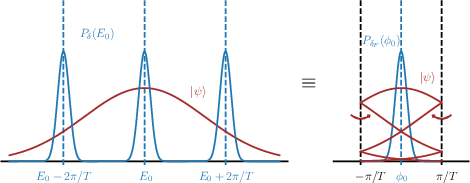
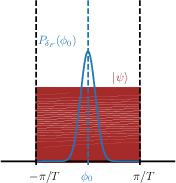
Figure 1: Action of the cosine filtered state Pδ on an initial state in the Floquet regime. The Gaussian envelope selects a window in quasi-energy (or energy at small T).
The filter width δF selects a window in the Floquet spectrum; for sufficiently small T, the construction maps to the Hamiltonian case. Crucially, the coefficients cm in the filtered sum approximate a Gaussian envelope:
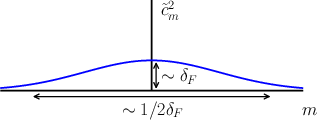
Figure 2: The normalized filter coefficients cm form a Gaussian of width 1/2δF centered at m=0. The weight c02∝δF.
The paper exploits the structural property that, under generic assumptions on the Loschmidt echo decay of product states (valid for generic, nonintegrable Hamiltonians), the reduced density matrix (RDM) of any finite subsystem Pδ0 in the filtered state is asymptotically block-diagonal, with each block corresponding to a single stroboscopic evolution step.
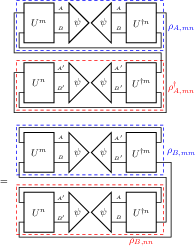
Figure 3: Diagrammatic representation of the key block diagonality in RDMs of filtered states, responsible for the suppression of off-diagonal coherence.
Scaling of Entanglement Entropy in Filtered States
One of the main goals is to characterize how closely the filtered state replicates the entanglement structure of a thermal state. For true thermal (Gibbs or microcanonical) states, all Rényi-Pδ1 entropies exhibit a volume law.
This work shows substantial deviation from thermality for filtered states with polynomially small filter width:
- For Rényi-Pδ2 entropies with Pδ3, the entropy scales only logarithmically with Pδ4.
- For the von Neumann entropy (Pδ5), the scaling is linear in Pδ6.
- For Pδ7, the entropy can be even more sensitive—quadratic or linear in Pδ8 depending on filter truncation.
They provide a block-structure and eigenvalue argument to explain this result and confirm universality of the asymptotic structure in both Floquet and Hamiltonian regimes. Strong numerical support is presented for the overlap decay between RDM blocks in chaotic models:
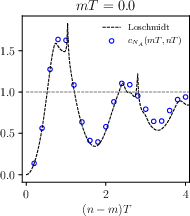
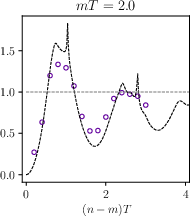
Figure 4: Overlap between diagonal blocks Pδ9 and T0 of the RDM as a function of time difference for a non-integrable Ising chain. Exponential decay validates block-diagonal approximation and supports the analytical ansatz.
This implies that, as long as T1 grows only polynomially with system size, entanglement entropy remains far subthermal, with filtered states clearly distinguishable from true thermal states using Rényi entropies with T2.
Thermality Bounds for Local Observables
Despite the non-thermal scaling of entanglement entropies, the paper rigorously demonstrates that local observables in the filtered state converge to their thermal values as the square root of the filter width. More precisely, for any local operator T3,
T4
assuming (Floquet or Hamiltonian) ETH holds. This square-root rate is proven using precise random matrix bounds on the off-diagonal matrix elements in the relevant ensemble, improving on previous numerics [Dymarsky & Liu 2019] and connecting with canonical universality.
This scaling is numerically validated in both stroboscopic and continuous-time setups:
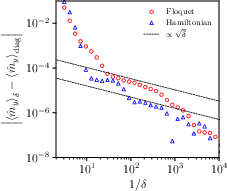
Figure 5: Difference between filtered state and thermal (diagonal ensemble) expectation value for the T5 observable. Both Floquet and Hamiltonian filtered states converge with a characteristic T6 scaling as the filter narrows.
Generalization to Hamiltonian Filters and Finite Systems
By leveraging a mapping from Hamiltonian-filtered to effective Floquet-filtered states, the results are shown to hold broadly, including the original (Hamiltonian) filtering protocols of earlier studies. Notably, the approach clarifies the cost in simulation/experiment: filter width T7 determines not only the energy resolution, but the degree of thermalization achievable in local observables and (lack of) volume-law entanglement.
They further numerically analyze the growth of von Neumann entanglement entropy in both Floquet and Hamiltonian filtering, again confirming analytic predictions:
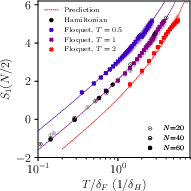
Figure 6: Scaling of half-chain von Neumann entanglement entropy for filtered states across regimes (Floquet and Hamiltonian), system sizes, and filter widths. Dashed lines: theoretical expectations.
Implications, Extensions, and Outlook
The main theoretical implication is the decoupling between local observable thermalization and entanglement scaling in polynomially narrow filtered states—filtered states are locally, but not globally, thermal. This aligns with the theoretical expectation that only filters that resolve energies exponentially accurately can guarantee full thermal typicality—including volume-law Rényi entropies for all T8.
Practically, this result quantifies the necessary energy resolution for accurate quantum simulation of local equilibrium properties and provides guidance for quantum algorithms based on purification or filtering.
Several directions for future research are opened:
- Exploring filtered state thermality in non-ergodic (MBL, many-body scar) or integrable systems, where the main technical assumption of exponential Loschmidt echo decay fails.
- Developing quantum simulation protocols that explicitly optimize for rapid local equilibration without requiring exceedingly narrow filters.
- Investigating the interplay between filter-induced prethermalization and true thermalization in driven or open systems.
- Understanding connections to classical and quantum simulatability thresholds, particularly in MPS-based methods where growth of Rényi entanglement entropy is a limiting factor.
Conclusion
This paper delivers a comprehensive and technically complete treatment of the thermality of filtered quantum many-body states, establishing clear, quantitative criteria for both local observable convergence and entanglement structure as a function of filter width. The analysis is unified across Floquet and Hamiltonian regimes and is supported by strong numerical verification. The results serve as a guidepost for both theoretical investigations and experimental/quantum algorithm implementations of finite-temperature physics via energy filtering.
Reference:
Yilun Yang, J. Ignacio Cirac, Mari Carmen Bañuls, "How thermal is a filtered state?" (2607.06847)