- The paper develops a comprehensive theoretical framework for scalable spin squeezing in S=1 spinor BECs by leveraging tunable quadratic Zeeman shifts and one-axis-twisting dynamics.
- It demonstrates universal OAT scaling with optimal squeezing metrics where the squeezing parameter scales as ξ_R² ∼ N^(–2/3) and minimal squeezing time as t_min ∼ N^(1/3).
- The study introduces a freezing mechanism via rapid quenching of the quadratic Zeeman shift, effectively preserving entangled states for prolonged coherence in quantum sensing.
Universal Spin-Squeezing Dynamics in Spinor Condensates
Context and Motivation
Spin squeezing in many-body quantum systems is a well-established approach for enhancing quantum metrological sensitivity and probing multipartite entanglement. Ultralow-temperature spinor Bose-Einstein condensates (BECs) with atoms possessing large internal spin degrees of freedom offer a promising platform for realizing scalable entangled states. The interplay between spin-dependent contact interactions and externally tunable quadratic Zeeman shifts fundamentally affects entanglement generation and metrological properties in such ensembles. This paper develops a comprehensive theoretical framework for spin squeezing in S=1 spinor BECs, leveraging arbitrary quadratic Zeeman shifts to break rotational symmetry and facilitate scalable one-axis-twisting (OAT)-type entangling dynamics (2607.06842).
Theoretical Model
The system studied comprises N bosonic atoms, each with spin S=1, confined to a common spatial mode. The relevant degrees of freedom are encoded in three spin modes labeled by m=−1,0,1. The Hamiltonian includes an SU(2)-invariant spin-dependent interaction and a quadratic Zeeman term, which is tunable via external fields:
cH=2NJ2+qm∑m2am†am
where J2 encompasses collective spin interactions and q is the normalized quadratic Zeeman shift. The system is initialized in a coherent spin state (CSSx) aligned with the x direction, representing maximal collective spin length. Without the Zeeman shift (q=0), this CSS is an eigenstate of the interaction and does not evolve into a squeezed or entangled state. However, the inclusion of the quadratic Zeeman term introduces non-commutativity and enables correlated dynamics.
Analytical Regimes and Effective Hamiltonians
Small Quadratic Zeeman Shift (N0)
Degenerate perturbation theory and Schrieffer-Wolff transformation yield an effective Hamiltonian projecting the dynamics onto the maximal-spin Dicke subspace:
N1
This form exemplifies the OAT model, ensuring scalable squeezing characterized by N2, with squeezing time N3.
Large Quadratic Zeeman Shift (N4)
In the large N5 regime, interaction-picture analysis and a generalized rotating-wave approximation lead to an effective Hamiltonian:
N6
Scalable squeezing persists but is realized stroboscopically, with modulation frequency N7. In contrast to dipolar lattice systems, the all-to-all interactions of the single-mode BEC maintain entanglement generation despite rapid depolarization.
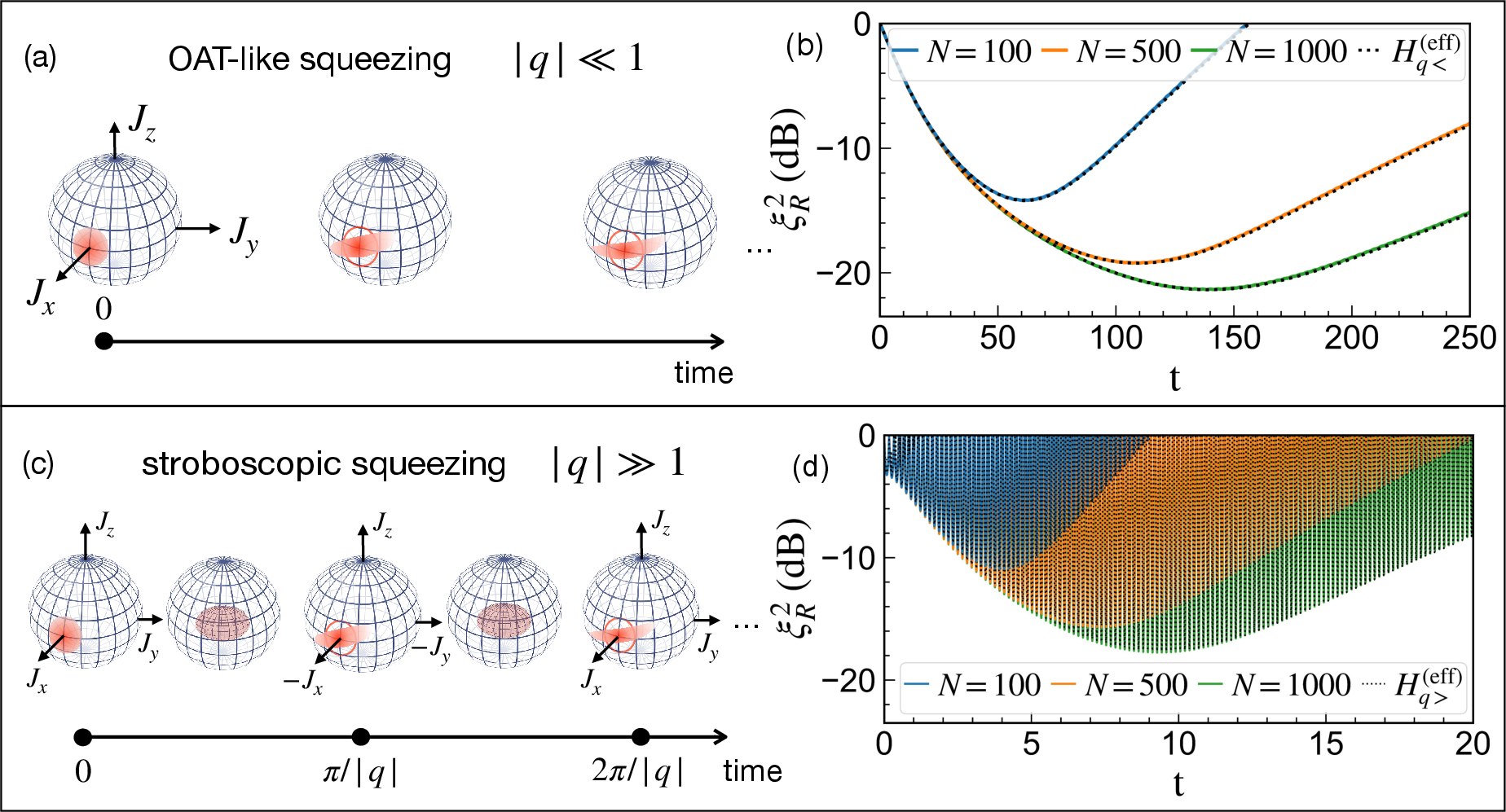
Figure 1: Spin squeezing dynamics visualized for both small and large N8, detailing OAT-like behavior and stroboscopic squeezing with associated uncertainty evolution on the collective Bloch sphere.
Numerical Analysis and Universal Scaling
Exact diagonalization (ED) of the full many-body Hamiltonian, exploiting symmetries and conservation laws, enables dynamics computations for N9. Across all accessible S=10 values, the optimal squeezing parameter S=11 and optimal squeezing time S=12 consistently exhibit OAT scaling, even in intermediate regimes (S=13) for which no analytical effective model is available. Variations in S=14 strongly affect the prefactors, with the smallest S=15 for S=16, but fastest preparation times at S=17. The product S=18 determines an optimal trade-off, minimized near S=19.
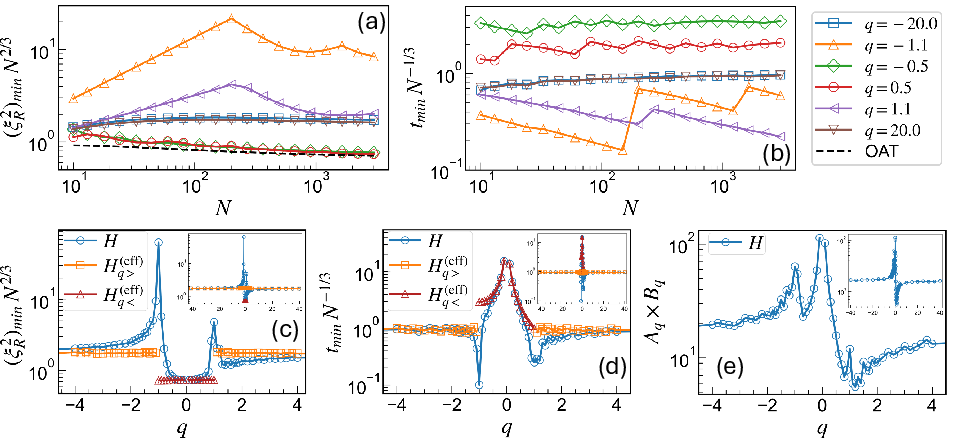
Figure 2: Universal OAT scaling for optimal squeezing and squeezing time as a function of system size, alongside parameter-dependent prefactors and their dependence on m=−1,0,10.
Freezing and Practical Application
A crucial operational insight is that quenching m=−1,0,11 to zero renders the spin Hamiltonian SU(2)-symmetric, completely freezing collective-spin properties and squeezing. This mechanism can extend coherence times in Ramsey interferometry, circumventing limitations imposed by finite quadratic shifts and enabling arbitrarily long interrogation periods for external field measurements. The commutation between field-induced rotations and post-freezing SU(2) evolution further ensures robust entanglement-enhanced sensing protocols.
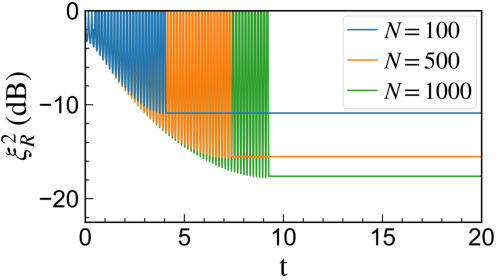
Figure 3: Demonstration of spin squeezing freezing via rapid switching of m=−1,0,12, preserving the entangled state through subsequent collective-spin evolution.
Extensions to Higher Spin and State Preparation
Atoms with m=−1,0,13 can be prepared in initial states with m=−1,0,14 overlap to m=−1,0,15 CSSm=−1,0,16 using single-atom Hamiltonians with appropriately tuned Rabi fields and quadratic shifts. For large m=−1,0,17, population is confined to m=−1,0,18 manifolds, allowing effective mapping to m=−1,0,19 physics in larger-spin condensates.
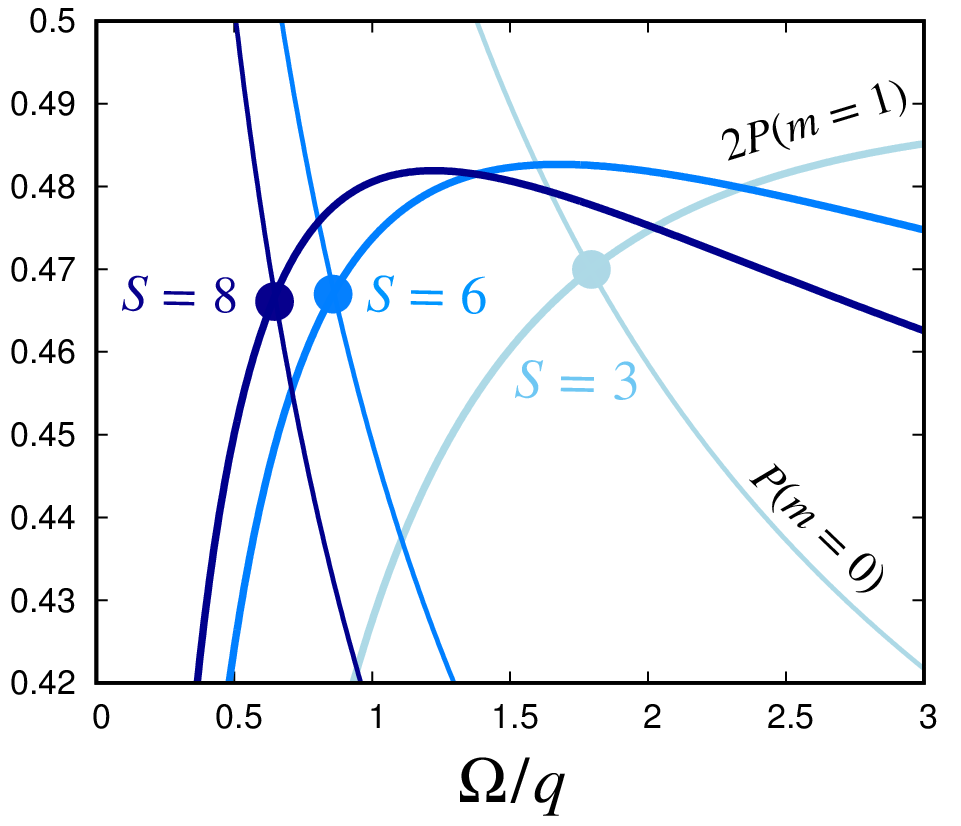
Figure 4: Probability distribution for cH=2NJ2+qm∑m2am†am0 atoms showing convergence to cH=2NJ2+qm∑m2am†am1 CSScH=2NJ2+qm∑m2am†am2 via optimal Rabi field and Zeeman shift parameterization.
Detailed Scaling and Oscillation Structure
Non-monotonic scaling in intermediate cH=2NJ2+qm∑m2am†am3 regimes is interpreted as abrupt advancement of global squeezing minima due to oscillatory structure in cH=2NJ2+qm∑m2am†am4; increasing cH=2NJ2+qm∑m2am†am5 can cause the optimal time window to jump between local minima. For moderate cH=2NJ2+qm∑m2am†am6, small-scale oscillations superposed upon OAT scaling emerge, representing leakage beyond the Dicke subspace.
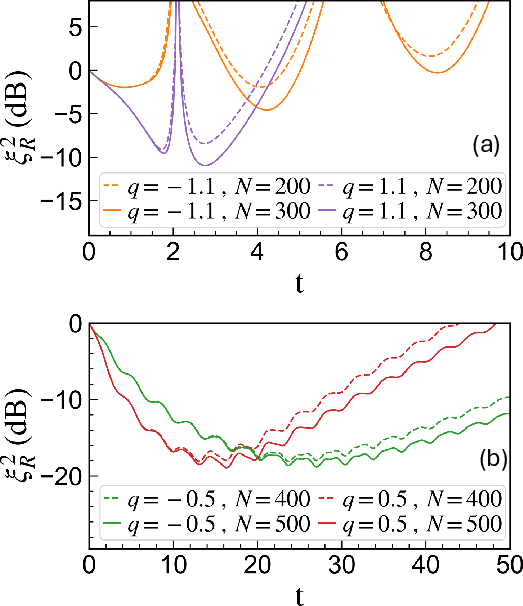
Figure 5: Fine structure in squeezing parameter evolution, highlighting jumps between minima and oscillatory behavior with system size and cH=2NJ2+qm∑m2am†am7.
Implications and Outlook
The study establishes that the quadratic Zeeman shift in spinor BECs serves as a universal, tunable driver for generating scalable spin squeezing and multipartite entanglement. This approach enables robust preparation of metrologically useful states even in large-cH=2NJ2+qm∑m2am†am8 systems, supporting advanced quantum sensing schemes. The freezing mechanism represents a strategic tool for maintaining squeezing during field interrogations. The theoretical predictions are expected to generalize to higher-spin (e.g., cH=2NJ2+qm∑m2am†am9Cr, J20Er, J21Dy) condensates, with the principal requirement being that spin-dependent physics remains dominated by SU(2)-invariant and quadratic Zeeman terms.
Potential future directions include analytical solution of effective Hamiltonians for large J22, exploration of squeezing in more complex interaction topologies, and experimental realization in high-spin atomic condensates with scalable entanglement.
Conclusion
The paper delivers an authoritative analysis of universal spin-squeezing dynamics in spinor condensates, grounded in rigorous analytical and numerical approaches. The results highlight the key role of the quadratic Zeeman shift in entanglement generation, demonstrate OAT-type universal scaling of squeezing, and introduce operational strategies for freezing entangled states. These insights significantly expand the theoretical and practical toolkit for quantum sensing and many-body entanglement engineering in ultracold atomic ensembles (2607.06842).

