- The paper demonstrates the universality of the Collins fragmentation function by comparing TMD-based predictions with STAR data in polarized pp collisions.
- The study employs a hybrid TMD framework that integrates SIDIS and e+e- data, offering a precise channel decomposition for interpreting pion-in-jet observables.
- The analysis shows that quasi-real photon (WW) contributions boost the unpolarized cross section without diluting quark sensitivity, enabling accurate transversity extraction at EIC kinematics.
Collins Effect in Pion-in-Jet Production in Polarized pp and ep Collisions
Overview and Theoretical Framework
The study investigates transverse spin-dependent azimuthal asymmetries in pion-in-jet production in polarized proton-proton (pp) and lepton-proton (ep) collisions, employing a hybrid transverse momentum dependent (TMD) framework. The analysis prioritizes the extraction of the Collins fragmentation function (H1⊥q) and the transversity distribution (h1q) from global fits to semi-inclusive deep inelastic scattering (SIDIS) and e+e− annihilation data. The treatment assumes collinear initial states, emphasizing TMD effects only in the fragmentation sector. This choice is motivated by the energy scales involved: large jet jT (transverse momentum) and small hadron jT, manifesting ordered scales conducive to TMD factorization. The Collins azimuthal asymmetry AUTsin(ϕS−ϕhH) provides direct sensitivity to the convolution of transversity, the polarized partonic cross section, and the Collins FF.
ep0 Collisions: Universality, Factorization, and STAR Data
The analysis for polarized ep1 collisions centers on ep2, focusing on the comparison with STAR data for ep3 and ep4 GeV. Employing the updated parametrizations from [Boglione et al., (Boglione et al., 2024)], the theoretical predictions accurately describe the full ep5 range of the experimental Collins asymmetry, including dependencies on ep6 and ep7 (momentum scale). No evidence for significant factorization-breaking effects is observed; TMD evolution is found to be marginal within the considered kinematics. The most salient result is support for the universality of the Collins function when transitioning between SIDIS/ep8 and hadron-in-jet processes, contrasting with the Sivers function's known process-dependence and sign change.
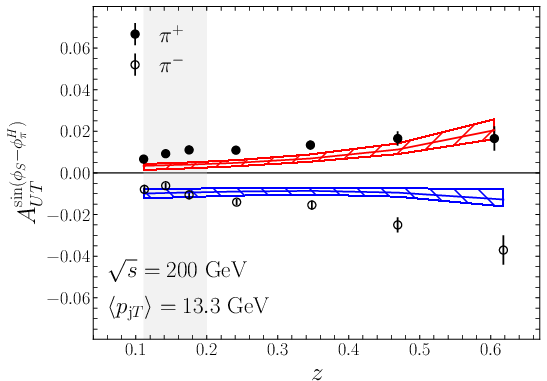

Figure 1: Collins asymmetry ep9 for pp0 as a function of pp1, showing robust agreement between TMD-based postdictions and STAR data at pp2 GeV (left) and pp3 GeV (right).
These findings strengthen the case for jet-based observables in extracting TMDs, especially at large pp4, complementing SIDIS and Drell-Yan analyses.
pp5 Collisions: Electron-Ion Collider Predictions and Channel Decomposition
Extension to polarized pp6 collisions (pp7) elucidates the channel composition and offers theoretically clean access to pp8. At leading order (pp9), only quark-lepton scattering dominates, while gluon contributions remain absent from the numerator of the Collins asymmetry. This feature minimizes dilution by channels insensitive to transversity and simplifies interpretation. Calculations incorporate both LO and Weizsäcker-Williams (WW) approximated quasi-real photon exchange (ep0), opening new channels (e.g., ep1, ep2) in the denominator. Despite sizable WW contributions—enhancing the unpolarized cross section by factors up to 2 in the backward region—the quark-initiated component remains dominant (80–90%), maintaining the effectiveness of the observable.
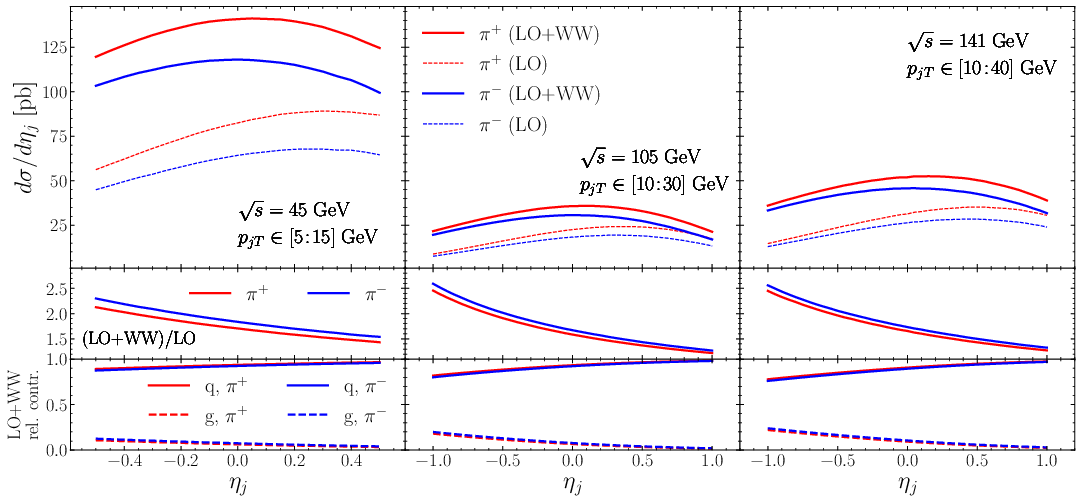
Figure 2: Unpolarized cross sections for ep3 as a function of rapidity for several c.m. energies, comparing LO and LO+WW predictions and the relative quark/gluon contributions.
Notably, WW-induced gluon channels modify the denominator but do not contribute to the numerator, preserving clean sensitivity to ep4 even as the unpolarized cross section increases.
Numerical Results: Asymmetries, Kinematic Dependence, and Sensitivity
Predictions for the EIC kinematics show that the Collins asymmetry is largest in the forward region and for ep5, reflecting the interplay of charge factors, transversity magnitudes, and favored/unfavored FFs. At forward rapidity, asymmetries reach ep6 for ep7 and ep8 for ep9. Inclusion of the WW term suppresses the asymmetry, especially in the forward region, but not sufficiently to challenge the dominance of quark-initiated channels.
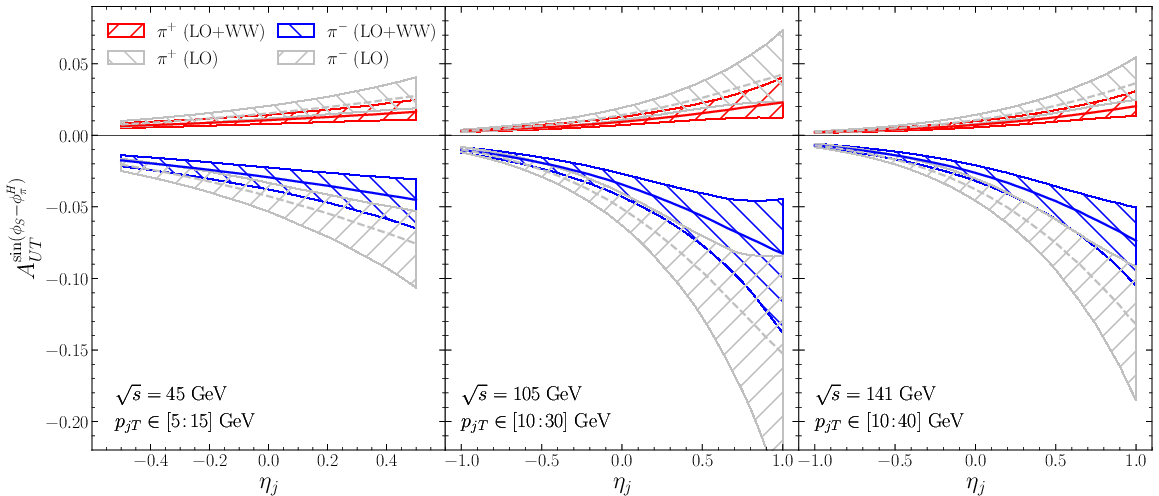
Figure 3: Collins asymmetries for H1⊥q0 as a function of jet rapidity, contrasting LO and LO+WW computations and showing forward/backward asymmetry profiles for varying c.m. energies.
The H1⊥q1-dependence demonstrates distinct behavior: almost flat for H1⊥q2 (H1⊥q32–3\%) and rising for H1⊥q4, peaking at H1⊥q58\% at large H1⊥q6. This reflects up-quark dominance and suppression of the unfavored Collins FF in the H1⊥q7 channel. At large negative pseudorapidity and higher energies, asymmetries are suppressed, exposing sensitivity to sea-quark transversity, not constrained by current data.
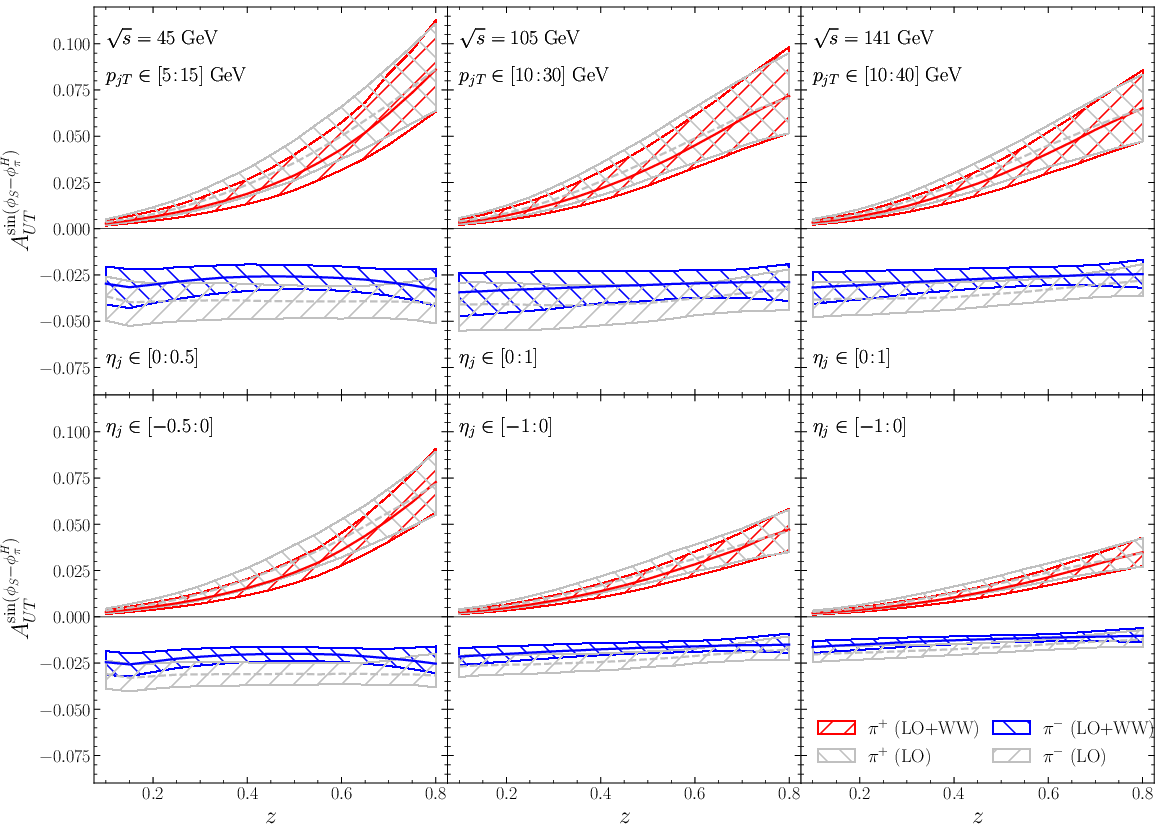
Figure 4: Collins asymmetries for H1⊥q8 versus H1⊥q9 for forward and backward rapidities, highlighting channel-dependent behavior and uncertainty bands.
The predicted signals are larger than in h1q0 collisions, attributable to the negligible gluon role in the numerator and indicate promising opportunities for precision extraction of transversity and validation of TMD factorization.
Implications, Outlook, and Theoretical Significance
The comprehensive study supports the universality of the Collins fragmentation function and the applicability of TMD factorization in pion-in-jet observables across h1q1 and h1q2 processes. The robustness of jet-based measures provides a complementary window for constraining TMDs, especially at large h1q3. The channel decomposition in h1q4 processes, with suppressed gluon contributions, allows for clean extraction of transversity, including the sea-quark component, given suitable experimental reach at the EIC.
The inclusion of WW approximated quasi-real photon exchange is shown to modify the denominator without compromising the dominance of quark-initiated channels in the numerator, validating the continued relevance of asymmetry measures for probing nucleon structure.
Future theoretical developments will target more intricate parametrizations, incorporate TMD evolution effects, and refine the treatment of jet fragmentation at next-to-leading order and beyond. High-precision EIC measurements will facilitate rigorous tests of TMD factorization, universality, and process dependence across a broader range of kinematics.
Conclusion
The paper delivers a detailed theoretical and phenomenological investigation of the Collins effect in pion-in-jet production for polarized h1q5 and h1q6 collisions, providing strong evidence for the universality of the Collins function and establishing the efficacy of jet-based observables for TMD extraction. Quasi-real photon contributions, while numerically significant for unpolarized cross sections, do not impair the dominance of quark channels in asymmetry measures. The presented results underscore the utility of EIC measurements for constraining transversity, particularly the sea-quark sector, and advocate for further refinement of TMD analyses and cross-channel comparisons. The findings reinforce the standing of TMD factorization and motivate targeted experimental efforts in hadron-in-jet production.

