- The paper introduces a new class of codimension-two observables (monodromy defects) in Chern-Simons theory, extending traditional Wilson loop operators.
- It employs twisted affine Lie algebras to compute modular and fusion data, linking algebraic structures to topological invariants and knot theory.
- Holographic duals are realized via orientifold backgrounds in topological strings, providing rigorous tests for symmetry-enriched TQFT and dualities.
Monodromy Defects in Chern-Simons Theory and Holography
Introduction and Motivation
The study of line and defect operators in Chern-Simons (CS) theory has led to major insights in low-dimensional topology, modular tensor categories, topological quantum field theory (TQFT), and the quantum Hall effect. Traditionally, Wilson loop operators, labeled by integrable representations of untwisted affine Lie algebras, have served as the fundamental nonlocal observables in CS theories.
The paper "Monodromy defects in Chern-Simons theory and Holography" (2607.06669) establishes a comprehensive generalization: in CS theories with a nontrivial outer automorphism (charge conjugation symmetry C), there exists a new class of codimension-two observables—monodromy defects—around which fields are twisted by C. These defects are labeled by integrable representations of the corresponding twisted affine Lie algebra. The authors fully characterize the modular and fusion data of these two classes and discover significant implications for both CS theory and its string theory duals.
Algebraic Structure of Defects
The monodromy and Wilson defects together form a Z2-graded crossed braided tensor category C×=C1⊕CC, with modular and fusion data dictated by the interplay between untwisted and twisted affine Kac-Moody algebras (Kac's classification).
- Wilson lines WR: Simple objects of C1; labeled by representations R in Int(gk) for untwisted affine gk.
- Monodromy defects Ma: Simple objects of C0; labeled by C1 in C2 for the twisted affine algebra.
The Hilbert spaces obtained by canonical quantization of CS theory on a torus in the presence of charge conjugation defects are classified according to whether C3-defect lines wrap each cycle:
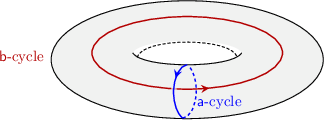
Figure 2: The C4- and C5-cycles of the torus C6, relevant for labeling sectors with (possibly) twisted boundary conditions for current algebras.
The modular C7- and C8-matrices determine correlation functions and quantum dimensions. Notably, expectation values on the C9 are entirely fixed in terms of these matrices:
- For Wilson lines Z20:
Z21
- For monodromy defects Z22:
Z23
The spectrum thus physically realizes all affine Lie algebras in Kac’s classification (untwisted for Wilson loops, twisted for monodromy defects).
Topological String Dualities and Holography
The analysis of the holographic duals is a central achievement. The insertion of monodromy defects in Z24 CS theory has the following dual consequences for A-model topological strings:
- Vacuum monodromy defect: The dual closed string background becomes a specific orientifold of the resolved conifold. Specifically, the background is either Z25 or Z26 orientifold of the resolved conifold, depending on group parities, with Z27 or Z28 orientifold planes respectively:
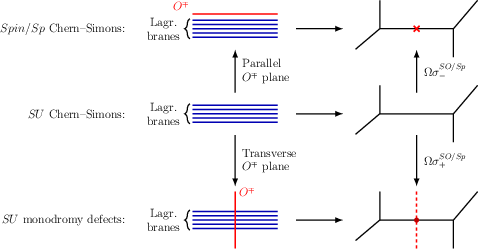
Figure 3: Summary of the two orientifold projections on the deformed and resolved conifold. Z29 introduces an C×=C1⊕CC0-plane parallel to branes (engineering C×=C1⊕CC1 CS theory); C×=C1⊕CC2 introduces an C×=C1⊕CC3-plane transverse to branes, realizing C×=C1⊕CC4-monodromy defects in C×=C1⊕CC5 CS.
- Excited monodromy defects: These are realized as explicit configurations of branes (or antibranes) and their images under the orientifold action, supported on the legs of the toric diagram of the resolved conifold:
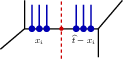
Figure 5: Branes ending on the internal edge at position C×=C1⊕CC6 in the C×=C1⊕CC7 geometry, corresponding to representations with C×=C1⊕CC8 rows of length C×=C1⊕CC9.
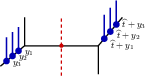
Figure 1: Antibranes ending on the external edge at position WR0 of the WR1 geometry, also mapping to generic representations with WR2 rows of length WR3.
Key features of the duality include:
- The orientifold involutions WR4 have fixed loci; for WR5, the fixed Lagrangian submanifold corresponds to the knot supporting the monodromy defect.
- The brane content specifying an excited defect is in one-to-one correspondence with the highest weight representation WR6 of the relevant twisted affine algebra.
- Detailed WR7-expansion matches on both the gauge and string theory sides confirm the duality at the level of all genus expansions (including both oriented and unoriented string contributions).
Modular and Fusion Data, and Physical Implications
Fusion rules are derived analogously to the Verlinde formula, and the authors provide explicit expressions for all mixed and twisted sector fusion coefficients. The algebraic realization of defect fusion and modular transformations establishes that the full data of the WR8-crossed category is explicitly computable directly from affine Lie algebra representation theory.
Numerical Highlights:
- The vacuum expectation WR9 for the lightest defect is shown to be strictly different from that of the trivial sector, i.e., Wilson loops do not exhaust the space of localizable observables.
- Quantum dimensions C10 of monodromy defects always satisfy C11, confirming their non-Abelian nature.
Contradictory/Strong Claims:
- The insertion of the lightest monodromy defect changes the string dual background from oriented to unoriented strings.
- All twisted affine Kac-Moody algebras in Kac's classification are realized physically as spectra of line defects in CS theory—a strikingly comprehensive statement connecting the full classification of affine algebras to physics.
Theoretical and Practical Implications
This work has several important implications:
- Symmetry-Enriched Topological Phases: The explicit construction serves as a laboratory for symmetry-enriched topological order, with a concrete implementation of C12-enrichment at the level of modular tensor categories.
- Duality Checks: The existence and explicit calculation of new defect observables presents a stringent test for holographic duality and significantly extends the dictionary between CS observables and topological string configurations.
- String Theory Landscapes: The orientifold backgrounds C13 for the resolved conifold acquire fully consistent gauge theory duals for both charge conjugation monodromy and for C14 gauge groups.
- Computation of New Invariants: This framework suggests the natural definition of new knot and link invariants, now refined by both representations and monodromy data.
Open Directions:
- Systematic enumeration of invariants of knots/links decorated by these new defects.
- Extension to monodromy defects associated with quantum symmetries (braided autoequivalences not descending from classical symmetries).
- Closed string (bubbling Calabi-Yau) geometric description of backreacted monodromy defects, analogous to what's available for Wilson lines.
- Generalization to C15 and the analysis of more general three-manifolds.
Conclusion
By extending the class of physical observables in Chern-Simons theory to include monodromy defects labeled by twisted affine algebras, and by providing their holographic dual as orientifold backgrounds in topological string theory, this work offers a rigorous, mathematically controlled, and computationally explicit expansion of topological quantum field theory and its string duals. The modular and fusion algebraic framework enables computation of all correlation functions, and the construction realizes the full roster of affine Kac-Moody algebras in physics. These results open prospects for a deeper understanding of symmetry-enriched TQFT, new knot and link invariants, and further string dualities.