- The paper introduces a spectral DPP framework using eigenfunctions of Laplacian-like operators for geometry-aware sampling.
- It achieves variance decay rates of order n^(-1-1/m), outperforming i.i.d. Monte Carlo by exploiting the intrinsic dimensionality of the data.
- Experimental results on manifolds and graphs validate the theoretical predictions and demonstrate robust performance under density variations.
Fast Determinantal Sampling on General Spaces and Diffusion Geometry
Introduction and Motivation
Determinantal point processes (DPPs) have become a central tool in constructing repulsive, diversity-promoting samplers for numerical integration, minibatch selection, and coreset construction. While DPP-based methods have demonstrated provable advantages over independent sampling in classical Euclidean settings, many datasets are inherently non-Euclidean or have low intrinsic dimension relative to their embedding. Existing DPP quadrature constructions often depend on polynomials or wavelets in ambient Euclidean coordinates, with rates dictated by the ambient dimension, limiting practical efficacy for manifold-structured or graph-structured data.
This work substantially addresses these issues by developing a general, spectral DPP sampling framework applicable to broad classes of spaces—most notably, to compact Riemannian manifolds and data-driven nearest-neighbor graphs—by leveraging diffusion geometry and spectral properties of Laplacian-like operators. Explicit MSE rates are obtained, demonstrating a strict improvement over i.i.d. benchmarks and, notably, an optimal dependence on the intrinsic rather than the ambient dimension.
Spectral DPPs: Construction and Variance Reduction
The foundation of this framework is the construction of projection DPPs using the first n eigenfunctions of a non-negative, self-adjoint Markov generator L, which acts as a Laplacian (or its generalization) with respect to a reference measure μ on a space X. The resulting rank-n kernel Kn(x,y)=∑k=1nϕk(x)ϕk(y) defines a DPP Sn with marginal repulsion properties appropriate to the geometry of X.
A central technical contribution is the establishment of a general master theorem (Theorem 1), which bounds the variance of linear statistics (i.e., empirical sums of test functions) for these spectral DPPs in terms of the decay of eigenvalues of the generator and the regularity of the test function (via a commutator approach and the carré du champ operator). Explicitly, for test functions f with controlled sup-norm and bounded carré du champ, the variance decays as
Var[Sn(f)]≤Cn1−2α/dint,
where L0 is a regularity parameter of the function and L1 is an effective spectral dimension of the underlying space, given by the Weyl asymptotics for L2.
This strictly outperforms i.i.d. rates, achieving MSE rates of order L3 for sufficiently smooth test functions on manifolds and their discrete analogues.
Sampling on Manifolds: Intrinsic Dimensional Dependence
Applying the general results to Monte Carlo integration on compact Riemannian manifolds, the authors use the Laplace–Beltrami operator (possibly drifted by non-uniform density) as L4. The classical pointwise Weyl law for elliptic operators enables control over the eigenvalue counting function, yielding sharp variance decay rates for DPP quadrature nodes constructed from the first L5 manifold eigenfunctions. For Lipschitz test functions, the main result establishes
L6
where L7 is the manifold dimension and L8 depends on geometric data and regularity. This matches, up to multiplicative constants and arbitrarily small exponents, the optimal rates obtained for Euclidean polynomial DPP quadrature—but now with respect to the manifold’s intrinsic dimension, not the ambient dimension.
For DPP-based quadrature estimators with appropriately rescaled importance weights, the root mean-squared error rate is L9, contrasting with the μ0 i.i.d. Monte Carlo rate and establishing the efficacy of spectral DPP sampling on general manifolds.
Minibatch Sampling on Data-Driven Graphs
For empirical sampling scenarios where the underlying manifold and density are unobserved and only a finite data cloud μ1 is available, the paper constructs neighborhood graphs (either μ2-graphs or μ3-nearest neighbor graphs) and uses the (normalized or unnormalized) graph Laplacian as the discretized generator.
By leveraging recent advances in spectral convergence theory for graph Laplacians—which guarantee, under regularity conditions and suitable scaling, that the graph spectrum converges to the corresponding continuous Laplacian spectrum—the authors transfer the variance-reduction guarantees of spectral DPPs to the graph setting. Crucially, a non-asymptotic high-probability analysis shows that the DPP variance decays as μ4, up to logarithmic correction factors, where μ5 is the intrinsic manifold dimension underlying the dataset.
This result validates the practical superiority of graph-spectral DPP minibatch selection over uniform subsampling for large-scale learning tasks, especially when the data are concentrated near low-dimensional structures in high-dimensional ambient spaces.
Experimental Verification
Empirical results conducted on synthetic datasets with known manifold structure (the circle μ6 and the sphere μ7) robustly corroborate the theoretical rates. For both uniform and non-uniform sampling densities, the observed variance decay in DPP quadrature is in precise alignment with theoretical predictions: μ8 on the circle and μ9 on the sphere for Lipschitz functions (Figure 1).
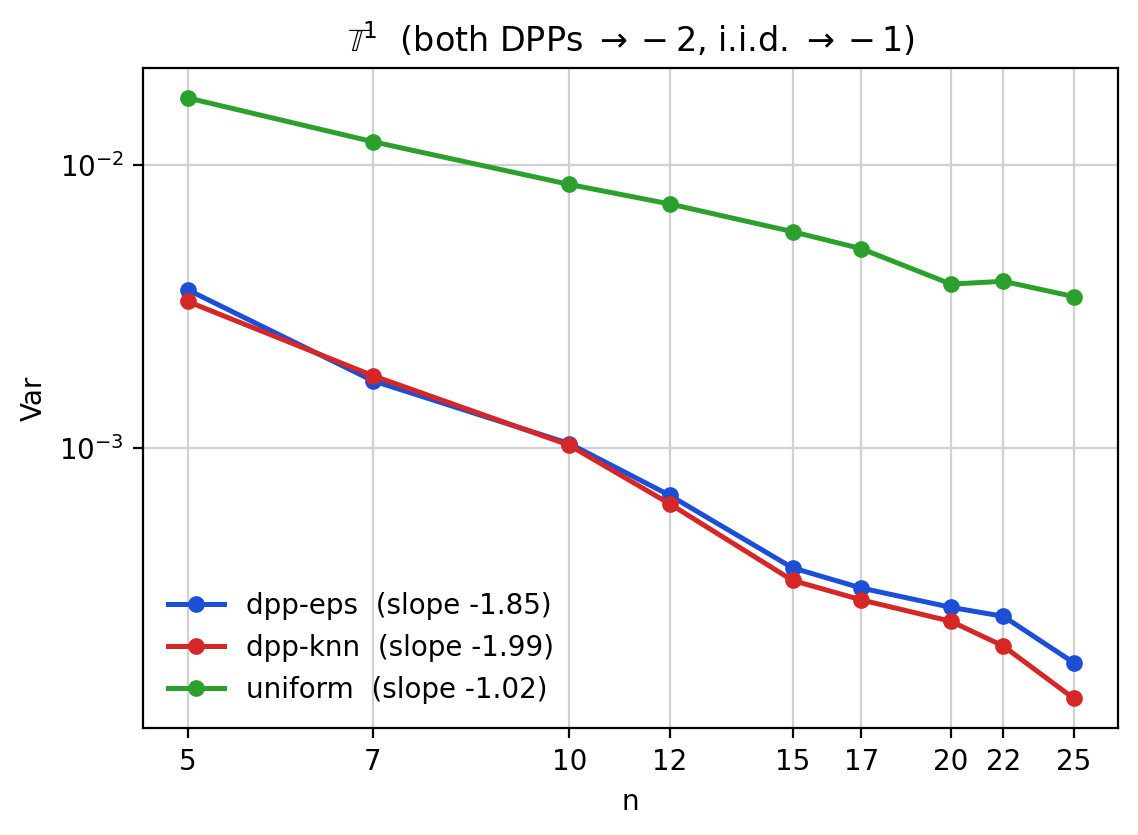
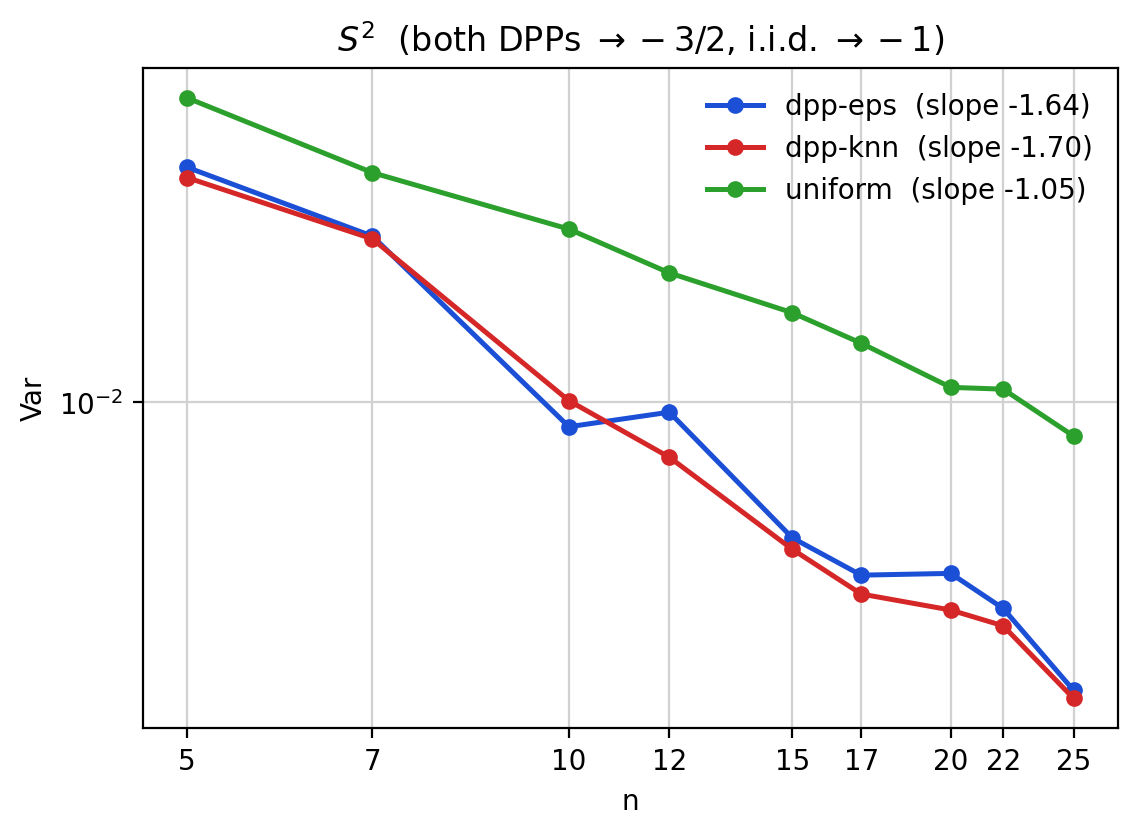
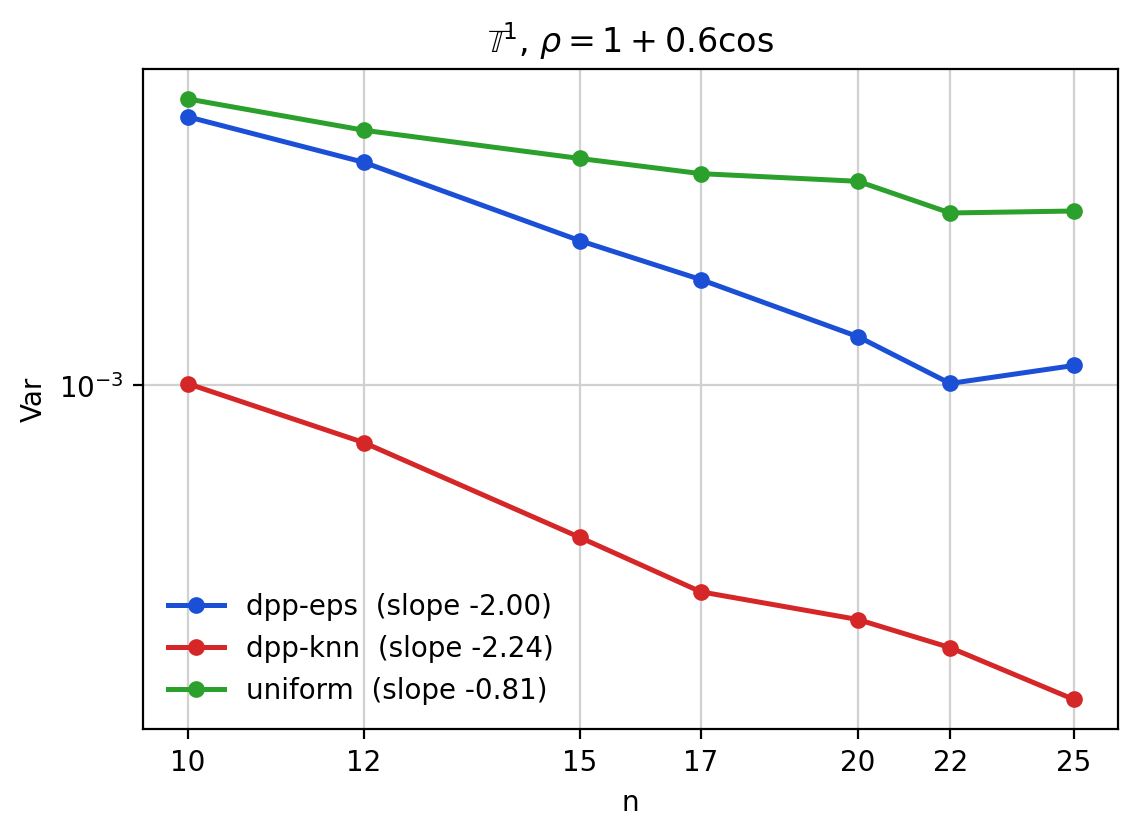
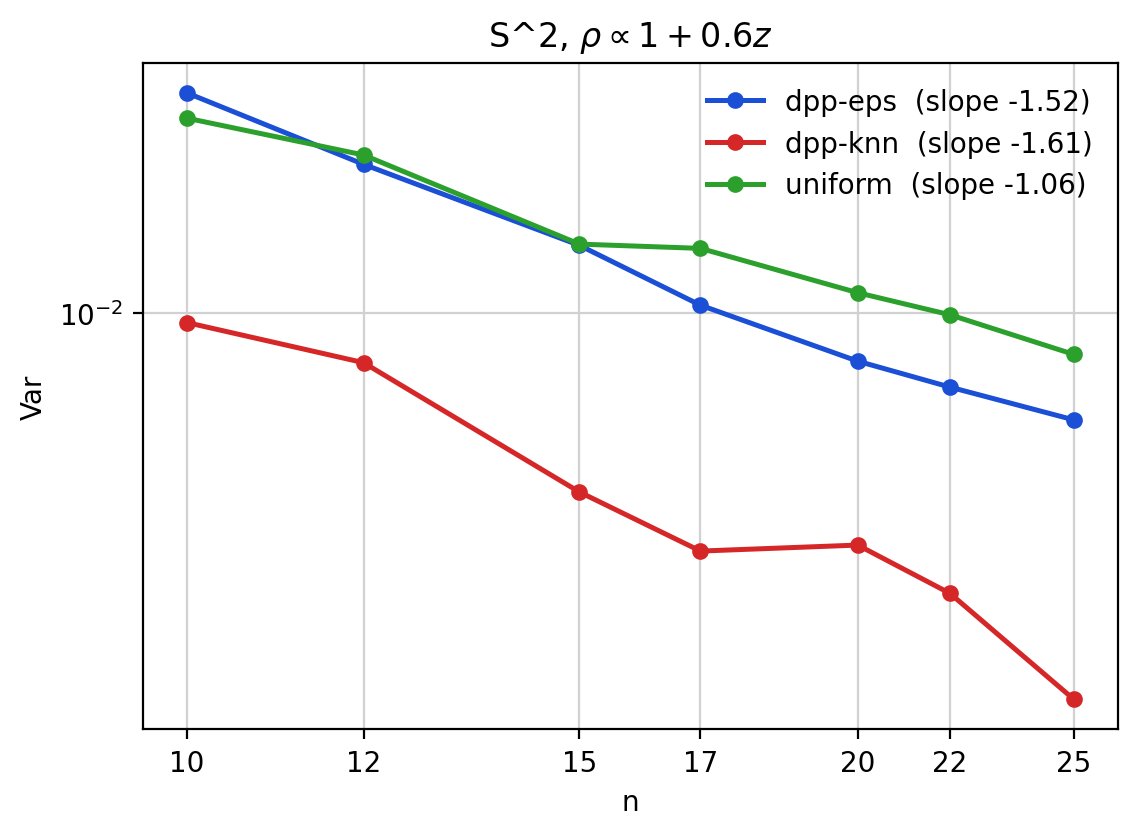
Figure 1: Variance decay for DPP-based quadrature on the circle with uniform measure empirically matches the predicted X0 rate, illustrating the correspondence with the intrinsic dimension.
Sensitivity of the variance constants to non-uniform densities is further assessed. It is observed that for X1-NN graph DPPs, the variance constant remains stable as the density parameter varies, whereas the variance constant for X2-graph DPPs is more sensitive to density inhomogeneities (Figure 2). This highlights the stabilizing effect of graph construction choices on DPP performance.
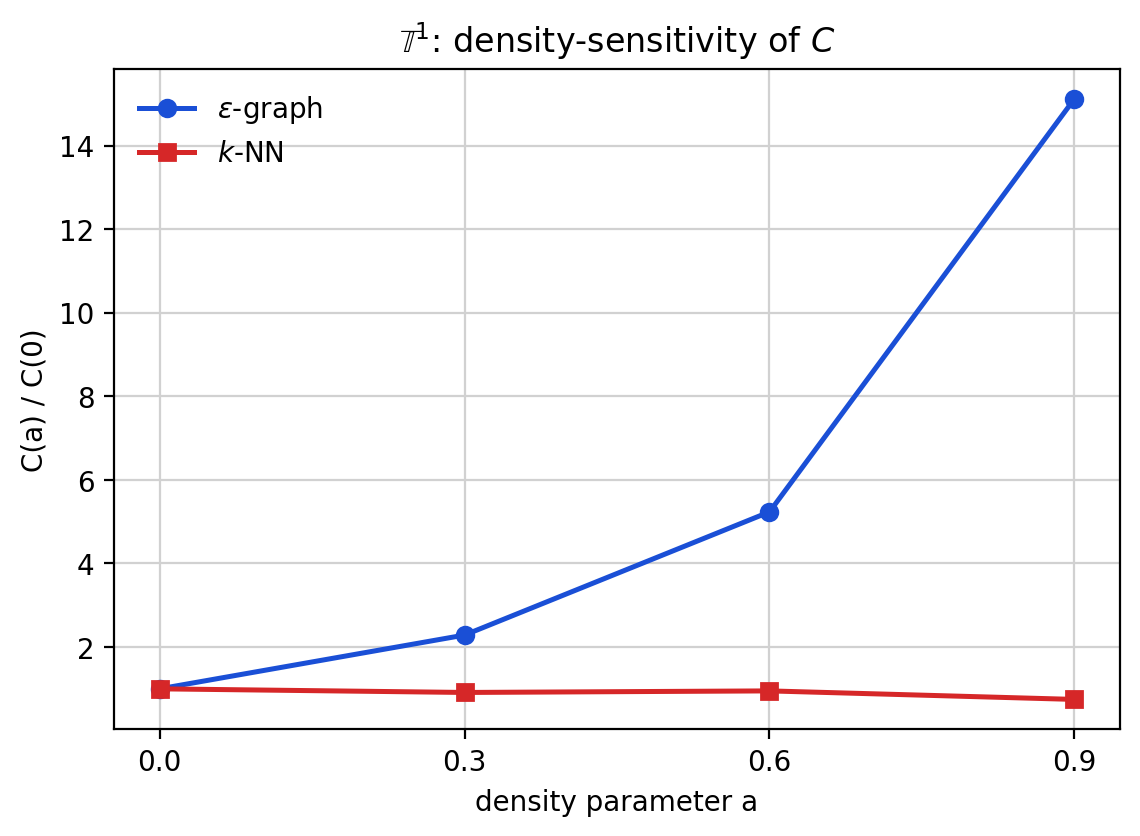
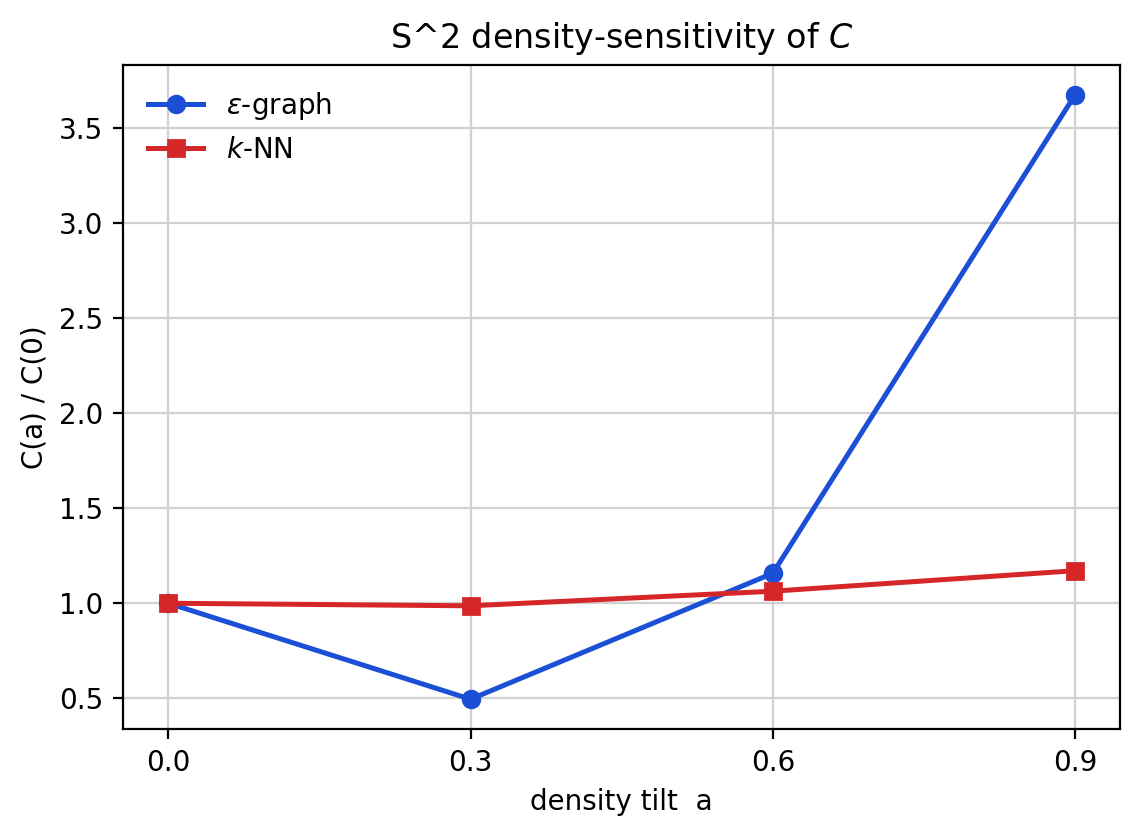
Figure 2: Density-sensitivity of DPP variance on the circle, showing that X3-NN graph DPPs have robust variance constants relative to density perturbations, while X4-graph DPPs remain sensitive.
Theoretical Implications and Extensions
The developed framework unifies the treatment of DPP sampling on both continuous and discrete geometric domains, providing a principled path from intrinsic geometry (via diffusion operators) to variance control in sampling schemes. The results confirm that the improved rates for DPP sampling do not merely depend on peculiarities of Euclidean geometry or polynomial bases, but are fundamentally linked to spectral properties of the underlying space.
This work opens avenues for further extensions:
- Adaptation to anisotropic or heterogeneous manifolds, leveraging different classes of differential operators.
- Extension to non-Lipschitz or rough functions using fractional Sobolev regularity, with variance rates interpolating accordingly.
- Deployment in scalable, distributed graph-structured learning scenarios, by exploiting sparsity and local spectral properties.
- Study of DPP sampling under non-trivial topologies, boundaries, or singularities, with a focus on robustness and finite-sample rates.
Additionally, the methodology is relevant for AI systems operating on non-Euclidean data, e.g., in geometric deep learning, graph representation learning, or model reduction on complex domains.
Conclusion
This paper provides a comprehensive, technically robust advancement of DPP-based sampling for quadrature and minibatch selection, establishing spectral, geometry-aware variance guarantees that depend optimally on the intrinsic structure of the data domain. The main theoretical contributions are strongly supported by numerical evidence, and the developed framework is broadly applicable in areas where geometric regularity and computational efficiency in sampling are vital.
Key Claims and Numerical Highlights:
- For compact X5-dimensional manifolds, DPP quadrature achieves MSE rates X6 for Lipschitz functions, matching Euclidean optimality but with respect to the manifold dimension.
- Graph-spectral DPP minibatch selection yields empirical variances decaying as X7 for data clouds, validated numerically on canonical examples.
- X8-NN graph DPPs are shown to be robust to density variations of the data—an important property for practical deployment.
These results strongly support further adoption of spectral and diffusion geometry-based DPPs in geometric and graph-based machine learning, stochastic numerics, and algorithmic development for high-dimensional, structured data analysis.
Reference:
"Fast determinantal sampling on general spaces and diffusion geometry" (2607.06644)