- The paper introduces the Graph Fractional Fourier Transform (GFRFT) that interpolates between vertex and spectral domains for tunable signal localization.
- It establishes generalized uncertainty principles using operator-based localization, highlighting trade-offs in joint energy concentration.
- Numerical experiments and spectral analyses validate the framework’s potential for improved graph signal representation and adaptive filter design.
Introduction and Motivation
The paper "Spectral Graph Uncertainty Principles via the Graph Fractional Fourier Transform" (2607.06574) addresses a fundamental extension of uncertainty principles in graph signal processing (GSP) by developing a fractional generalization in the spectral graph domain. While classical GSP uncertainty relations focus on the trade-off between localization of signals on a graph’s vertices and their localization in the graph spectral domain (typically set by the Graph Fourier Transform, GFT), this work introduces and analyzes uncertainty principles in the graph fractional Fourier transform (GFRFT) domain. This extension enables a tunable interpolation between the canonical vertex and spectral (GFT) domains, providing a continuous family of spectral representations for graph signals and revealing new localization trade-offs that go beyond classical scenarios.
The conceptual advance is grounded in the operator-theoretic perspective: localization is codified via Hermitian operators (vertex and spectral filters), and uncertainty is connected to the joint concentration of energy as quantified by these operators and their compositions. The framework further incorporates geometric and numerical-range analyses to describe feasible localization regimes.
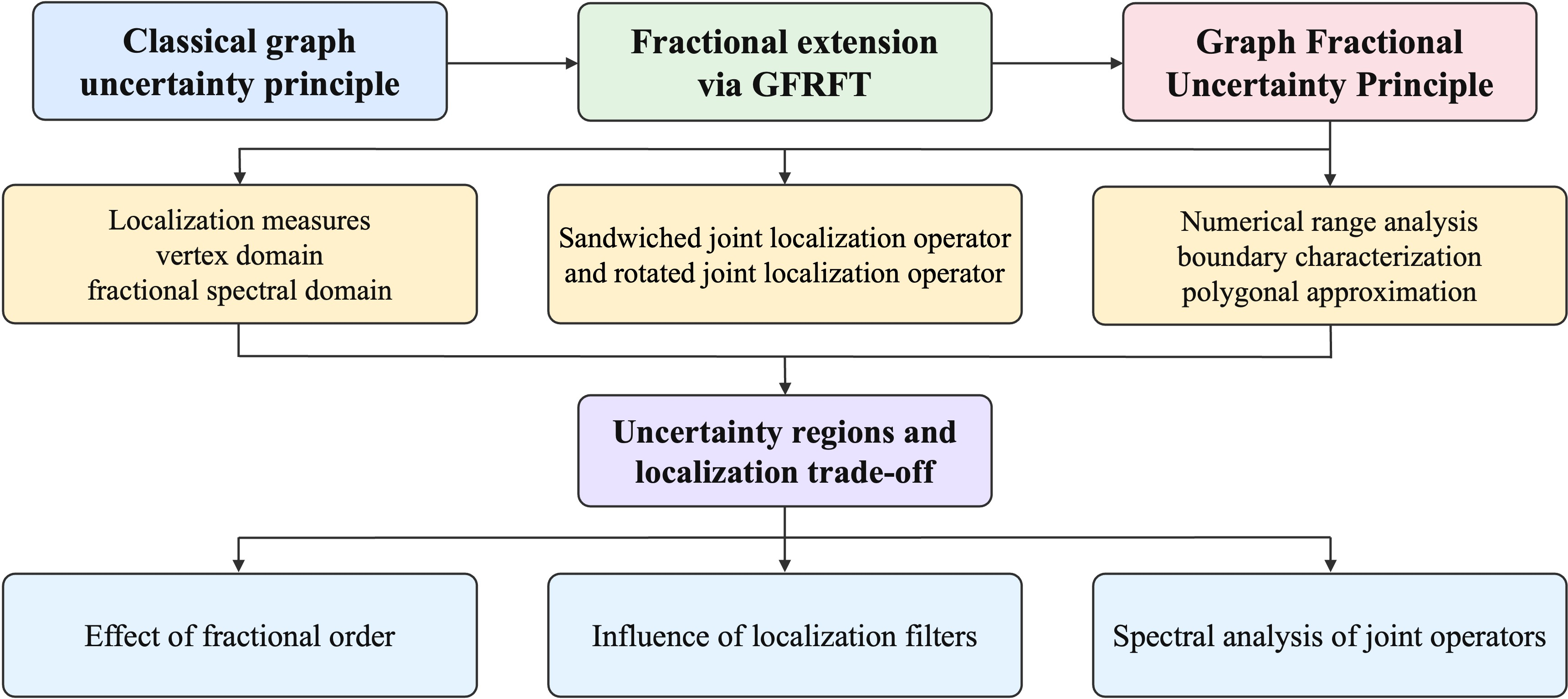
Figure 1: Overview of the proposed graph fractional uncertainty principle framework and its applications.
The GFRFT provides a continuous generalization of the GFT by introducing a fractional order parameter α. Given an undirected graph with Laplacian L and its eigendecomposition, the GFT of a signal is expressed in its Laplacian eigenvector basis. The GFRFT constructs a unitary transform Fα that interpolates between the identity (α=0, pure vertex domain), the GFT (α=1, classical graph spectral domain), and other fractional spectral domains specified by α∈R.
For any α, a graph signal x is mapped to its fractional spectral representation x^=Fαx, with the structure of Fα determined via functional calculus on the Laplacian spectrum or by operator exponentiation. This fractionalization enables the creation of spectral domains that support flexible and tunable localization properties, affecting how energy is distributed and concentrated within vertex and spectral subspaces.
Operator-Based Localization and Uncertainty Measures
The manuscript introduces vertex-domain and fractional spectral-domain localization operators, L0 and L1 respectively, associated with properly normalized filters L2 and L3. These operators act as projectors or soft masks, enabling a flexible quantification of localization (energy concentration) within prescribed vertex or spectral regions/subsets.
The joint localization of a graph signal is characterized using two complementary approaches:
- Sandwiched Joint Localization Operator: The operator L4 quantifies the maximum attainable joint concentration via its largest eigenvalue. A tight upper bound for simultaneous localization in both vertex and fractional spectral domains is established, and the admissible region of L5 pairs (vertex and spectral quadratic forms) is described.
- Rotated Operator and Numerical Range: The operator L6 provides a geometric representation of the admissible localization region as the intersection of half-planes defined by the numerical range, with boundary-supporting lines induced by the maximal eigenvalues for varying L7. This approach encapsulates the uncertainty region as a convex set and admits efficient polygonal numerical approximations.
Main Theoretical Results and Analysis
- Generalized Uncertainty Principle: The paper derives a necessary constraint on simultaneous localization, parameterized by the maximal eigenvalue L8 of the sandwiched joint operator. For any normalized signal, if L9, then the localization measures Fα0 and Fα1 satisfy
Fα2
and equivalently,
Fα3
This generalizes energy-concentration-based uncertainty principles to the GFRFT domain.
- Region Geometry and Computational Approach: Through the rotated operator and the numerical range convexity, the boundary of the admissible region is realized by eigenvectors corresponding to maximal eigenvalues for a family of trade-off operators indexed by angle Fα4. A polygonal numerical scheme enables efficient computation and visualization of the achievable region for arbitrary fractional orders and filter choices.
- Perfect Joint Localization: The paper identifies scenarios (Fα5) where perfect localization is possible—a phenomenon absent in classical time-frequency analysis but feasible in certain graph configurations—emphasizing the structural distinctions induced by the graph topology and filter supports.
Numerical Experiments and Empirical Insights
A series of numerical demonstrations elucidate how the fractional order Fα6 and the choice of vertex/spectral filters reshape the uncertainty regions for diverse graph topologies.
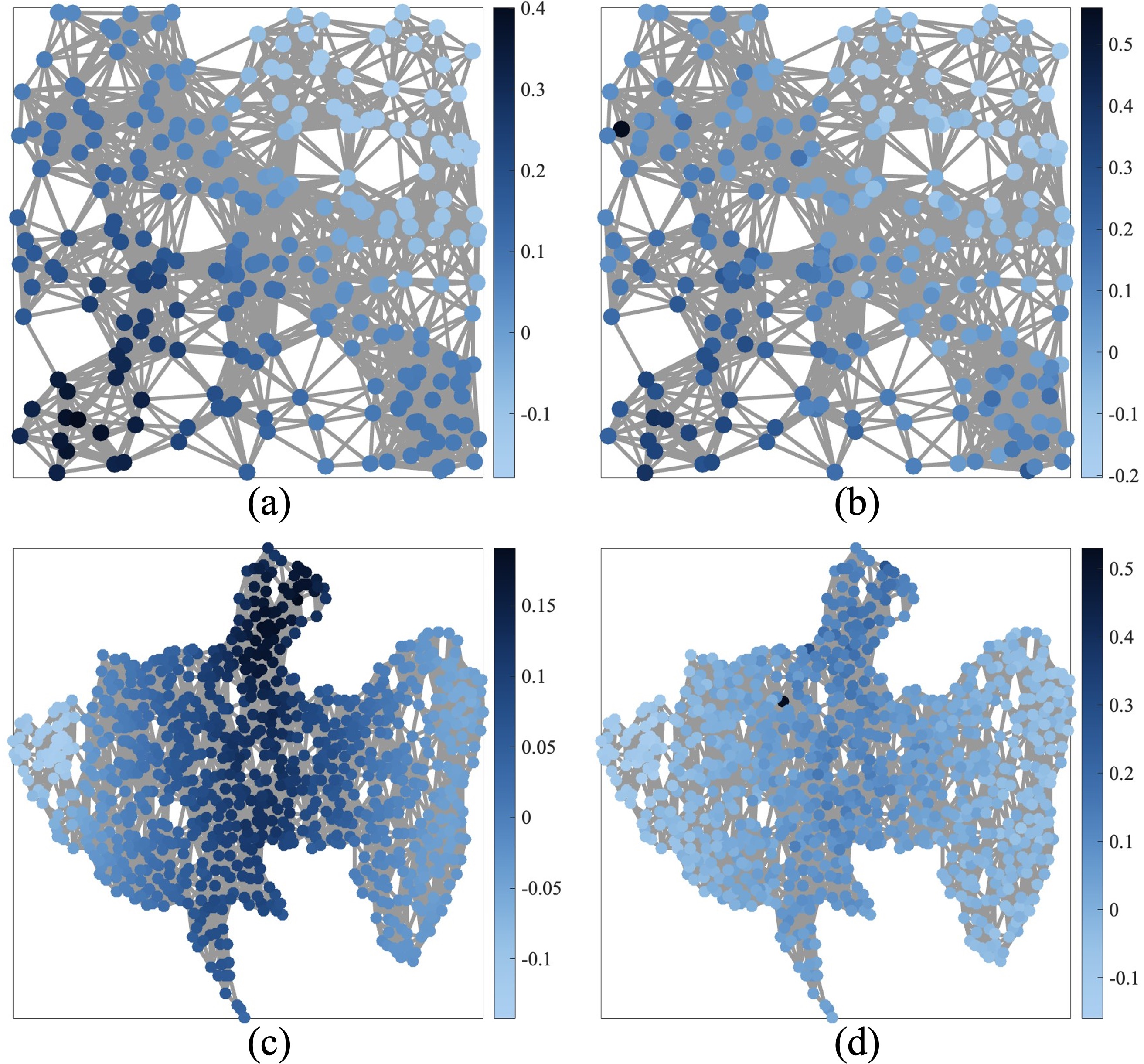
Figure 2: Representative GFT and GFRFT signals: (a) Erdős–Rényi GFT, (b) Erdős–Rényi GFRFT, (c) guppy GFT, (d) guppy GFRFT.
- Basis Modification by Fractional Order: Varying Fα7 significantly alters the spatial distribution of graph spectral atoms. The GFRFT basis offers a continuous family of signal atoms with diverse localization profiles in both vertex and spectral domains.
- Trade-off Geometry Alteration: For Erdős–Rényi and guppy graphs, increasing the fractional order can either contract or expand the attainable joint localization region, depending on the graph and the filter types.
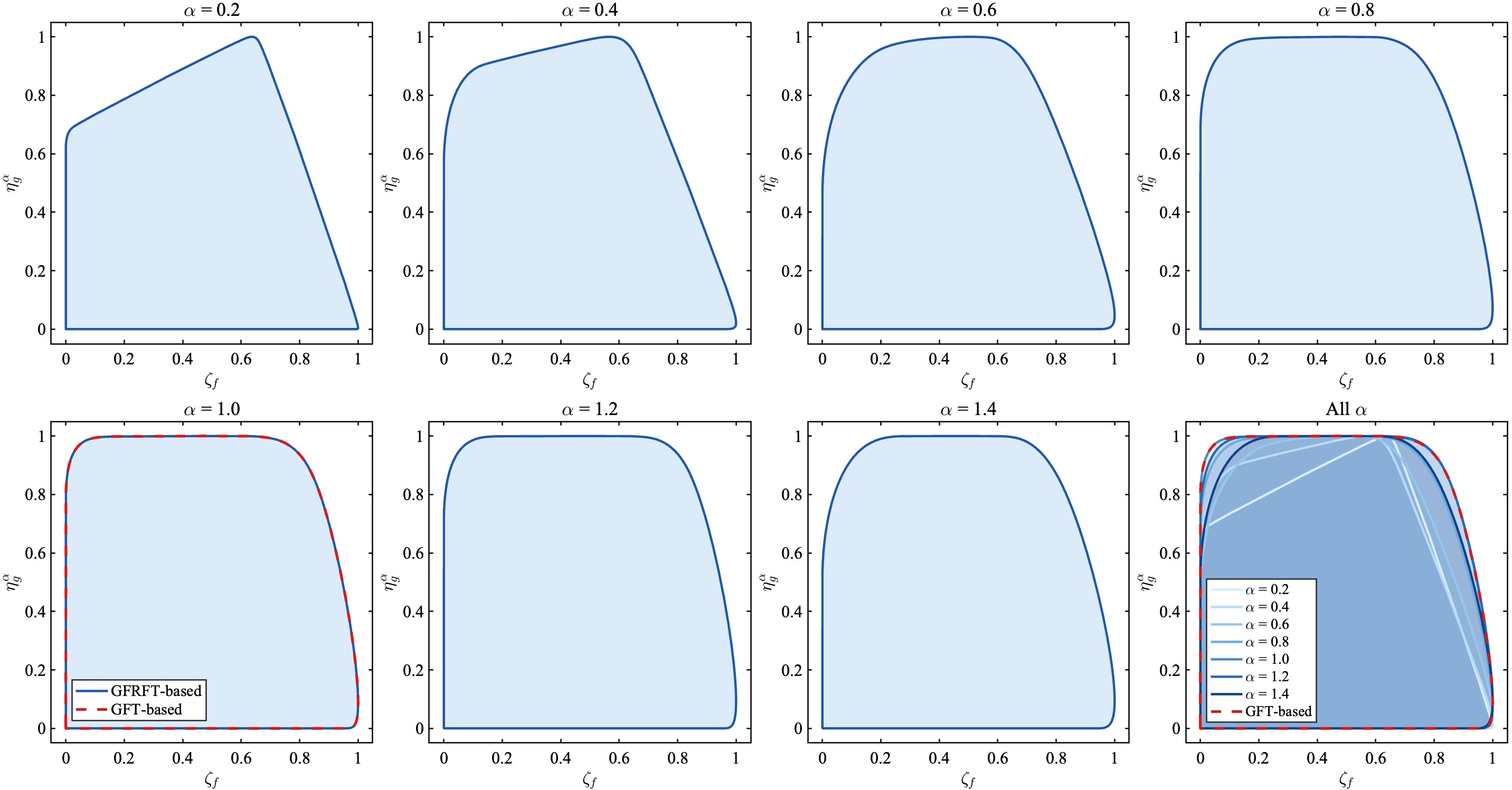
Figure 3: Effect of the fractional order Fα8 on the uncertainty regions for the Erdős–Rényi graph.
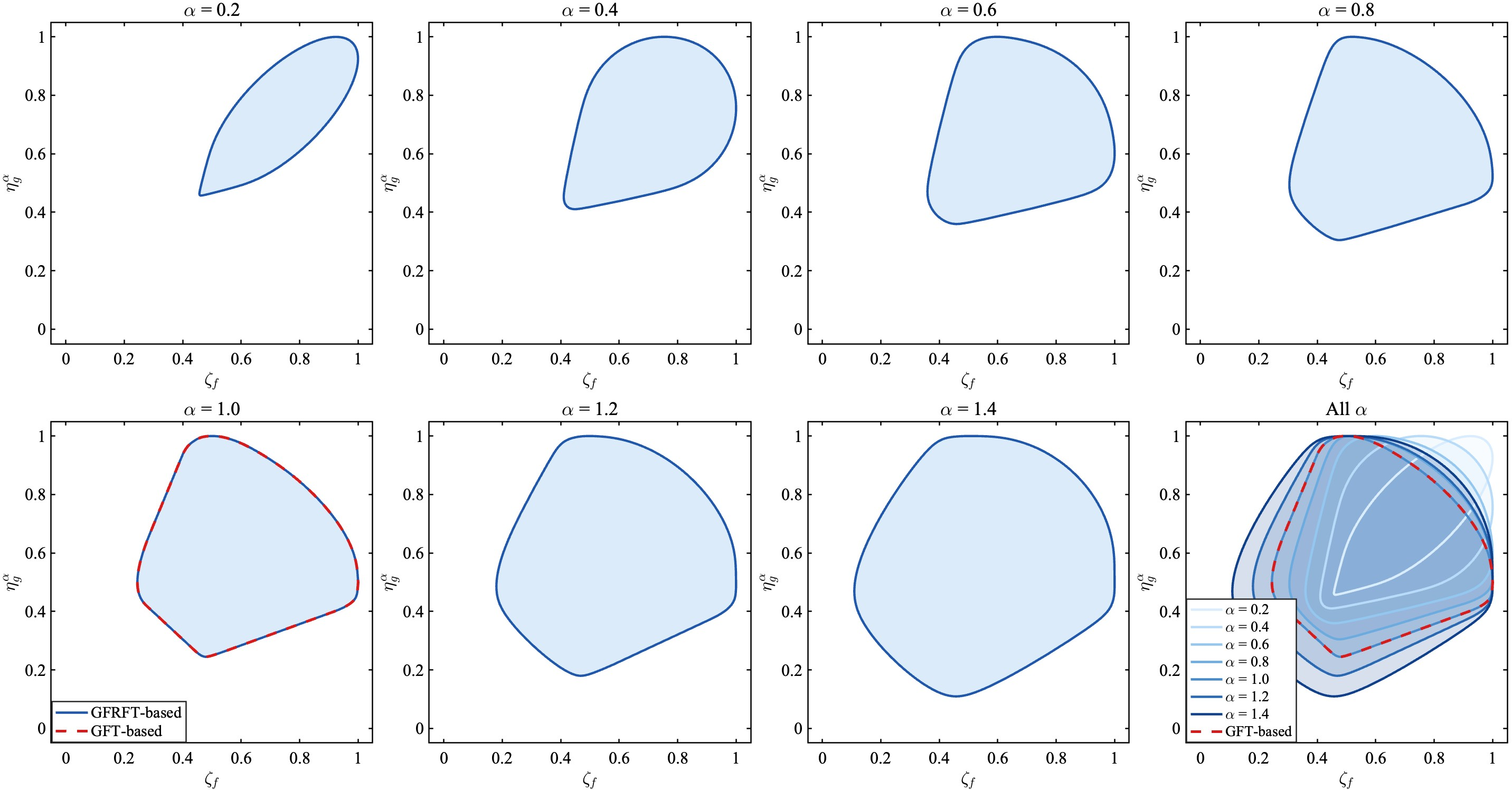
Figure 4: Effect of the fractional order Fα9 on the uncertainty regions for the guppy graph.
- Influence of Operator Structure: The selection of α=00 and α=01 (hard/soft masks, distance-based, spectral spread, etc.) fundamentally changes both the structure and tightness of the uncertainty region.
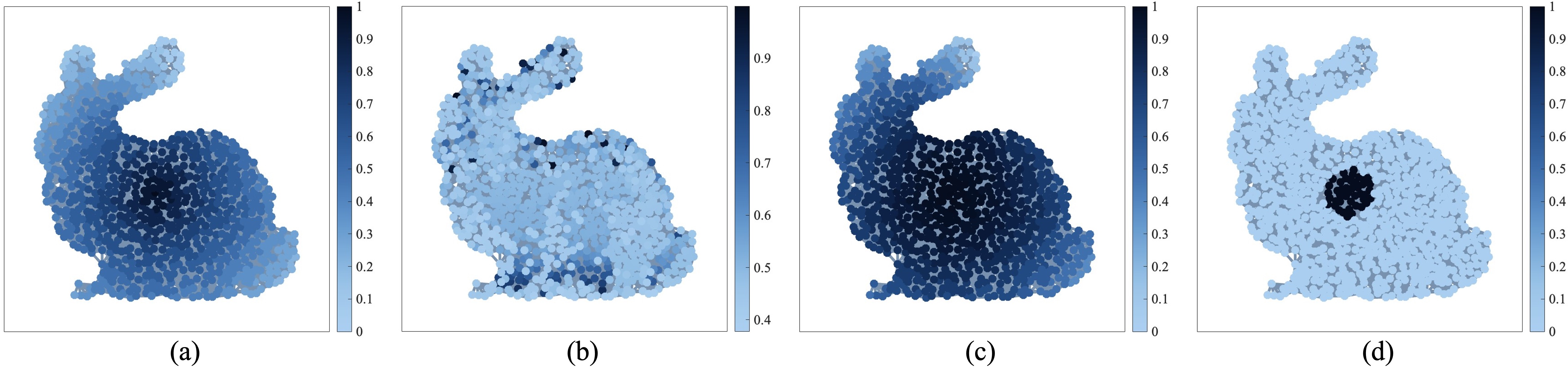
Figure 5: Vertex-domain filter signals α=02 for four localization examples on the bunny graph.
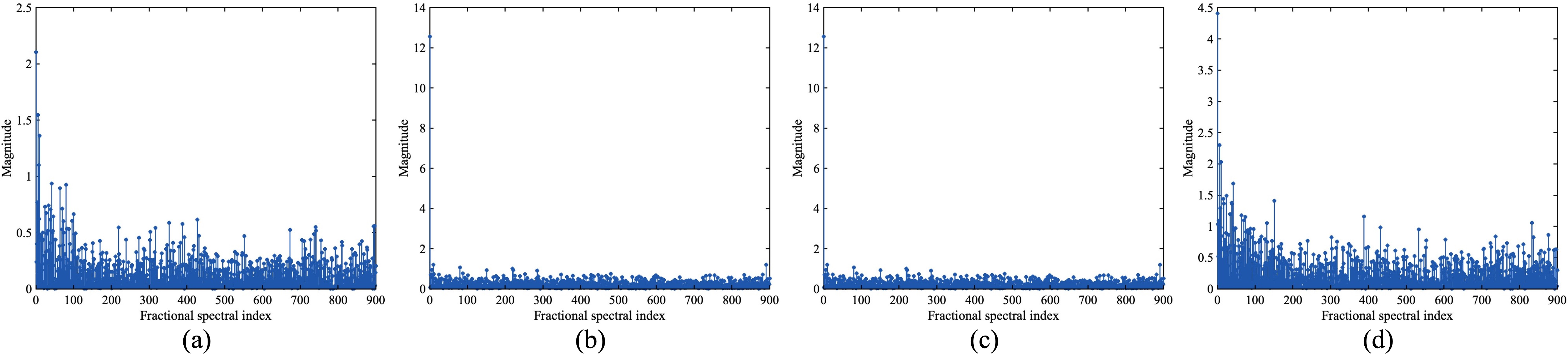
Figure 6: GFRFT-based spectral representations α=03 of the four spectral filters on the bunny graph.
- Atom Distribution and Boundary Characteristics: Internal points, corresponding to the leading joint-localized eigenvectors, are situated relative to the admissible region’s boundary, highlighting the attainable concentration structures under fixed operator parameters.
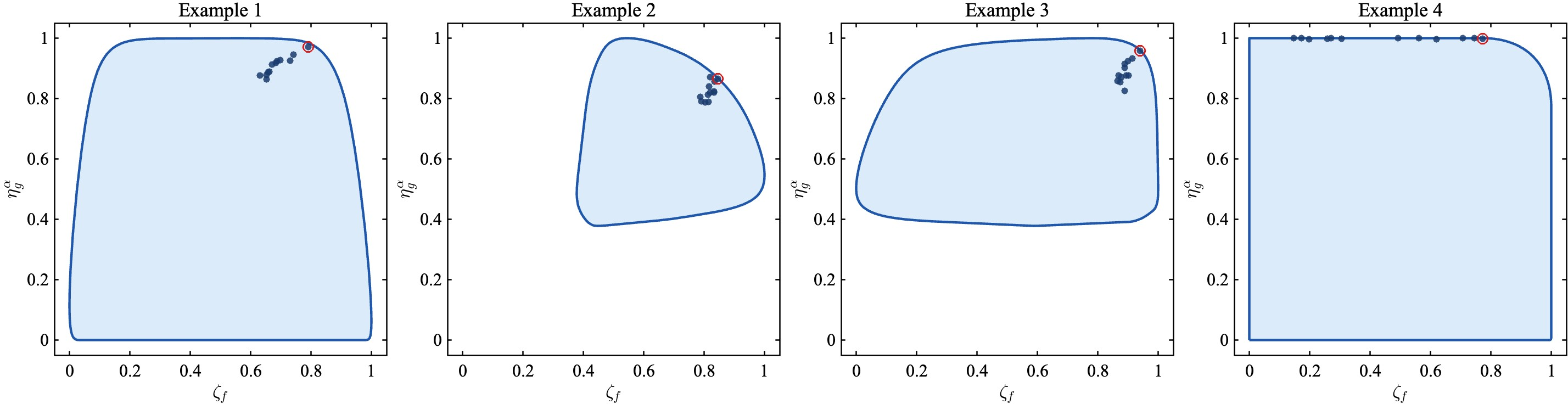
Figure 7: Uncertainty regions for four localization examples on the bunny graph. The internal dots indicate leading vertex-fractional spectral atoms, and the ringed dot marks the dominant atom.
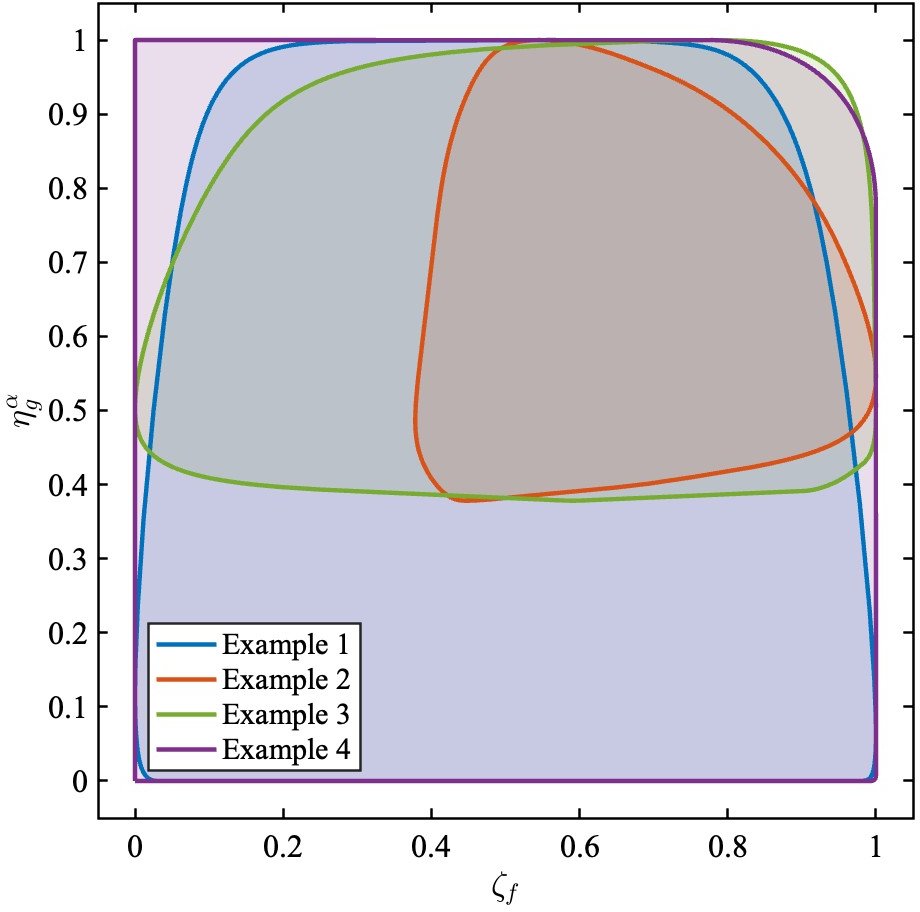
Figure 8: Overlay of the four uncertainty regions on the bunny graph.
- Spectral Properties of Joint Operators: The eigenvalue spectra of α=04 and α=05 demonstrate how both α=06 and α=07 (the rotation/tradeoff parameter) impact joint localization properties and the approximation capabilities via dominant eigenvector decomposition.
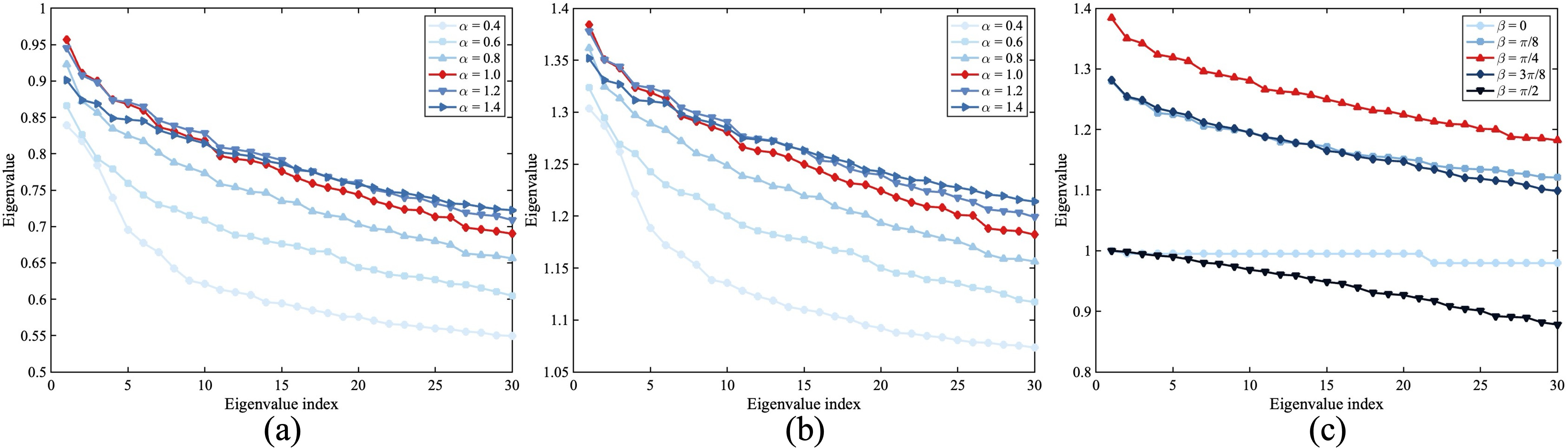
Figure 9: Spectral analysis of the joint localization operators on the bunny graph. (a) Eigenvalue decay of the sandwiched operator α=08 for different fractional orders. (b) Eigenvalue decay of α=09 for different fractional orders at fixed α=10. (c) Eigenvalue decay of the rotated operator α=11 for different rotation angles at fixed α=12.
Implications, Theoretical and Practical
The operator-theoretic and geometric framework of GFRFT-based uncertainty principles enriches the analytical toolkit of spectral graph theory and GSP. Notable implications include:
- Adaptivity and Flexibility: The fractional parameter α=13 provides a tunable knob to interpolate and adapt spectral representations, offering finer control for applications that require balancing vertex and spectral concentration, or for graph signals with chirp-like or highly nonstationary features.
- Enhanced Graph-Adapted Designs: The framework supports the design of new classes of localization-promoting filters, frames, and dictionaries that are sensitive to both graph structure and task-specific localization requirements.
- Theoretical Generalization: This work bridges uncertainty principles known for GFT with those arising under more general graph spectral operators, establishing results that are also valid for extended transforms like the Graph Linear Canonical Transform and joint time-vertex analyses.
- Efficient Approximation and Representation: The spectral properties of the joint operators determine the feasibility and performance of sparse or adaptive signal representations—critical for both inference and sampling/reconstruction in graph-based systems.
- Potential for Non-Euclidean Signal Analysis: The results pave the way for advanced GSP applications in networks, point clouds, and manifold-embedded data, where standard Euclidean uncertainty principles are insufficient.
Future Directions
Potential future research avenues include:
- Extending these principles to directed graphs and hypergraphs.
- Characterizing exact phase transitions/thresholds for perfect localization in structured graphs.
- Developing algorithmic schemes for dictionary learning, sampling, and optimal filtering within the GFRFT domain.
- Translating these results to applications in semi-supervised learning, community detection, and adaptive sensor network design on graphs.
Conclusion
This work synthesizes localization operator theory, spectral analysis, and geometric numerical-range frameworks to establish and analyze GFRFT-based uncertainty principles for graph signals. The results generalize and extend classical GFT uncertainty relations, enabling a continuously tunable interplay between vertex and spectral localization. The proposed theory and numerical methodologies provide robust analytical and practical tools, opening new directions for advancing signal processing on complex graph domains.