- The paper presents an unsupervised domain adaptation pipeline that uses style transfer to tackle calcification classification challenges across multi-site mammography datasets.
- It evaluates CycleGAN and AdaIN for style transfer, finding that CycleGAN better preserves calcification morphology and minimizes artifact generation.
- External validation showed AUC improvements from 0.68 to 0.73, underscoring the clinical relevance of robust domain adaptation in computer-aided diagnosis.
Unsupervised Domain Adaptation for Calcification Classification in Mammography Across Multi-Site Datasets
Problem Definition and Motivation
The challenge addressed in "Unsupervised Domain Adaptation for Calcification Classification in Mammography Across Multi-Site Datasets" (2607.06549) centers on mitigating the domain shift inherent to multi-site mammography analysis. CAD systems leveraging deep learning have demonstrated robust performance in mammogram lesion classification; however, when deployed across datasets originating from different institutions, vendors, imaging protocols, and patient populations, substantial performance degradation can be observed due to these domain shifts. Calcifications, an important but under-studied lesion subtype, exacerbate this problem given their morphological variability and scarcity in existing datasets.
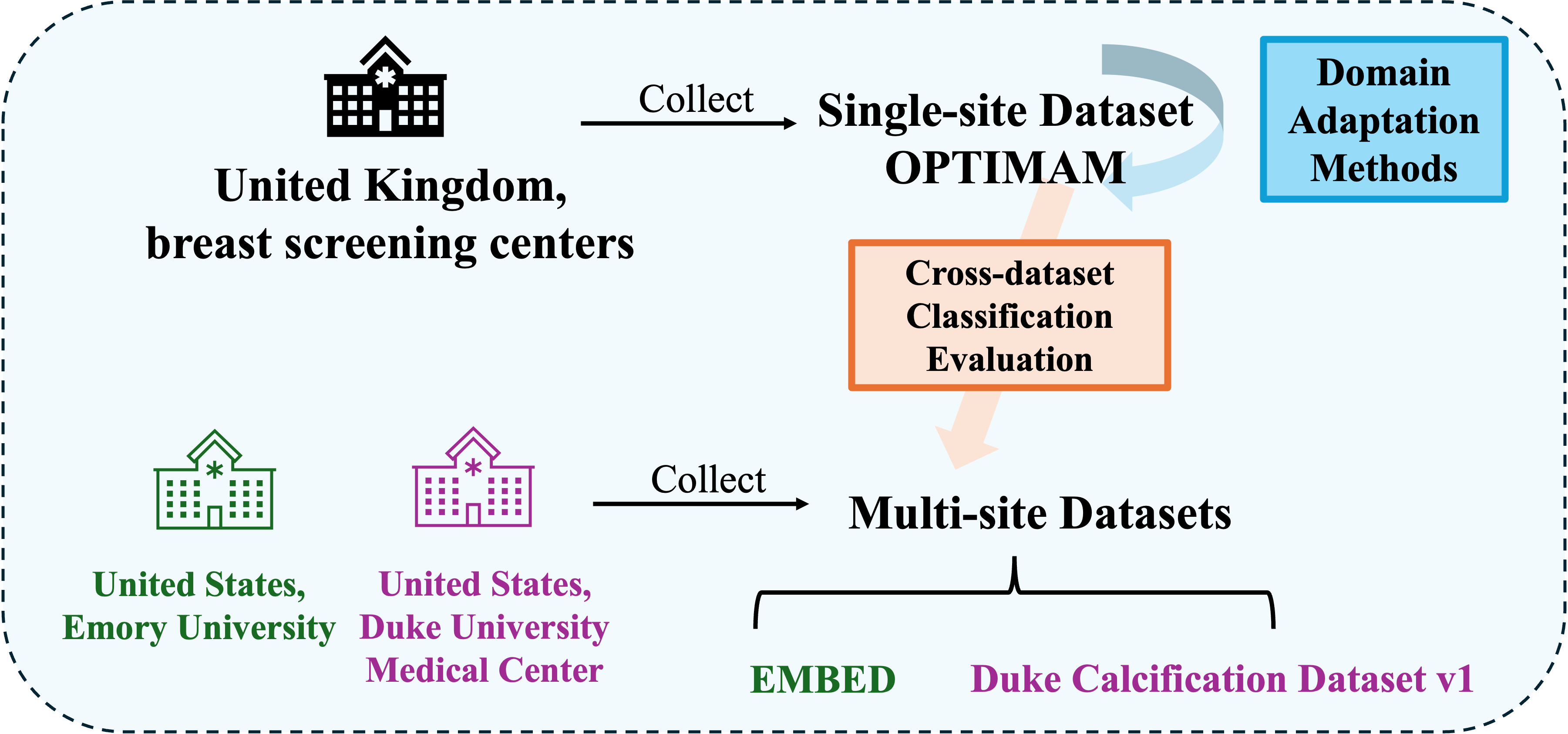
Figure 1: Illustration of single-site and multi-site dataset settings and domain adaptation across institutions.
Dataset Heterogeneity and Domain Shifts
The work systematically identifies and characterizes the sources of domain shifts, including hardware variations (different scanner manufacturers: GE, Hologic), imaging technique differences (FFDM vs. synthetic 2D from tomosynthesis), annotation variability, patient cohort demography, and acquisition protocol disparities.
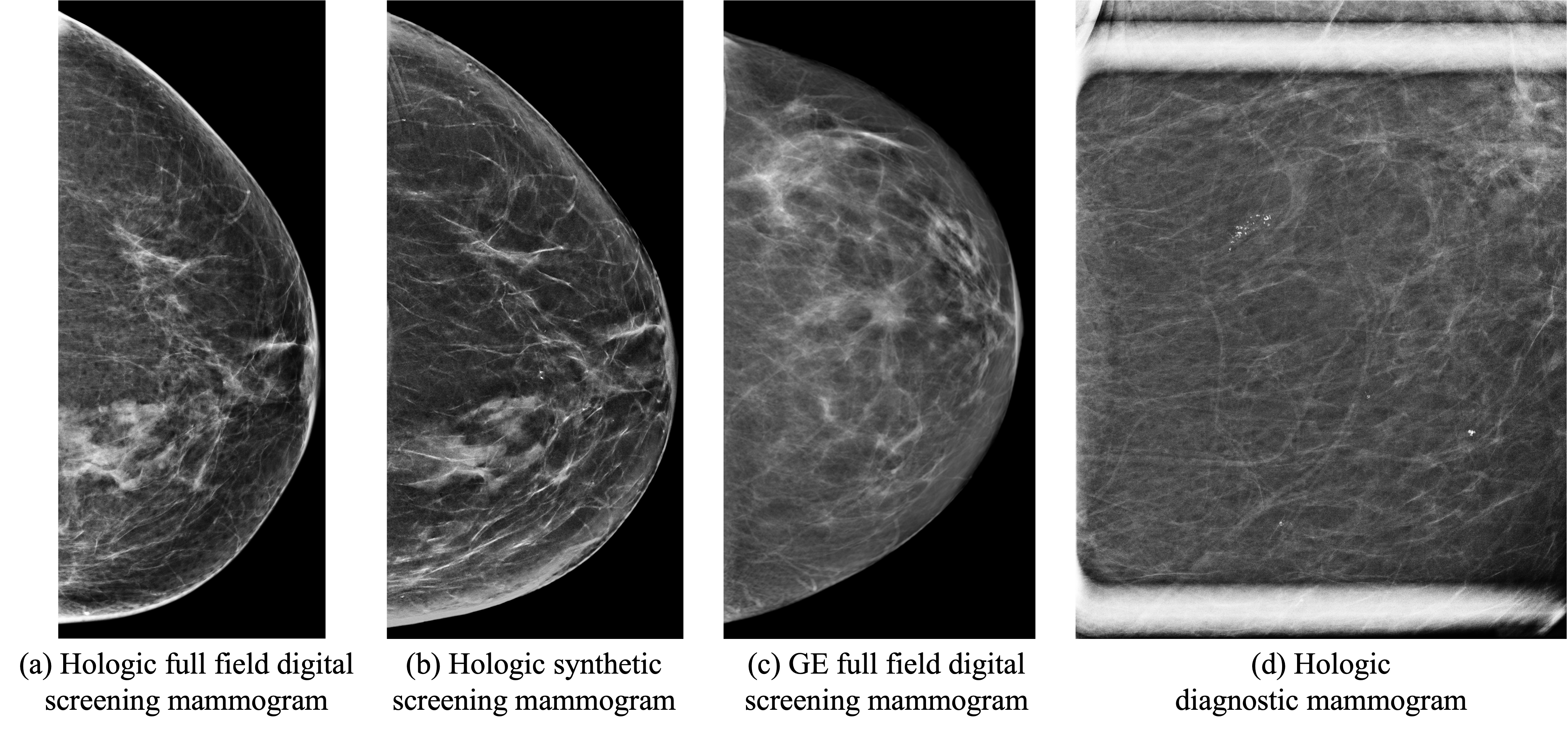
Figure 2: Representative examples of mammograms from different scanner vendors (GE and Hologic) and acquisition techniques.
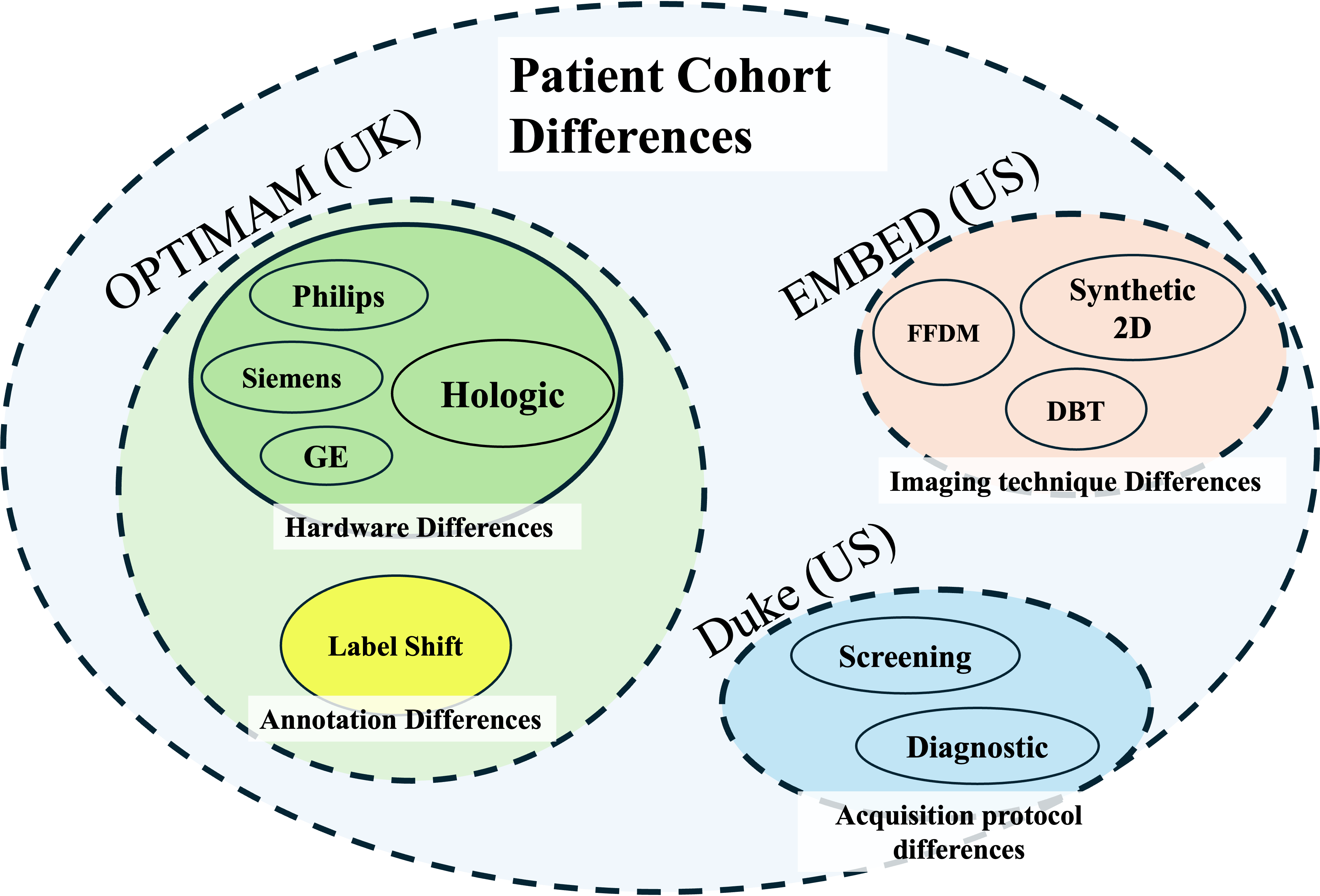
Figure 3: Domain shifts across OPTIMAM, EMBED, and Duke datasets: hardware, annotation, imaging technique, protocol, and cohort differences.
Three curated datasets were leveraged:
- OPTIMAM (UK, n=2994): predominantly Hologic FFDM, used for training/validation.
- EMBED (US, n=125): Hologic FFDM, public subset used for external testing.
- Duke Calcification Dataset v1 (US, n=788): GE/Hologic, includes FFDM and synthetic modalities, independent test set.
The diversity in vendor, imaging technique, and protocol is visually reinforced, emphasizing the necessity for robust domain adaptation.
Domain Adaptation Framework and Style Transfer Integration
The central methodological contribution is a two-stage pipeline:
- Unsupervised Domain Adaptation Module: Vendor- and technique-specific synthetic patches are generated from annotated lesion patches and unlabeled mass patches using style transfer. Two models are compared:
- AdaIN: Feature-level normalization for rapid style alignment, supplemented with a segmentation branch (Dice loss) to preserve calcification content.
- CycleGAN: Adversarial framework for unpaired image-to-image translation, allowing flexible depiction of vendor-specific characteristics.
- Supervised Classification Module: Swin Transformer V2, selected after extensive backbone benchmarking, receives both native and stylized patches for patch-level malignant/benign classification, with case-level aggregation (max aggregation).
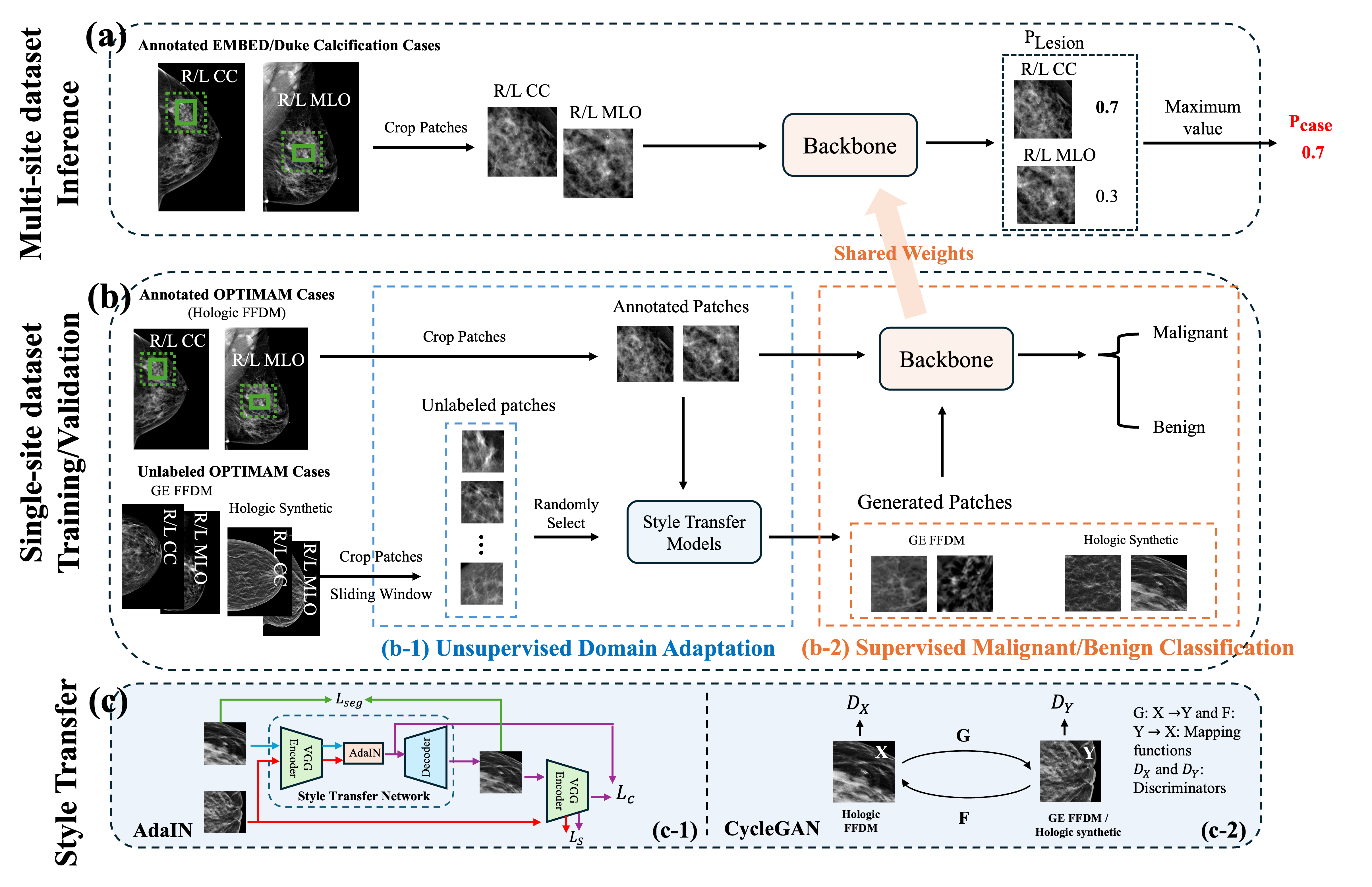
Figure 4: Schematic illustration of the domain adaptation and classification framework; CycleGAN/AdaIN generate vendor-specific patches, augmenting supervised training.
Backbone Architecture Evaluation
Eight backbone networks (seven CNNs, one transformer) were evaluated for single-site (OPTIMAM) calcification classification. Despite disparate ImageNet accuracies (70–85%), fine-tuned AUCs converged (0.78–0.81), with Swin Transformer V2 achieving the highest AUC of 0.81, illustrating limited transferability between natural image performance and medical imaging efficacy.
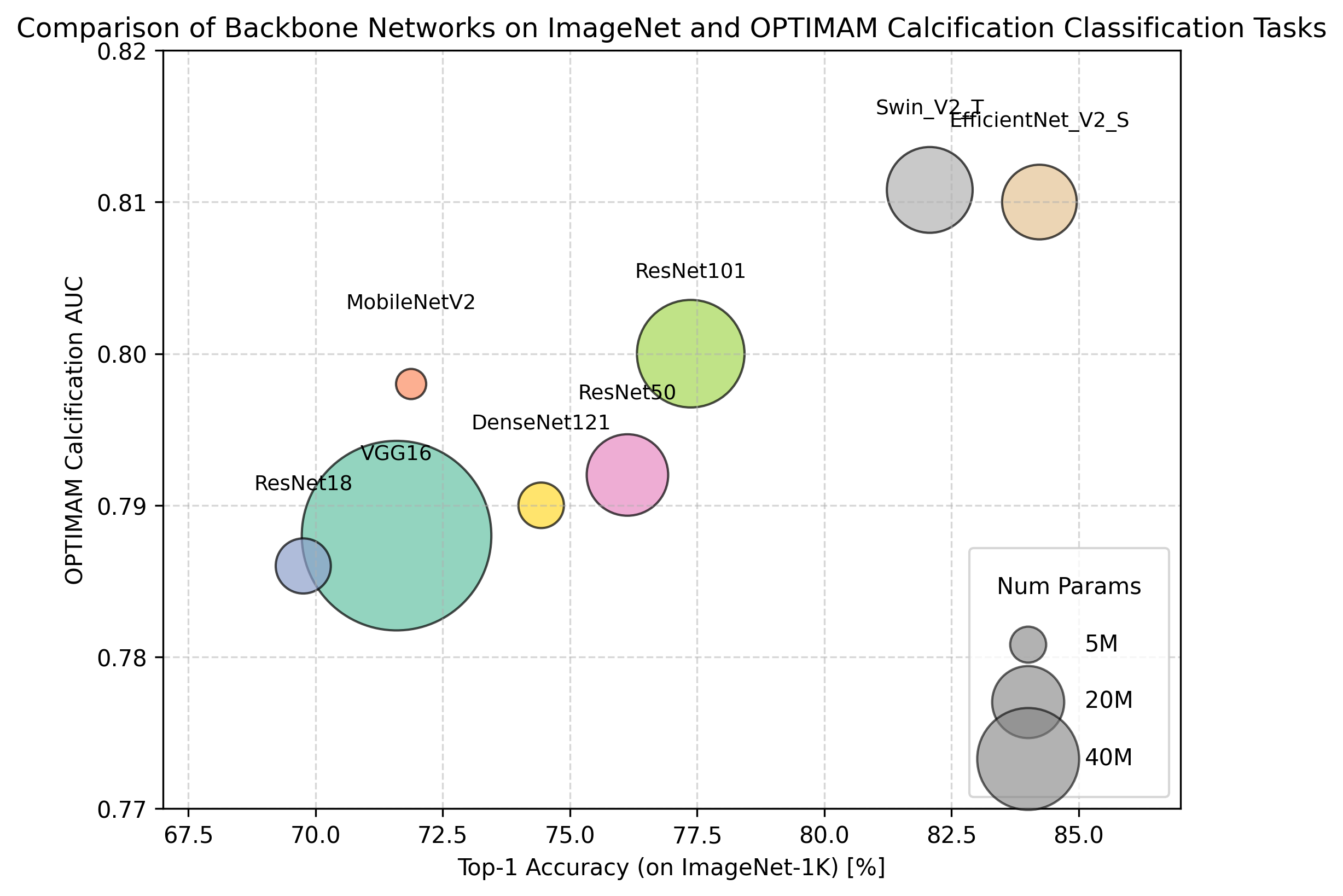
Figure 5: Comparative performance of backbone architectures on OPTIMAM; Swin Transformer V2 selected for downstream experiments.
Visual Analysis of Style Transfer Outputs
The visual fidelity and content preservation of AdaIN and CycleGAN were scrutinized. CycleGAN demonstrated superior retention of calcification boundaries and minimized artifact generation, whereas AdaIN often introduced blurred regions and spurious connections, validating the preference for adversarial approaches in medical domain translation.
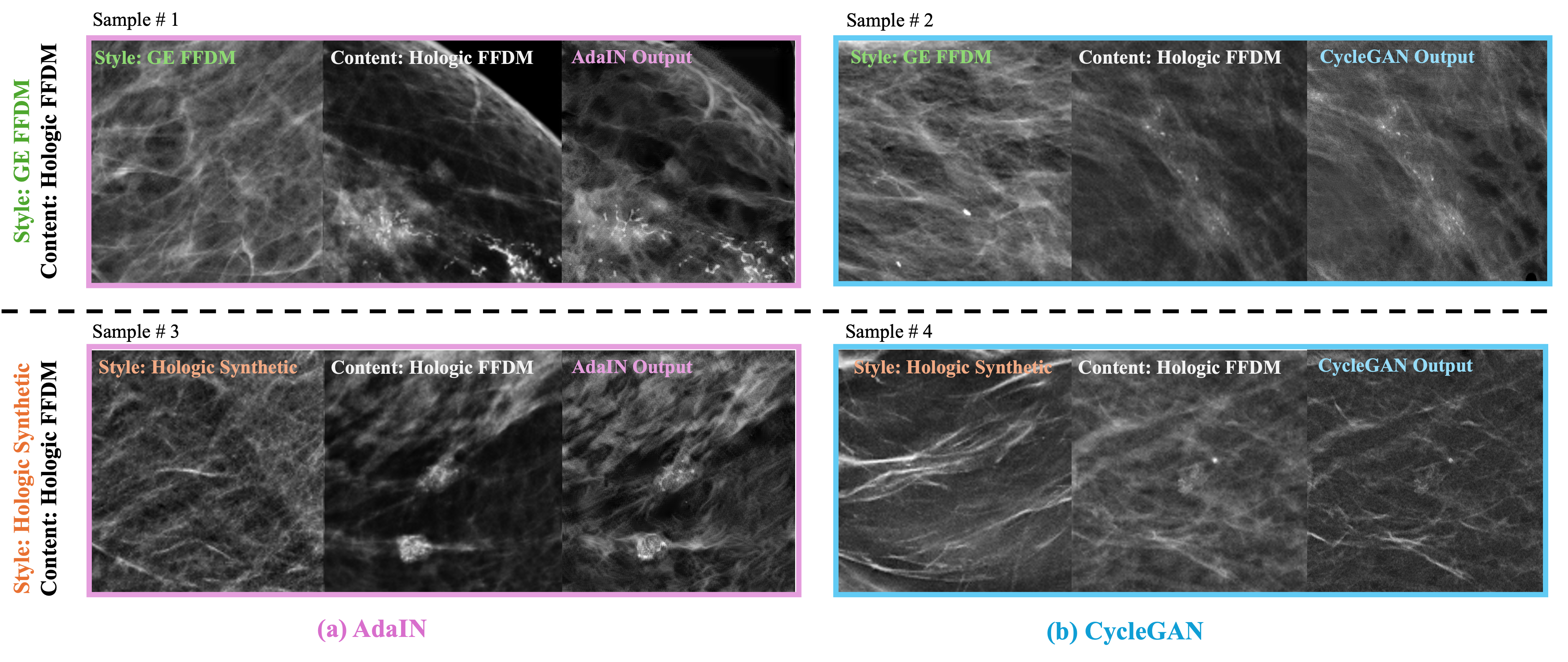
Figure 6: Style transfer outputs comparing AdaIN and CycleGAN: CycleGAN better maintains lesion morphology across domain shifts.
External validation on EMBED and Duke datasets quantified the impact of domain adaptation. CycleGAN-augmented training yielded marked improvements:
- EMBED: AUC increase from 0.68 (baseline) to 0.72 (CycleGAN).
- Duke: AUC increase from 0.68 (baseline) to 0.73 (CycleGAN), with vendor-specific gains (GE: 0.70→0.75, Hologic: 0.67→0.71).
- Sensitivity at fixed specificity was consistently elevated.
These robust results demonstrate that style transfer-driven patch augmentation mitigates domain-induced model performance drop, substantiating the claim that domain adaptation is mandatory for cross-site generalization in calcification classification.
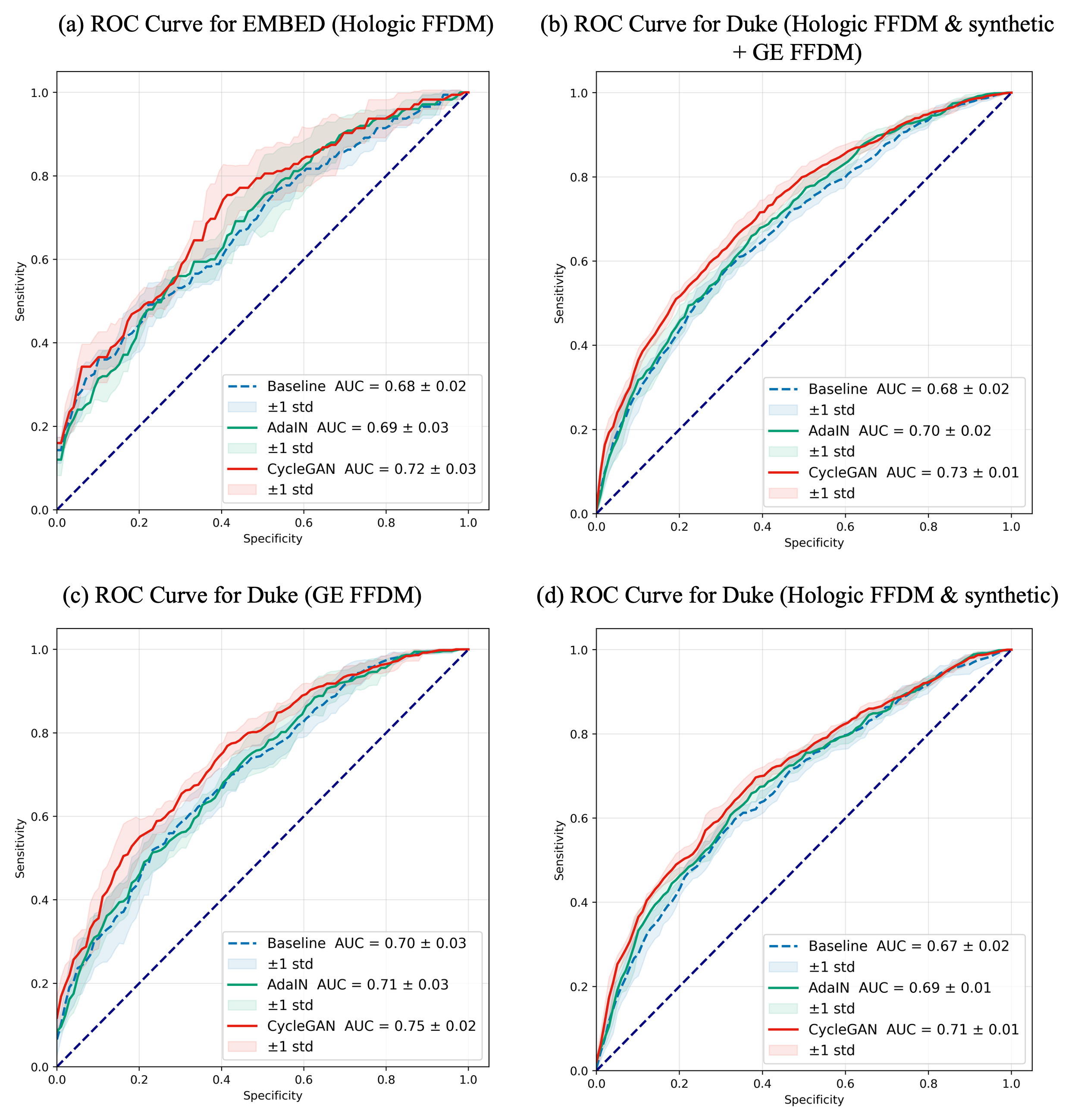
Figure 7: External validation results: domain adaptation (CycleGAN) improves sensitivity and AUC across EMBED and Duke datasets.
Implications, Limitations, and Future Directions
The study evidences that backbone selection is less pivotal than robust domain adaptation for multi-site generalization, and that cycle-consistent adversarial transfer remains effective for clinical patch synthesis. The approach circumvents annotation bottlenecks, enabling vendor/technique augmentation without manual labeling. Nevertheless, AdaIN and CycleGAN are mature paradigms; further improvements with transformer-based or diffusion-style transfer models are likely. The single-site training limitation and batch-level balancing underscore persistent dataset composition and annotation shift issues.
Practically, this unsupervised adaptation framework can substantially reduce site-specific retraining costs and facilitate scalable, deployable CAD systems. Theoretically, it opens avenues for exploring more sophisticated domain-invariant representation learning and cross-modality adaptation. The methodology can be generalized to other lesion subtypes and imaging tasks, with potential for integration into federated learning pipelines or semi-supervised annotation frameworks.
Conclusion
This work presents a rigorous unsupervised domain adaptation pipeline for calcification classification in mammography across heterogeneous, multi-site datasets. Integrating style transfer (especially CycleGAN) with supervised transformer-based classification enables substantial performance gains in unseen domains, empirically reducing the cross-site accuracy gap. The results confirm the necessity of domain adaptation for clinical CAD deployment and suggest future exploration of advanced generative models and broader lesion/institution generalization tasks.