- The paper shows that the spatial derivative of entanglement entropy in finite-density O(N) models directly recovers the thermal entropy density in the macroscopic limit.
- This result is obtained using a dual-variable flux representation and replica method with Monte Carlo simulations, which overcomes the sign problem at finite density.
- The findings provide a novel nonperturbative method for extracting equations of state and verifying thermodynamic consistency in interacting quantum field theories.
Entanglement Entropy as a Probe of Thermodynamics in Finite-Density O(N) Models
Introduction and Motivation
This paper presents a comprehensive nonperturbative investigation of the connection between entanglement entropy (EE), specifically Rényi entropies, and thermodynamic observables in the three-dimensional finite-density O(N) lattice model (2607.06286). The central result is a rigorous demonstration that, in interacting quantum field theories (QFTs), the derivative of entanglement entropy with respect to the size of a spatial subregion becomes equivalent to the thermal entropy density in the large-subregion limit. This allows the extraction of bulk thermodynamic quantities directly from entanglement data, offering a new computational approach for determining equations of state in interacting systems.
Contrary to perturbative intuition from free bosonic systems—where macroscopic entanglement exhibits only a subleading, logarithmic dependence on the particle number and vanishes in the thermodynamic limit—this work reveals that interactions crucially induce extensive entanglement, enabling the recovery of genuine thermodynamic information. The authors circumvent the notorious sign problem at finite density by using a dual-variable (flux) representation of the lattice O(N) model, simulated with a worm algorithm, allowing precise Monte Carlo evaluation of Rényi and entanglement measures.
Replica Construction and the Entanglement-Thermodynamics Correspondence
Entanglement entropy is defined for a spatial region A through the reduced density matrix and computed via the replica trick as a path integral over a multi-sheeted geometry, resulting in a ratio of two partition functions Z and Z~. The authors clarify the geometric interpretation of the two partition functions and their associated temporal boundary conditions:
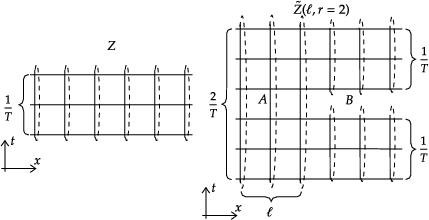
Figure 1: Sketches demonstrating the temporal topologies of the systems described by the two partition functions Z (single-sheet, $1/T$ periodicity) and Z~ (multi-replica, region A has O(N)0 periodicity) as used in the replica method.
In strongly coupled gauge theories and QFTs, EE is known to exhibit an "area law", dominated by UV-divergent contributions at the boundary between O(N)1 and its complement O(N)2 [Srednicki:1993im]. However, the derivative of EE with respect to the width O(N)3 of a slab-shaped O(N)4 is UV-finite and, as the authors show, is dominated by contributions from thermal bulk entropy in the limit O(N)5 (with O(N)6 the longest correlation length).
They provide both a formal path-integral derivation and a thermodynamic argument showing that, for general QFTs,
O(N)7
where O(N)8 is the transverse area, and O(N)9 is the thermal entropy density.
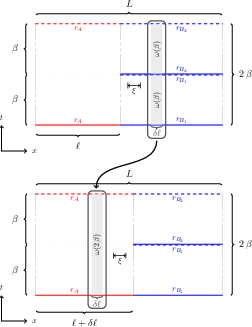
Figure 2: Illustration of how the dimensionless free energy varies in a replicated system, visualizing the thermodynamic limit and underpinning the correspondence between the derivative of EE and the bulk thermal entropy density.
This result is generalized at integer O(N)0 to Rényi entropies, where the same derivative yields a step-scaling approximation to the entropy density, converging to O(N)1 as O(N)2. The authors emphasize that their analysis rigorously extends beyond free theories and applies to fully interacting systems, provided a finite correlation length is present.
To access the finite-density regime and avoid the sign problem, the O(N)3 model is mapped onto dual flux variables, yielding a manifestly sign-free representation suitable for worm algorithm sampling. This representation encodes the partition function entirely in terms of conserved integer-valued link and site variables, subject to local constraints.
A generalized worm algorithm is elaborated, allowing efficient non-local updates by temporarily violating local constraints and propagating "defects" (i.e., external source-sink pairs) through the lattice. Both connected and disconnected worm moves are employed, with additional technical innovations introduced for updating the boundary between the entangling regions in replicated geometries:
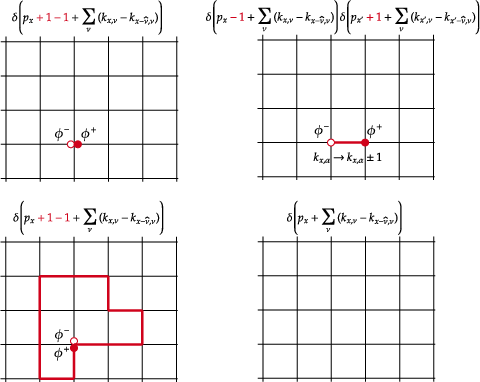
Figure 3: Illustration of the worm update process in the O(N)4-sector, involving source-sink insertion and propagation with local flux adjustments to maintain constraint satisfaction.
When evaluating the change in free energy associated with increasing O(N)5, boundary deformations are implemented either via localized plaquette updates or with "boundary worm" moves, both maintaining ergodicity and detailed balance even in the presence of complicated dual constraints.
Numerical Simulations and Results
Simulations are conducted in three dimensions for the O(N)6 sigma model, in the regime of spontaneous symmetry breaking (large O(N)7), with explicit source terms to provide a controlled mass scale for the (pseudo-)Goldstone modes. The spectrum and correlation lengths are characterized as functions of source and chemical potential, confirming that the system is in a regime where O(N)8 is finite and adjustable (Figures 7 and 8).
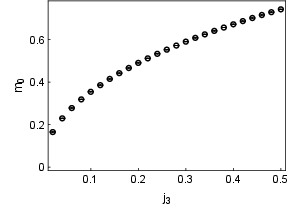
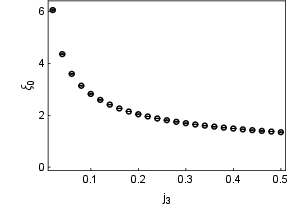
Figure 4: Mass O(N)9 (top) and corresponding correlation length A0 (bottom) of the three degenerate pseudo-Goldstone modes in the A1 model, as a function of source strength.
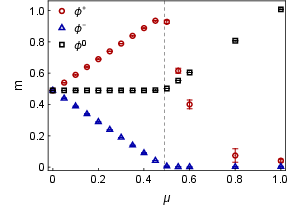
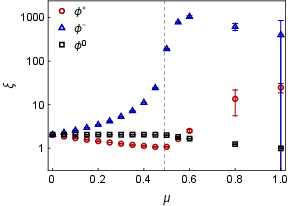
Figure 5: Mass splittings and correlation lengths for A2 as a function of chemical potential, illustrating the critical behavior and the Silver Blaze phenomenon at finite density.
For a variety of temperatures and chemical potentials, the derivative of the Rényi entropy with respect to A3 as extracted from replicated lattice simulations exhibits a rapid crossover to a plateau once A4, at a value that matches the thermal entropy density as computed independently—confirming the main theoretical claim.
Strong numerical agreement is demonstrated for different approaches to evaluating the mixed derivatives of the replicated partition function Figure 6, and the Maxwell relation connecting charge and entropy fluctuations is explicitly verified Figure 7. This constitutes a nonperturbative check of the entanglement-thermodynamics correspondence.
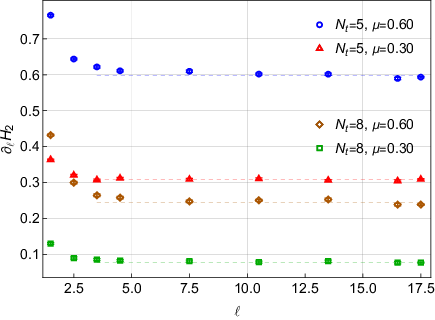
Figure 8: The derivative of the Rényi entropy with respect to strip width A5 for several values of temperature and chemical potential, demonstrating saturation to the thermal entropy density plateau.
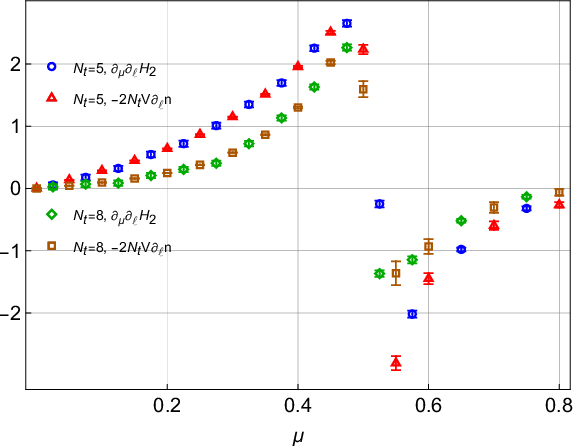
Figure 6: Comparison of results for A6 from independent estimators, showing precise consistency at finite density.
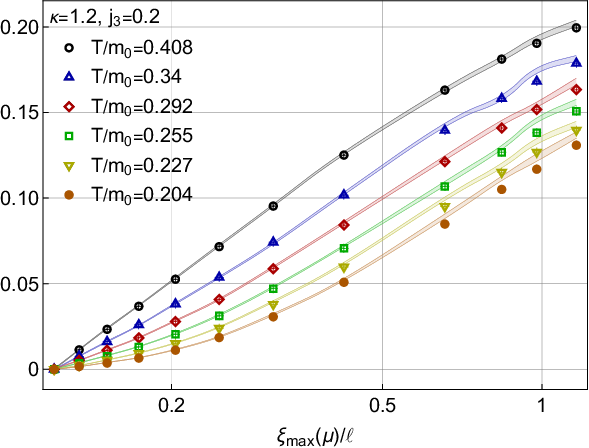
Figure 7: Explicit Maxwell relation test: comparison of A7 and the corresponding finite-difference charge density, confirming the theoretical prediction up to large ratios of correlation length to region width.
The dependency of entropy density on chemical potential tracks the expected phase structure, with a clear signature of the finite-density phase transition and the Silver Blaze effect reproduced.
Implications and Prospects
The established equivalence between the spatial derivative of entanglement entropy and the fundamental thermodynamic entropy density opens a principled route for extracting extensive thermodynamic observables from local measurements of entanglement in nonperturbative QFTs, including those with conserved charges and at finite density. In particular, this offers a novel strategy for numerically accessing the full equation of state from entanglement data alone.
On a practical level, the new lattice algorithms provide a rigorous framework for measuring entanglement properties at finite chemical potential in strongly correlated bosonic theories, successfully evading both the sign and overlap problems. The explicit realization in the A8 universality class, which is pertinent to aspects of quantum magnetism, critical dynamics, and low-energy effective theories of QCD, establishes a benchmark for similar studies in statistical and high-energy lattice systems.
Theoretically, the results clarify the role of interactions in generating extensive entanglement and bridge the gap between information-theoretic and thermodynamic probes of QFT. The method can be extended to canonical ensembles, symmetry-resolved entanglement, or more complex geometries, and provides fresh input for holographic duality, especially given the connection between entanglement plateaux and thermal states. Extensions to gauge theories are immediate, with algorithmic machinery largely in place.
Conclusion
This paper rigorously establishes that, for interacting QFTs with finite correlation length, the spatial derivative of EE (or suitable Rényi entropies) approaches the thermal entropy density in the macroscopic limit of subregions. Nonperturbative simulations in the A9 model at finite density confirm these predictions, including thermodynamic consistency relations, establishing entanglement entropy as a quantitative probe of bulk thermodynamics accessible via advanced lattice Monte Carlo methods. The approach enables new strategies for determining phase structure, equations of state, and thermodynamic response functions through entanglement observables, both in condensed matter and high-energy contexts (2607.06286).

