- The paper introduces WHMM, a novel iterative approach that uses time-domain wave solving to recover the homogenized Helmholtz solution.
- It couples macro-scale HMM with localized micro-scale simulations and temporal filtering to achieve exponential upscaling accuracy.
- The method demonstrates second-order convergence, efficient parallelization, and robustness near spectral resonances.
The WaveHoltz Heterogeneous Multiscale Method: Rigorous Multiscale Numerical Homogenization for the Helmholtz Equation
Overview and Context
The "WaveHoltz Heterogeneous Multiscale Method" (WHMM) (2607.05811) introduces a new numerical homogenization approach for the Helmholtz equation with highly oscillatory coefficients and time-harmonic forcing. The method addresses the computational intractability of direct discretization in heterogeneous media by combining the Heterogeneous Multiscale Method (HMM) for the wave equation with the iterative WaveHoltz procedure. WHMM operates in the time domain, iteratively converging to the solution of the homogenized Helmholtz equation without requiring prior knowledge of the homogenized coefficients or extensive resolution of fine-scale features throughout the computational domain.
Problem Setting
The main equation of interest is the scalar Helmholtz equation: ∇⋅(aε(x)∇u)+ω2u=b(x),x∈Ω,
where aε(x) exhibits rapid spatial oscillations at scale ε≪1, and ω is a nonresonant frequency.
Under scale separation and (possibly local) periodicity, homogenization theory asserts that the solution admits an expansion in powers of ε, with the leading term governed by a homogenized operator where the coefficient aˉ(x) is independent of ε. Accurately and efficiently computing the corresponding homogenized solution, particularly when aε(x) is not globally periodic or lacks a simple analytical homogenization, is the core challenge.
Review of Existing Multiscale Methods
The paper situates WHMM among established methods for numerical homogenization:
- MsFEM/GMsFEM: Construct multiscale basis on a coarse mesh from localized solves, but can suffer from errors due to artificial local boundary conditions and require oversampling for accuracy.
- LOD: Employs local orthogonal decomposition to achieve exponential error decay but also requires localized solution throughout the domain.
- HMM: Estimates the homogenized operator indirectly by coupling a macro-scale PDE with micro-scale simulations; is highly effective under scale separation but less so for nonseparated scales.
All these paradigms, especially when extended to the Helmholtz equation, face difficulties: the lack of coercivity, boundary artifacts at the microscale, and resonance effects. Existing direct frequency-domain multiscale discretizations often introduce spurious boundary layers or fail for indefinite systems.
WaveHoltz Iteration in the HMM Framework
The central algorithmic innovation of WHMM is employing the WaveHoltz iteration on the macro-scale HMM surrogate of the heterogeneous wave equation. Rather than discretizing the frequency-domain problem directly, WHMM applies fixed-point iteration rooted in time-domain evolution, using periodic time forcing to filter toward the stationary Helmholtz solution.
The iteration consists of:
- Time-domain solve: At each macro-iteration, the wave equation with source term −b(x)cos(ωt) and suitable initial conditions is solved over one period.
- Temporal filtering: The solution is filtered via a weighted time average to extract the time-harmonic component relevant for the Helmholtz problem.
This procedure can be combined with Krylov acceleration due to the symmetric positive definiteness induced by the energy-conserving boundary conditions and the properties of time-domain propagation.
Heterogeneous Multiscale Method Coupling
At every macro time step, the effective flux required by the macro-solver is estimated through localized micro-scale simulations:
- Micro-scale problem: Solve the unforced wave equation in a localized subdomain with data interpolated from the macro variable and open/outflow boundary conditions, taking care to avoid artificial boundary-induced errors.
- Averaging: Compute the macroscopic flux by high-order local averaging in space and time using compactly supported kernels with multiple vanishing moments and high regularity to achieve exponential accuracy in the upscaled coefficients.
This micro-macro coupling is designed to be sparse and computationally cheap (independent of global ε), enabling parallelization and amortization of setup costs.
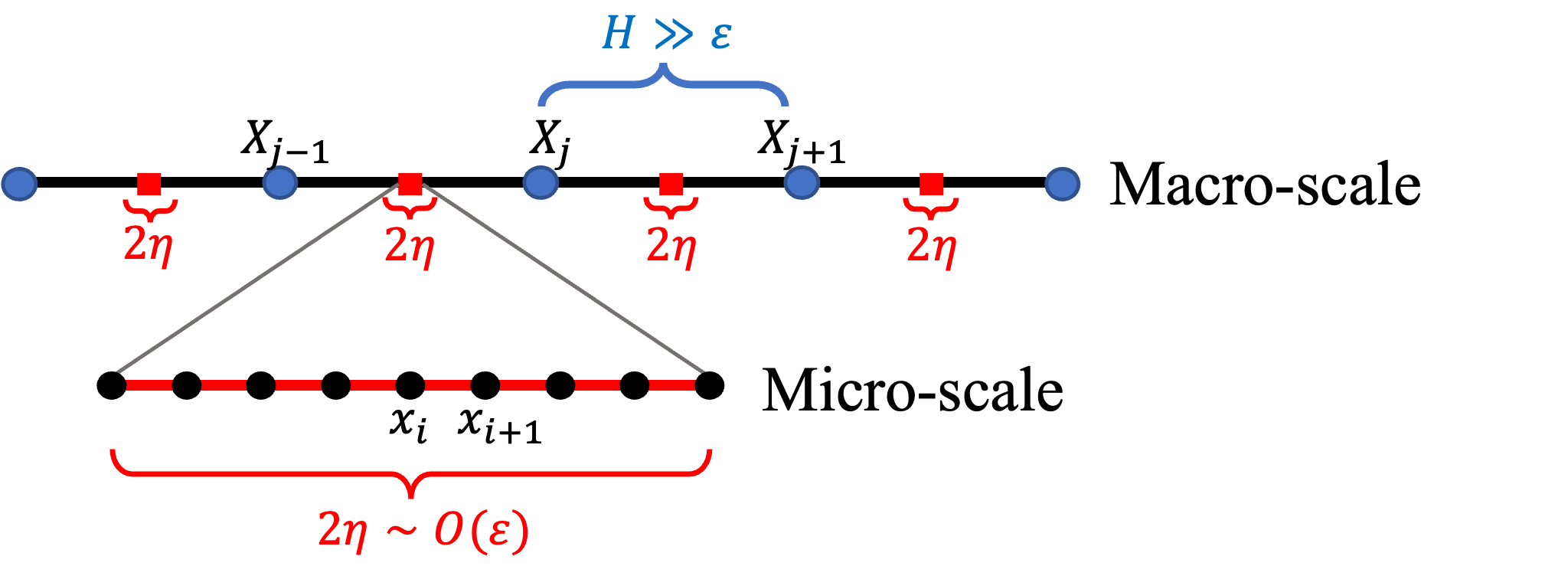
Figure 1: The arrangement of macro-scale and micro-scale meshes illustrating localized domain decomposition in WHMM.
Theoretical Analysis and Convergence
The paper provides a comprehensive theoretical analysis in 1D for periodic (and locally periodic) coefficients. The key results include:
- Discrete and Continuous Error Bounds: Quantitative estimates for the difference between the WHMM iterates and the true homogenized solution, with errors decomposed into discretization (aε(x)0) and upscaling (aε(x)1) contributions, both amplified near spectral resonance by a aε(x)2 factor.
- Coefficient Consistency: Demonstrated that the local averaging procedure for the flux achieves exponentially small error in the micro box size-to-scale ratio under sufficient kernel regularity/moments.
- Relative Error Behavior: Established that, as aε(x)3, the WHMM solution converges to the homogenized solution at the predicted rates; for fixed aε(x)4, the error is dominated by the upscaling accuracy unless the grid is coarsened past the pollution error threshold.
- Role of Resonance: Sharp peaks in error are shown to align with frequencies near elliptic eigenvalues, reflecting intrinsic ill-conditioning of the continuous problem.
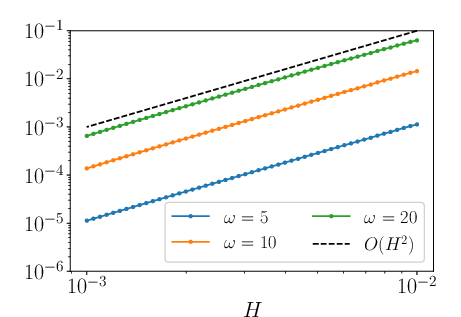
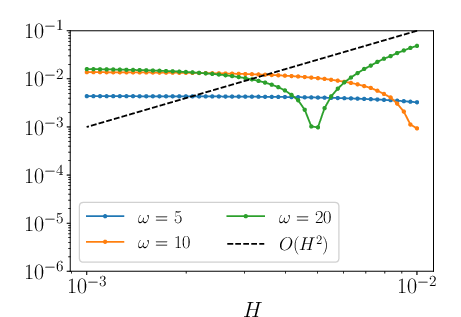
Figure 2: Second-order convergence in the macro grid size aε(x)5 for the relative error in WHMM, demonstrating the effect of accurate (left) versus poor (right) homogenized coefficient estimation.
Numerical Validation
WHMM is validated on a battery of 1D and 2D experiments featuring periodic and locally periodic coefficients, smooth and oscillatory right-hand sides, and both constant and spatially varying homogenized tensors.
Key Observations:
- High Accuracy with Proper Kernel Design: For optimal kernel parameters (e.g., aε(x)6), upscaling error is below aε(x)7.
- Convergence Rates: Where theory predicts, WHMM converges at second order in aε(x)8 (macro grid) for a fixed aε(x)9 away from resonance.
- Error Structure: For fixed ε≪10, error vs. ε≪11 is dominated by discretization; for fixed ε≪12, error vs. ε≪13 is dominated by upscaling/homogenization error until a sharp transition when both are small.
- Generality: In 2D, ε≪14 error decay is observed, even for locally periodic tensor coefficients.
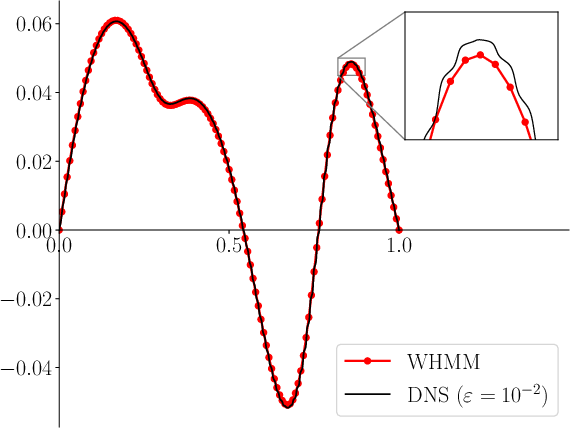
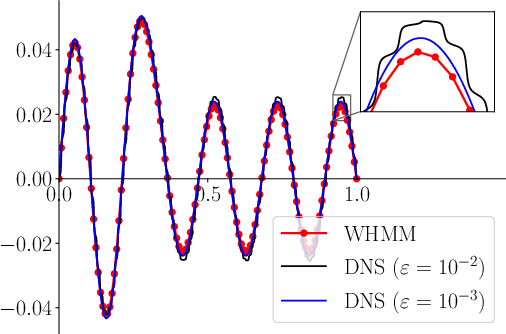
Figure 3: Comparison between DNS and WHMM solutions in 1D with ε≪15 highlighting the reduction in microscopic oscillations and close matching to the coarse-scale homogenized solution.
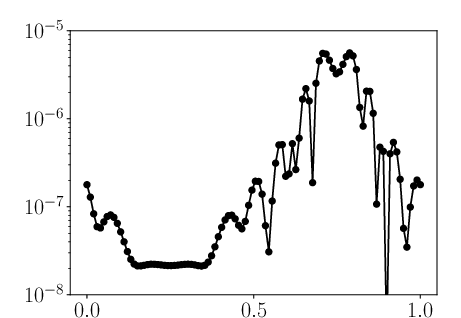
Figure 4: Accuracy of the computed homogenized coefficient by HMM compared to the analytic homogenized coefficient, demonstrating excellent upscaling performance and negligible local upscaling error.
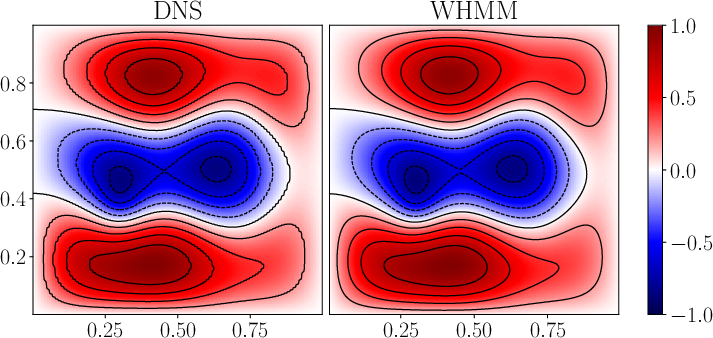
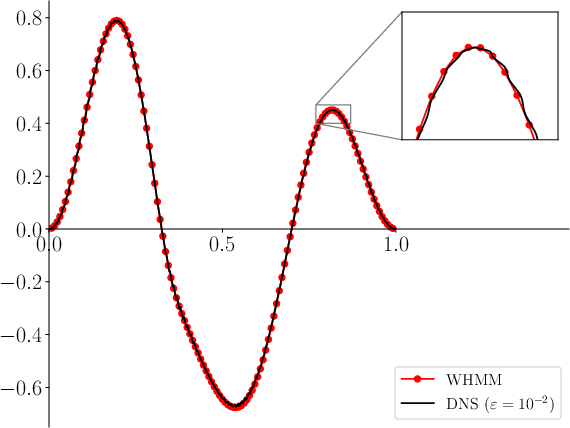
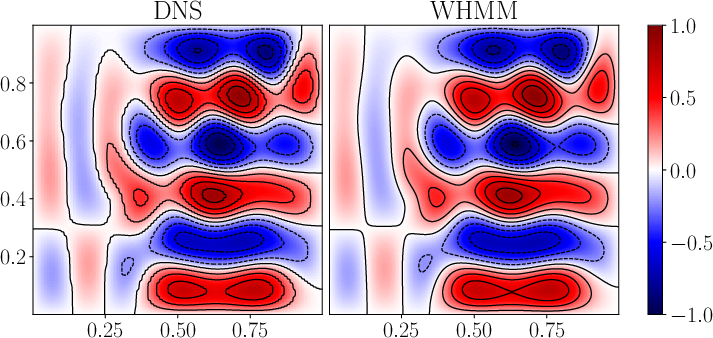
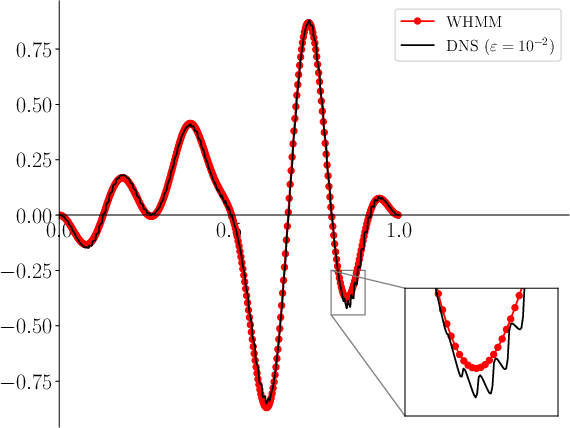
Figure 5: Contour plots and slices of 2D WHMM solutions for increasing ε≪16 show precise recovery of the coarse-scale wavefield in heterogeneous media.
Implications and Future Directions
Practical Implications
WHMM provides a scalable, robust, and generalizable method for high-frequency wave problems in rapidly varying media:
- Boundary Artifact Suppression: The time-domain formulation and open boundary micro-solvers eliminate spurious nonphysical boundary layers.
- Computational Efficiency: Macro-level solves operate at ε≪17-independent cost; micro-solves can be executed offline and amortized across frequencies and right-hand sides.
- Ease of Parallelization: The independence of local micro-problems facilitates efficient parallel implementations.
Theoretical Implications
- Advancement over Existing HMMs: By embedding WaveHoltz into HMM, the method is more robust to indefinite/oscillatory operators and better handles the pollution effect familiar in high-frequency Helmholtz discretizations.
- Versatility: Although the theoretical analysis focuses on periodic/locally periodic settings, experimental results indicate the method's applicability in general smooth/high-contrast coefficients.
Future Research
Potential avenues for further development include:
- Generalization to Nonperiodic and Non-separated Scales: Extending both the theoretical framework and upscaling techniques for coefficients with more complex dependencies, including random, stochastic, or fractal structures.
- Integration with Advanced Basis Construction: Combining WHMM with modern operator-adapted or local spectral basis (e.g., LOD, gamblets, domain decomposition) for further efficiency.
- Nonlinear and Vector Problems: Adapting the methodology to nonlinear wave equations or Maxwell systems with strong multiscale features.
- Robustness and Preconditioning: Leveraging WHMM's symmetric positive definite structure for optimal preconditioning strategies in high-frequency indefinite problems.
Conclusion
The WaveHoltz Heterogeneous Multiscale Method constitutes a mathematically rigorous, computationally efficient approach to the numerical homogenization of the Helmholtz equation with rapidly oscillatory coefficients. Through a judicious coupling of time-domain multiscale evolution and frequency-domain iteration, WHMM achieves discretization and upscaling errors consistent with or outperforming classical HMM, while avoiding several of their practical limitations. Its strong theoretical underpinning, high accuracy in numerical benchmarks, and algorithmic flexibility position WHMM as a significant contribution for both computational mathematics and applications involving wave propagation in heterogeneous media.

