- The paper demonstrates a quantum-HPC hybrid workflow that constructs reduced active-space Hamiltonians for simulating multistate electronic dynamics in iron-based catalysts.
- It employs quasi-diabatic potential fitting and state tracking to reproduce SA-CASSCF energy spectra and coherent population-transfer dynamics with high quantitative accuracy.
- The study evaluates NISQ strategies like coupling pruning and Trotterization, validating the workflow on trapped-ion quantum hardware to capture key dynamical trends.
Quantum-HPC Hybrid Workflow for Multistate Electronic Dynamics in Cytochrome P450-Inspired Iron Complexes
Overview and Motivation
A critical challenge in quantum chemistry and catalysis involves accurately simulating the multistate electronic dynamics of transition-metal reaction centers such as cytochrome P450. Strong electronic correlations, complex redox and electron-transfer processes, and dynamically changing interstate couplings often render even advanced classical electronic structure calculations computationally prohibitive along reaction coordinates. This work proposes a quantum-HPC hybrid framework that enables the construction, validation, and execution of reduced active-space Hamiltonians derived from high-level multireference calculations, with a demonstration using a [Fe(CN)4(O2)]2− model system. The workflow achieves chemically interpretable population-transfer dynamics on a trapped-ion quantum computer, advancing the current capabilities of quantum simulation for realistic chemical problems (2607.05786).
Construction of the Reaction-Center Model and Electronic Structure
The authors select a cytochrome P450-inspired [Fe(CN)4(O2)]2− complex to probe electronic population dynamics involving Fe 3d ↔ O2 π∗ transfer and corresponding multistate mixing. As direct stabilization of reactive Fe(III)--O2∙− species is problematic, the model incorporates CH20NH21 (counter ion) and explicit H22O molecules to physiologically anchor the electronic wavefunctions. Spin multiplicity is determined via DFT geometry optimizations, confirming the quintet as the lowest energy manifold.
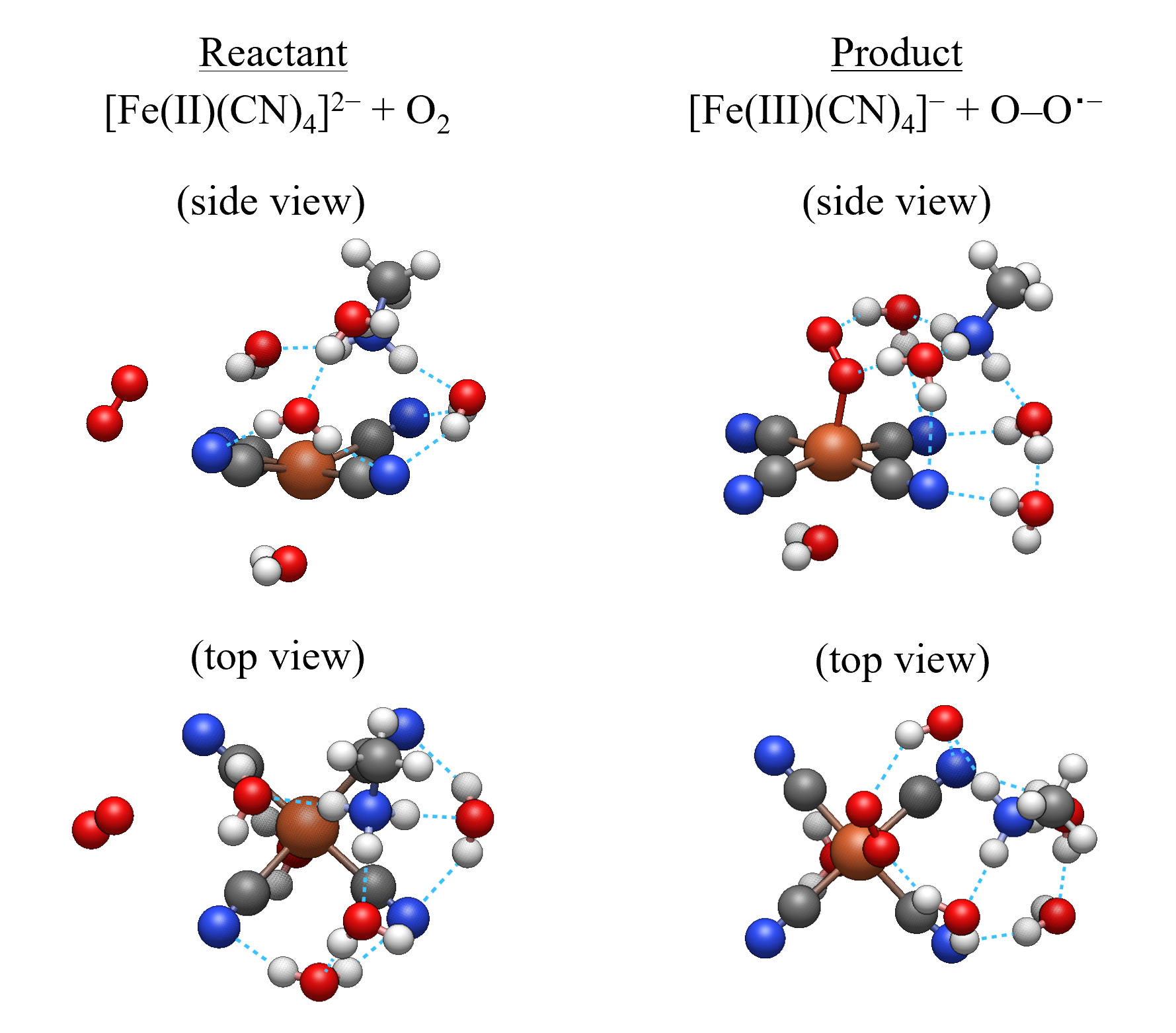
Figure 1: Molecular structures of the geometry-optimized reactant and product Fe complexes at the ROHF level.
The electronic structure is described using state-averaged CASSCF (SA-CASSCF) with 8 electrons in 6 orbitals (CAS(8e,6o)), chosen to span all relevant Fe 3d and O23(24) configurations. Fifteen nearly degenerate states are included in the energy landscape, capturing essential transitions and the structurally driven changes in dominant configurations.
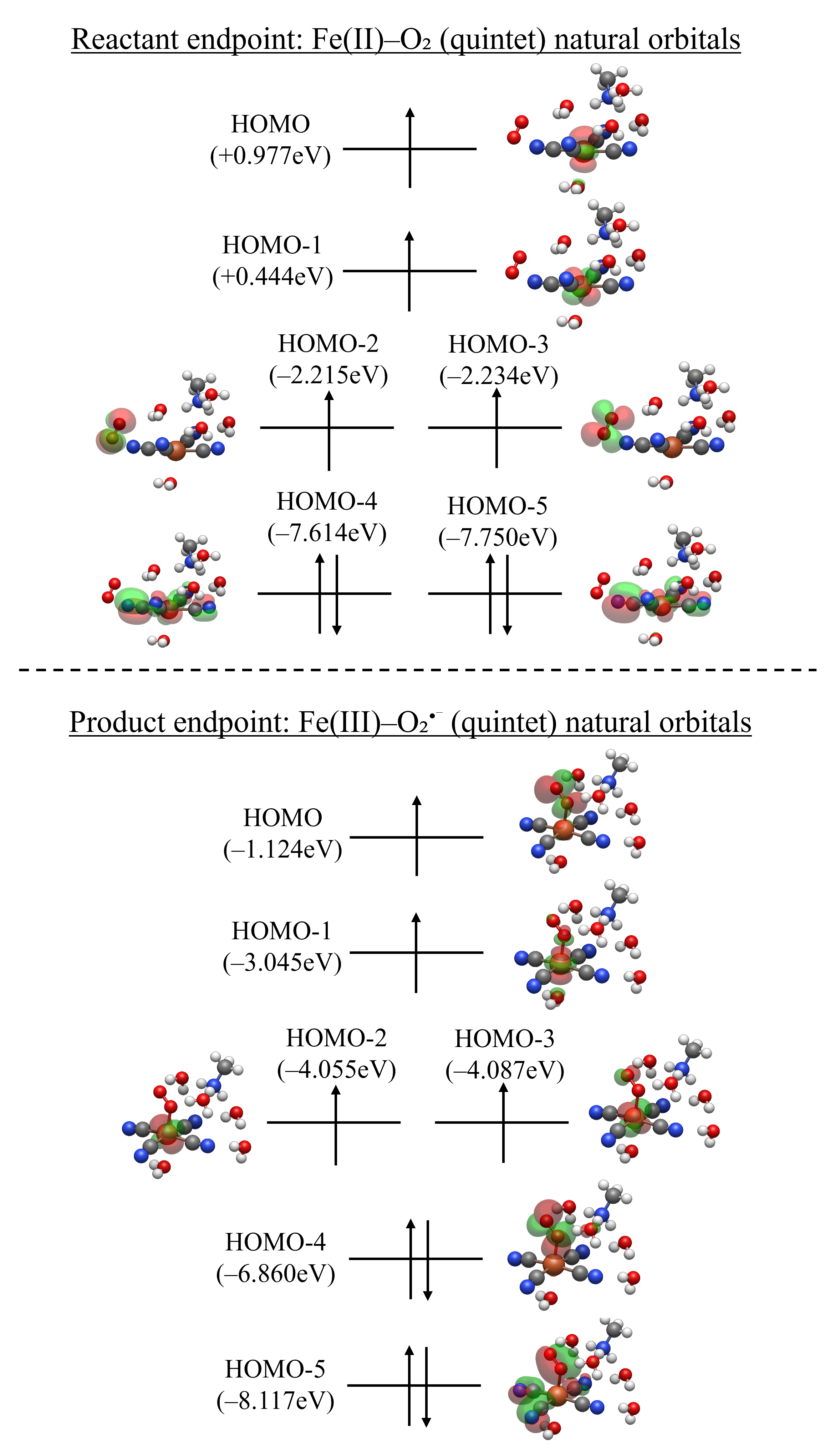
Figure 2: Active-space natural orbitals (HOMO--HOMO--5) and their orbital energies for SA-CASSCF (8e,6o) at the Fe(II)--O25 and Fe(III)--O26 endpoints.
A geometrically continuous reaction coordinate 27 is constructed using geodesic interpolation, with quantum chemical calculations at 21 points. State tracking ensures chemical consistency of multistate labeling despite possible avoided crossings.
Reduced Hamiltonian Construction and Validation
Quasi-diabatic potentials 28, combining two Morse terms plus a Gaussian term, parameterize the diagonal PES for each tracked state. Off-diagonal couplings 29 are optimized to best reproduce the adiabatic SA-CASSCF spectrum via eigenvalue fitting, yielding a sparse 2−0 real-symmetric Hamiltonian. Only crossing pairs with significant state mixing are retained as "active pairs," while energetically separated states are pruned.
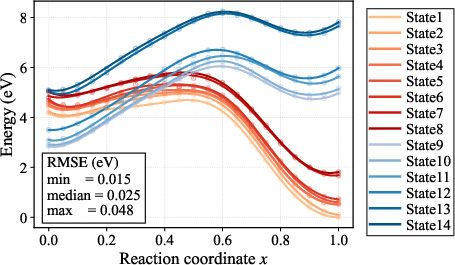
Figure 3: Quasi-diabatic potentials 2−1 for each state along the reaction coordinate, distinguishing product-side and reactant-side states.
Spectral validation shows the reduced Hamiltonian reproduces ab initio SA-CASSCF energies across the pathway with RMS deviation of 0.030 eV and maximum absolute error 0.143 eV, establishing quantitative reliability for subsequent dynamical simulation.
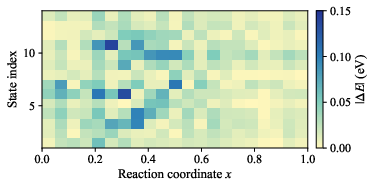
Figure 4: Absolute energy deviations between adiabatic eigenvalues of the reduced Hamiltonian and SA-CASSCF references along 2−2.
Population-Transfer Dynamics as a Diagnostic Observable
A key innovation is the use of early-time product-manifold population 2−3, summed over product-side states, as a sensitive diagnostic for dynamic adequacy of the reduced Hamiltonian. While energy metrics are insensitive to near-degeneracy and missed couplings, population-transfer dynamics directly reveal deficiencies in state mixing essential to electron transfer.
Analysis reveals a pronounced resonance in 2−4 at 2−5, with values reaching 0.488 after 10 fs of evolution, in contrast to suppressed populations at 2−6 (2−7) or 2−8 (2−9). This local maximum corresponds to a region of strong near-degeneracy and large state mixing between the Fe(II)--O40 and Fe(III)--O41 sectors, with the dominant couplings mediated by Fe 3d--O42 43 interactions.
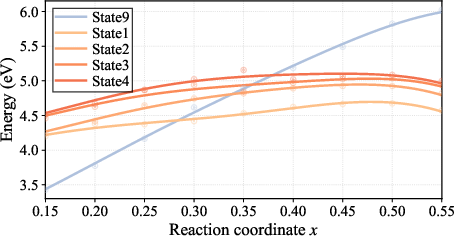
Figure 5: Key state energies in the near-degeneracy region, showing closely coupled reactant and product states.
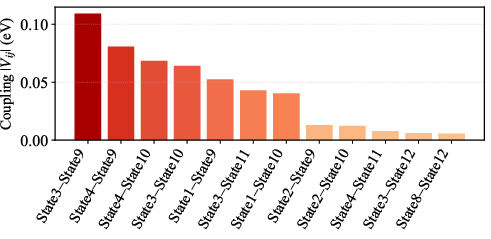
Figure 6: Dominant optimized couplings 44 between reactant-side and product-side states.
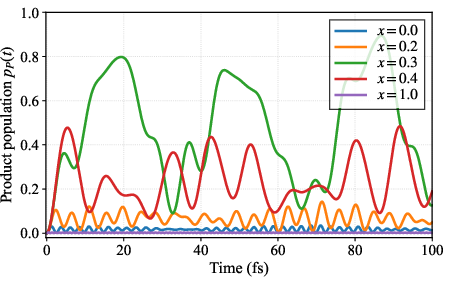
Figure 7: Exact time traces of the product-manifold population 45 at representative reaction-coordinate points, highlighting coherent oscillations at 46.
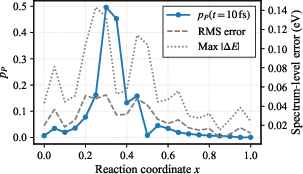
Figure 8: Reaction-coordinate dependence of 47 at 10 fs, clearly identifying the near-degeneracy window.
NISQ Implementation: Resource-Accuracy Trade-off
To render this workflow tractable for current quantum hardware, two principal approximations are investigated:
- Coupling pruning: Introducing a threshold 48 on 49, reducing the number of significant couplings (from 32 to 7 at 20 eV) while maintaining the key population transfer features.
- Trotterization: First-order Trotter-Suzuki decomposition approximates the time-evolution operator with 21 steps. Empirically, 22 minimizes error under NISQ noise, achieving a mean absolute population error of 23 in emulation at fixed circuit depth.
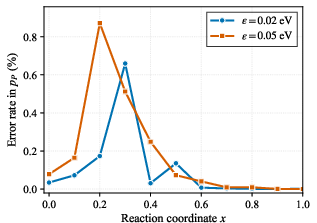
Figure 9: Effect of coupling cutoff on error rate in 24; 25 eV yields low, uniform error, while higher cutoffs degrade accuracy in sensitive regions.
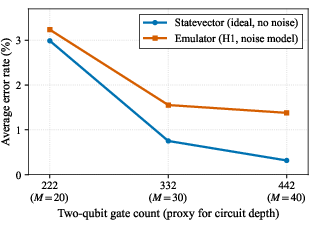
Figure 10: Accuracy-resource tradeoff for Trotterization, comparing mean absolute error versus two-qubit gate count.
Detailed scrutiny of emulator runs (statevector, idealized/noisy, and with selective error channels) reveals that discrepancies in 26 are primarily sensitive to digital (Trotter) errors in regions of strong state mixing and are not predominantly dictated by leakage outside the single-excitation subspace.
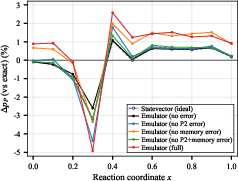
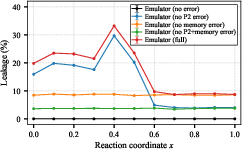
Figure 11: Emulator validation—(a) deviation in 27 from classical evolution as a function of reaction coordinate, (b) postselection leakage rate as a complementary error diagnostics.
Hardware Demonstration and Validation
The workflow is executed on Quantinuum's "Reimei" trapped-ion QC, with direct measurements of 28 at 29 fs for all 2−0. The quantum hardware accurately reproduces the key population-transfer trends, notably the maximal transition at 2−1 (2−2 on hardware, 2−3 in emulator), and the qualitative dependence across the reaction coordinate matches the emulated behavior.
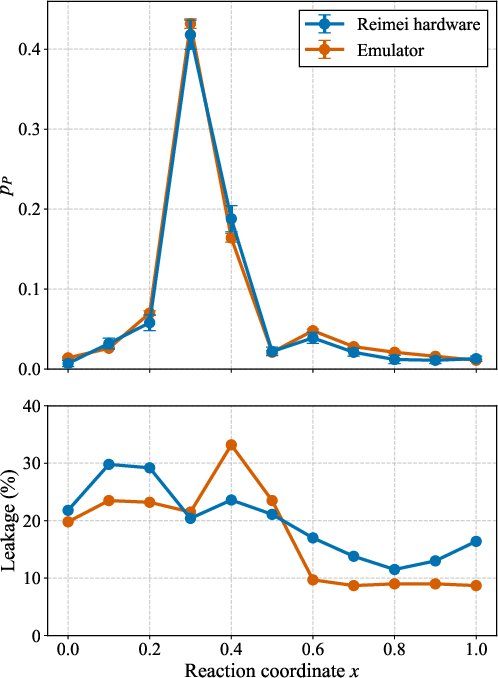
Figure 12: Hardware validation—(a) 2−4 versus 2−5 on Reimei hardware vs emulator, (b) corresponding postselection leakage rates.
Observed quantitative discrepancies are attributed to hardware noise, residual digital errors, and calibration mismatch; however, the principal dynamical signature—coherent population transfer in the near-degenerate window—is robust. Postselection leakage and confidence intervals are analyzed, but do not obscure the chemically interpretable dynamical trends.
Implications, Limitations, and Outlook
This study establishes a workflow for validating reduced Hamiltonian active-space models via population dynamics, with quantum hardware already capable of capturing essential transition-metal electronic dynamics within relevant NISQ resource budgets. Importantly, the work demonstrates that correctly engineered reduced models, leveraging population-transfer observables, enable not only spectral matching but also correct dynamical evolution—improving upon energy-based diagnostics alone.
The current framework is limited to fixed-nucleus dynamics and modest subspace sizes. Extending the method to treat nuclear motion, environmental perturbations, and larger or more adaptive effective Hamiltonians remains open. Nevertheless, the approach is generalizable to other strongly correlated catalytic centers and may serve as a diagnostic paradigm for validating emergent quantum algorithms and hardware capabilities in quantum chemistry.
Conclusion
The quantum-HPC hybrid workflow developed here provides a robust path for validating, compiling, and executing reduced active-space Hamiltonians governing complex multistate electronic dynamics in bioinorganic systems. By employing population-transfer dynamics as a rigorous diagnostic, the authors demonstrate the reproducibility, interpretability, and practical feasibility of such workflows on present-day quantum devices. This work marks a significant step in harnessing quantum computing for chemically relevant electronic dynamics beyond static energy estimation, with broad implications for the simulation of catalysis, electron transfer, and correlated molecular phenomena.