- The paper introduces an adapter (EquiFiLM) that adds charge conditioning through a FiLM block while preserving full E(3)-equivariance.
- It employs channel-wise modulation on scalar features with only ~15% extra parameters and no additional inference cost.
- Empirical tests on charged liquid water show significant error reductions, achieving up to 61× lower energy RMSE and robust generalization across charge states.
EquiFiLM: Charge-Conditioned Equivariant Force Fields via Feature-wise Linear Modulation
Motivation and Background
The proliferation of foundation machine learning force fields (MLFFs), such as MACE-MP-0 and UMA, has provided high-accuracy, transferable models for atomistic simulation across diverse chemistries. However, conventional MLFFs are constrained by their dependence on equilibrium ground-state physics, lacking mechanisms to natively incorporate external driving variables, including system charge, field, or temperature. As a result, they are unable to address a suite of problems relevant to electrified interfaces, photoexcited matter, or materials design under non-neutral states. Existing solutions for incorporating charge awareness often require extensive retraining regimes, large model architectures, and dedicated supervision of atomic charges or explicit long-range machinery, making them impractical to extend foundation models to driven or excited-state phenomena.
Methodology: EquiFiLM Adapter Architecture
EquiFiLM introduces a minimal and efficient adapter for adding a continuous external-conditioning axis to any equivariant MLFF possessing scalar interaction channels. The technological core is a Feature-wise Linear Modulation (FiLM) block, inspired by conditional parameter-efficient adaptation approaches in large-scale models, but architected to preserve E(3)-equivariance by design. Specifically, for each model layer, a ChargeFiLMBlock is inserted that applies channel-wise scale and shift transforms—parametrized as functions of the conditioning scalar (system charge, q), via small MLPs—only to the scalar channels, leaving equivariant (ℓ>0) geometric channels invariant. This construction maintains the geometric consistency of the model outputs, a necessity for physically viable force predictions, while enabling explicit and flexible modulation along arbitrary external axes.
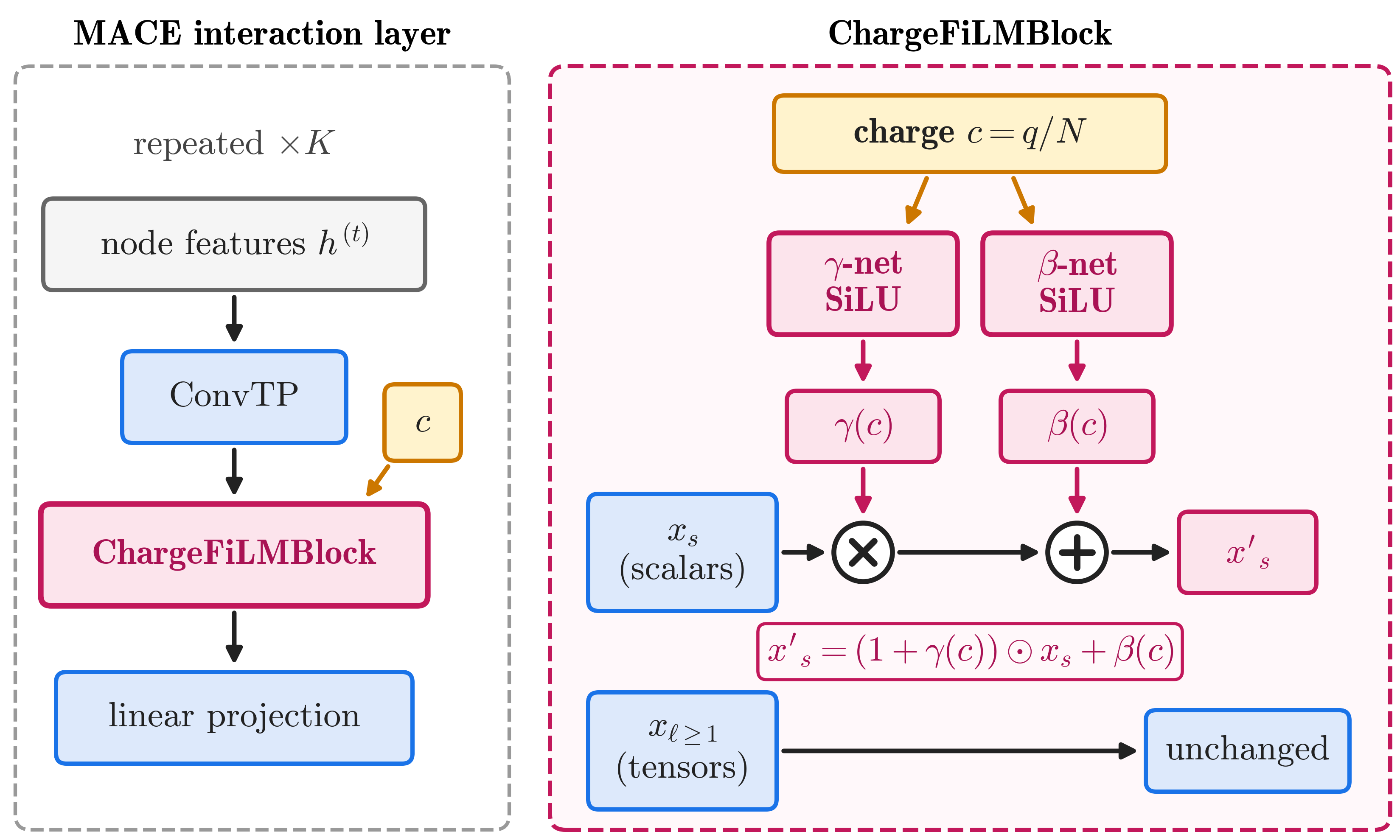
Figure 1: ChargeFiLMBlock integration into MACE; charge-dependent per-layer scale and shift are computed by MLPs acting only on scalar channels, preserving equivariance.
Critically, this design choice ensures bitwise equivalence to the original backbone at initialization, introduces minimal parameter overhead (approximately 15% relative to the backbone), and adds no measurable inference cost.
The EquiFiLM approach is implemented atop the MACE-MatPES backbone, yielding the E-MACE model. Its efficacy is demonstrated on a nontrivial testbed: charged liquid water, with ab initio molecular dynamics (AIMD) DFT labels spanning four discrete training charges. E-MACE is jointly fine-tuned on all training charges, with the conditioning axis set by a normalized per-atom system charge.
Performance is benchmarked across both interpolation and challenging extrapolation regimes (totaling 11 charge states). On the four training charges, E-MACE achieves a 3.1× reduction in force RMSE (from 21.3 to 6.96 meV/Å) and a 61× reduction in per-atom energy RMSE (from 6.1 to 0.10 meV/atom) relative to a baseline lacking charge conditioning. In held-out charge regimes not seen in training, force RMSE remains bounded between 18 and 61 meV/Å and energy RMSE between 0.7 and 5.4 meV/atom, with errors controlled and smoothly growing with increasing distance in charge from the training set.
The adapter’s efficacy is further contextualized by comparison to the much larger purpose-built, charge-aware foundation MACE-POLAR-1-M, which includes explicit per-atom charge machinery and is 20× larger by parameter count. E-MACE matches or outperforms this reference on both force and energy metrics using no explicit charge supervision, enabled solely by the external-conditioning axis and per-layer FiLM gating.
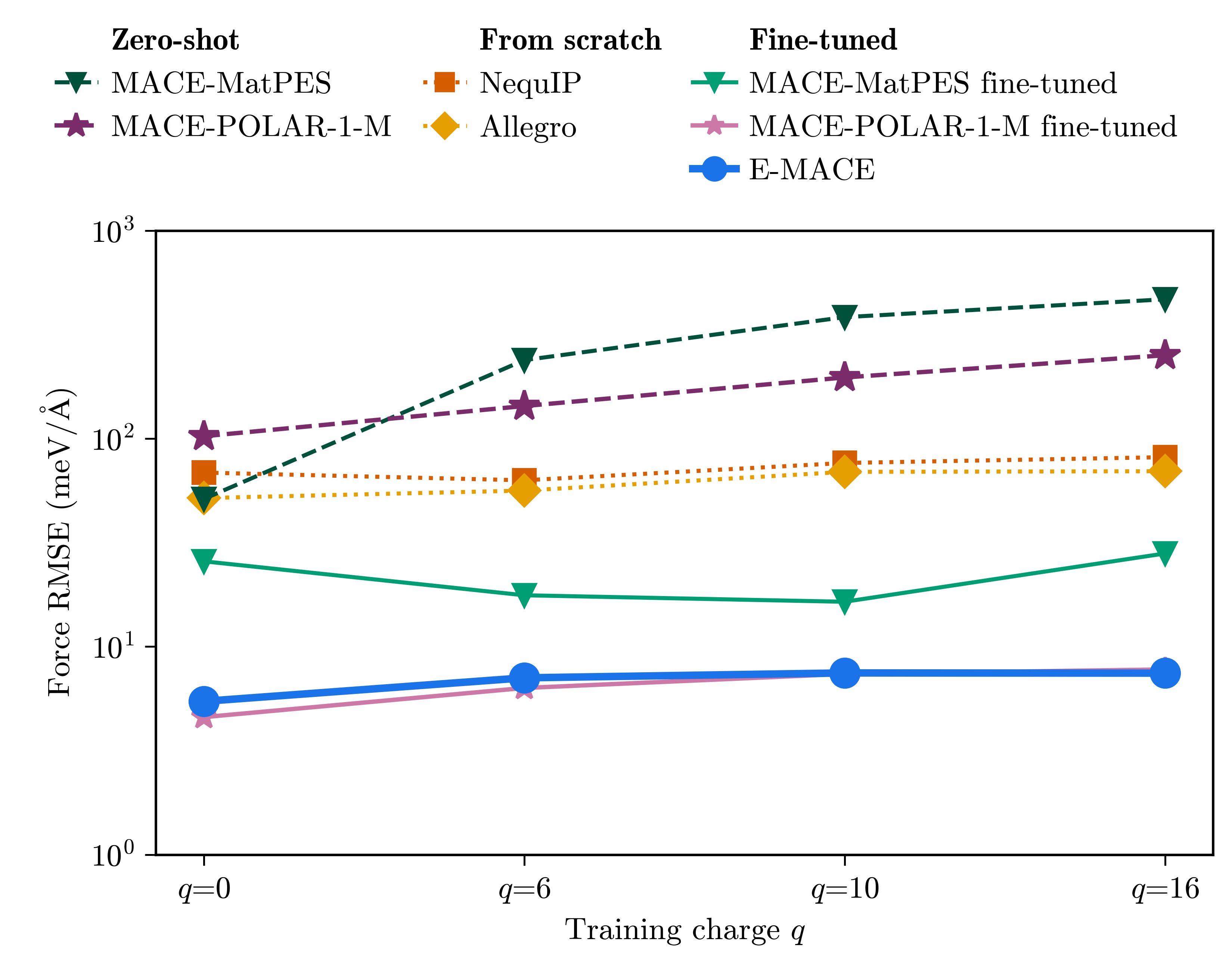
Figure 2: Per-charge force RMSE at the four training charges for various models; E-MACE matches the large, charge-aware foundation and significantly outperforms unconditioned and specialist baselines.
Further analyses conclusively demonstrate that single-condition specialist models—fine-tuned only at a specific charge and lacking a conditioning axis—catastrophically fail to generalize outside their training charge, degrading by orders of magnitude in both force and energy RMSE. By contrast, a single E-MACE parameterization yields near-specialist accuracy simultaneously across all charge conditions.
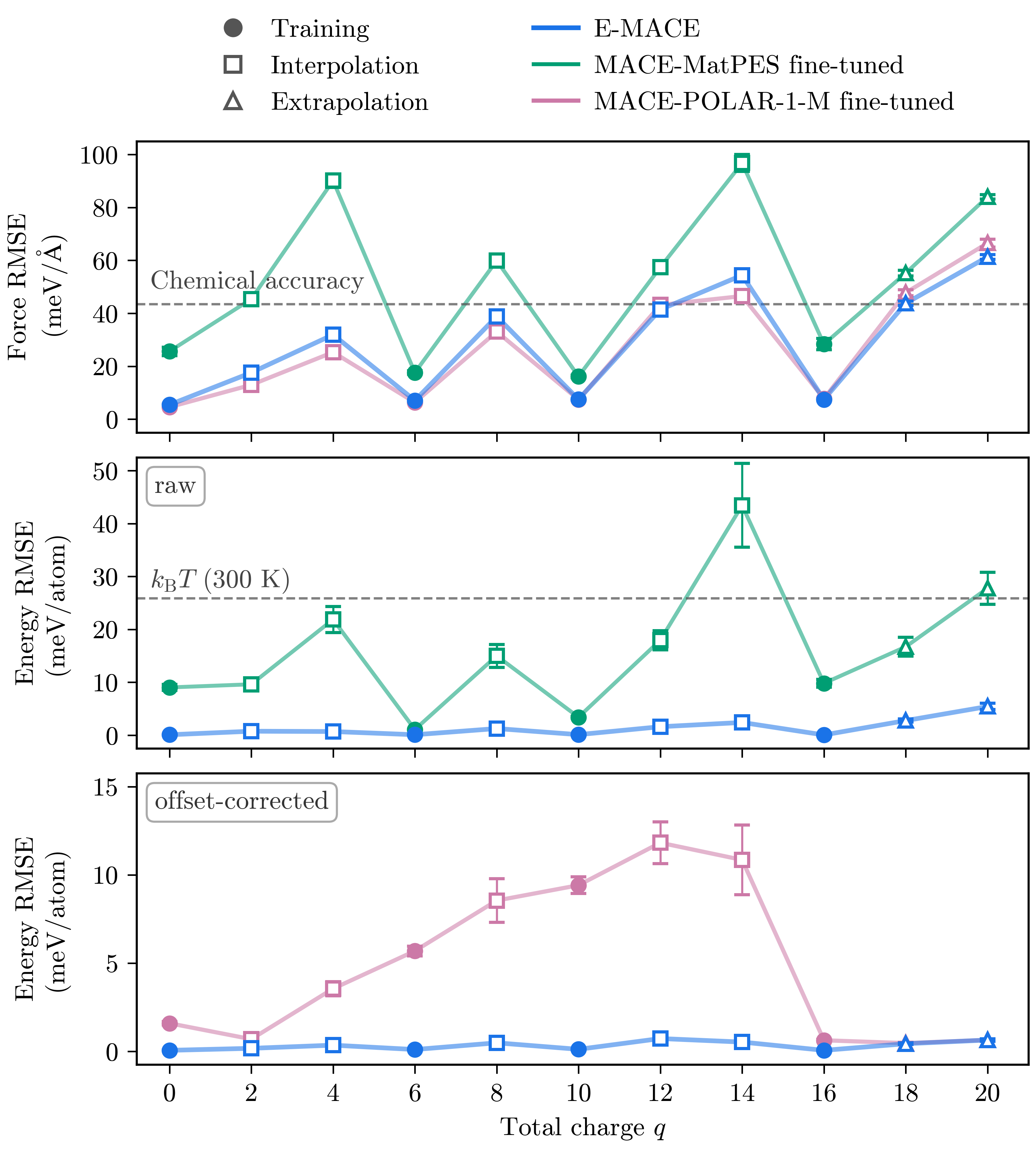
Figure 3: Per-charge RMSE for force and energy on training, interpolation, and extrapolation splits; E-MACE delivers competitive or superior performance across the full axis.
Data and Parameter Efficiency
A strong attribute of EquiFiLM is its outstanding data efficiency. Energy RMSE saturates at ≈0.2 meV/atom with just 25% of the training set (≈1,600 frames), and force RMSE saturates at ≈8 meV/Å with 50% (≈3,200 frames). Adapter width variation (h=64 vs h=128) provides marginal gains, confirming that most benefits stem from architectural design rather than gating capacity. Ablation studies indicate that even additive gating (β) alone recovers the majority of the benefit, with multiplicative gating (γ) potentially essential only for axes inducing strong feature rescaling (e.g., temperature).
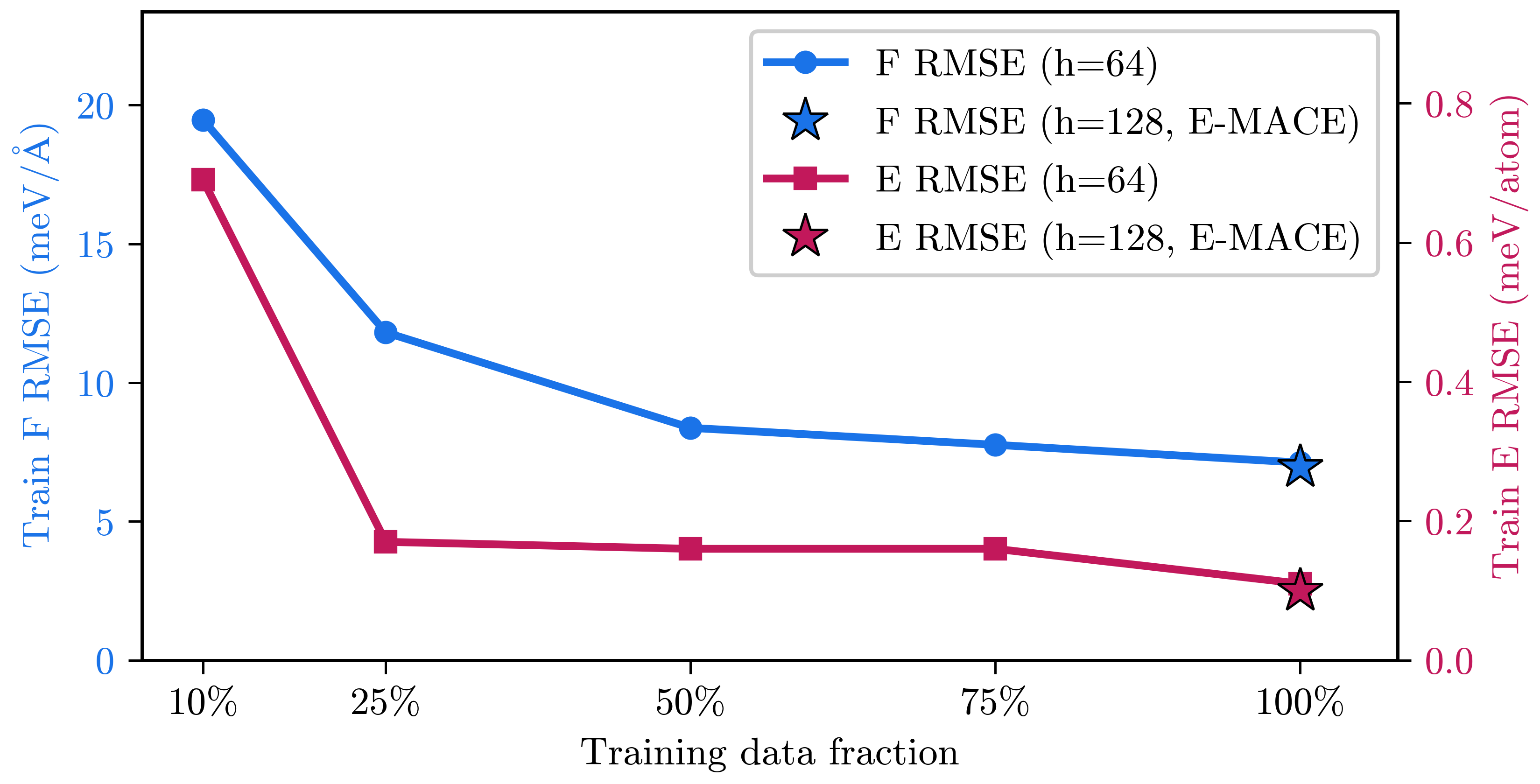
Figure 4: Training charge mean force and energy RMSE versus training set fraction, revealing rapid saturation and high sample efficiency.
Physical Fidelity and Generalization
The generalization capabilities of E-MACE are subjected to stringent tests:
- Energy conservation in MD simulations (microcanonical NVE) across interpolation and extrapolation charges is within 0.01 meV/atom drift over 1.5 ps, signifying that the FiLM-based conditioning does not introduce artificial non-conservative force artifacts.
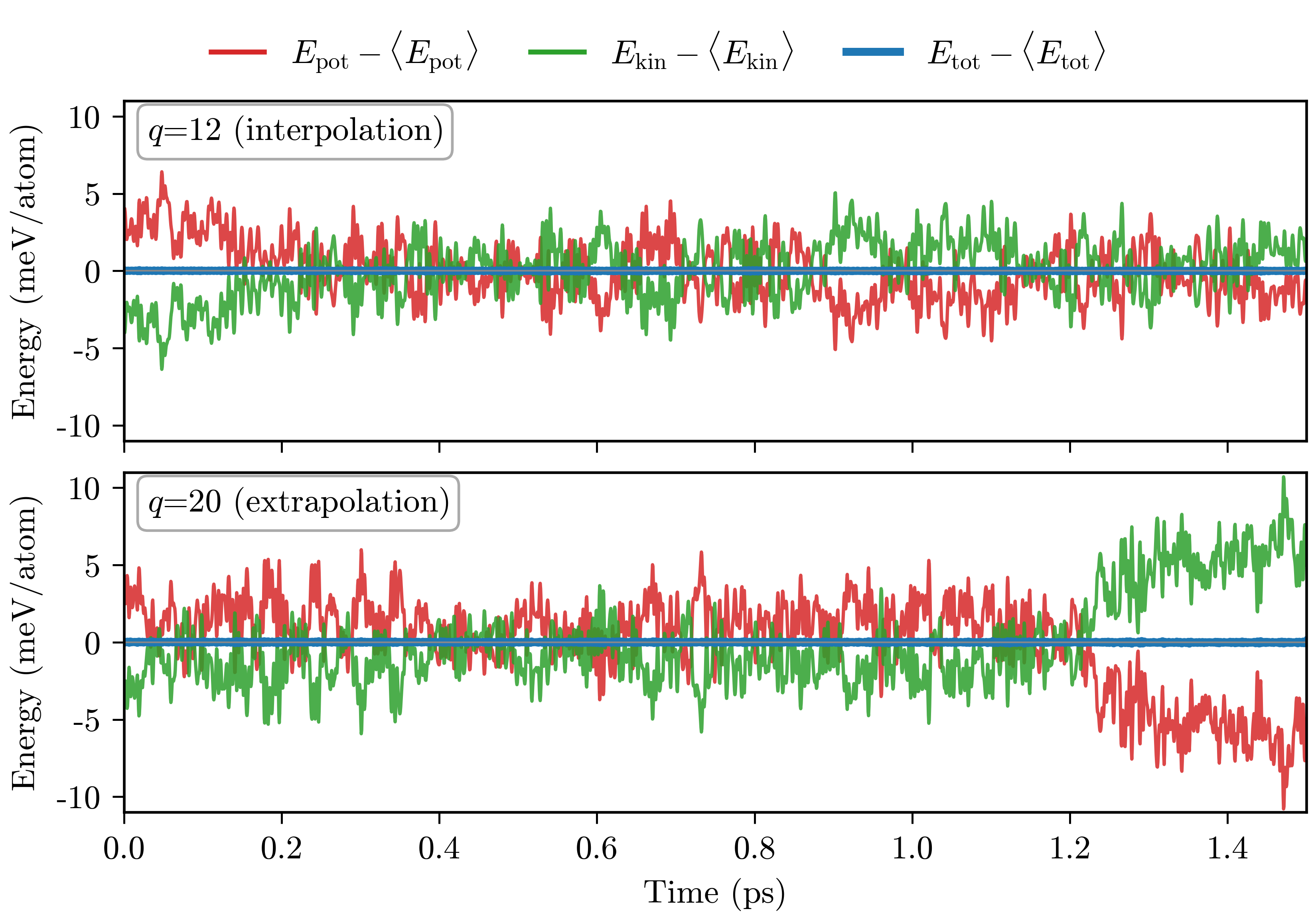
Figure 5: Energy conservation during NVE dynamics at interpolation and extrapolation charges; total energy remains stable.
- Physical structural response prediction: E-MACE correctly captures and interpolates the charge-induced shifts in O-O coordination shell positions and H–H pair correlations in liquid water, a signature observable in ultrafast electron diffraction.
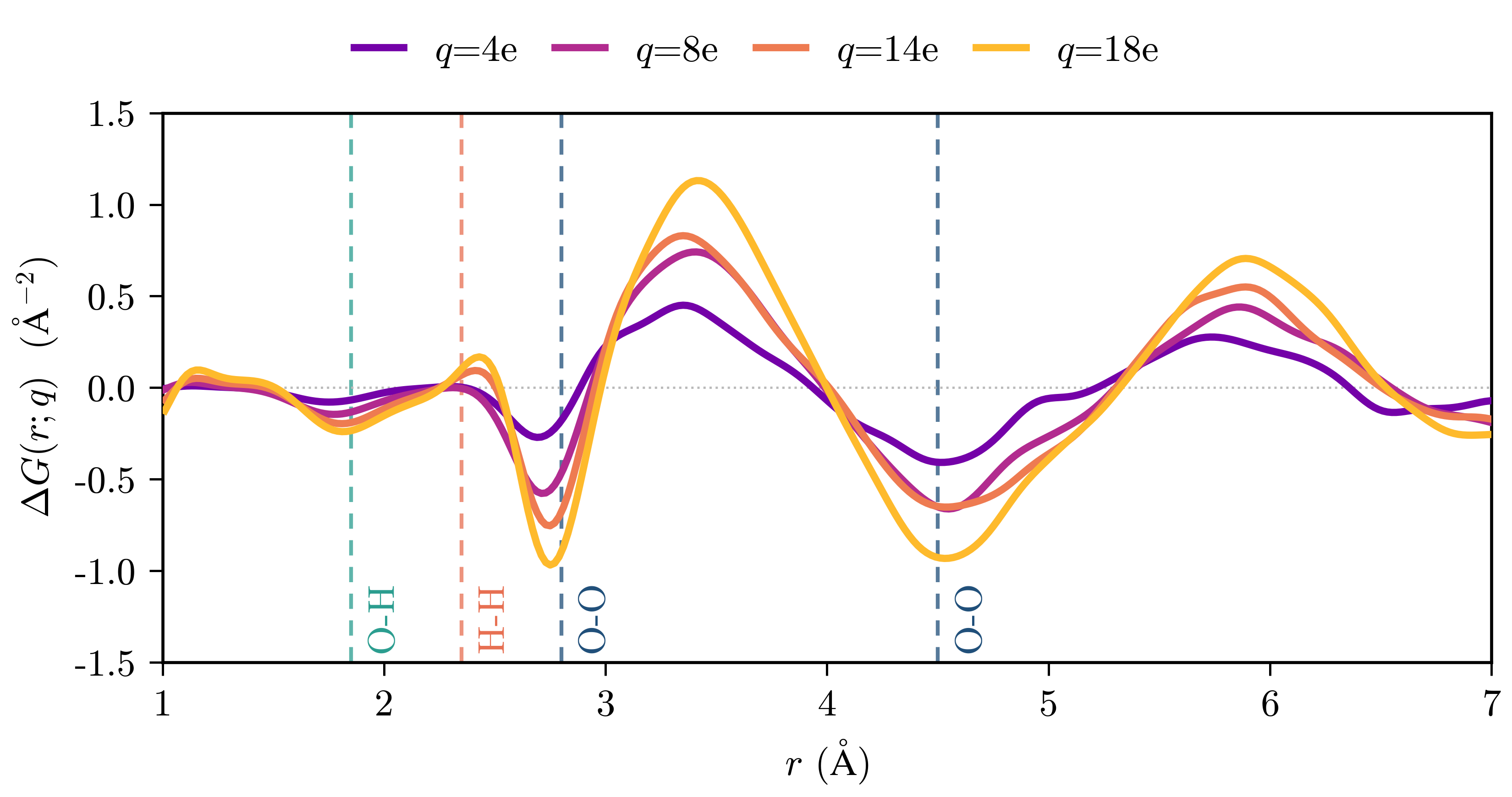
Figure 6: Equilibrium charge response in the reduced PDF from E-MACE MD; outward shift and monotonic scaling of first-shell features with increasing charge.
- Cross-method validation: The force response with respect to charge predicted by E-MACE matches independent DFT (GPAW/PBE) calculations on held-out geometries, with discrepancies only at lowest-charge regimes, likely reflecting both functional and data limitations rather than model pathology.
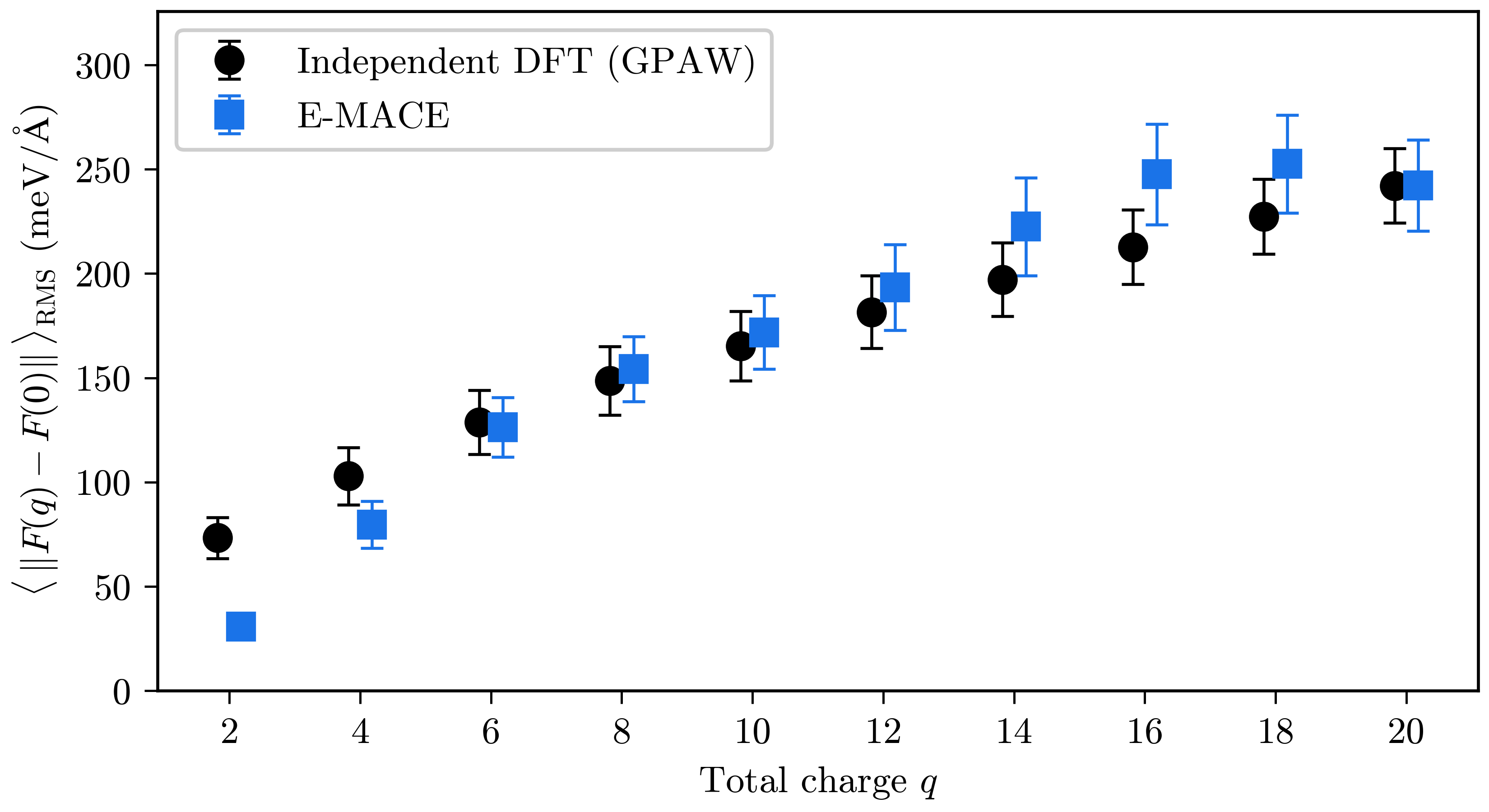
Figure 7: Agreement between E-MACE-predicted and independent DFT force-difference response across the charge axis.
Finite-size effects are excluded via transfer to a 2,592-atom supercell, where E-MACE maintains energy conservation and recovers the same charge-dependent pair-distribution responses, ensuring scalability and robustness.
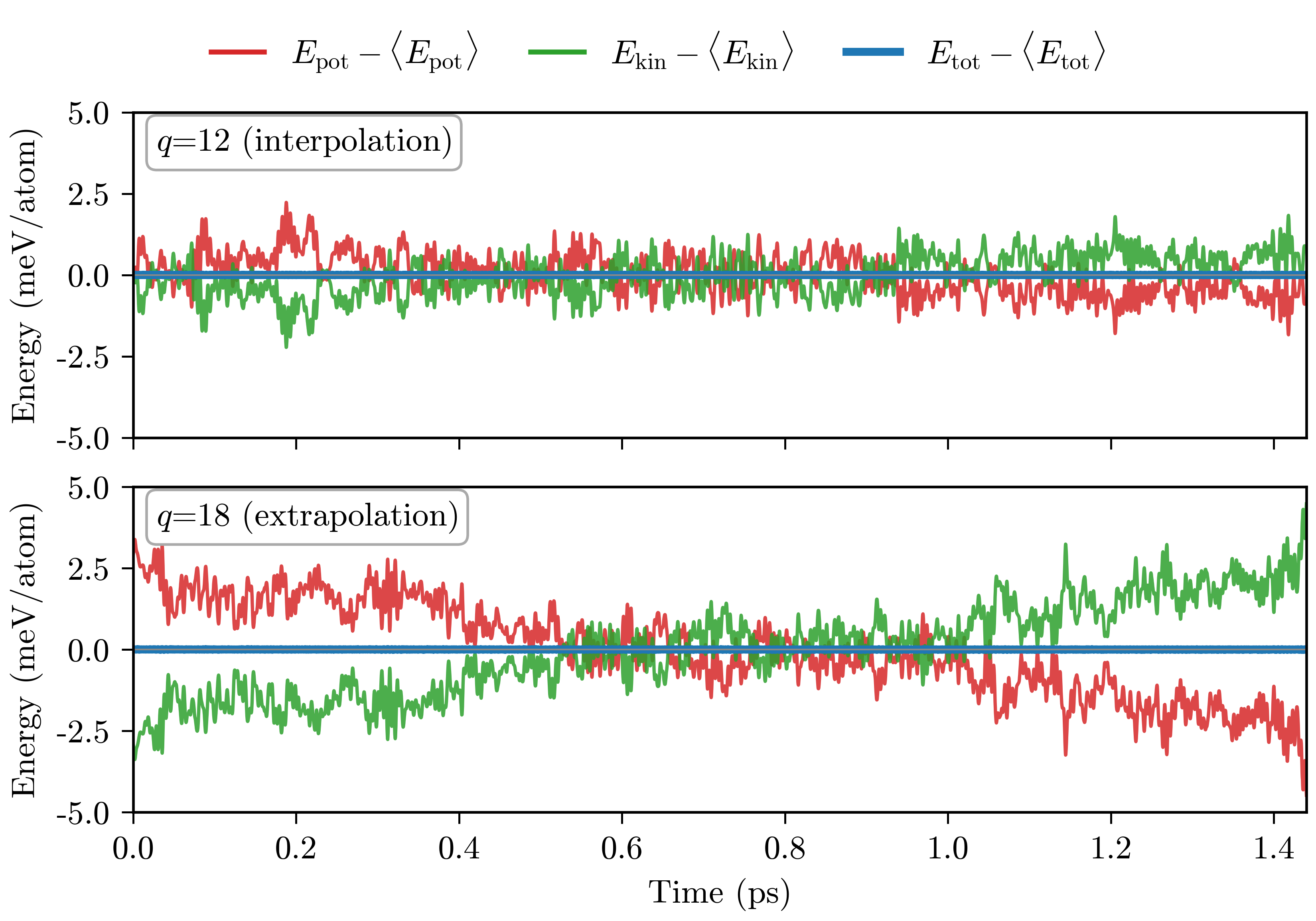
Figure 8: Energy conservation in large supercell MD across charge values.
Theoretical and Practical Implications
EquiFiLM demonstrates that parameter-efficient, conditional adapters can furnish foundation MLFFs with external control axes—such as charge—requiring orders-of-magnitude less data and computational expense than retraining dedicated charge-aware models. The approach:
- Preserves full E(3)-equivariance.
- Maintains inference cost.
- Is agnostic to the backbone model, applicable to any equivariant force field possessing scalar channels.
- Is generalizable for other continuously-valued driving variables, including temperature, pressure, or doping fraction, without modification of architecture.
This reduces foundational model adaptation to a tractable fine-tuning problem, provided the underlying chemistry remains within backbone coverage and the dependence on the external axis is smooth.
Limitations and Future Directions
The efficacy of EquiFiLM is conditioned on the backbone’s representational sufficiency for unperturbed chemistry and on the smoothness of the target property along the conditioning axis. Conditioning on categorical or discrete axes, handling multi-axis conditioning, and regimes involving sharp, non-smooth phase transitions or strongly localized charge phenomena remain unexplored. Extension to other architectures (e.g., NequIP, Allegro) and other physicochemical axes is an open area for future research, as is empirical validation for axes that induce more nontrivial rescaling or require richer equivariant interventions.
Conclusion
EquiFiLM extends the paradigm of parameter-efficient conditional adaptation to the domain of equivariant atomistic force fields, circumventing the necessity of dedicated charge-aware foundation models. It robustly adds externally controlled axes—demonstrated for electronic charge—by modulating only scalar feature channels, with no sacrifice to physical fidelity, inference efficiency, or model generality. As MLFF architectures proliferate across chemistry, materials science, and condensed matter, this approach positions adapter-based conditioning as a central tool for bridging ground-state models with technologically relevant driven and excited-state processes.