- The paper presents a FCIQMC approach that accurately computes nuclear structure via a stochastic method, overcoming challenges of full CI methods.
- It details algorithm steps such as spawning, death/cloning, and annihilation, enhanced by a heat-bath excitation generator and adaptive shift.
- Benchmark tests on various nuclei confirm robust convergence and effective extrapolation techniques that mitigate initiator bias and walker-number dependencies.
Full Configuration Interaction Quantum Monte Carlo for Accurate Nuclear Structure: Algorithms and Calculation Details
Introduction and Context
This paper presents a comprehensive and technically detailed implementation of the Full Configuration Interaction Quantum Monte Carlo (FCIQMC) method tailored for accurate ab initio nuclear structure calculations using chiral effective field theory (EFT) Hamiltonians (2607.05525). The need for such a stochastic many-body solver arises from the computational intractability of deterministic full configuration interaction (FCI) in large nuclear Hilbert spaces, and the limitations of truncated methods (e.g., many-body perturbation theory (MBPT), in-medium similarity renormalization group (IMSRG), and coupled-cluster (CC) expansions) in quantifying residual errors at high excitation rank. FCIQMC is thus positioned as a systematically improvable, excitation-rank-unconstrained alternative that can access high-order correlations in both closed- and open-shell nuclei.
FCIQMC Algorithmic Framework
The FCIQMC approach represents the many-body wave function in a Slater-determinant (SD) basis as a distribution of signed walkers, which evolve in imaginary time under a stochastic propagation algorithm. The Hamiltonian is never stored explicitly; all matrix elements are generated on-the-fly during the simulation, crucial for large nuclear model spaces.
The core propagation involves three steps per time slice:
- Spawning: Walkers on determinant Di stochastically attempt to spawn onto connected determinants Df, with probabilities proportional to the absolute value of the off-diagonal Hamiltonian matrix elements.
- Death/Cloning: Each walker may be removed or cloned depending on the difference between the diagonal Hamiltonian element and a dynamically adjusted energy shift.
- Annihilation: Opposite-signed walkers on the same determinant cancel, ensuring the correct sign structure for the fermionic wave function.
An essential modification for nuclear systems is the adoption of a heat-bath excitation generator, which samples excitations efficiently according to the magnitude of interaction matrix elements, minimizing wasted stochastic effort on negligible couplings.
Treatment of Initiator Bias and Adaptive Shift
FCIQMC’s sign problem is mitigated by the initiator approximation (i-FCIQMC), wherein spawning from determinants with occupation below a fixed threshold (ninit) is restricted except when the destination is already occupied. This introduces a walker-number-dependent bias, removable in the limit of infinite walkers. The adaptive shift (AS) refinement further accelerates convergence by dynamically assigning local energy shifts to non-initiator determinants, parameterized by an offset; the residual bias is then more efficiently suppressed as walker population increases.
Observable Estimation and Reduced Density Matrix Sampling
For ground-state energy, the method combines:
- Projected estimators relying on a reference determinant,
- Trial estimators using a compact diagonalization in a trial subspace,
- Pure estimators via unbiased sampling of the reduced density matrix (RDM) using independent walker replicas.
The RDM formalism is critical for accessing non-commuting observables, such as radii. Diagonal and off-diagonal elements are accumulated during propagation, normalized, and symmetrized post-sampling.
Benchmark Results and Numerical Validation
Imaginary-Time Dynamics
A typical FCIQMC calculation for the 8Be ground state demonstrates clean walker population stabilization and rapid convergence of the projected energy and angular momentum observables.
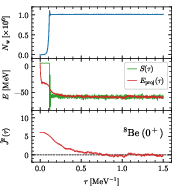
Figure 1: Representative FCIQMC imaginary-time evolution for the 8Be Jπ=0+ ground state in the emax=10 space, showing walker number growth, energy shift convergence, and ⟨J^2⟩ stabilization.
The benefits of multi-configurational initialization and use of trial estimators for open-shell systems—substantially reducing equilibration time and variance—are demonstrated.
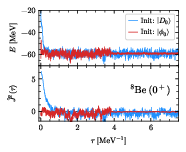
Figure 2: Effect of multi-configurational initialization and trial estimators for the 8Be calculation; initialization from a pre-converged walker distribution speeds up convergence versus a single determinant.
Small-Space Benchmarks
Exact FCI calculations in Di0 model space for Di1He, Di2Be, Di3C, and Di4O validate the stochastic propagation, estimator choices, and RDM sampling.
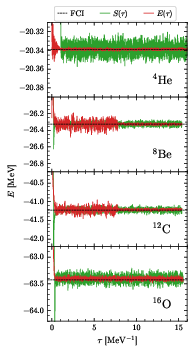
Figure 3: Imaginary-time evolution of energies and shifts for several nuclei in the Di5 model space, showing convergence to exact FCI values.
Walker-number convergence studies for Di6O demonstrate that both ground-state energies and radii obtained from FCIQMC coincide with deterministic FCI as the walker number increases and initiator/AS schemes are tuned.
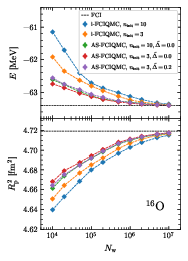
Figure 4: Walker-number convergence of Di7O energy and radius, showing systematic reduction of initiator bias and approach to exact values.
Large-Space and Infinite-Walker Extrapolation
In the Di8 model space, energies for light nuclei (e.g., Di9He) converge directly with walker number. For heavier systems, RDM-based quantities (notably radii) display residual walker-number dependence. Here, a power-law (Df0) extrapolation, with Df1 fixed by the requirement of projected and pure estimator consistency, is deployed to obtain infinite-walker estimates.
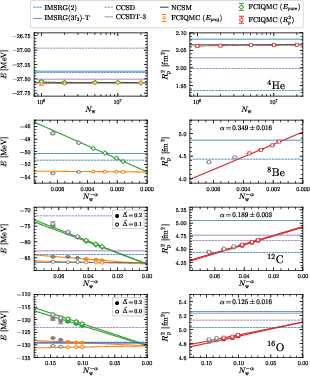
Figure 5: Walker-number and infinite-walker extrapolation of ground-state energy and point-proton radius for selected nuclei in the Df2 space. Energies converge rapidly, while RDM-based radii require extrapolation.
The validity and robustness of the extrapolation approach are confirmed through both self-consistency and independence from the adaptive shift offset parameter.
Independent calculations for symmetric nuclear matter at saturation density also exhibit the same large-walker power-law bias convergence pattern.
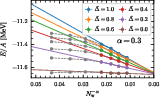
Figure 6: Extrapolation of projected energy per particle in symmetric nuclear matter as a function of inverse walker number.
Excited-State Extension
The multi-state FCIQMC extension is employed for the low-lying spectrum of Df3Li, demonstrating simultaneous propagation and orthogonalization of multiple walker ensembles. Rapid stabilization of both energies and angular momenta indicates effective isolation of target states.
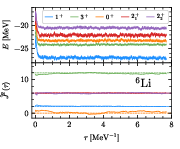
Figure 7: Imaginary-time evolution of the five lowest states of Df4Li, with projected Df5 and Df6 converging to their respective plateaus.
Excitation energies as a function of walker number confirm the method’s capacity to yield a converged and correctly ordered spectrum, with superior efficiency over NCSM for equivalent accuracy.
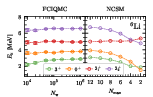
Figure 8: FCIQMC excitation energy convergence for Df7Li versus walker number, with direct comparison to deterministic NCSM convergence.
Implications and Future Directions
This work establishes FCIQMC, complemented with initiator and AS schemes, as a systematically controllable stochastic many-body solver for Df8 nuclear structure, free from excitation-rank truncations. Pure estimators via RDM sampling deliver access to observables sensitive to high-order correlations, with uncertainties dominated by walker-number (rather than basis or method) limitations. The walker-number extrapolation protocol, substantiated both in finite nuclei and nuclear matter, provides a practical path to quantifiable uncertainty control. The multi-state extension enables direct treatment of excited states and low-lying spectra without resorting to global truncations.
The demonstrated capacity to treat mid-Df9-shell nuclei and nuclear matter paves the way for future studies involving explicit three-nucleon forces, systematic exploration of deformation and clustering, and extensions to more collective observables and electroweak transitions. The method presents a rigorous benchmark for testing the residual errors of approximate many-body expansions.
Conclusion
The presented algorithmic framework substantiates FCIQMC as an unbiased and highly flexible stochastic solver for nontrivial nuclear Hamiltonians in large model spaces. Rigorous walker-number and estimator convergence analyses, robust treatment of residual sign problem bias, and the demonstrated extension to excited-state spectroscopy consolidate its potential as a reference approach for quantifying nuclear many-body uncertainties and exploring complex correlation-driven phenomena in medium-mass nuclei (2607.05525).