- The paper establishes empirical scaling relations linking star–disc collision parameters to observed QPE flare properties.
- It employs 3D SPH simulations with flux-limited diffusion to quantify shock heating, outflow asymmetries, and lightcurve evolution.
- The results support the star–disc collision scenario as a viable engine for QPEs and call for more comprehensive global modeling.
Systematic Radiation-Hydrodynamic Study of Star–Disc Collisions: Parameter Dependence of Outflows and Lightcurves
Introduction
This work presents a comprehensive parameter study of star–disc collisions using three-dimensional local radiation-hydrodynamics simulations. The context is the origin of quasi-periodic eruptions (QPEs), a class of soft X-ray nuclear transients associated with accreting supermassive black holes (SMBHs). QPEs display recurrent, hour-to-day flares with peak luminosities Lpeak∼1041–1043 erg s−1 and alternate long–short, strong–weak patterns. One leading model posits that intermittent star–disc collisions are the energy source for these transients, requiring robust, predictive models to connect local hydrodynamics with observed flare properties. This paper focuses on systematically varying the local disc and stellar parameters to quantify their effects on the hydrodynamics, outflow characteristics, and observable signatures.
Simulation Setup and Methodology
Simulations are performed with the Phantom SPH code, adopting a local Cartesian domain centered on the disc midplane. Fiducial parameters correspond to a 106M⊙ SMBH and a $4$ h QPE period, with a solar-radius star crossing a radiation pressure-dominated, optically thick α-disc (α=0.1, M˙/M˙Edd=0.1). The study independently varies:
- Stellar velocity v⋆
- Disc surface density Σd
- Stellar radius 10430
- Disc vertical density profile
- Local collision angle 10431
Radiation transport employs the flux-limited diffusion approximation in LTE, and the star is modelled as a rigid sphere. Effects such as disc self-gravity, rotation, coronal layers, and detailed stellar response are neglected to focus on the local, short-timescale hydrodynamics dominant during a crossing.
Dynamical Evolution of Star–Disc Collisions
The collision process robustly proceeds through four key stages: bow-shock formation, heating and shock propagation, lateral and wake outflow formation, and breakout-driven radiative losses. The shocked gas and associated radiation energy densities are initially trapped, subsequently being liberated as the outflow expands and photon diffusion timescales decrease.
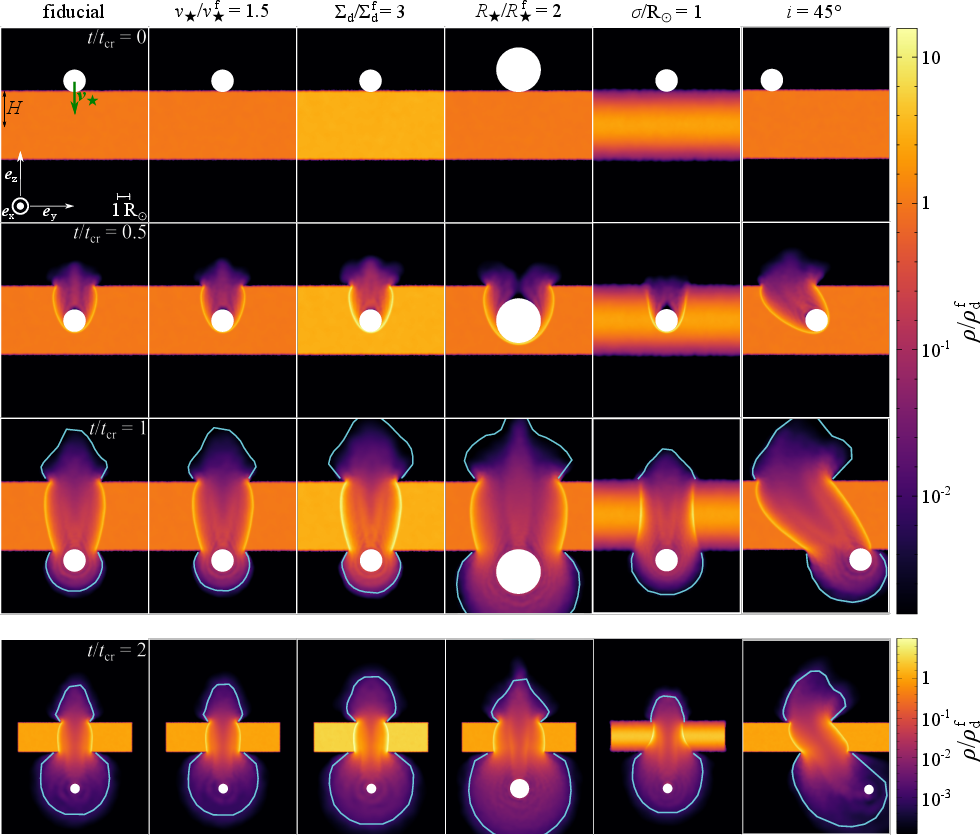
Figure 1: Gas density slices in the 10432-plane at 10433 illustrate outflow structures for fiducial and parameter-varied simulations at successive stages.
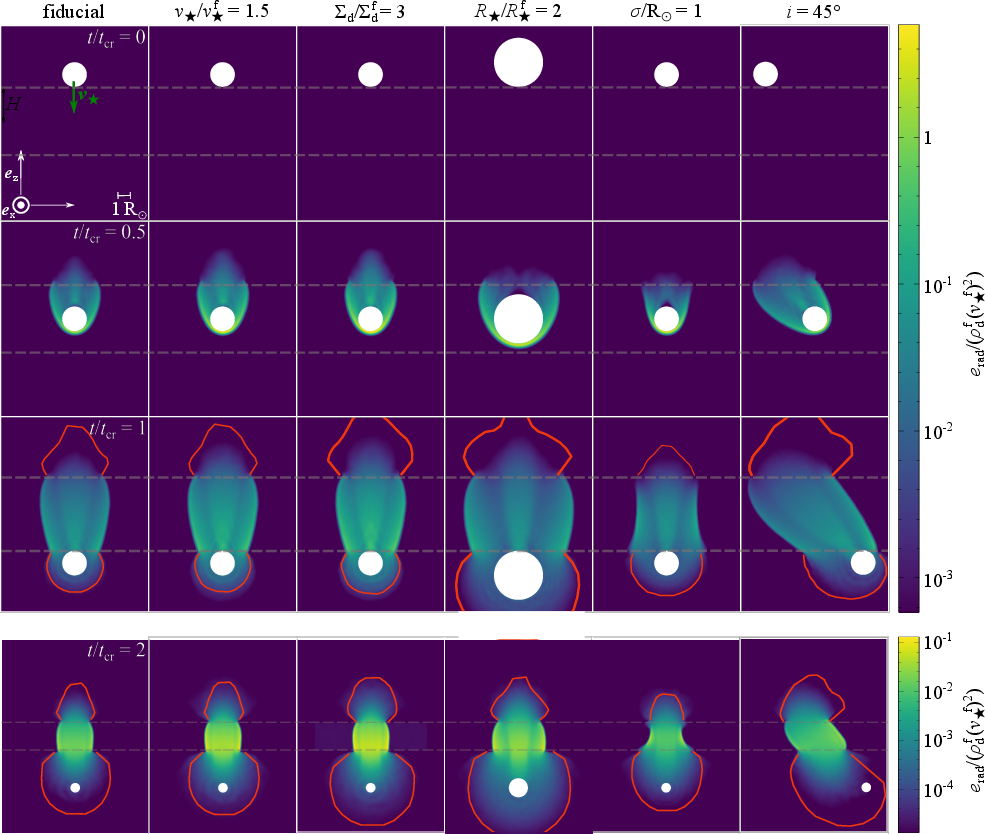
Figure 2: Radiation energy density slices at matching epochs highlight the redistribution of photon energy as a function of system parameters.
Qualitatively, the outflow morphology retains its generic structure under variations of 10434 and 10435, but becomes increasingly asymmetric for larger 10436 and for more perpendicular (10437) crossings. More grazing impact geometries (10438) produce elongated cavities and reduce forward–backward outflow asymmetries.
Shock Heating and Outflow Kinematics
Shock heating, quantified via the energy injection rate 10439, strongly scales with −10 and −11, but is largely invariant in dimensionless form across changes in −12 and −13 at fixed geometry.
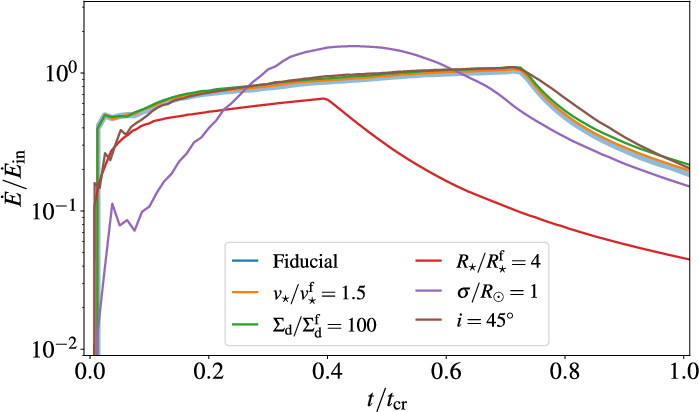
Figure 3: Shock heating rate −14 over time for varying parameters demonstrates near-invariant temporal profiles for −15 and −16.
Vertical momentum analysis reveals systematic forward–backward outflow asymmetries that are controlled by −17 and −18; specifically, −19 and 106M⊙0, with asymmetry vanishing for 106M⊙1.
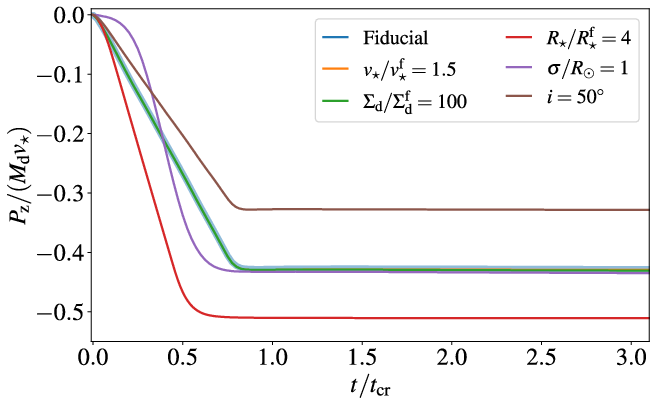
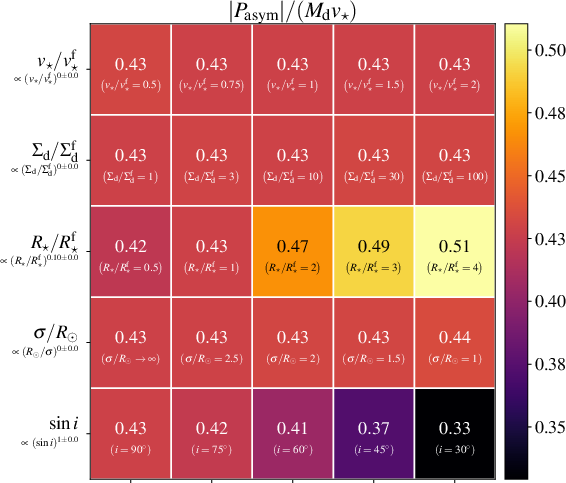
Figure 4: Time evolution and parameter-dependence of outflow momentum, emphasizing reduced symmetry for small 106M⊙2 or large 106M⊙3.
Mass outflow rates 106M⊙4 for both forward and backward directions follow analogous trends, with late-time constancy linked to the lateral expansion geometry and buildup of shocked gas.
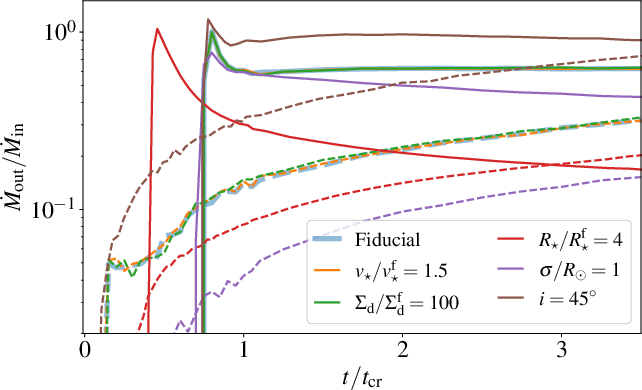
Figure 5: Mass outflow rates for different parameter regimes, demonstrating consistent trends for 106M⊙5, 106M⊙6, and distinct evolution for 106M⊙7, 106M⊙8, and disc density profile.
Outflow Emission and Synthetic Lightcurves
The simulated bolometric lightcurves are obtained by integrating diffusive and advective fluxes escaping through the photosphere of the outflow, resolved independently for forward and backward directions.
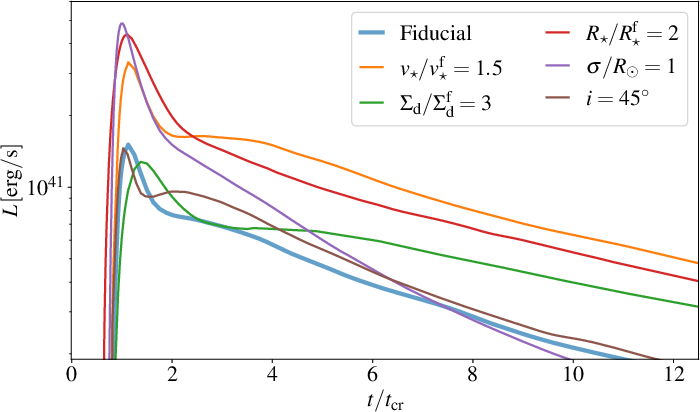
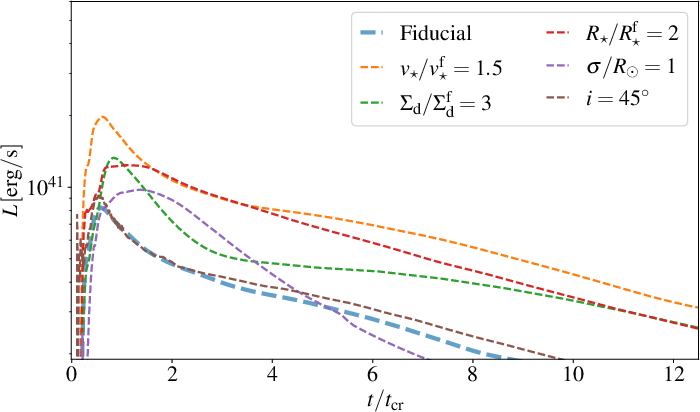
Figure 6: Temporal evolution of emergent luminosity for forward and backward outflows, and impact of parameter variation on peak, duration, and asymmetry.
Key scaling relations are derived and fit empirically:
- 106M⊙9; $4$0
- $4$1 (forward), $4$2
- $4$3 (backward), $4$4
- Disc vertical concentration (smaller $4$5) produces brighter and shorter flares
These trends are captured in two-dimensional heatmap illustrations:
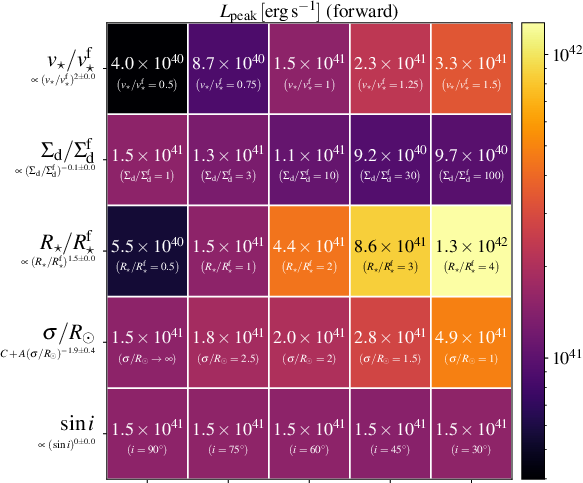
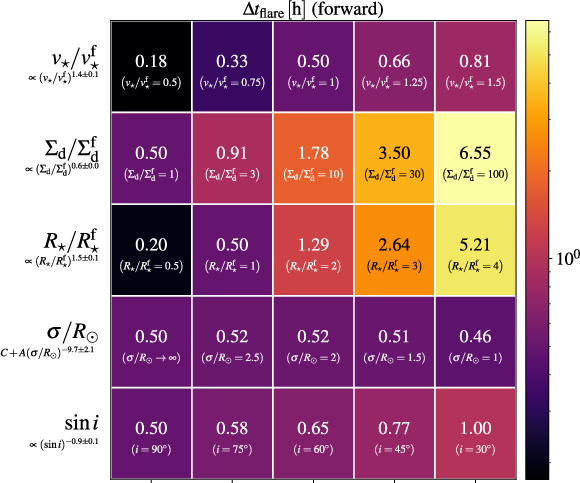
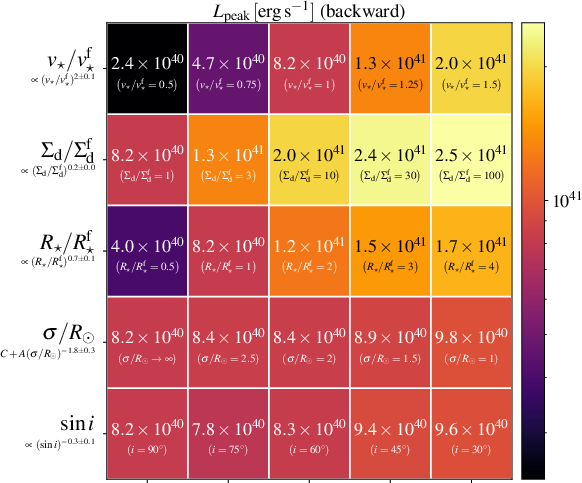
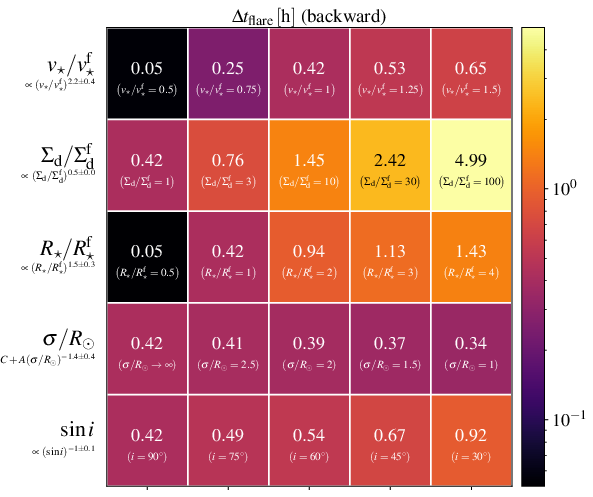
Figure 7: Heatmaps of $4$6 and $4$7 reveal monotonic or weak dependencies for each varied parameter, clarifying the governing physical processes.
Application to Observed QPEs: Parameter Constraints
Utilizing these empirical relations, the parameter space compatible with well-studied QPE sources (GSN 069) is mapped by matching observed $4$8, flare duration, duty cycles, and strong–weak patterns.
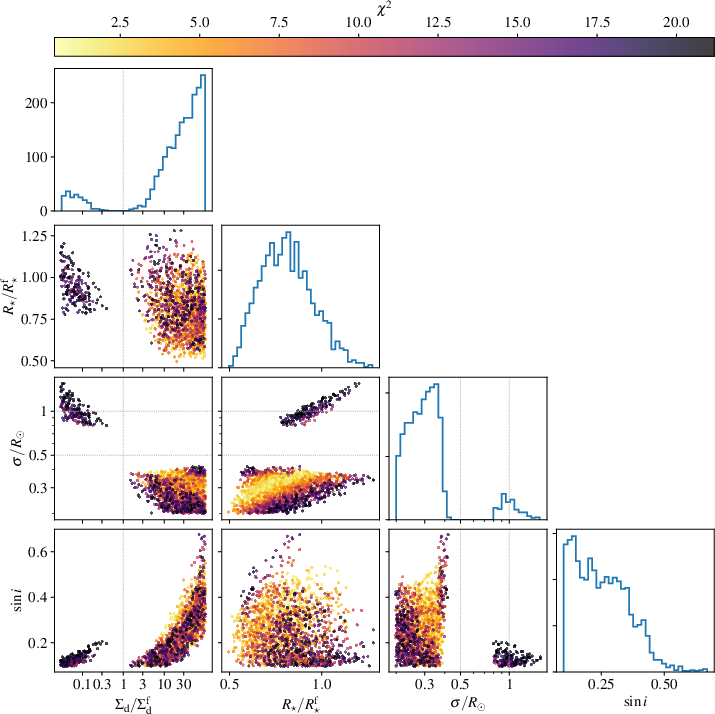
Figure 8: Corner plot of parameter space regions reproducing GSN 069 flare properties within a factor of three, showing preference for retrograde, post-TDE disc solutions or, alternatively, very grazing low-density discs.
Candidate solutions divide into two families:
- High surface density ($4$9 fiducial), vertically concentrated discs (α0), mildly sub-solar α1, and retrograde collisions;
- Lower α2, more standard disc thickness, but requiring extremely grazing (α3) geometries.
The first branch is most compatible with TDE-formed discs, with geometrically thin, high-density structures inferred.
Implications and Theoretical Consequences
The results provide robust quantitative support for the star–disc collision scenario as a plausible engine for QPEs, particularly when disc structure, collision geometry, and stellar properties conspire to produce the range of observed flare behavior. The sensitivity of α4 and α5 to α6, α7, α8, and α9 reinforces prior semianalytic and lower-dimensional findings, while the 3D modeling confirms that overall collision morphology is resilient to most parameter variations but that radiative and kinematic asymmetries are highly parameter-dependent.
The modeling also exposes limitations—most notably, the need for future simulations incorporating global disc rotation, magnetic fields, non-Gaussian disc profiles, evolving stellar structure, and full spectral transport, rather than grey LTE. The neglect of viewing angle, shearing, and post-collision disc evolution restricts direct comparison to detailed X-ray lightcurves and spectra.
Conclusion
This work establishes empirical scaling relations linking local star–disc collision parameters to outflow dynamics and observable flare properties using 3D radiation-hydrodynamics simulations. It demonstrates that QPE phenomenology, including the strong–weak alternation and parameter-dependent durations, can be reproduced within the star–disc collision framework for specific ranges of disc and impact geometry parameters. The findings strongly motivate further global, long-duration modeling and spectroscopic transport studies for definitive theoretical–observational synthesis, and they provide a critical foundation for interpreting forthcoming QPE data, both photometric and spectroscopic, from current and future high-cadence X-ray missions.