- The paper demonstrates that SN 2019yvr shows a steadily declining CSM density (ρ ∝ r^(-1.65)) indicating moderate mass loss from the progenitor.
- It employs detailed radio (GMRT/VLA) and X-ray (Chandra/Swift) data with SSA modeling to derive shock dynamics, magnetic field evolution, and expansion radii.
- The results suggest that late-time hydrogen features can occur without dramatic CSM density jumps, refining models of binary stripping or Wolf-Rayet wind evolution.
Radio and X-ray Diagnostics of SN 2019yvr: Multiwavelength Constraints on Progenitor Mass Loss
Introduction and Context
The evolution, classification, and progenitor channels of stripped-envelope supernovae (SESNe)—specifically Type Ib explosions that undergo a post-explosion transition to show evidence of dense, hydrogen-rich circumstellar material (CSM)—remains a core question in time-domain astrophysics. SN 2019yvr offered a unique opportunity due to its well-sampled, multi-year radio and X-ray dataset. This event displayed canonical SN Ib-like spectra at early times but developed interaction-driven hydrogen features ∼100 days post-explosion, thus undergoing a rare "Ib→IIn" metamorphosis. The central aim of the study is to reconstruct the CSM properties and mass-loss history of the progenitor based on continuous monitoring in radio (GMRT/VLA) and X-ray (Chandra/Swift) wavelengths over nearly five years (2607.05500).
Data: Observational Basis
The dataset comprises:
- Eleven epochs of GMRT radio observations (1.25, 0.75, 0.4 GHz),
- Five VLA epochs covering 1–26.5 GHz,
- Extended X-ray coverage using Swift-XRT (30+ epochs), and a single Chandra observation at 42 days post-explosion.
Detailed imaging across the electromagnetic spectrum enabled morphological and flux evolution studies:
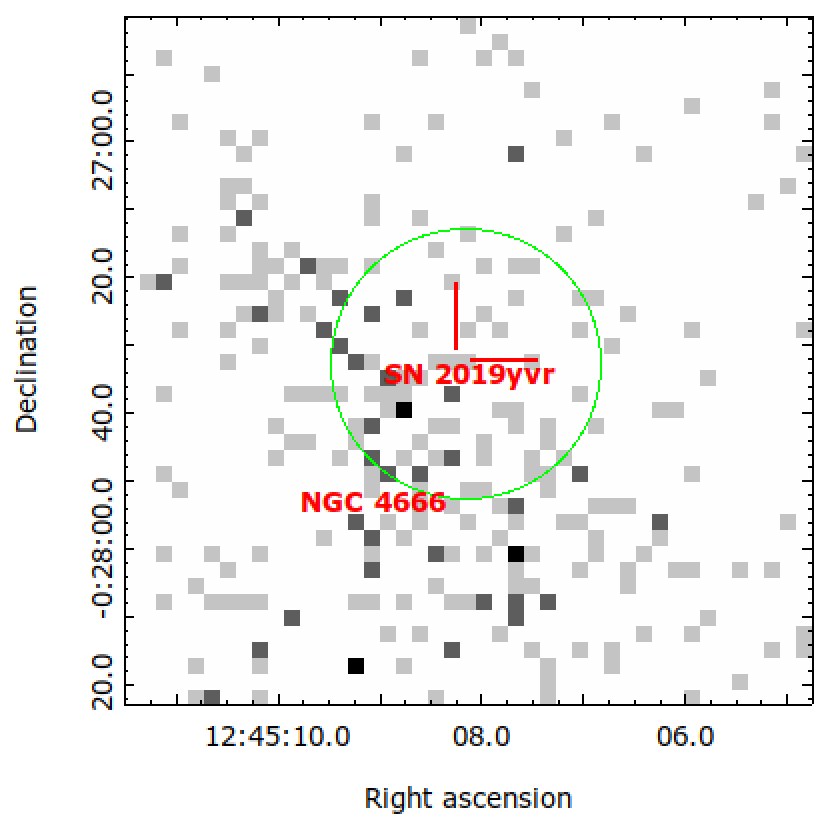
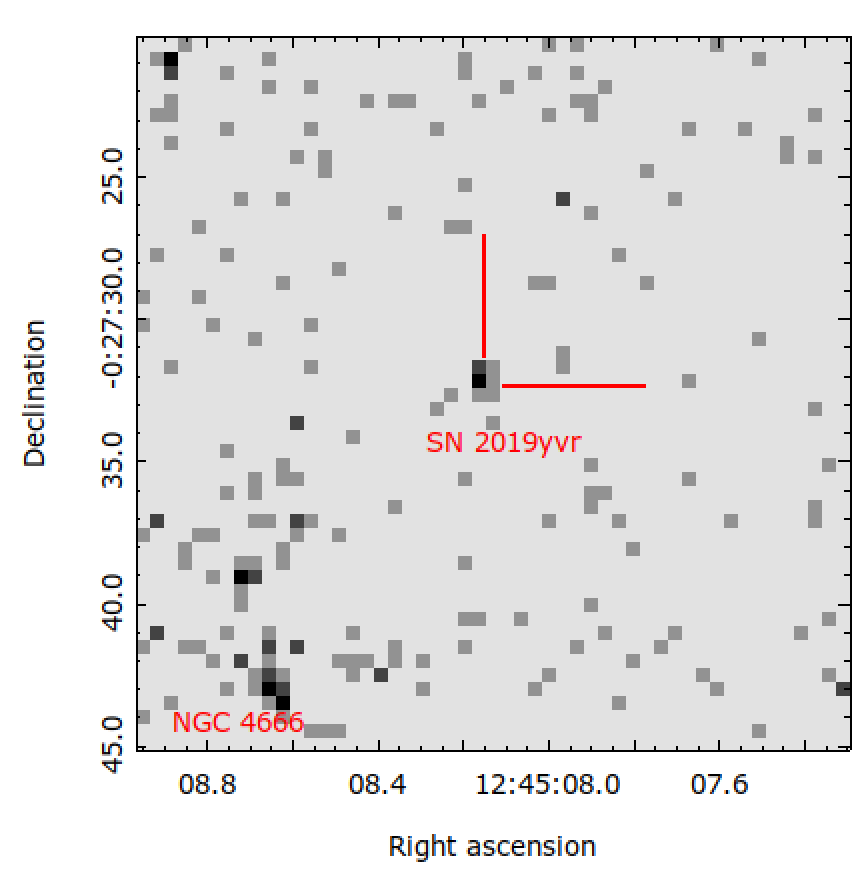
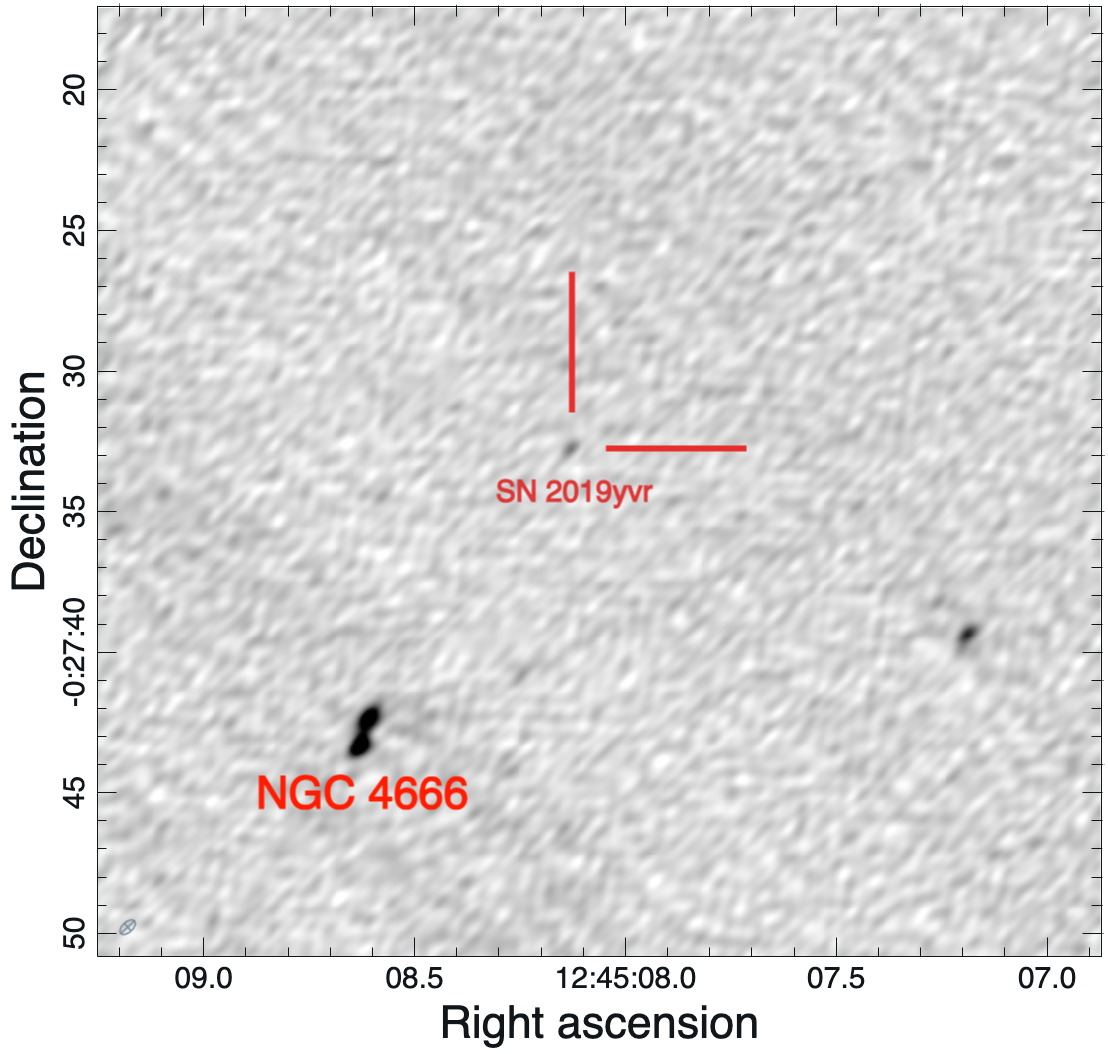
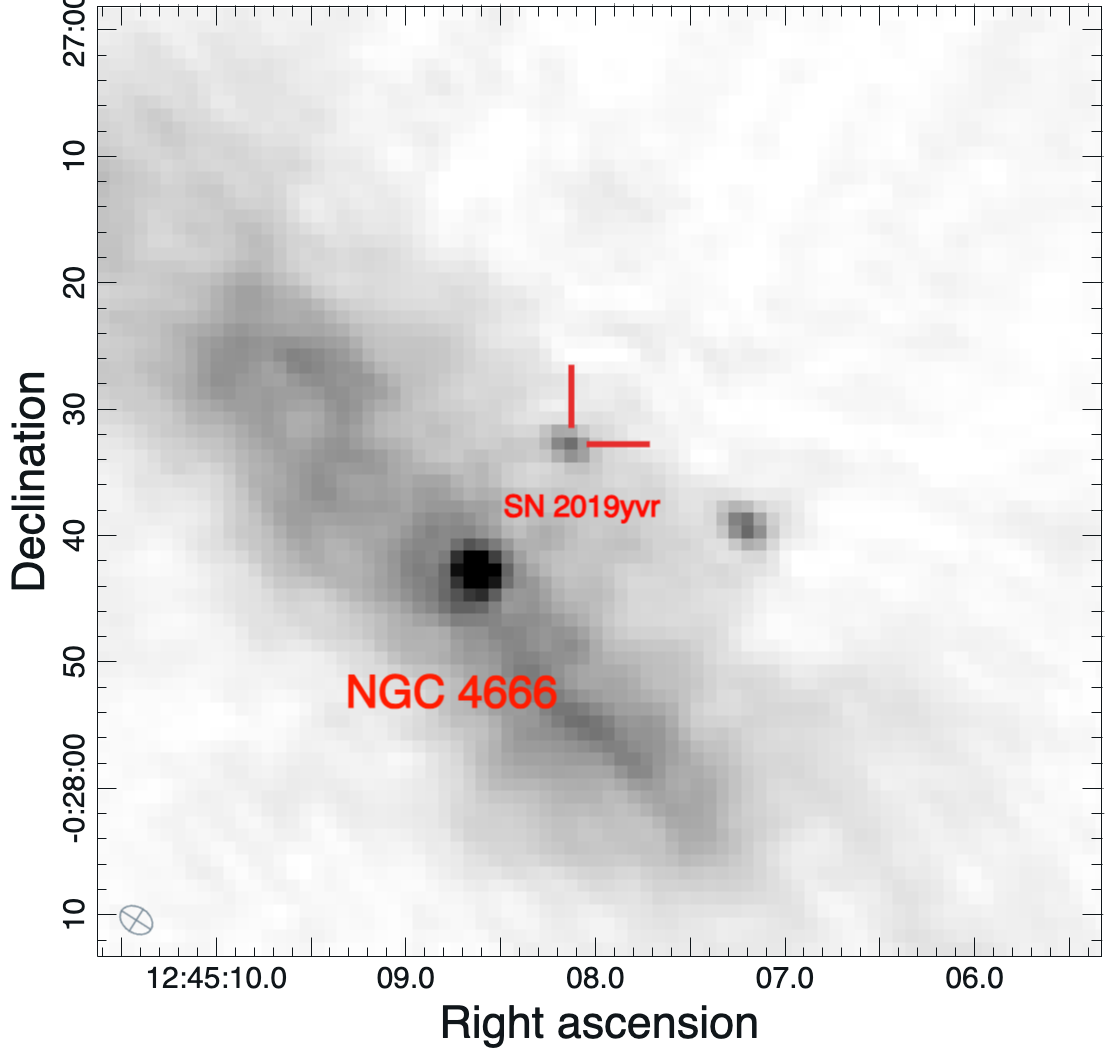
Figure 1: Radio and X-ray images of SN 2019yvr at multiple points in its post-explosion timeline, showing the spatial context of the emission in the presence of a bright host galaxy.
Lightcurve comparison revealed that SN 2019yvr's peak radio fluxes, spectral shapes, and temporal evolution are distinct from canonical SN IIn and resemble the small subset of SESNe with delayed hydrogen features (SN 2014C, SN 2004dk, SN 2019oys).
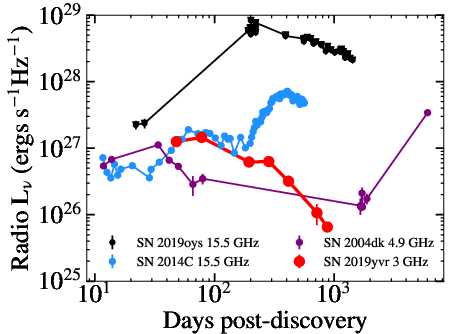
Figure 2: Radio lightcurves at various frequencies for SN 2019yvr and three reference transitional SNe, highlighting similarities and differences in both peak flux and rise/decline behavior.
Radio Analysis: Absorption Regimes and Dynamical Inference
Synchrotron Self-Absorption as the Dominant Mechanism
SSA and FFA models were fit to the full dataset, with the SSA scenario marginally favored (χν2=5.39 versus FFA's $5.77$). No significant free-free absorption signatures are present, differentiating SN 2019yvr from events such as SN 2014C, which exhibited sharp late-time increases in CSM density/FFA opacity.
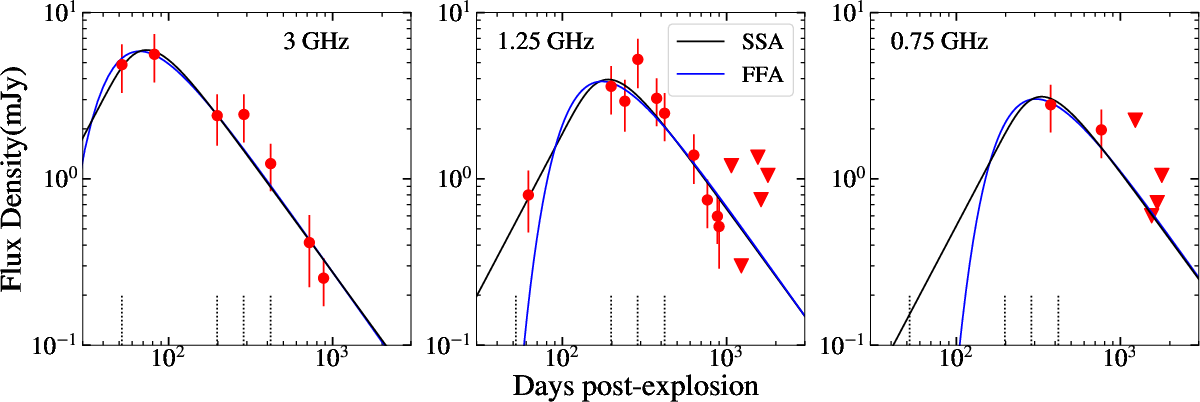
Figure 3: Full radio lightcurves and best-fit SSA/FFA models; model over/underprediction at 1.25 GHz illustrates moderate CSM inhomogeneity.
Single-epoch SSA fits were performed at four key epochs, constraining Fbrk, νbrk, and by extension, post-shock radius (R), magnetic field (B), and shock velocity (Vsh). Derived radii span (1.7−6.1)×1016 cm within the first 419 d, with →0 decreasing from →1 to →2 G due to geometric dilution and shock deceleration.
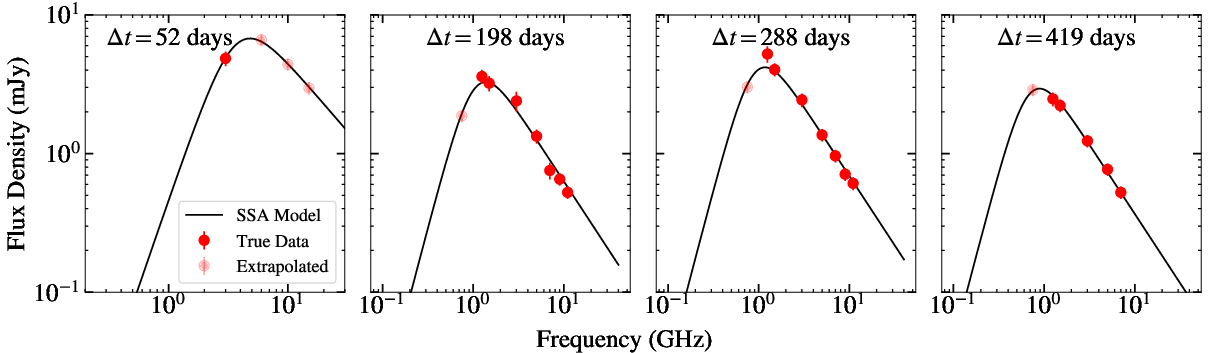
Figure 4: SSA SED fits at four epochs, with extrapolated low-frequency points for turnover constraints.
The shock deceleration parameter →3 (→4) and CSM density profile →5 (→6) were inferred from temporal fits to →7 and →8. The derived mass-loss rate, assuming →9 and χν2=5.390 km/s, ranges from χν2=5.391 χν2=5.392~yrχν2=5.393, consistent with expectations from Wolf-Rayet wind or binary stripping scenarios.
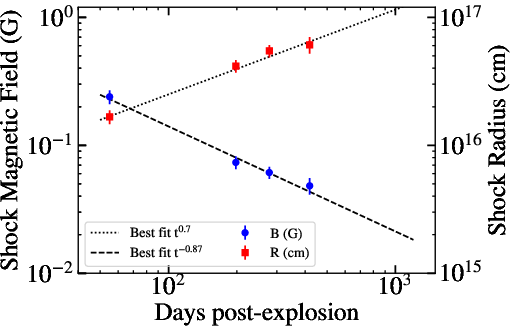
Figure 5: Temporal decline of post-shock χν2=5.394 and expansion of χν2=5.395 from SSA fits.
No significant increase ("jump") in CSM density is observed at the time of optical transition to Hχν2=5.396 dominance, precluding a SN 2014C-like scenario of discrete shell or envelope ejection at large radii.
X-ray Diagnostics: Constraints on Mass Loss from High-energy Emission
Chandra detected SN 2019yvr at 42 days post-explosion at χν2=5.397 erg~sχν2=5.398, with Swift providing upper limits at other epochs. Power-law fits to the X-ray spectrum combined with non-thermal cooling arguments excluded synchrotron X-rays and indicated thermal origin, most likely from the adiabatic reverse shock. Modelling yields a consistent mass-loss rate of χν2=5.399~yr$5.77$0 (large systematic error), supporting the radio-determined values and the absence of late-time X-ray rebrightening seen in denser CSM-interacting SNe.
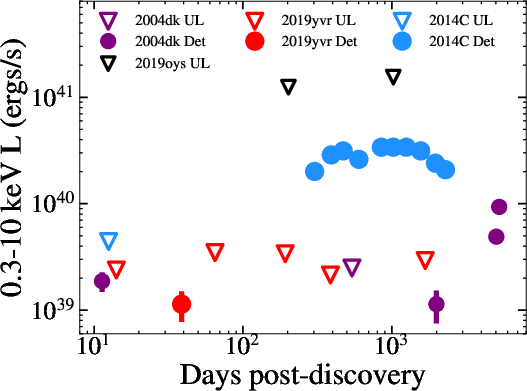
Figure 6: X-ray luminosity evolution of SN 2019yvr versus comparable transitional SNe.
Comparative Analysis: Mass-loss Evolution and Context within Transition SNe
The four transitional SNe currently known (2014C, 2004dk, 2019oys, 2019yvr) exhibit diverse CSM structures:
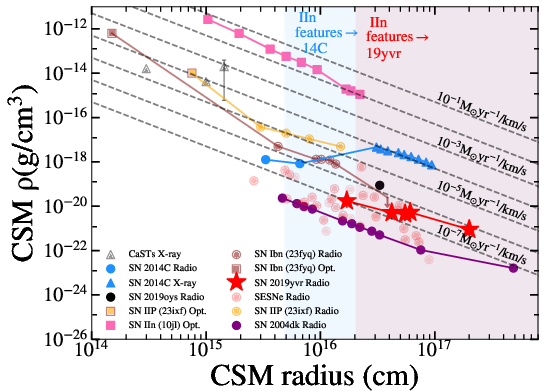
Figure 7: Derived CSM densities for SN~2019yvr versus a range of interacting and non-interacting SNe; transitional SNe occupy an intermediate regime between canonical Ib/c and extreme IIn events.
In SN 2019yvr, the CSM density and mass-loss rate only increase by a factor of $5.77$12–3 at larger radii, while SN 2014C showed orders of magnitude contrast contemporaneous with the emergence of optical interaction signatures. In SN 2004dk, delayed H$5.77$2 onset and radio rebrightening at $5.77$3 days are interpreted as evidence for a wind-blown cavity and secondary CSM shell, while SN 2019oys presents intermediate properties. The majority of SN Ib do not display such CSM interaction, emphasizing the rarity and diversity of progenitor evolution pathways.
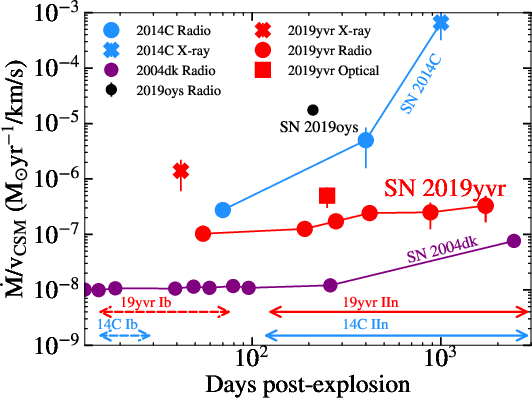
Figure 8: Mass-loss evolution for transitional and regular SESNe, showing the absence of a major density discontinuity in SN 2019yvr at the time of optical transformation.
Progenitor Mass-loss Mechanisms and System-Level Implications
The absence of a strong CSM density jump, coupled with high early-time radio velocities ($5.77$4 km/s), strongly points to a compact progenitor (likely a WR star or low-mass stripped star in a binary system). The measured $5.77$5 CSM profile deviates mildly from wind-like $5.77$6, indicating a history of moderate temporal decline in mass-loss rate, possibly reflecting changes in the binary mass-transfer efficiency or wind driving physics during the final centuries.
Competing scenarios—hydrogen being "hidden" at early times due to optical depth/geometric effects or a moderate, not dramatic, increase in CSM density at $5.77$7100 days—cannot be fully excluded, but are less favored given the radio/X-ray constraints on mass loss and shell geometry.
Implications and Future Prospects
This work demonstrates that SESN progenitors can harbor extensive, modest-density CSM extending to %%%%38χν2=5.39039%%%% cm, ejected over centuries, without requiring late-time, high-density shell formation. Not all IbFbrk0IIn transitions are produced by common-envelope ejection or dramatic binary episodes; instead, a continuum of mass-loss behavior is observable within this rare class.
The combination of high-cadence, multi-wavelength monitoring and detailed spectral fitting is essential for reconstructing the pre-explosion evolution of these progenitors. The lack of a major density discontinuity in SN 2019yvr sets constraints on binary stripping and WR wind models, suggesting that dramatic "optical metamorphosis" can proceed without an associated CSM density spike. Larger, more systematically targeted samples with future radio arrays (SKA, DSA-2000) and persistent X-ray coverage will be fundamental for population-level constraints on SESN mass-loss histories, environments, and evolutionary channels.
Conclusion
SN 2019yvr provides a robust multi-wavelength constraint on the mass-loss histories of SESN progenitors with late-onset circumstellar interaction, demonstrating:
- Radio and X-ray emission consistent with modestly declining, but not discontinuous, CSM density profiles (Fbrk1);
- Mass-loss rates (Fbrk2~yrFbrk3 at Fbrk4 km~sFbrk5) compatible with either binary stripping or WR winds;
- No evidence for abrupt CSM density jumps or late-time FFA/FFA increases found in more extreme cases (e.g., SN 2014C).
SN 2019yvr thus broadens the diversity of SESN CSM interaction and challenges presumptions that all IbFbrk6IIn spectral transformations correlate with substantial, recent envelope ejection. Further, more extensive radio/X-ray monitoring is needed to refine the mapping between progenitor evolution and CSM structures in this critical regime.