The Fate of Black Hole-Induced Moduli Excursions in the Presence of Scalar Potentials
Published 6 Jul 2026 in hep-th, astro-ph.CO, gr-qc, and hep-ph | (2607.05488v1)
Abstract: Large charged black holes can create macroscopic, locally weakly curved regions in which moduli take values different from their asymptotic values. We study how robust this mechanism is once the scalar has a nontrivial potential. In four-dimensional Einstein-Maxwell-dilaton theory, the massless GHS solution provides a finite exterior throat in which the scalar and the gauge coupling vary logarithmically. We develop fixed-throat diagnostics for the competition between the black hole gauge source and a scalar potential, and compare them with back-reacted exterior evolutions when needed. The relevant criterion is not the mere presence of a potential, but how its force behaves along the scalar trajectory traced by the black hole throat. Quadratic stabilizing potentials erase the throat when the Compton wavelength becomes comparable to the horizon scale. Runaway, periodic, and barrier-type potentials instead exhibit distinct failure modes controlled by their slope, sign, oscillations, or barrier distance along the GHS trajectory. A quintessence-like scalar remains effectively massless on astrophysical black hole scales, leaving the throat essentially unobstructed. If the charge belongs to a hidden sector, and if the scalar also controls visible couplings or bulk propagation, such surviving altered-modulus regions could leave phenomenological imprints in near-horizon accretion or emission.
The paper develops a diagnostic framework that quantitatively compares scalar potential forces with black hole-sourced gauge effects in moduli dynamics.
It demonstrates that various potential types — quadratic, exponential, inverse power, racetrack, and periodic — impose distinct thresholds and deformations on the black hole throat.
The study provides practical criteria linking microscopic model parameters to observable moduli stabilization phenomena near black holes.
Black Hole-Induced Moduli Excursions and the Role of Scalar Potentials
Introduction and Background
The analysis of moduli dynamics in the vicinity of black holes is central to connecting gravitational solutions with high-energy effective theory, especially in the context of string compactifications. This study systematically quantifies how charged, dilatonic black holes can generate macroscopic spatial regions wherein moduli (scalar fields dictating coupling constants and geometric moduli of string compactifications) are displaced far from their vacuum expectation values, under the nontrivial influence of scalar potentials.
Prior work established that in Einstein--Maxwell--dilaton (EMD) systems without potentials, a large, near-extremal charged black hole generates a "throat": an extended, weakly curved region with significant moduli variation while curvature invariants remain small [Sen:2025ljz]. The physical question, which this work answers in detail, is how various classes of moduli potentials V(ϕ) compete with the black hole-sourced scalar trajectory, thereby possibly obstructing, deforming, or preserving such excursions.
Einstein--Maxwell--Dilaton System and Throat Geometry
The framework consists of a four-dimensional static EMD action with a generic potential:
S=∫d4x−g[2MPl2R−21(∂ϕ)2−V(ϕ)−41B(ϕ)FμνFμν].
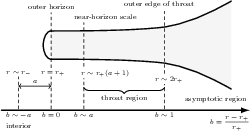
Black hole solutions with exponential gauge kinetic B(ϕ)=exp(−2αϕ/MPl) and massless scalar (V(ϕ)=0) yield the Gibbons–Horowitz–Strominger (GHS) solution, which supports a finite throat outside the horizon wherein the scalar varies logarithmically. The throat is characterized by dimensionless variables b=r+r−r+ and a=r+r+−r−, with a≪1 yielding the "long throat" limit.
Figure 1: Schematic of the throat geometry, with a parameterizing near-extremality. For a≪1, an extended throat develops between b∼a and S=∫d4x−g[2MPl2R−21(∂ϕ)2−V(ϕ)−41B(ϕ)FμνFμν].0.
Near-extremality (S=∫d4x−g[2MPl2R−21(∂ϕ)2−V(ϕ)−41B(ϕ)FμνFμν].3) yields large excursions S=∫d4x−g[2MPl2R−21(∂ϕ)2−V(ϕ)−41B(ϕ)FμνFμν].4 over a macroscopic region.
Competition between Scalar Potentials and Black Hole Sources
The major advance in this work is to develop a precise, diagnostic framework for quantifying the competition between the scalar potential and the black hole gauge source. Several classes of diagnostics are introduced:
Pointwise Source Ratio: The dimensionless ratio S=∫d4x−g[2MPl2R−21(∂ϕ)2−V(ϕ)−41B(ϕ)FμνFμν].5 comparing the local potential gradient to the gauge source on the unperturbed GHS background.
Local and Cumulative Flux Diagnostics:S=∫d4x−g[2MPl2R−21(∂ϕ)2−V(ϕ)−41B(ϕ)FμνFμν].6 weights the potential-sourced flux over a logarithmic radial interval; S=∫d4x−g[2MPl2R−21(∂ϕ)2−V(ϕ)−41B(ϕ)FμνFμν].7 integrates this effect across the full throat.
Linearized Profile Deformation: Direct solution for the induced S=∫d4x−g[2MPl2R−21(∂ϕ)2−V(ϕ)−41B(ϕ)FμνFμν].8 and its effect on the local coupling.
These are combined with fully back-reacted exterior evolutions of the EMD system to determine actual obstructions or persistence of displaced-throat regions.
Systematic Survey of Scalar Potentials
Quadratic Stabilizing Potentials
A quadratic potential S=∫d4x−g[2MPl2R−21(∂ϕ)2−V(ϕ)−41B(ϕ)FμνFμν].9 erases the throat when the Compton wavelength B(ϕ)=exp(−2αϕ/MPl)0 becomes smaller than the horizon scale B(ϕ)=exp(−2αϕ/MPl)1. The transition is not controlled by long-tail scaling, but by an order-one ratio, B(ϕ)=exp(−2αϕ/MPl)2. Back-reacted solutions confirm that the GHS-like region is mildly deformed for B(ϕ)=exp(−2αϕ/MPl)3 and thus masses with B(ϕ)=exp(−2αϕ/MPl)4 rapidly pin the scalar to its minimum.
Shifted and Pure Exponential Potentials
Exponential potentials,
B(ϕ)=exp(−2αϕ/MPl)5
introduce orientation-dependent effects. Favorable sign (B(ϕ)=exp(−2αϕ/MPl)6) yields a force that diminishes toward the horizon; the gauge throat is preserved. Conversely, for the dangerous sign (B(ϕ)=exp(−2αϕ/MPl)7), the potential amplifies in the inward direction, yielding much stronger obstruction—especially when the dimensionless exponent B(ϕ)=exp(−2αϕ/MPl)8. For dangerous exponentials, even small B(ϕ)=exp(−2αϕ/MPl)9 can drastically constrain the allowed throat.
Inverse-Power Runaways
Potentials V(ϕ)=00 with V(ϕ)=01 growing along the throat, yield a force that weakens as one moves inward. The deep throat is therefore more, not less, protected—gauge dominance prevails at small V(ϕ)=02, and strong deformations are only possible near the outer matching region. The critical amplitude for significant deformation is independent of the throat length in the V(ϕ)=03 limit.
Racetrack and Barrier-Type Potentials
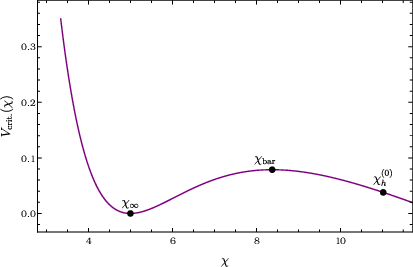
Racetrack (multi-exponential) and barrier-type potentials impose a sharp field-space criterion: the throat is destabilized only if the moduli excursion driven by the black hole exceeds the field distance to the barrier. The threshold for escape is controlled by the geometric ratio V(ϕ)=04, where the latter is the distance in field space to the top of the barrier.
Figure 2: The critical racetrack potential V(ϕ)=05, with the minimum and barrier indicated; throat-driven excursions may cross the barrier when field distances coincide.
Axion-like Periodic Potentials
Periodic potentials V(ϕ)=06 exhibit large local force that can integrate to nearly zero deformation due to oscillatory cancellations, particularly when the scalar excursion covers many periods.
SUGRA-Inspired Corrections
Potential corrections V(ϕ)=07 (with V(ϕ)=08 controlling the local gauge coupling) exhibit dramatic sign sensitivity: plus-sign exponentials are highly dangerous at weak coupling, while minus-sign corrections are exponentially suppressed and—at weak coupling—not relevant for the throat's survival.
Hierarchy of Outcomes and Strong Results
The main outcomes can be organized as follows:
Quadratic or shifted-exponential potentials erase the throat for V(ϕ)=09.
Exponential runaways with dangerous sign obstruct the throat for b=r+r−r+0, with increased severity for larger b=r+r−r+1.
Inverse powers, periodic potentials, and minus-sign SUGRA corrections exert negligible effect on the throat, especially in long-throat or weak-coupling regimes.
Barrier crossing by racetrack potentials is decided almost entirely by the field-space distance traversed due to the gauge source, rather than detailed shape of the potential.
All strong claims are supported by explicit quantitative, often order-one, thresholds for the relevant parameters.
Phenomenological Implications and Theoretical Outlook
If the gauge sector carrying the black hole charge is hidden (for instance, a dark b=r+r−r+2), and if the modulus couples to visible-sector couplings or propagating bulk fields, the existence of an altered-modulus region could have phenomenologically significant imprints—e.g., on accretion, near-horizon emissions, or matter dynamics in the vicinity of a macroscopic black hole.
Quintessence-like scalars with b=r+r−r+3 are too light to obstruct throat formation for astrophysical-sized black holes (b=r+r−r+4), leaving the altered-modulus region unmodified in practice by the potential.
The critical diagnostic is always the behavior of the potential along the black hole-induced field trajectory, not just the mere presence of a potential or its naive power counting. Thus, the actual field range accessed by the black hole throat must be compared directly against the structure, sign, and scale of b=r+r−r+5.
Conclusion
This work systematically classifies, quantifies, and benchmarks the fate of black hole-induced moduli excursions under a wide range of scalar potentials. The existence and structure of the black hole throat is highly sensitive to the shape, scale, and orientation of the modulus potential, with universality classes identified for stabilizing, runaway, barrier, and periodic scenarios. The results directly specify criteria which any microscopic (string/supergravity-derived) or phenomenological model must obey to realize black-hole-altered coupling regions in a four-dimensional effective theory. The methodologies and insights also open a road toward using macroscopic black holes as probes of compactification geometry and modulus stabilization scenarios, potentially with observational consequences if visible-sector couplings are modulated near black holes.
Further investigation along these lines—incorporating explicit string-theoretic potentials, full UV-matched backreacted solutions, and realistic accretion environments—can sharpen both theoretical control and potential phenomenological applications of black hole-induced altered-modulus regions.