- The paper introduces the Cycle Counting Ratio (CCR) estimator to recover node-specific β parameters from 3-node subgraph counts, effectively addressing sparsity challenges.
- It leverages explicit log-ratios of non-isomorphic triangles to bypass iterative MLE, ensuring computational scalability for large sparse networks.
- Theoretical and empirical analyses confirm the estimator's minimax optimality, asymptotic normality, and uniform consistency under weak sparsity conditions.
Subgraph Counting Estimation for the β-Model in Sparse Networks
Introduction and Motivation
The β-model serves as a canonical random graph model with node-specific parameters controlling degree heterogeneity. Estimating these parameters in sparse regimes is central to statistical network analysis but presents significant difficulties due to non-standard inference, non-existence of the maximum likelihood estimator (MLE), and computational and statistical instability. The work under discussion provides a comprehensive approach to parameter estimation for the β-model in sparse networks, introducing the Cycle Counting Ratio (CCR) estimator based on log-ratios of subgraph counting statistics—specifically, 3-node cycles.
Methodological Innovations
The primary contribution is the proposal and analysis of the CCR estimator, grounded in the idea that the ratio of the probabilities of two non-isomorphic cycles yields direct access to the node-specific parameter, βt. By focusing on 3-node cycles ("triangles" and their non-isomorphic variants), the approach avoids the combinatorial explosion and analytical complications associated with longer cycles. The use of explicit algebraic operations, rather than iterative likelihood maximization, provides desirable computational scalability for large sparse graphs.
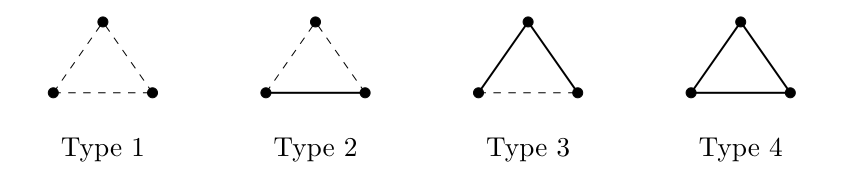
Figure 1: All non-isomorphic cycles with $3$ nodes.
The justification for this focus arises from the underlying combinatorial structure: among the possible 3-node non-isomorphic cycles (depicted in Figure 1), only certain pairs yield valid identifiability via log-ratio conditions required by the theory. The estimator for any node t is given by
β^t=21logTn,t(b)Tn,t(a),
where Tn,t(a) and Tn,t(b) denote appropriate counts of 3-node subgraphs involving t corresponding to different cycle types, and the exponent β0 and selection of β1 and β2 follow from the structure in Proposition 1 (in the text, conditions (critical)).
The computational complexity is linear in the maximum degree, β3, of the network—making it feasible for massive sparse graphs.
Theoretical Properties
Consistency and Minimax Optimality
Under the sparsity regime β4 and the effective signal condition β5—where β6 and β7—the CCR estimator is proven to be consistent for each β8. Notably, these assumptions are strictly weaker than previously required for penalized or regularized MLE approaches, which either constrain parameter configurations or impose higher minimum density.
The mean-squared error (MSE) of the CCR estimator matches the minimax lower bound in the sense that
β9
and no estimator can uniformly outperform this rate over the natural parameter space. This establishes asymptotic minimaxity for CCR in the sparse β0-model.
Asymptotic Normality
For each β1, provided the above conditions and slightly reinforced versions, the CCR estimator is asymptotically normal with variance matching that of the MLE (when the latter exists). Specifically, for a finite collection of nodes,
β2
with β3.
Uniform consistency over all node parameters can be achieved under a more stringent but still weak condition on the minimum node strength and network size, specifically when β4. The maximal error over nodes vanishes with β5 at a rate determined by network sparsity.
Practical Implications and Empirical Evaluation
Beyond theory, the estimator's robustness and computational tractability are corroborated through extensive simulations and application to real-world data. Key findings include:
- For networks with densities down to the Erdős-Rényi lower bound (β6), CCR achieves low error and closely matches (or outperforms, when the MLE is undefined) the classical MLE and penalized approaches.
- No substantial empirical gain is realized by using longer cycle statistics (e.g., 5 or 7 nodes), reinforcing 3-node cycle sufficiency both for accuracy and computational speed.
- In observed networks (e.g., Facebook ego-networks), CCR provides interpretable degree parameter estimates and enables reliable hypothesis testing regarding node homogeneity.
Significance in the Landscape of Network Models
This work addresses a fundamental gap in the estimation of random graph models for genuinely sparse regimes, where classical likelihood-based methods and their regularized variants break down either theoretically (due to existence issues, ill-posedness) or computationally. The CCR estimator's reliance on explicit cycle counts and log-ratio representation circumvents these barriers and scales to large β7.
Methodologically, the subgraph counting approach connects with recent advances in combinatorial and spectral statistics for network inference (e.g., graphlet analysis, signed-polygon statistics), reinforcing the utility of small motif statistics in parameter recovery and optimality characterization.
The weak conditions for identification and consistency may inspire analogous methodologies in broader classes of random graph models, including directed/weighted/hypergraphs, or in settings with covariates or dynamic structure. The approach may also inform differentially private estimation and robust inference under network data perturbations.
Future Prospects
Outstanding theoretical directions include the development of high-dimensional (diverging β8) joint central limit theorems for correlated parameter estimators, as well as extension of the cycle counting paradigm to more general exponential random graph models (ERGMs), or models with additional structure (e.g., community, attribute, or time dependence).
Practically, the CCR estimator's explicitness and scalability position it as a promising tool for large-network empirical studies, enabling hypothesis testing and parameter estimation in settings inaccessible to conventional techniques.
Conclusion
This paper delivers a substantial advance in sparse network parameter estimation, establishing the CCR estimator as a consistent, computationally efficient, and minimax optimal alternative for the β9-model under weak assumptions. It demonstrates that motif-based subgraph counts, when judiciously selected, provide both statistical identifiability and scalability—even at near-critical sparsity. The implications extend to both applied network analysis and the theoretical underpinnings of random graph inference, setting a new standard for estimation methodology in the sparse regime (2607.05273).