- The paper introduces a rigorous algebraic-geometric framework that leverages tangent-space methods to compute excitation spectra in quantum many-body systems.
- The paper presents rank tomography to assess particle-resolved expressivity via Schmidt rank profiles, highlighting limitations due to bond dimensions.
- The paper validates its approach with Bose–Hubbard model simulations, achieving excitation energy accuracy on the order of 10⁻⁵ near sector transitions.
Excitation Spectra and Rank Tomography in Matrix Product State Tangent Spaces
The paper "Excitation spectra and rank tomography of linear matrix product tangent spaces" (2607.05269) presents an in-depth algebraic-geometric framework for describing and exploiting the tangent spaces of matrix product state (MPS) manifolds. The work rigorously formulates tangent-space methods for the computation of excitation spectra in quantum many-body systems—encompassing finite, non-uniform chains with open boundary conditions—and introduces a novel "rank tomography" for characterizing expressivity via particle-sector resolved rank profiles.
Algebraic and Geometric Structure of the MPS Variational Manifold
The paper begins by situating pure states within projective Hilbert space and then considers structured variational classes, with a focus on MPS. The key shift lies in treating the set of MPS with fixed bond dimensions as a projective algebraic variety, defined via polynomial rank constraints on various tensor flattenings. This leads to several crucial algebraic descriptions:
- Rank Description: For an MPS defined by bond pattern D, a point lies in the MPS variety if each bipartition flattening across cut k has matrix rank at most Dk. The full-rank stratum, for which all flattenings saturate these bounds, forms a smooth Zariski open subset.
- Gauge Structure and Tangent Space: Due to gauge freedoms in the MPS parametrization, the tangent space naturally decomposes into vertical (gauge-related) and horizontal (physical) subspaces. The horizontal tangent space, after removing gauge directions, captures all physical variations and is essential for projection-based variational methods.
The Tangent-Space Method for Excitation Spectra via TDVP
The authors employ the time-dependent variational principle (TDVP) to project Schrödinger dynamics onto the tangent space of variational MPS. This approach linearizes time evolution around a variational ground state, yielding––after orthogonalization and SVD compression––a reduced generalized eigenvalue problem for effective excitations:
Bredy=ωy,
where Bred=U†(H−ω0)U and U forms an orthonormal basis of the tangent space. This Hermitian eigenproblem quantifies first-order excitation energies within the linearized ansatz (see Figure 1 for the geometric picture of tangent-space projection).
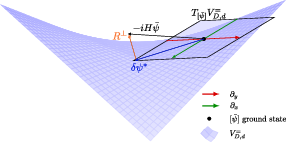
Figure 1: Illustration of TDVP's projection onto the tangent space of the real cone of V= for an MPS variety, emphasizing geometric structure and orthogonality of physical directions.
Numerical Validation and Practical Implications
The method's accuracy is established through applications to the Bose–Hubbard model on finite chains, comparing spectra obtained from tangent-space projection against direct exact diagonalization:
- For moderate bond dimensions, the tangent-space method closely reproduces low-lying excitations, including particle- and hole-type modes across particle-number sectors, capturing the softening near the Mott–insulator/superfluid transition.
- The precision of reconstructed excitation energies (∣ω−ωexact∣∼10−5 near sector transitions) underscores the adequacy of the tangent-space basis for low-energy excitations when sector ranks are sufficient.
- Explicit breaking of U(1) symmetry via source terms shows the approach is robust beyond particle-number conserving cases.
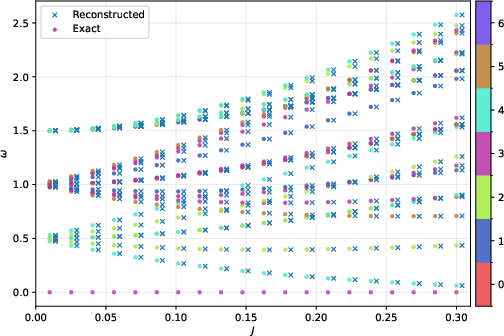
Figure 2: Exact vs. tangent-space reconstructed excitation spectrum for N=3, k0, k1; precise agreement across all particle-number sectors highlights the method's fidelity for sufficient bond dimension.
Rank Tomography and Particle-Resolved Expressivity
A major contribution is the introduction of rank tomography, providing a fine-grained assessment of tangent-space expressivity across particle-number sectors:
- Parametric Deficiency: For excitation sector k2, the difference between the tangent-space dimension and the dimension of the Hilbert sector quantifies the number of missing (unrepresentable) directions. This deficiency directly correlates with approximation errors in spectral reconstruction.
- Particle-Resolved Schmidt Rank (PRSR): Bond dimension patterns alone are inadequate; the PRSR details how Schmidt ranks are distributed across particle channels, sharply determining which sectors are well or poorly represented. These profiles may vary internally even under fixed bond patterns and have observable consequences for sector-specific spectral accuracy.
- Rank Frustration: Constraints on local occupation impose combinatorial limits on admissible bond patterns, introducing "rank frustration" visible in tangent-space expressivity.
Practical and Theoretical Implications
This formalism has immediate consequences:
- Algorithm Design: The explicit physical tangent-space construction provides a systematic means to improve excitation ansätze and informs the selection of bond dimensions for target physical sectors.
- Generalizability: The full algebraic machinery is suggestive for other tensor network geometries (e.g., tree tensor networks, PEPS) and potentially for symmetry-resolved or topologically non-trivial ground states (e.g., AKLT models).
- Limitations: The linear tangent-space approach is bounded by polynomial scaling in bond dimension but may require prohibitively large k3 for highly entangled or large systems; higher-order (double-tangent) expansions may address expressivity limitations where first-order tangent spaces lack the necessary rank support.
Conclusion
The paper provides a mathematically rigorous and computationally practical approach to extracting excitation spectra from MPS representations by leveraging the algebraic structure of the tangent space and its rank profiles. The rank tomography framework reveals the underlying source of sector-dependent spectral accuracy, a result of direct practical utility for targeting excitations in quantum simulation. These results lay a foundation for systematic improvements in tangent-space-based variational methods and offer a blueprint for the adaptation of such algebraic techniques across broader classes of tensor networks.

