- The paper precisely determines the worst-case tail probability under mean, variance, and bounded kurtosis constraints using explicit regime maps and matching extremal distributions.
- It introduces a four-regime phase diagram with sharp expressions and minimal SOS proof degrees to certify each regime’s tail bound.
- Applications include robust statistics, median-of-means estimation, and margin-based error bounds, improving high-confidence inference under weak moment assumptions.
Exact Worst-Case One-Sided Tail Probability with Bounded Kurtosis
The paper "The Exact Worst-Case Tail Probability under Bounded Kurtosis" (2607.05226) addresses a longstanding open question regarding the tightest achievable upper bound on the one-sided tail probability of real random variables, subject to constraints on the first, second, and fourth moments (mean zero, unit variance, and bounded kurtosis, respectively), with the third moment (skewness) left completely unconstrained. This problem is highly relevant in robust statistics, learning theory (especially SoS-based algorithms), and applications where only partial moment information is available — a setting ubiquitous in modern subgaussianity certification pipelines.
Specifically, for the class
C={X:EX=0,EX2=1,EX4≤κ},κ≥1,
the goal is to determine, for any t>0,
V1(t,κ)=X∈CsupP(X≥t)
with the supremum taken over all distributions in C.
This formulation is distinguished from classical results such as Zelen’s and Royden’s, which pin all moments up to degree four, including skewness, or only provide partial or asymptotic solutions in the kurtosis-constrained, skewness-free case. The current work resolves this gap by providing a closed-form complete answer across all (t,κ) pairs, together with explicit extremal distributions and sum-of-squares certificates, rendering every claim algorithmically verifiable and suitable for downstream application.
The Four-Regime Phase Map
The major contribution is a four-regime phase diagram partitioning the (t,κ) plane according to which moment constraints are active, and where closed-form, certified upper bounds coincide with explicit extremal distributions.
Immediately after the introduction, the global structure of V1(t,κ) is illustrated.
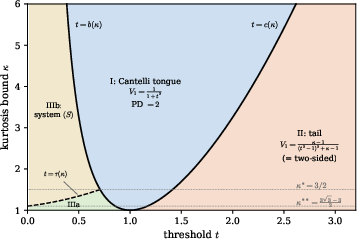
Figure 1: The regime partition of the (t,κ) map, with explicit boundaries. The "tongue" region identifies where kurtosis adds no power; outside, the structure transitions to regimes where kurtosis is tight.
The regimes are:
- Regime I (Cantelli tongue, b(κ)≤t≤c(κ), equivalently κ≥θ(t)): Kurtosis is irrelevant, and the two-moment Cantelli upper bound is tight:
t>00
attained by a two-point law on t>01.
- Regime II (tail, t>02): The kurtosis budget is binding, and the sharp value is
t>03
with extremal distribution a skewed three-point law on t>04 with explicit weights and t>05 depending on t>06 and t>07.
- Regime IIIa (plateau, only for t>08): For thresholds t>09 below V1(t,κ)=X∈CsupP(X≥t)0 but above a computable lower bound, the maximum is frozen, independent of V1(t,κ)=X∈CsupP(X≥t)1,
V1(t,κ)=X∈CsupP(X≥t)2
with a two-point extremal measure.
- Regime IIIb (central regime): For small V1(t,κ)=X∈CsupP(X≥t)3 and moderate V1(t,κ)=X∈CsupP(X≥t)4, the value is characterized by an explicit algebraic system for a three-point distribution; closed-form roots or nested radicals are provably impossible for generic points, a fact certified by explicit computation of minimal polynomials with degree exceeding two.
All regime transitions and boundaries are given by explicit algebraic expressions in V1(t,κ)=X∈CsupP(X≥t)5 and V1(t,κ)=X∈CsupP(X≥t)6 (e.g., V1(t,κ)=X∈CsupP(X≥t)7).
Numerical Comparison With Classical and Non-Sharp Bounds
The obtained bounds strongly tighten classical Chebyshev-Cantelli and naive fourth-moment Markov inequalities as soon as the kurtosis constraint becomes binding. This is starkly evident in the regime V1(t,κ)=X∈CsupP(X≥t)8:
- Chebyshev’s two-sided bound decays as V1(t,κ)=X∈CsupP(X≥t)9.
- Cantelli’s one-sided, two-moment bound is C0.
- The fourth-moment Markov bound yields C1.
- The new sharp bound improves the coefficient of C2 by a nontrivial factor of C3, which can be significant for small C4.
This relationship is made explicit for C5 in the following log-scale plot.
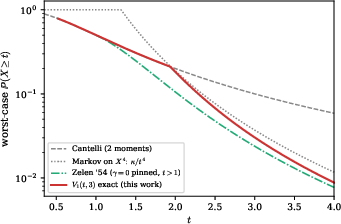
Figure 2: The sharp map for C6 compared to Cantelli, the fourth-moment Markov bound, and Zelen’s symmetric bound. The multiplicative gap quantifies the effective value of kurtosis information for tail risk.
The third-moment (skewness) freedom in C7 is essential: bounds for the skewness-pinned or symmetric class can be strictly smaller. At C8, for example, the sharp value is C9 under freedom, but (t,κ)0 with symmetry pinned — exactly the (provable) price of not knowing the skewness.
Structural Transitions of Extremal Distributions
The extremal (worst-case) distributions emanating from each regime reveal intricate structural transitions in support:
- On the Cantelli tongue and the plateau—pure two-point laws.
- In Regimes II and IIIb—genuine three-point laws, with or without an atom placed exactly at the threshold.
These transitions, and the differences in their support and skewness, are visualized:
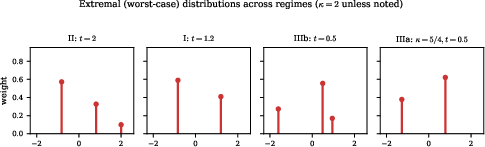
Figure 3: Extremal worst-case distributions (atoms and weights) across the regimes. Note the change from two-point supports (I, IIIa) to skewed three-point configurations (II, IIIb).
Sum-of-Squares Proof Degree and Certificate Complexity
A major theoretical innovation is the identification of a proof complexity phase transition for the sharp tail bound, quantified by the minimal degree of a sum-of-squares (SOS) polynomial certificate needed to certify each regime’s bound. On the Cantelli tongue, degree-2 suffices, whereas degree-4 is necessary and sufficient elsewhere, matching the combinatorial structure of extremal measures and the dual solution in the corresponding SDP.
This result provides both theoretical insight for proof-complexity and practical guidelines for SoS-based algorithm deployments: lower-degree proofs are optimal precisely where the kurtosis constraint is uninformative, while higher-degree certificates are necessary as soon as the kurtosis becomes binding.
Methodology: Certified Automation and Machine-Verified Certificates
The discovery and validation pipeline, LemmaForge, systematically integrates numerical SDP solving (Clarabel, SCS), integer relation detection, symbolic rationalization, and explicit sum-of-squares decomposition, capped by a fully independent exact arithmetic checker. All sharp values are certified with explicit polynomial certificates and extremal discrete laws, machine-verifiable line-by-line. Degenerate and unattainable cases are exhaustively and conservatively labeled. Every instance is cross-checked by discretized LPs and multiple code paths for reliability.
This approach enables:
- Complete application-ready tables of certified tail bounds.
- Error-resilient algorithms for downstream worst-case analysis, value-at-risk, and estimators.
- Rigorous artifact archives (code, certificates, instances) for reproducibility and extension.
Theoretical and Practical Implications
These results have direct implications in multiple fields:
- Robust high-dimensional statistics: Certifiable subgaussianity and robust moment estimators often invoke bounded kurtosis. These tight constants replace loose Markov/Chebyshev estimates, yielding tighter confidence intervals and sharper deviation inequalities.
- Median-of-means and algorithmic construction: Precise Kurkosis-improved constants for block assignment in median-of-means estimators, improving the critical deviation exponent over Chebyshev from (t,κ)1 to (t,κ)2 in the i.i.d. case with bounded kurtosis.
- Value-at-risk and stress testing: Closed-form quantile thresholds for chance constraints under fourth-moment information with skewness unknown; large improvements over traditional bounds.
- Sum-of-squares algorithms: Degree-4 SoS certificates are precisely necessary and sufficient outside the tongue, providing templates for algorithm designers and complexity theorists regarding proof degree lower bounds.
Limitations and Potential Extensions
The central regime (IIIb) lacks a closed-form expression in nested radicals, a fact proven by explicit computation of irreducible minimal polynomials of degree exceeding two. For those points, certified algebraic system solutions and sandwich certificates are provided, but symbolic formulas are impossible. The regime map, proof-degree locus, and all downstream results generalize to the equality-constraint case and can be directly extended via the same machinery to higher moments, constrained supports (e.g., one-sided classes), and certain matrix settings, with promising implications for more complex measure concentration domains and SoS proof complexity landscapes.
Conclusion
This paper provides a complete, constructive solution to the worst-case one-sided tail probability problem under a kurtosis constraint with free skewness, filling a longstanding gap in the analytic and algorithmic literature. The multifaceted regime structure, sharp constants, explicit extremal measures, and machine-verifiable SoS certificates together constitute a robust toolkit for both theoretical analysis and practical algorithm design in robust statistics, learning theory, and risk management. The methodology and results serve as a template for future work at the intersection of probability, optimization, and proof complexity.