- The paper demonstrates that symplectically aspherical Kähler manifolds cannot admit positive scalar curvature and inherently possess large fundamental groups.
- It employs explicit constructions, such as symmetric products and branched cyclic covers, to broaden the class of Kähler manifolds.
- The study elucidates deep connections between complex geometry, group cohomology, and curvature constraints to guide future classification efforts.
Symplectically Aspherical Kähler Manifolds: Scalar Curvature and Fundamental Groups
Introduction
This paper develops the theory of symplectically aspherical Kähler manifolds—closed complex manifolds whose Kähler forms become exact upon pulling back to the universal cover. The authors significantly expand the landscape of such manifolds, move beyond the strictly aspherical case, and establish non-trivial topological and geometric constraints. Notably, they reveal that manifolds in this class possess large fundamental groups in the sense of Kollár and cannot support Kähler metrics of positive scalar curvature. Motivated by these constraints, the authors explore a symplectic extension of the classical Gromov–Lawson conjecture for positive scalar curvature. The paper further studies the structure of Kähler cones on symplectically aspherical manifolds, addresses the realizability of discrete groups as fundamental groups, and explores complex-geometric implications, particularly via symmetric products of curves.
Definitions and Structural Properties
The symplectically aspherical property imposes strong restrictions: a symplectic form ω is aspherical if all integrals over spherical homology classes vanish. Equivalently, ω pulls back to an exact form on the universal cover. When such a form is Kähler and compatible with the complex structure J, the manifold (M,J,ω) is termed a symplectically aspherical Kähler manifold.
General structural properties established include stability under finite products, passage to finite covers, and submanifolds. These manifolds are rationally essential, with maximal Lusternik–Schnirelmann category, and satisfy the strong Arnol'd conjecture under mild constraints. Topologically, the symplectic asphericity enforces cohomological dimension constraints: the real cohomological dimension of π1(M) is at least the real dimension of M, and the class [ω] must descend from group cohomology.
Abundance and Construction
The authors show that symplectically aspherical Kähler manifolds are much more abundant than previously known. Explicit constructions include symmetric products of generic curves and branched cyclic covers of abelian varieties. These yield non-aspherical examples (i.e., with non-trivial π2), especially in complex dimension two, broadening the class well beyond aspherical varieties.
Branched cyclic covers serve as a general recipe: given an aspherical projective variety Yn and an ample divisor, one can construct a smooth projective branched cover Xn which is symplectically aspherical but not necessarily aspherical. The canonical line bundle becomes ample, and the aspherical property is preserved through the pullback in cohomology.
Comparison with Classical Classes
Symplectically aspherical Kähler manifolds are situated between classical classes such as Kähler hyperbolic, Kollár large, Kobayashi hyperbolic, and varieties with Stein universal covers. The inclusion relations are rigorously established:
- Every symplectically aspherical Kähler manifold is Kollár large, as the exactness of the pulled-back Kähler form prohibits positive-dimensional compact complex subspaces in the universal cover.
- The first Betti number of a symplectically aspherical Kähler manifold is always even and at least ω0 if nontrivial second homotopy exists.
- The class includes examples with amenable fundamental groups, which are excluded from Kähler hyperbolic manifolds.
Generic symmetric products ω1 of curves provide explicit SAK examples with amenable fundamental groups, infinite real spherical homology, and general type in complex dimension ω2.
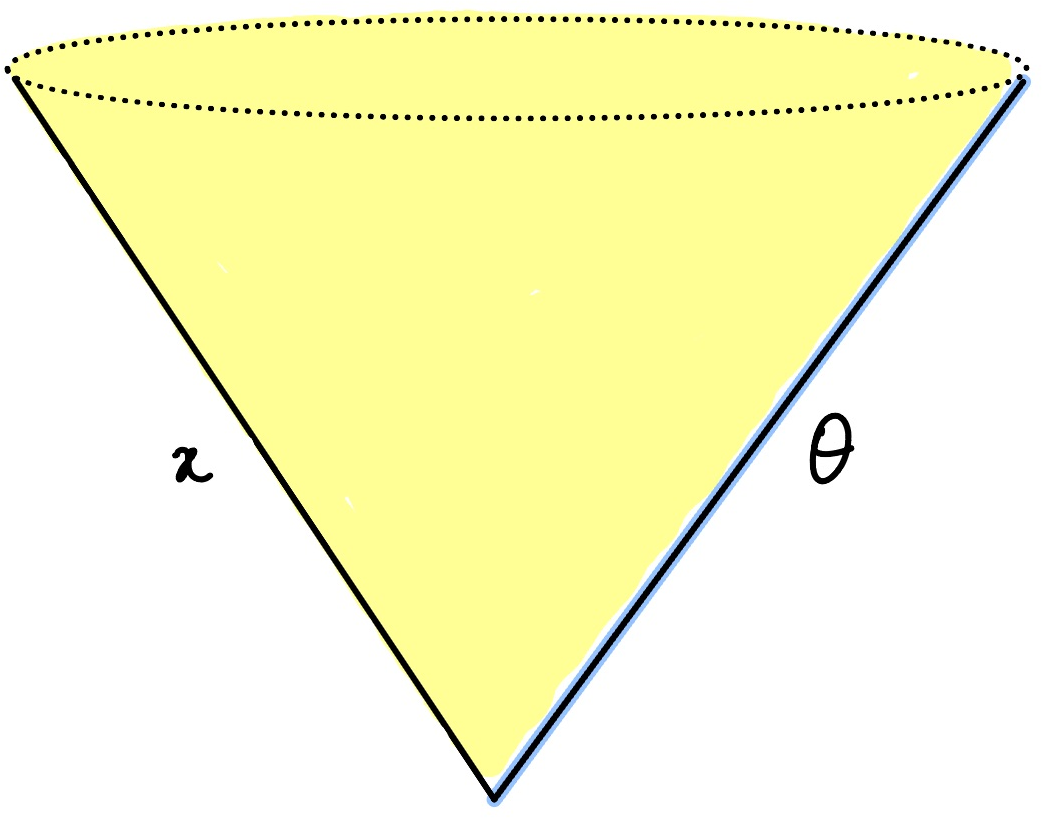
Figure 1: The J-Kähler cone of ω3 spanned by ω4 and ω5, with aspherical Kähler forms on the blue axis.
Fundamental Group Realizability
A major result is the realization problem: the authors show that every free abelian group of even rank at least ω6 arises as the fundamental group of a symplectically aspherical smooth projective surface of general type with nontrivial real spherical homology. For ω7 with ω8, symmetric products ω9 realize the group, and for J0, explicit branched covers of abelian surfaces do.
The approach reduces the problem to complex dimension two, leveraging the Lefschetz hyperplane theorem and positivity of line bundles. Group-theoretic obstructions are carefully enumerated: SAK groups must be infinite, have exactly one end, and satisfy vanishing of Massey products in J1. The extension to finite abelian factors remains an open question.
Scalar Curvature Obstructions
The authors establish strong obstructions to positive scalar curvature on symplectically aspherical Kähler, or even symplectic, manifolds:
- No symplectically aspherical projective variety admits a Kähler metric of positive scalar curvature; non-existence extends to birational images thanks to the ampleness or nef property of the canonical bundle.
- Under spin conditions (either finite covers or universal cover admitting spin structure), positive scalar curvature metrics are ruled out, using Rosenberg's index theorem and the Novikov conjecture for low-degree classes.
- In dimension J2 and J3, Seiberg–Witten theory and rational essentiality combine to prohibit positive scalar curvature without additional topological assumptions.
A conjectural symplectic extension of the Gromov–Lawson conjecture is proposed: closed symplectically aspherical manifolds do not support any metric of positive scalar curvature.
Kähler Cones and Spherical Homology
The topology is further restricted when all Kähler forms compatible with a given complex structure are aspherical (“total Kähler asphericity”). Proposition: the dual vector space to real spherical homology classes lies inside the real Dolbeault group J4; for Kähler surfaces with J5, J6 if and only if every compatible Kähler form is aspherical. Any Kähler surface with a symplectically embedded J7-sphere necessarily admits a non-aspherical Kähler form.
Uniqueness and Flexibility
On symmetric products J8, a rigorous algebraic argument (via the Néron–Severi group and Macdonald’s relations) establishes that the axis of aspherical Kähler forms is essentially unique up to scalar multiples. Perturbing away from this axis yields non-aspherical Kähler forms, producing marked flexibility in the geometry even after fixing the complex structure.
Figure 1: The J9-Kähler cone of (M,J,ω)0, highlighting the distinction between aspherical (blue) and non-aspherical (yellow) Kähler forms.
Implications and Outlook
From both the complex and symplectic geometric perspectives, symplectically aspherical Kähler manifolds represent a robust class merging tractability and richness. The interplay between scalar curvature, group cohomology, and geometric structures opens new avenues:
- Theoretical implications: Fundamental group constraints, ampleness/nefness of canonical bundles, and the restriction on curvature provide bridges between algebraic and differential geometry.
- Practical implications: The explicit realization of abelian groups, control over the Kähler cone, and the non-existence of positive scalar curvature metrics feed into classification problems and the study of moduli spaces.
- Future directions: The extension to group realizability with finite factors, further exploration of the Novikov conjecture in this context, and the consequences for macroscopic dimension and essentiality.
Conclusion
This paper rigorously advances the study of symplectically aspherical Kähler manifolds by demonstrating their abundance, establishing strict curvature and topological constraints, and delineating the structure of their Kähler cones. The classification results for their fundamental groups and the explicit constructions suggest broad applicability and a foundational role in the intersection of complex geometry, symplectic topology, and global differential geometry. The interplay of aspherical properties with scalar curvature and group cohomology provides deep structural insights and sets the stage for future developments, particularly concerning group realizability and curvature conjectures in the symplectic and complex settings.