- The paper introduces Physiological Noise Augmentation (PNA) that injects empirical artifact components to regularize neural decoders.
- PNA leverages ICA to extract ocular and cardiac artifact signals and re-injects scaled perturbations, enhancing robustness across trials.
- Empirical evaluation on MEG data shows that PNA improves decoding accuracy with trial averaging, outperforming conventional noise augmentation methods.
Physiological Noise Augmentation for Robust Non-Invasive Brain-to-Speech Decoding
Introduction
Non-invasive brain-to-speech decoding seeks to restore communication capabilities for individuals affected by neurodegenerative disease, stroke, or spinal cord injury, leveraging non-invasive modalities such as MEG and EEG. A core challenge in advancing this line of research is the inherently low signal-to-noise ratio (SNR) of non-invasive neural recordings, exacerbated in tasks involving imagined speech where the evoked neural responses are weak and temporally diffuse. While trial averaging can increase SNR, it imposes a latency and repetition burden incompatible with real-time communication paradigms.
The paper "Physiological Noise Augmentation Improves Non-Invasive Brain-to-Speech" (2607.05165) proposes Physiological Noise Augmentation (PNA), a principled ICA-driven augmentation framework that generates biophysically realistic, label-preserving perturbations by injecting empirical artifact components (e.g., ocular and cardiac) into training data. The goal is to regularize neural decoders to become invariant to the dominant nuisance structure encountered at test time.
Methodological Framework
PNA is structured in three main stages, summarized as follows:
- Artifact Measurement: During data acquisition, reference channels specific to common artifact sources—electrooculography (EOG) for ocular and electrocardiography (ECG) for cardiac activity—are recorded in parallel with MEG signals.
- Artifact Extraction and Identification via ICA: FastICA is performed on windowed neural data. Artifact-related components are identified by correlating estimated independent components with the recorded reference channels, using thresholding on correlation magnitude. These components are projected back to sensor space, isolating the artifact contributions for each trial.
- Physiological Augmentation: During training, augmented samples are generated by rescaling the extracted artifact components according to donor artifact-to-clean amplitude ratios sampled from their empirical distribution. These scaled artifacts are then injected into cleaned data to form the final training signals used for model updates, ensuring the augmented data span the physiological artifact distribution observed in real recordings.
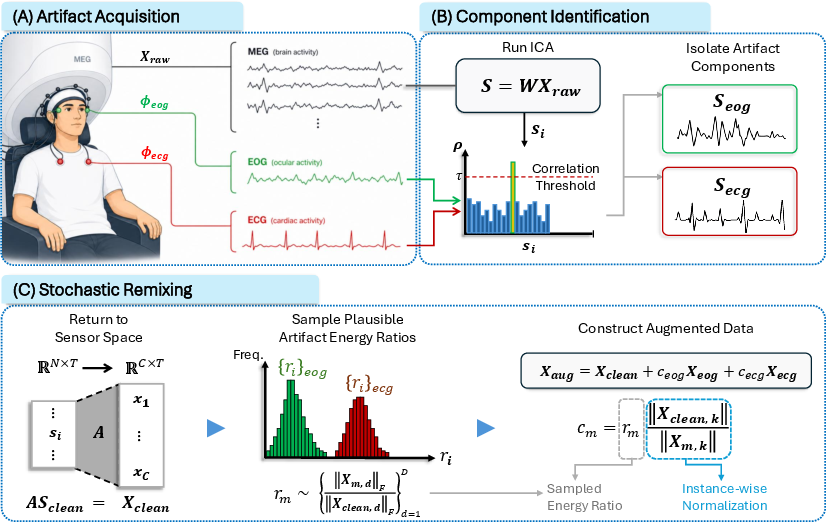
Figure 1: Overview of physiological noise augmentation pipeline, depicting reference artifact collection, ICA decomposition/selection, and artifact reinjection into neural data.
Control over the strength of the injected artifacts is facilitated by a per-artifact scaling parameter, α. During augmentation, random donor artifact trials are selected, artifacts are scaled and injected, and the resulting label-preserving samples constitute a diverse representation of realistic nuisance conditions.
Theoretical Derivation and Regularization Properties
The authors provide a detailed theoretical treatment, demonstrating that PNA, when combined with multi-trial averaging, is equivalent in expectation (to leading order) to adding an anisotropic Jacobian penalty to the original loss. This penalty specifically suppresses model sensitivity along artifact-dominated directions identified by the empirical artifact covariance. The regularization induced by PNA is:
ℓclean(z,y)+Kα2Tr(JzΣnJz⊤)
for the squared error loss (with Jz the logit Jacobian and Σn the artifact noise covariance). For cross-entropy, the equivalent regularizer is Fisher-weighted.
This theoretical analysis clarifies that PNA's artifact-aware perturbations structurally differ from generic additive noise or input-level augmentations, enforcing invariance precisely in the subspace where physiological artifacts dominate.
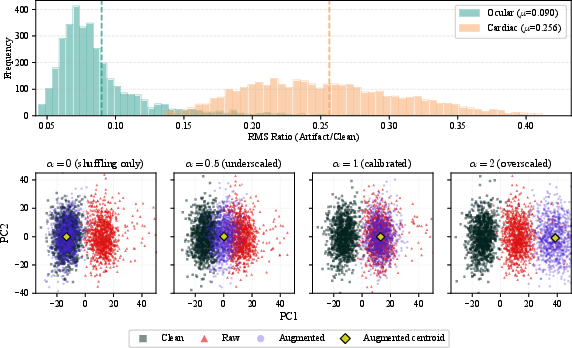
Figure 2: Empirical artifact-to-clean amplitude ratio distributions (top) and PCA projections (bottom) showing that PNA-augmented embeddings interpolate between raw and clean artifact distributions.
Empirical Evaluation
Dataset and Models
Experiments are conducted on MegNIST, a publicly available, class-balanced, single-subject MEG dataset for imagined digit classification, featuring 12,000 trials along with EOG/ECG references. The primary models evaluated are a multilayer perceptron (MLP) and EEGNet, a compact convolutional architecture tailored for EEG/MEG data.
Decoding Accuracy and Averaging
PNA is evaluated in combination with various averaging levels. Consistent improvements are observed when PNA is coupled with trial averaging: for EEGNet, 10-trial averaging with PNA increases decoding accuracy from 73.0%±1.4% (raw only) to 76.3%±1.1%. The primary uplift is not observed in single-trial settings but emerges robustly as averaging increases, reflecting synergistic effects between artifact-invariance and global noise suppression.
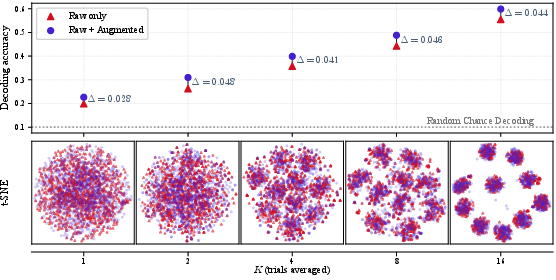
Figure 3: PNA improves MLP decoding accuracy and modifies t-SNE data embeddings, especially with higher levels of averaging.
Figure 4 provides evidence that accuracy scales with the ratio of augmented-to-raw samples. The most pronounced benefits are observed under high-SNR regimes facilitated by averaging.
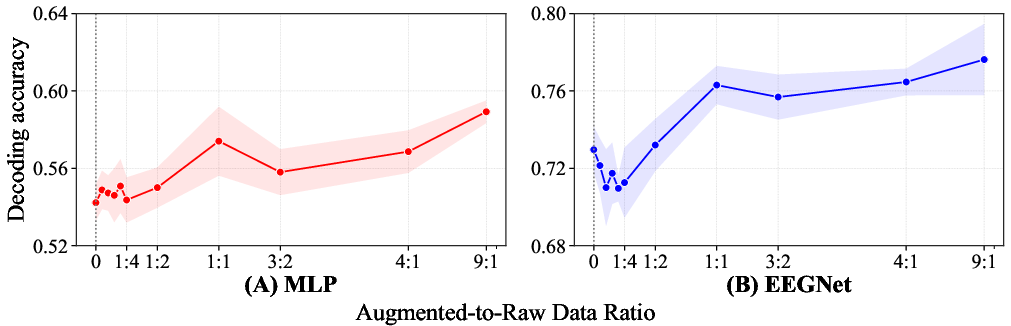
Figure 4: Decoding accuracy as a function of augmented-to-raw training data ratio, showing statistical improvement with increased PNA sampling.
Comparison with Baseline Augmentations
PNA is compared against baselines, including white noise addition, smooth time masking, frequency/temporal shifts, and amplitude scaling. PNA consistently delivers either matching or superior gains compared to all baselines under equivalent model and data regimes. Especially for EEGNet, PNA outperforms all methods under 10-trial averaging.
Augmented data embeddings with PNA, visualized using t-SNE and UMAP, show alignment with raw artifact-corrupted data and increased class separability post-averaging.
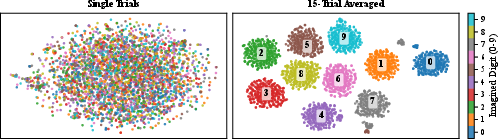
Figure 5: t-SNE embeddings, with and without averaging, illustrate the emergence of digit class clusters post-averaging.
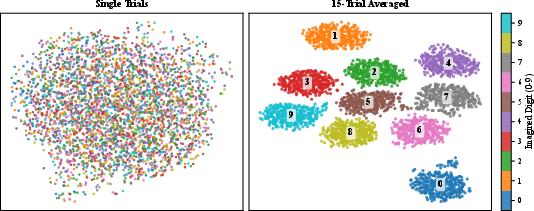
Figure 6: UMAP projection confirms improved class structure and, unlike t-SNE, reveals global organization of class clusters.
Implications, Limitations, and Future Directions
PNA represents a shift toward physiologically-grounded data augmentation strategies, leveraging domain-specific reference channels to construct empirical artifact distributions for robust regularization. This approach systematically reduces the "repetition burden" previously required to boost SNR by averaging, improving the clinical viability of non-invasive BCI systems for continuous or rapid communication.
However, the principal limitation of PNA is its requirement for artifact reference channels (EOG/ECG) during data acquisition, restricting applicability to datasets for which such references are available. Future efforts could address artifact identification without reference signals—e.g., through unsupervised ICA component classification or by integrating additional modalities (e.g., EMG).
Broader adoption of PNA across larger, multi-subject MEG/EEG datasets and generalized internal speech paradigms is needed to assess transferability and generalization, especially across heterogeneous artifact environments. Furthermore, the domain-specific principle embodied by PNA could inform augmentation strategies for other bioelectrical modalities (fMRI, ECoG, LFP), where structured, task-agnostic noise systematically degrades decoding accuracy.
Conclusion
Physiological Noise Augmentation provides a robust framework for training invariance to physiologically structured artifacts in non-invasive brain-to-speech decoding systems. The ICA-based pipeline, informed by reference artifact distributions, outperforms conventional heuristically designed augmentations and achieves pronounced gains in high-SNR (averaged) settings. Theoretical analysis confirms that PNA functions as a structured anisotropic regularizer, locking the model’s invariance to empirically dominant nuisance directions. The practical and methodological implications point to artifact-aware regularization as a critical driver for future non-invasive neural decoding advances.