- The paper introduces a novel VAoI metric and a closed-form threshold-based source policy to optimize information freshness in multi-hop IoT networks.
- It derives recursive VAoI distributions and validates significant performance gains via simulations compared to randomized baseline policies.
- Feedback-enabled forwarding reduces redundant transmissions, enhancing energy and spectrum efficiency in practical IoT deployments.
Version-Aware Communication in Multi-Hop IoT Networks with Feedback
Introduction and Context
The paper "Version-Aware Communication in Multi-Hop IoT Networks with Feedback" (2607.04996) addresses the problem of maintaining information freshness in resource-constrained multi-hop IoT networks, extending the classical Age of Information (AoI) with Version Age of Information (VAoI). Unlike AoI, which tracks staleness solely via the time since the last update, VAoI quantifies the lag in delivered versions, capturing content evolution and obviating the need for clock synchronization. The work targets practical IoT scenarios where minimizing redundant or outdated transmissions is critical for energy and spectrum efficiency, especially as IoT deployments proliferate and data rates increase.
The research closes a gap in prior work, which predominantly focused on AoI or first-moment (mean) analysis, often limited to single-hop settings. By providing a comprehensive distributional and optimization-theoretic analysis of VAoI in multi-hop networks with both transmission constraints and feedback mechanisms, the paper significantly advances the literature on semantic and content-aware communication.
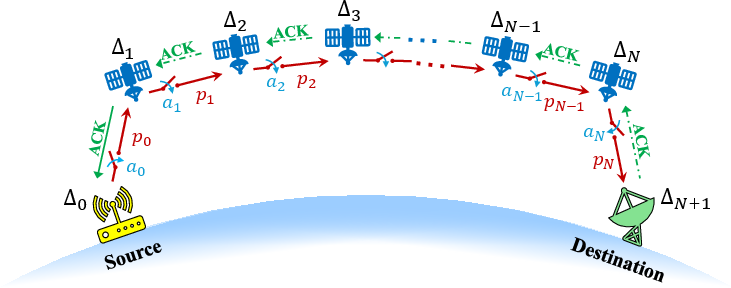
Figure 1: System model of a multi-hop network.
The considered system is a multi-hop line network comprising a rate-constrained source, a sequence of N relays, and a destination. Communication proceeds in discrete time slots, with each link modeled as an independent packet erasure channel. Version generation at the source follows an i.i.d. Bernoulli process with parameter pg. Transmission opportunities are subject to per-slot constraints, and nodes buffer only the most recently received version.
Notably, the system incorporates instantaneous, error-free ACK feedback channels from each node to its upstream neighbor, enabling feedback-aware forwarding and efficient suppression of redundant transmissions.
The core problem is formulated as a bi-level optimization:
- Upper-level (VAoI Optimization): Determine the source policy ϕ to minimize the average VAoI at the destination, subject to a source update rate constraint.
- Lower-level (Update Rate Optimization): For the optimal source policy, minimize intermediate nodes' update rates under feedback-aware forwarding while preserving optimal destination VAoI.
VAoI Modeling and Theoretical Results
Recursive Characterization of VAoI
For the multi-hop topology, the VAoI at each node is recursively expressed as a function of the VAoI at the previous node with added randomness due to erasure and version generation processes. Specifically, the VAoI increment across a hop is modeled as the sum of a random geometric delay (number of transmission attempts until success) and a binomially-distributed count of new versions generated during this interval.
This approach leads to a tractable representation of the VAoI evolution through the network, which, under stationarity, supports both the derivation of closed-form means and stationary distributions.
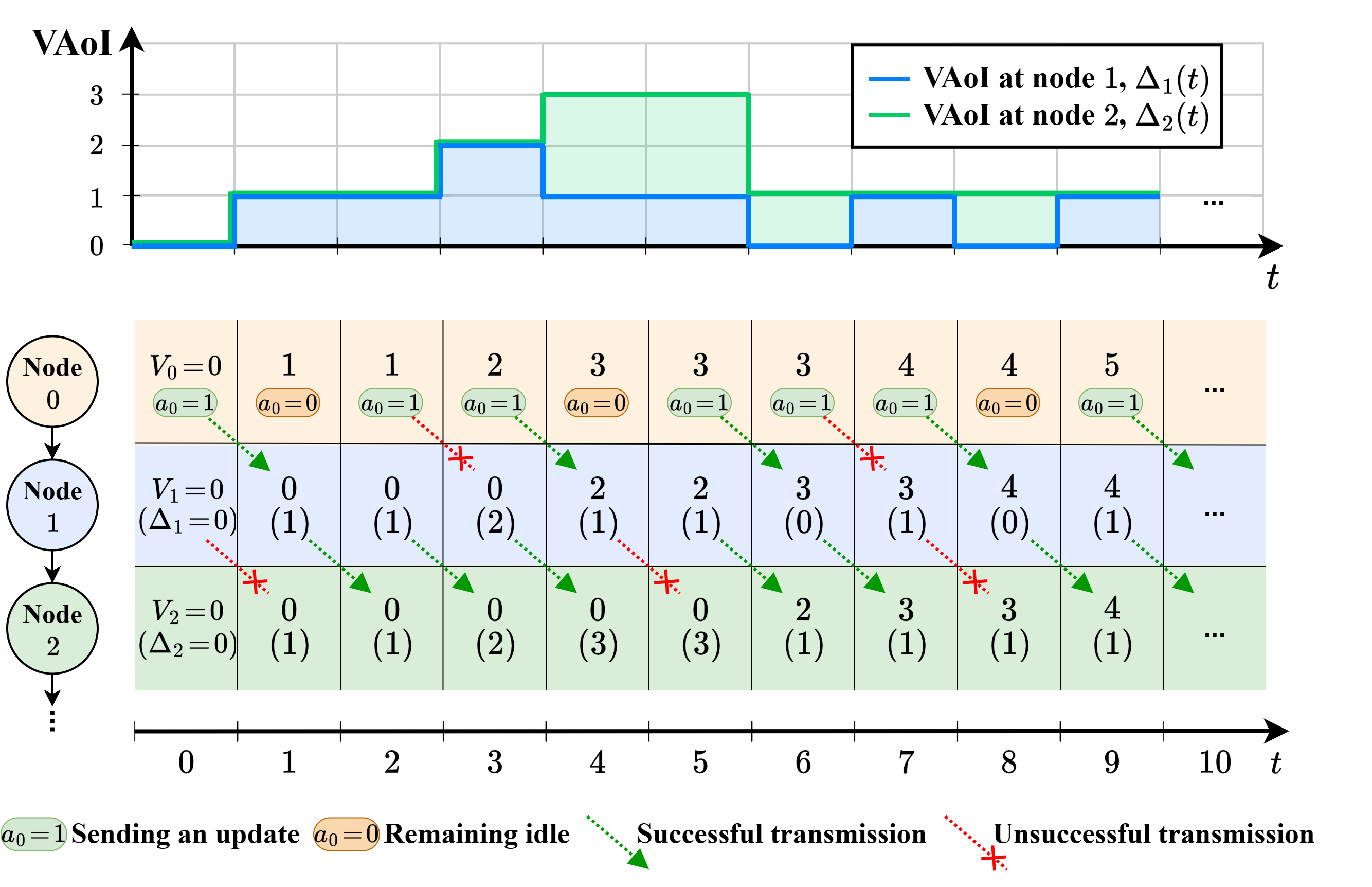
Figure 2: Evolution of VAoI within the network over time.
Optimal Source Policy Structure
A major contribution is the analytical derivation of the optimal source update policy. The paper rigorously proves, via Constrained Markov Decision Process (CMDP) duality and value iteration arguments, that the optimal policy for the source is always threshold-based: transmit only when the VAoI between the source and its immediate neighbor exceeds a computed integer threshold ΔT∗. This optimal threshold is provided in closed form as a function of system parameters and may require randomized mixing between two adjacent thresholds in degenerate cases due to the discrete nature of policy choices.
Key numerical result:
For low source update rates, the optimal threshold scales as ΔT∗≈⌈ψp0pg⌉, where ψ is the allowed average source update rate and p0 is the link success probability.
Stationary Distributions and Mean VAoI
For both the optimal threshold-based (version-aware) and a baseline randomized (version-agnostic) source policy, the paper derives:
- Closed-form stationary VAoI distributions at all network nodes.
- Closed-form average VAoI and node update rates as explicit functions of thresholds, per-link success probabilities, and version-generate rates.
Notably, it is shown that the mean VAoI at the destination is additive in the number of relays; the total is the sum of the first-hop mean VAoI plus (expected number of version generations along all hops).
Feedback-Aware Forwarding Policies
Intermediate nodes, benefiting from feedback, are shown to optimally follow a policy wherein a node retransmits its current version until it has been acknowledged by the downstream node (feedback-aware), avoiding redundant transmissions. In cases where each received update is a newly generated version (as under threshold policies at the source), this feedback-aware policy coincides with a VAoI-aware policy (transmitting only until the stored version is newer than the downstream buffer).
Algorithmic procedures for deriving multi-hop stationary distributions and update rates are provided for scaling this analysis to arbitrary network depth.
Numerical Evaluation and Implications
The theoretical findings are validated via extensive Monte Carlo simulations.
- Performance gains: In tightly constrained update regimes, the optimal threshold policy can reduce required source update rate by over 50% compared to a randomized baseline for a given freshness objective.
- Distributional properties: Threshold policies induce tightly bounded, nearly uniform VAoI distributions at the first relay, which, through convolution, become smoother and heavier-tailed at deeper nodes. Randomized policies produce exponentially decaying distributions with longer tails and hence higher mean VAoI.
- Feedback effects: Feedback at the intermediate nodes dramatically reduces communication overhead; the benefit is most pronounced under the proposed version-aware policies versus conventional always-forwarding.


Figure 3: Order of events at the network nodes.
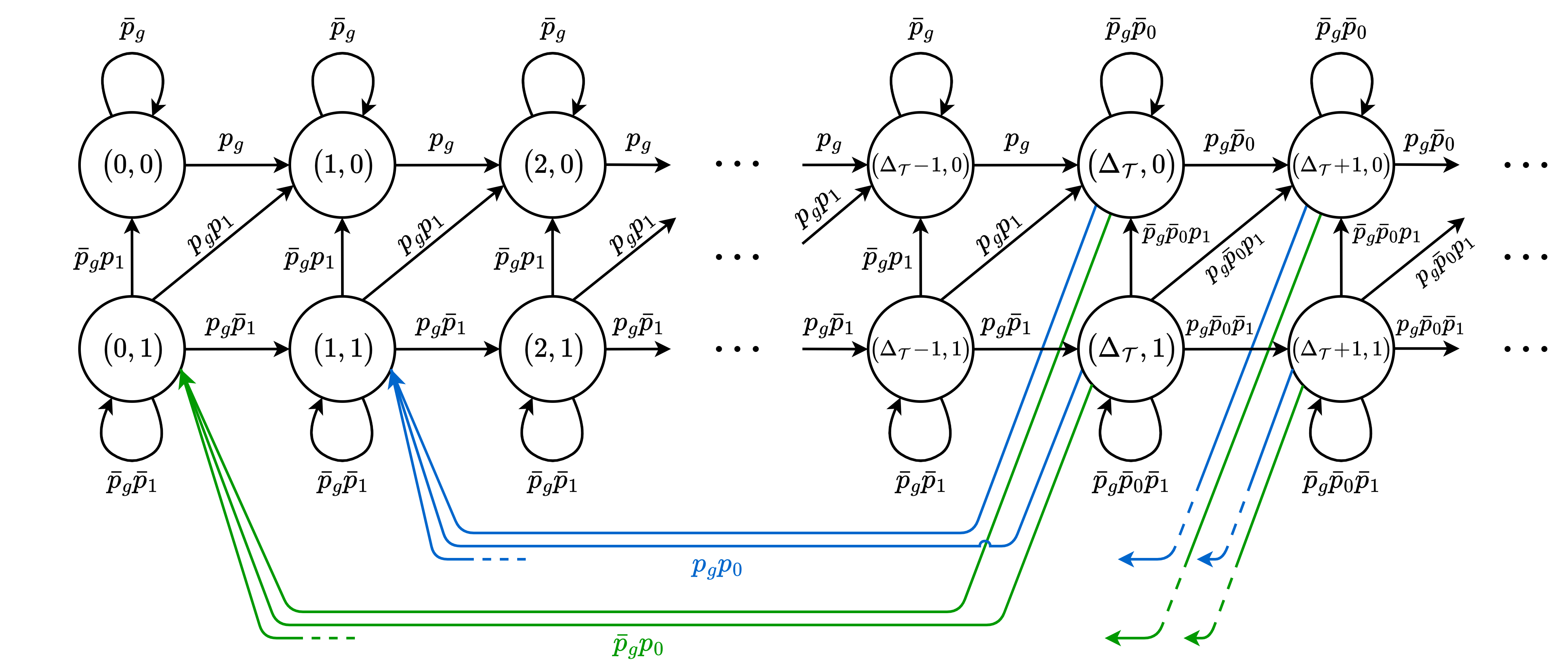
Figure 4: Markov Chain of $(\Delta^{\phi_{\mathcal{T}_1},\mathrm{a}^{\phi_{\mathcal{T}_1})$ under the threshold policy.
Practical and Theoretical Implications
The results provide significant insights for the design of IoT and other cyber-physical systems:
- Energy and spectrum efficiency: VAoI-aware and feedback-enabled communication minimizes unnecessary transmissions, extending device battery life and reducing interference in crowded environments.
- Semantic and content-aware metrics: By moving beyond pure timestamp-based staleness, resource allocation can be optimized for actual informativeness, aligning with the evolving paradigm of semantic communications.
- Closed-form tractability: Availability of closed-form and iterative calculation methods enables integration into real-time network control, scheduling, and cross-layer optimization algorithms.
- Scalability: The analysis naturally extends to arbitrary multi-hop depth and link heterogeneity, informing network design under diverse IoT deployment contexts.
Future Directions
The work creates several avenues for future research and AI integration:
- Extensions to network coding, multipath, and broadcast: Adapting VAoI-based metrics to more general network topologies, including wireless mesh and multi-access scenarios.
- Learning-based adaptive policies: Leveraging reinforcement learning to dynamically tune thresholds in non-stationary or unmodeled environments, possibly with partial feedback or imperfect acknowledgments.
- Integration with application-layer semantics: Coupling VAoI minimization with explicit task or application requirements, such as event detection latency or estimation fidelity.
- Robustness under delayed or unreliable feedback: Generalizing the analysis to account for non-instantaneous or lossy ACK channels, which occur in real-world wireless settings.
Conclusion
This study establishes a rigorous optimization, modeling, and analysis framework for version-aware communication in multi-hop IoT networks with feedback. By developing closed-form optimal policies, recursive distributional characterizations, and validating gains through simulation, the paper demonstrates the notable practical benefits—both in resource efficiency and informativeness—of VAoI-aware and feedback-aware protocols. These findings will inform the development of next-generation communication protocols for semantic, resource-constrained, and distributed IoT systems.