- The paper demonstrates that JWST/MIRI imaging identifies 928 dust-enshrouded IR-excess sources tracing on-going star formation primarily regulated by merger-accreted gas in the warped disk.
- It employs multi-band photometry to distinguish between stellar photospheric and dusty populations, revealing a bimodal color distribution aligned with the disk structure.
- The findings refute significant AGN jet-induced star formation in the inner disc, emphasizing merger-driven gas accretion as the primary trigger for star formation.
Introduction
The analysis of Centaurus~A (Cen~A, NGC~5128) via JWST/MIRI imaging provides an unprecedented probe into the connection between star formation and AGN activity within the central ∼4×2~kpc. Cen~A presents an optimal laboratory due to its proximity, active nucleus (bolometric luminosity Lbol∼1043--4×1043 ergs/s), established radio jets, and a marked dusty, warped disk—a result of a gas-rich merger. This study utilizes high spatial resolution mid-infrared photometry in three filters (F560W, F770W, F1130W) to dissect the resolved stellar populations in the disc and to delineate the effects, if any, of the AGN radio jet on current star-formation episodes.
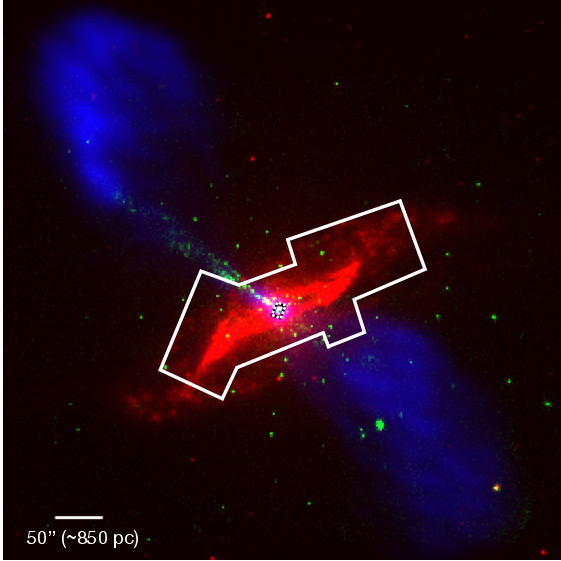
Figure 1: Colour composite image of Centaurus~A (Cen~A) integrating Spitzer 5.8~μm, Chandra X-ray, and VLA radio jet emission, with the MIRI mosaic footprint indicated.
Observational Data and Photometric Sample
Deep mosaics with MIRI, combining data from JWST observing programs 1269 and 4529, cover the central warped disc and active nucleus using a multi-dither strategy for sub-arcsecond resolution, yielding a contiguous ∼6.9 arcmin2 field. The multi-band point source selection, performed with the starbugii pipeline, prioritizes robust photometric errors (σ≤0.1 mag) and the rejection of diffuse or extended sources, resulting in a master catalog of 58,445 unique objects, of which 2,558 are deemed high-confidence detections in all bands.
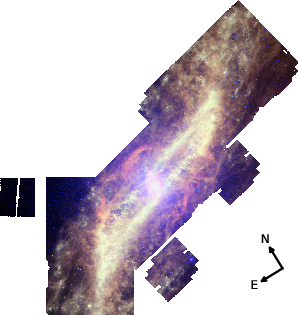
Figure 2: Three-colour JWST/MIRI mosaic of the central region and inner disc of Cen~A displays the disk, filamentary substructure, and the bright AGN nucleus.
Mid-Infrared Source Classifications: Diagnostics and Population Distinction
The F560W, F770W, and F1130W photometry reveal a clear bimodality in color-magnitude and color-color distributions, manifesting as:
- A primary population with near-zero F560W-F770W color, consistent with stellar photospheric emission and a range of moderate extinction.
- A secondary, distinctly red population, with mean F560W-F770W ≈ 2.20 mag and F560W-F1130W > 1.8 mag, spatially concentrated within the disc and indicative of significant infrared excess.
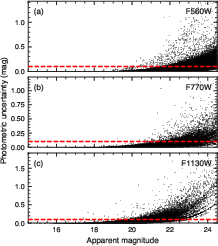
Figure 3: Photometric uncertainties across F560W, F770W, F1130W as a function of AB magnitude for quality assessment.
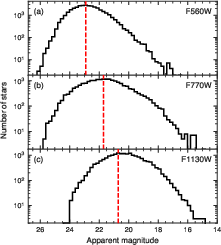
Figure 4: Luminosity functions for all three MIRI filters, completeness thresholds indicated.
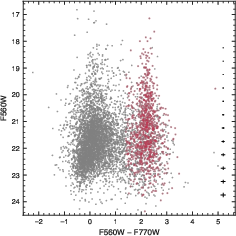
Figure 5: F560W-F770W color–magnitude diagram, red sources represent embedded IR-excess objects.
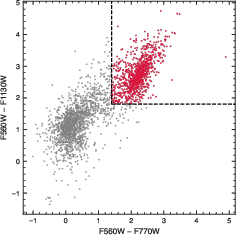
Figure 6: Color–color diagram using F560W-F770W vs. F560W-F1130W. Dust-enshrouded sources are identified within empirically defined cuts.
Using color cuts informed by source distribution minima and comparisons to MIRI-based stellar population studies of Local Group star-forming regions, 928 sources (36.3\% of the high-quality sample) are classified as dust-enshrouded infrared-excess objects.
Spatial Distribution and Morphology
These red, dust-enshrouded sources exhibit a strong geometric correlation with the warped dust disc. Principal component analysis reveals that 94\% of their positional variance lies along the disc major axis, contrasting with the more isotropic distribution of photospheric-population objects. The transverse dispersion of the red sources (σ⊥,red=0.38 kpc) is substantially less than that of the broader population (×0 kpc).
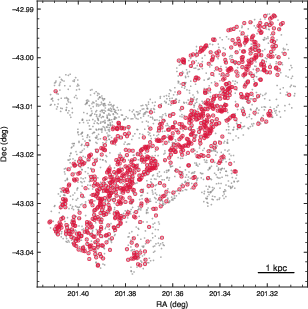
Figure 7: Spatial mapping of all MIRI sources (×1~mag errors) with red circles denoting IR-excess, disc-confined sources.
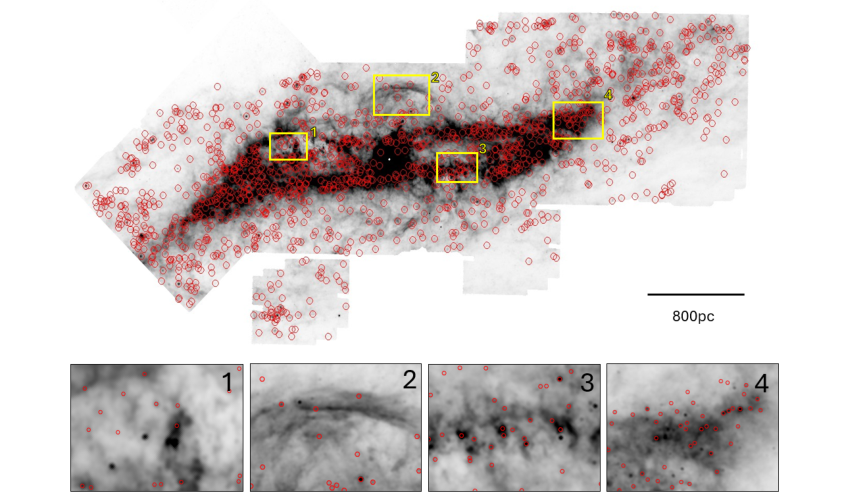
Figure 8: Overlay of the red, dust-enshrouded sources on the F1130W image, with subregion cutouts highlighting association with dusty filaments and disc substructure.
Mid-Infrared SEDs and Physical Interpretation
Median normalized SEDs for the red group display systematically rising mid-IR slopes, ×2 (16th–84th percentile: 2.95–4.24), inconsistent with mere extinction effects (given the flatness of the mid-IR extinction curve) and instead pointing to strong warm dust emission. This is characteristic of Stage I embedded YSOs (×3–×4 yr), although with possible minor admixing from extreme mass-losing evolved stars.
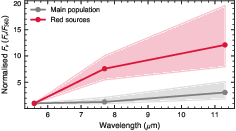
Figure 9: Median normalized SEDs for red sources versus the photospheric population, denoting steeper spectral slopes for the dust-rich subset.
Large Scale Dust Structures and ISM Context
The F1130W emission resolves the previously ambiguous “oval dusty shell” into discrete loop-like features, more morphologically complex than Spitzer/IRAC could suggest. These features are bright in PAH emission (F1130W) and do not co-locate with radio jet or hot X-ray emission, but instead closely follow the distribution of cold molecular gas (CO(1-0)), supporting a scenario where merger-accreted gas drives the ongoing star formation.
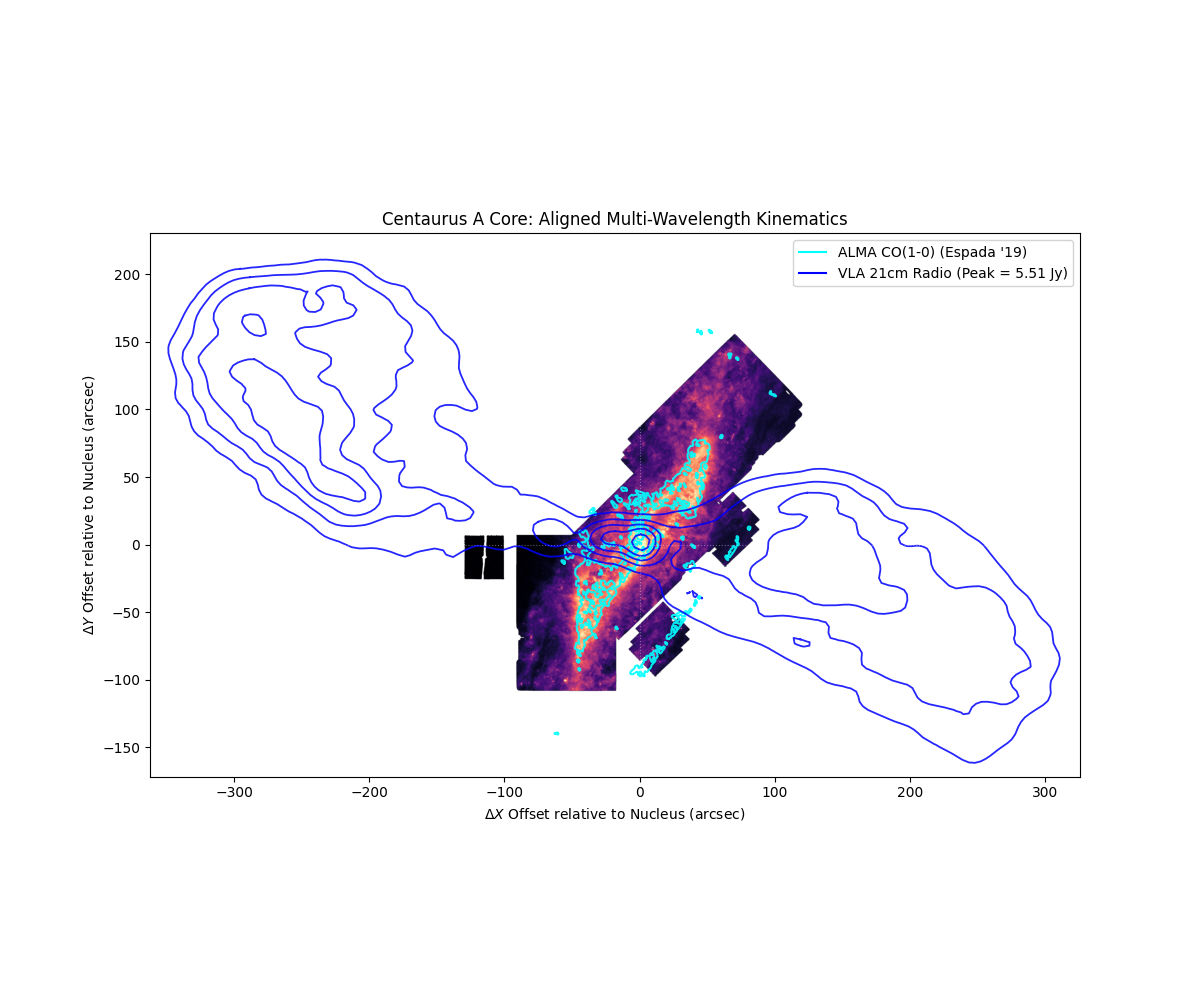
Figure 10: F1130W emission overlaid with CO(1–0) and VLA 21cm data. IR/submm structures trace molecular gas, not radio features.
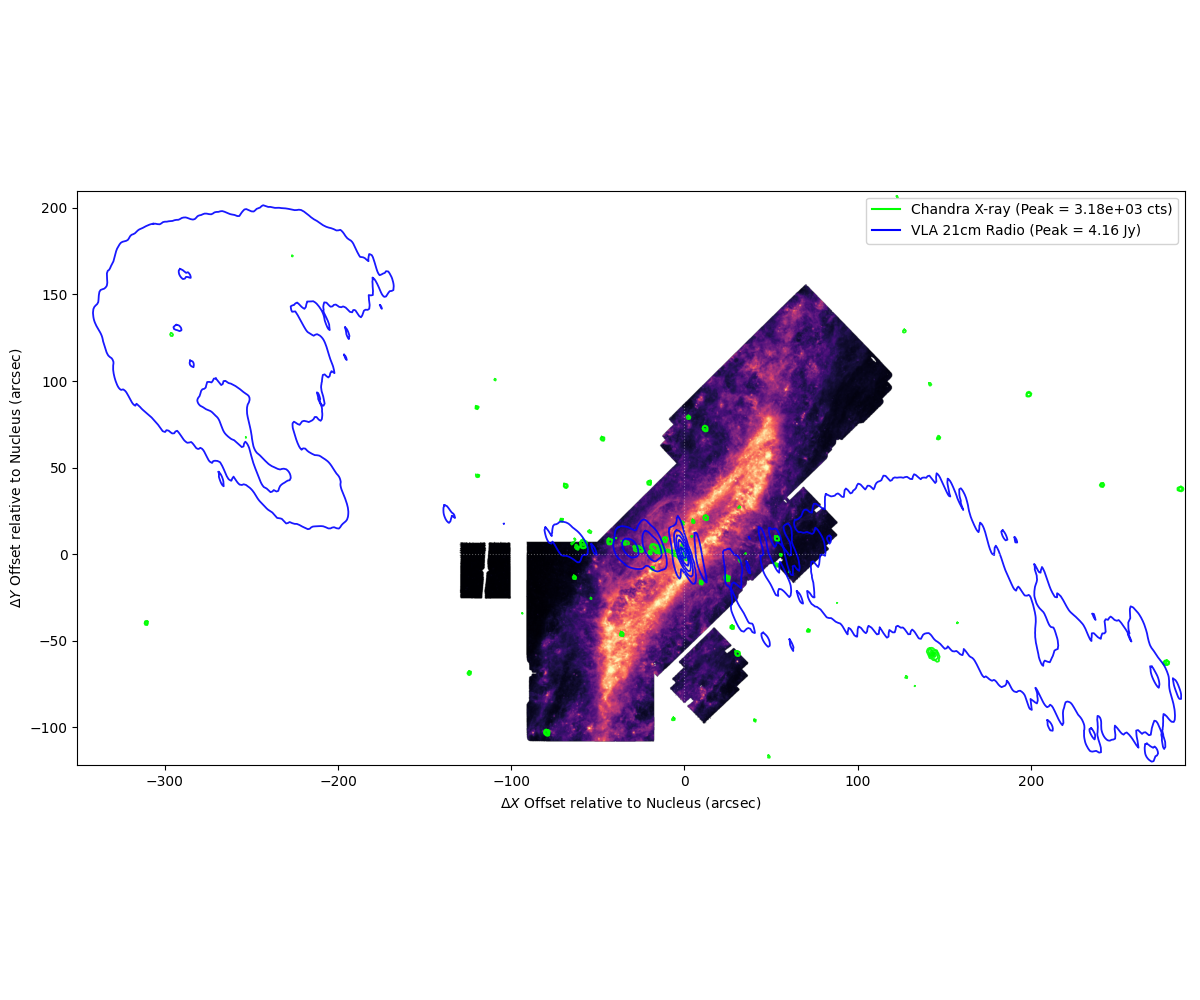
Figure 11: F1130W compared with VLA radio and Chandra X-ray, further excluding alignment between dusty star-forming filaments and AGN jet activity.
The disc-confined infrared-excess population is consistent with on-going star formation in a dynamically cold, gas-rich, merger-accreted structure, with spatial confinement and SED slopes supporting an embedded YSO origin. The lack of correlation with jet orientation or X-ray structures refutes the hypothesis of AGN-triggered jet-induced star formation within the central ×54 kpc. Instead, the data imply that, at least in the central disc, star formation is primarily set by gas accretion and settling from previous mergers.
In contrast to filamentary, jet-induced star-formation sites found at ×610 kpc in the Cen~A halo, the MIRI results show no evidence for local jet/ISM interaction impacting young star distribution in the inner disc. AGN feedback effects are dynamically relevant on circumnuclear (×7200 pc) scales, but not on the larger disc-wide embedded star-formation traced here.
Limitations and Prospects
Disentangling YSOs from evolved stars in mid-IR-only datasets is non-trivial; spectroscopic identification, or NIR photometry, will be required to more stringently classify dusty sources, especially for low-luminosity or low-mass YSOs. The present color-based selection, while robust, is susceptible to contamination from extreme AGB stars, though their expected numbers and distribution are inconsistent with the observed spatial profile. Systematic uncertainties from internal extinction, crowding, and diffuse PAH contributions also affect detailed luminosity and mass derivations.
Conclusion
JWST/MIRI imaging has resolved the young, embedded stellar population within Centaurus~A’s warped disc, characterizing a cohort of 928 IR-excess, dust-enshrouded sources representing ongoing star formation primarily regulated by the merger-accreted gas disc rather than AGN jet activity. Dust filament and loop morphologies are decomposed with unprecedented clarity, sharply distinguishing between merger-fueled disc-based star-formation and jet-induced effects seen in the outer halo. This work demonstrates the capability of mid-IR JWST studies to resolve the mechanisms of star-formation regulation in composite AGN-disk systems and motivates future spectroscopic campaigns for full population demography and ISM interaction mapping.
(2607.04942)