- The paper introduces analytic and semi-analytic wall potentials that cancel interfacial oscillations to realize constant density profiles.
- It employs Rosenfeld's Fundamental Measure Theory to derive explicit expressions for planar, spherical, and cylindrical geometries, with numerical DFT validation.
- The study highlights curvature effects and the interplay of hard-sphere repulsion with attractive forces, providing robust tests for DFT implementation.
Overview and Motivation
The work "Uniform distributions in nonuniform systems: Wall potentials generating constant density profiles in classical density functional theory" (2607.04863) investigates the inverse problem in classical DFT: determining the external potential needed to enforce a constant equilibrium density near an interface, specifically in the presence of hard-sphere interactions and mean-field attractions. Whereas most DFT studies solve for density profiles given an external field, this work inverts the problem, constructing analytic and semi-analytic wall potentials that exactly cancel wall-induced oscillatory structure, even in the microscopically nonlocal FMT framework. The analysis addresses planar, spherical, and cylindrical substrate geometries, and provides both theoretical expressions and numerical validation.
Theoretical Framework
The formulation is anchored in Rosenfeld's Fundamental Measure Theory (FMT), which provides highly accurate predictions for hard-sphere fluids and can be extended via perturbative, mean-field treatment of truncated Lennard-Jones attractions. The system's grand potential minimization gives rise to the Euler-Lagrange equation for the density profile:
ρ(r)=Λ−3exp[βμ−βV(r)+c(1)(r)],
where c(1)(r) is the functional derivative of the excess free energy, and V(r) is the external field. The inverse problem entails, for a prescribed constant density profile, direct construction of the required V(r).
The complexity of the resulting wall potential is strongly geometry-dependent. In planar symmetry, all relevant FMT convolutions reduce to analytic 1D integrals; in spherical symmetry, the expressions remain analytic but are more involved due to explicit curvature dependence; in cylindrical symmetry, the necessary kernels involve elliptic integrals, precluding closed-form analytic results and necessitating numerical computation.
Results in Planar Geometry
For the planar substrate, explicit analytical forms for all FMT-weighted densities and correlation functions are derived for both hard-sphere only and truncated Lennard-Jones fluids. The resultant compensating wall potentials are shown to be purely repulsive and short-ranged for hard spheres, while incorporating attractive minima for the Lennard-Jones fluid, reflecting the interplay between packing constraints and cohesive interactions.
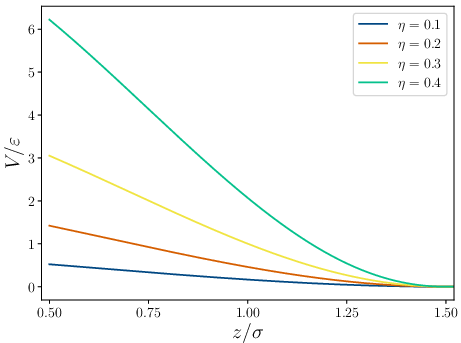
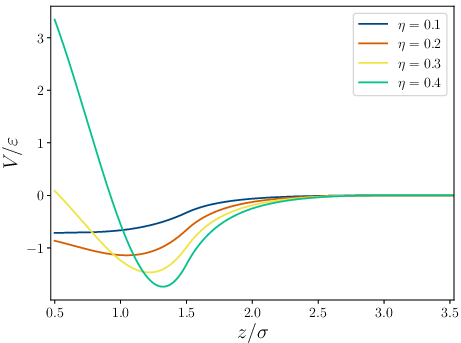
Figure 1: Planar wall potentials that generate constant density profiles, shown for several packing fractions η in (a) the hard-sphere fluid and (b) the fluid with truncated Lennard-Jones attractions at T=1.5kB−1ε.
The contact value of the wall potential recovers the exact sum-rule for pressure, ensuring the analytic construction's internal consistency.
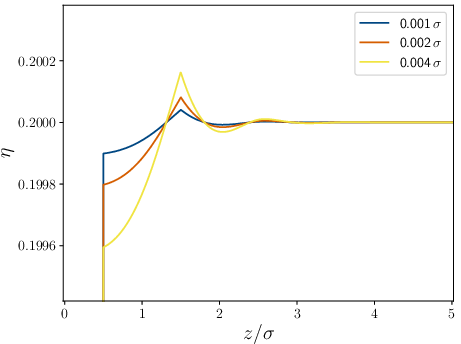
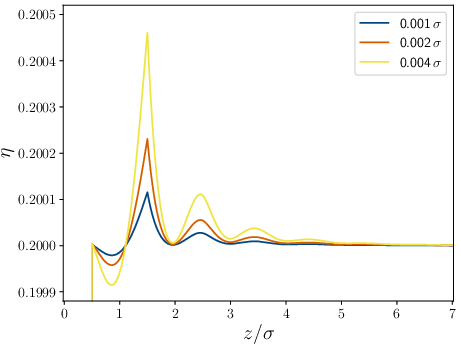
Figure 2: DFT density profiles in planar geometry using the constructed wall potentials; the profiles remain flat within numerical precision, demonstrating suppression of wall-induced structure.
The numerical DFT validation confirms that these potentials accurately enforce constant density, with deviations purely attributable to grid discretization.
Surface Curvature Effects: Spherical and Cylindrical Cases
In spherical geometry, curvature modifies the wall potential, with the effect more pronounced when attractive interactions are present. For hard-spheres, the deviation from the planar solution is minor at moderate radii, but the attractive fluid shows a clear shift: the minimum of the wall potential becomes shallower as the radius decreases, reflecting the reduced coordination at highly curved interfaces.
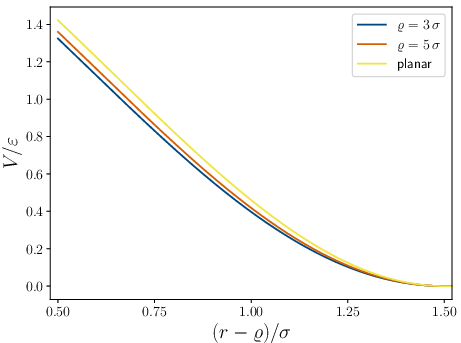
Figure 3: Hard-sphere wall potential in spherical geometry for η=0.2 and two radii, compared to the planar limit.
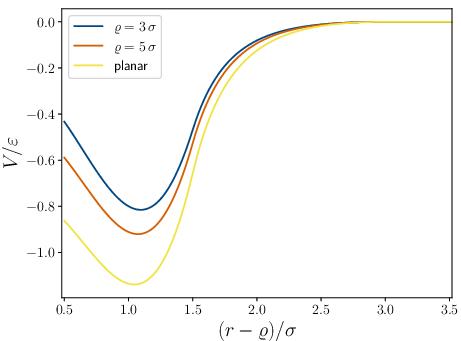
Figure 4: Wall potential in spherical geometry with attractions, for various sphere radii; the attractive minimum's depth and position are notably curvature-dependent.
Again, DFT calculations with the derived potentials produce flat density profiles to high numerical accuracy.
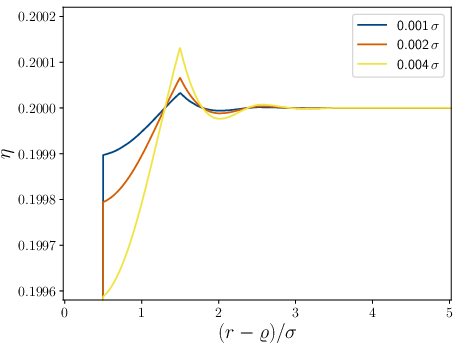
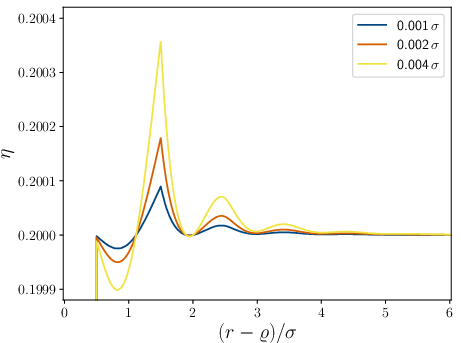
Figure 5: DFT density profiles in spherical geometry using analytic wall potentials, for both fluid models; convergence to the flat profile is observed as grid resolution increases.
The cylindrical case is analytically less tractable. All relevant convolutions for FMT in cylindrical geometry yield kernels with complete elliptic integrals. The required compensating potentials are thus computed by numerical quadrature. The cylindrical wall potential interpolates between the planar and spherical cases as a function of curvature.
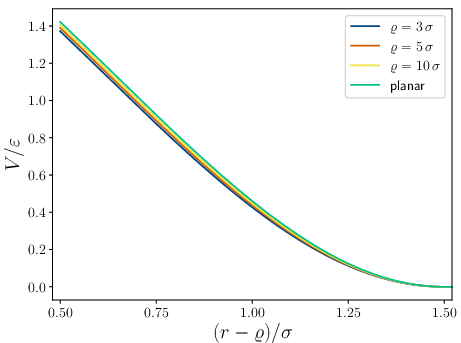
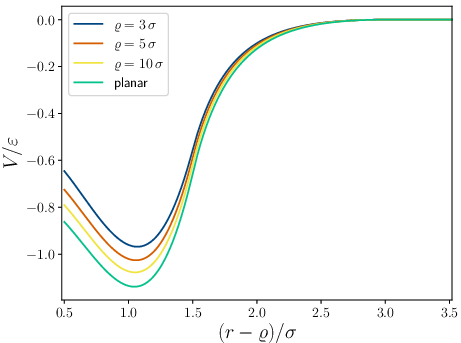
Figure 6: External wall potentials in cylindrical geometry, numerically evaluated for different cylinder radii and compared to the planar result; both hard-sphere and attractive fluids are shown.
An aggregate comparison for fixed radius demonstrates that the cylindrical case occupies an intermediate position between planar and spherical as expected by geometric arguments.
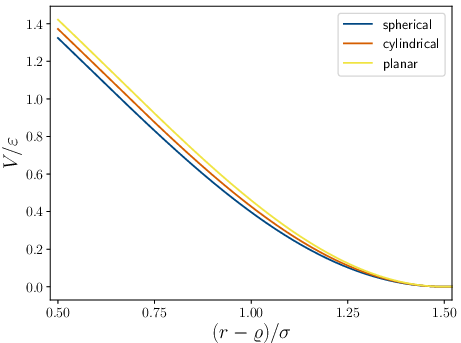
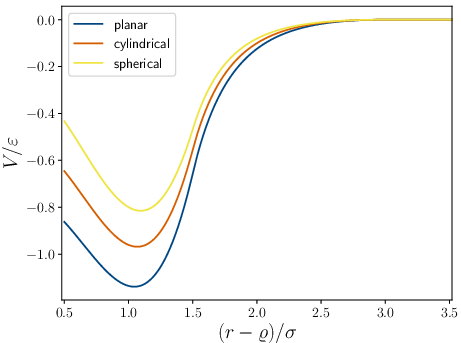
Figure 7: Comparison of wall potentials for planar, cylindrical, and spherical geometries at the same wall radius; the cylindrical potential is intermediate between the planar and spherical solutions.
Implications and Future Directions
The work delivers explicit, compact analytic recipes for structure-cancelling wall fields across geometries, facilitating direct construction of uniform density states in classical fluids governed by nonlocal interactions. The analytic expression's finiteness and range stem from the finite range of both the FMT kernel and the Lennard-Jones attraction; at criticality in real systems, long-range fluctuation effects could extend the compensating field's tail, but such effects are absent at this mean-field level.
The results also provide robust tests for DFT codes, since correct numerical implementation must recover the flat equilibrium profiles. More theoretically, the explicit construction connects to the prediction of multicritical wetting and drying states, where bulk and interface interactions conspire to produce flat profiles—a phenomenon now shown to be implementable at the explicit microscopic level in a nonlocal DFT.
Prospective extensions include multicomponent fluids, which may enable selective adsorption control by targeted cancellation of interfacial structure; curvature expansions enabling systematic interpolation between planar and curved geometries; translation of the method to more sophisticated FMTs that go beyond the original Rosenfeld form; and exploration in dynamic or rheological regimes.
Conclusion
This work rigorously solves the inverse problem of uniform density realization via external wall fields in classical DFT, delivering closed-form and numerical solutions for planar, spherical, and cylindrical geometries for both hard-sphere and attractive models. This explicit construction enhances understanding of interfacial compensation mechanisms and provides tools for both theoretical studies and practical DFT implementation validation. The analytic techniques and results further support broader explorations in interfacial phenomena, criticality, and tailored control of inhomogeneous classical fluids (2607.04863).