- The paper demonstrates that nonlocal, bond-resolved Kondo-exchange, rather than local Zeeman splittings, is the primary source of substantial Berry curvature leading to intrinsic AHE.
- A multiorbital tight-binding Hamiltonian with c–f hybridization and DMFT corrections is employed to quantitatively reproduce the experimental AHC in Ce₂CuGe₆.
- Selective Ge 4p bands near the Fermi level, activated by spin-dependent intersite hoppings, underpin the large anomalous Hall conductivity observed in the collinear AFM state.
Introduction
This work develops a comprehensive microscopic theory for the intrinsic anomalous Hall effect (AHE) in antiferromagnetic (AFM) metals with strongly localized $4f$ electrons, exemplified by Ce2CuGe6. Traditional models of the AHE in itinerant AFM systems, rooted in Stoner-like mechanisms, do not directly translate to f-electron materials, where magnetism resides on localized $4f$ orbitals and transport is mediated by itinerant ligand p-bands. The paper introduces and analyzes a nonlocal Kondo-exchange-mediated mechanism that resolves the conundrum of large Berry curvature and intrinsic AHC in these systems—the essential insight being that nonlocal, spin-dependent hopping terms, generated via c–f virtual hybridization, provide the dominant origin of Berry curvature and associated Hall response, not a simple Zeeman-type local effective field.
Theoretical Framework: Effective Hamiltonian and Kondo Exchange
The authors start with a multiorbital tight-binding Hamiltonian incorporating conduction electrons and localized $4f$ orbitals, mediated by $4f$0–$4f$1 hybridization. In the strong-coupling (localized) regime, they downfold the $4f$2-degrees of freedom to derive an explicit effective Hamiltonian for the conduction carriers. This procedure—rooted in a static limit of the Green's function formalism and consistent with the Schrieffer–Wolff transformation—captures both local and nonlocal exchange processes. The first induces a local molecular field, while the latter produces spin-dependent intersite hopping terms originating from the geometrically and orbitally structured $4f$3–$4f$4 hybridization.
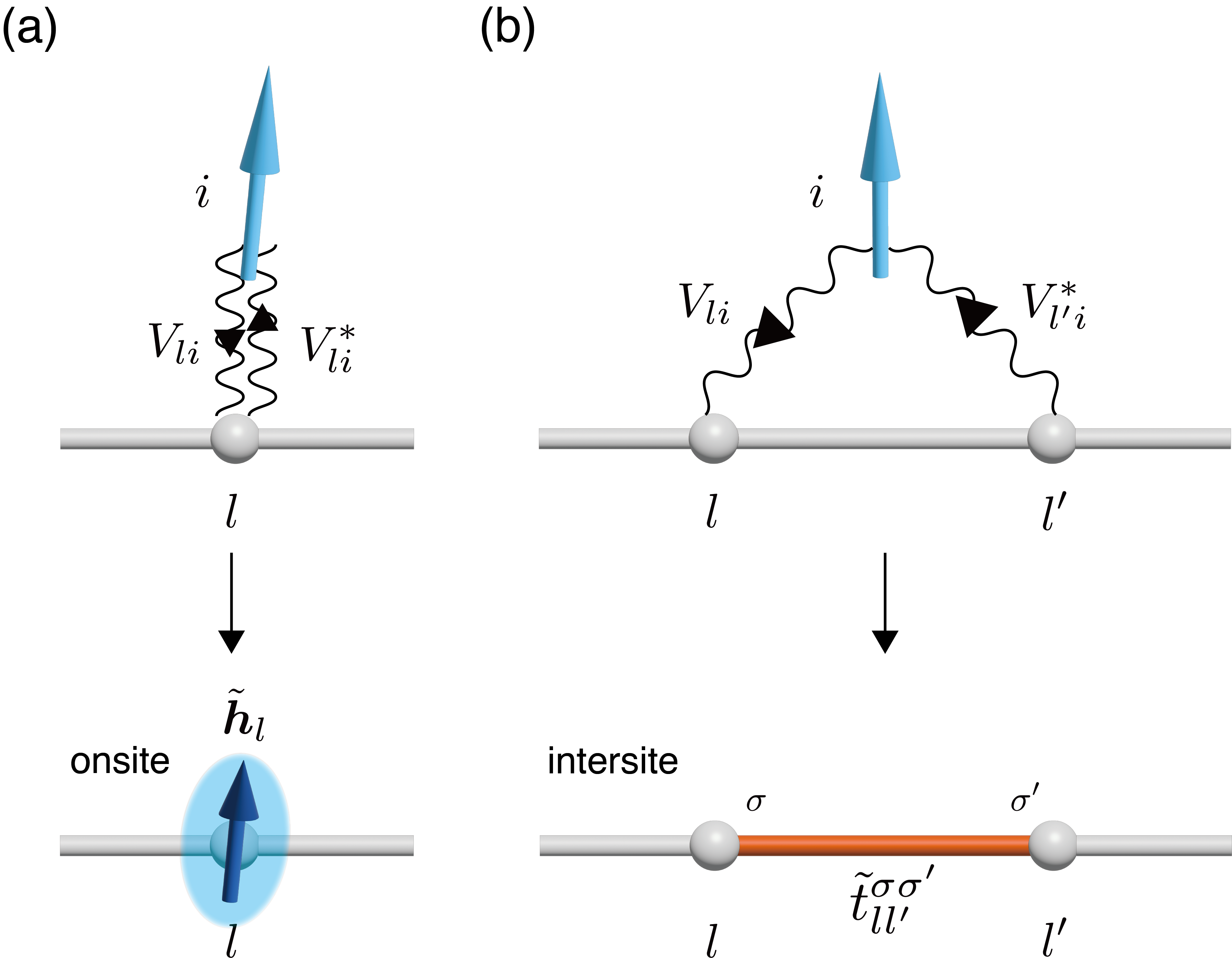
Figure 1: Schematic depiction of (a) local field and (b) nonlocal spin-dependent hopping contributions, arising from virtual $4f$5–$4f$6 hybridization in the localized-$4f$7 regime.
A critical claim, supported by quantitative analysis, is that local effective field terms (which act as Zeeman splittings on conduction electrons) are insufficient to explain the observed large anomalous Hall conductivities. Instead, the nonlocal, bond-resolved Kondo exchange, manifesting as spin-flip and spin-dependent hopping, is necessary to produce substantial Berry curvature and associated transport signatures.
Application to Ce$4f$8CuGe$4f$9: Electronic Structure and Transport
The theory is applied to Ce20CuGe21, a prototypical 22 antiferromagnetic metal with a collinear AFM structure and experimentally measured large AHC. The calculation pipeline combines first-principles DFT to construct the underlying tight-binding model, inclusion of strong 23-electron correlations via Hubbard-I/DMFT, and the evaluation of self-energies and Green’s functions. The AFM state is modeled to reproduce experimental magnetic structures, canting, and moment directions.
Numerical results show that the intrinsic AHC at 24 and negligible 25-axis canting is approximately 26–27, in close agreement with measurements. Importantly, the magnitude and sign of the AHC are robust against the suppression of the net ferromagnetic (canting) component, establishing that the Hall response originates from the collinear AFM state itself rather than any net moment or scalar spin chirality.
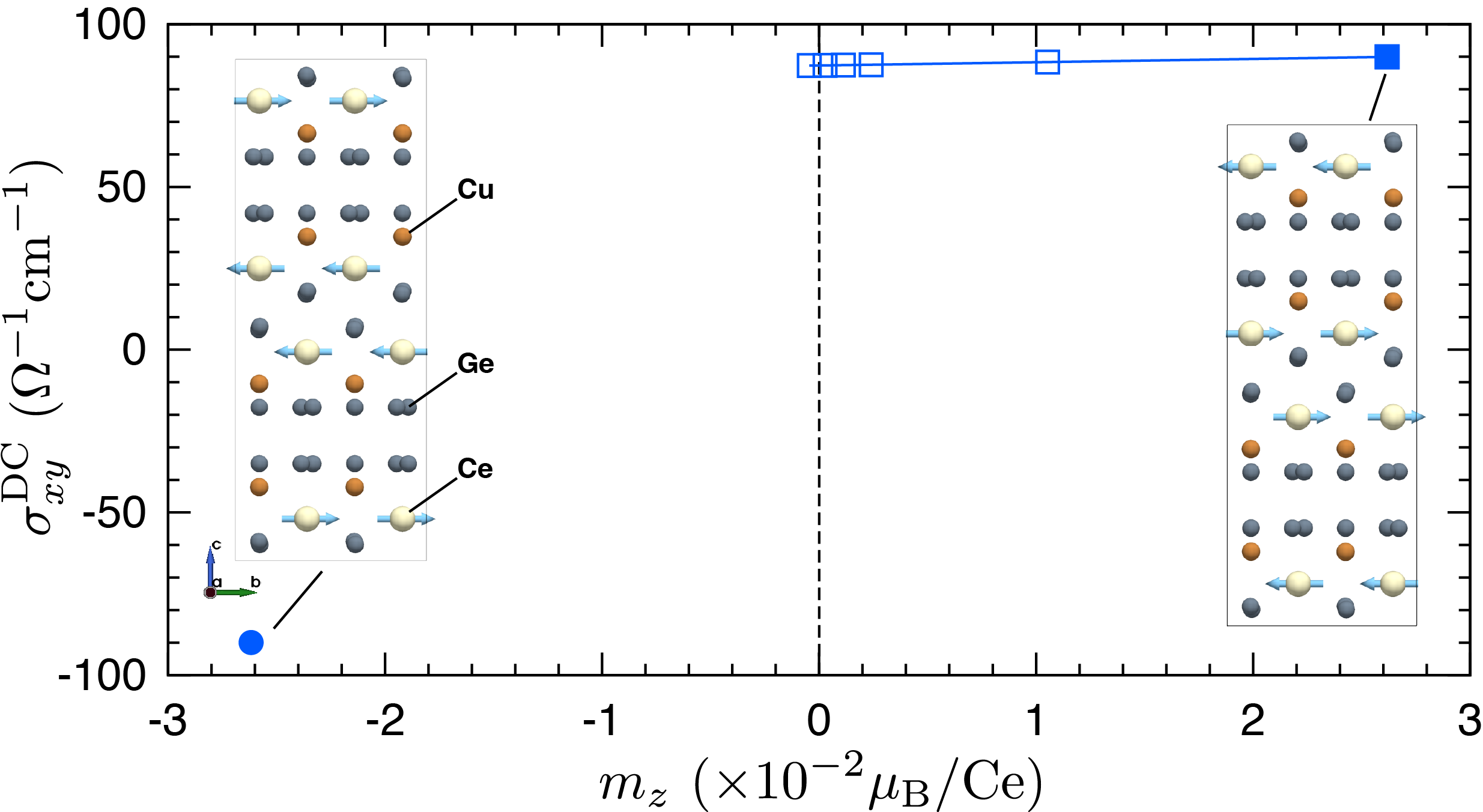
Figure 2: Intrinsic AHC 28 vs. canting magnetization 29 showing minimal variation with 60, highlighting AHE generation from AFM order.
Analysis of the band structure from the effective Hamiltonian reveals sizable spin-splitting near the Fermi level in regions of high total angular momentum polarization, particularly in the vicinity of high-symmetry Brillouin zone points.
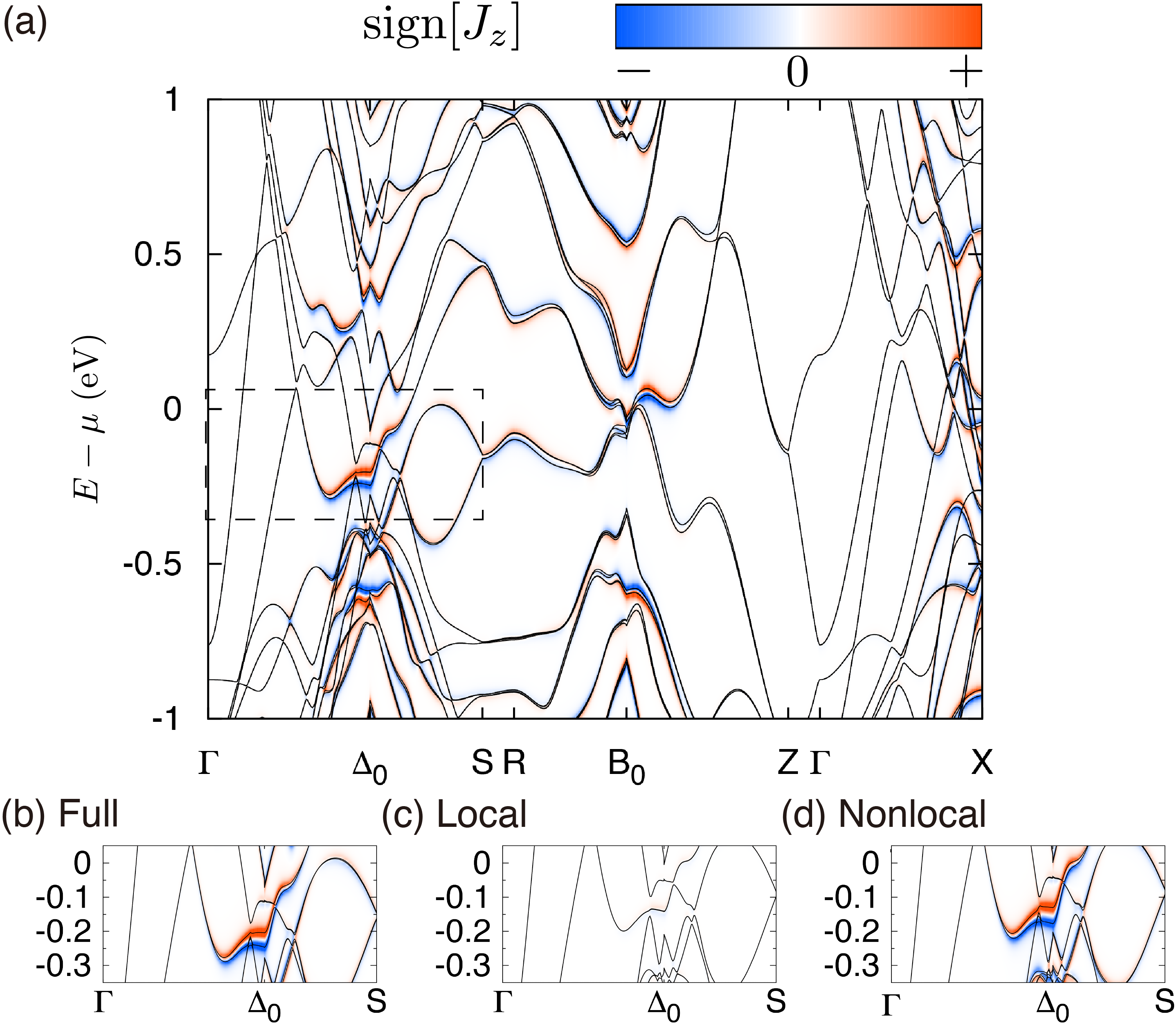
Figure 3: (a) Band structure with color map indicating 61 polarization, (b) close-up near the Fermi level, and (c,d) selective retention of local/nonlocal contributions for Ge 62.
Decomposition of the band contributions to AHC decisively shows that Ge 63-derived bands are dominant near the Fermi level, and, crucially, further resolution into local and nonlocal terms confirms that nonlocal (off-site) spin-dependent hoppings provide essentially the entire intrinsic AHC.
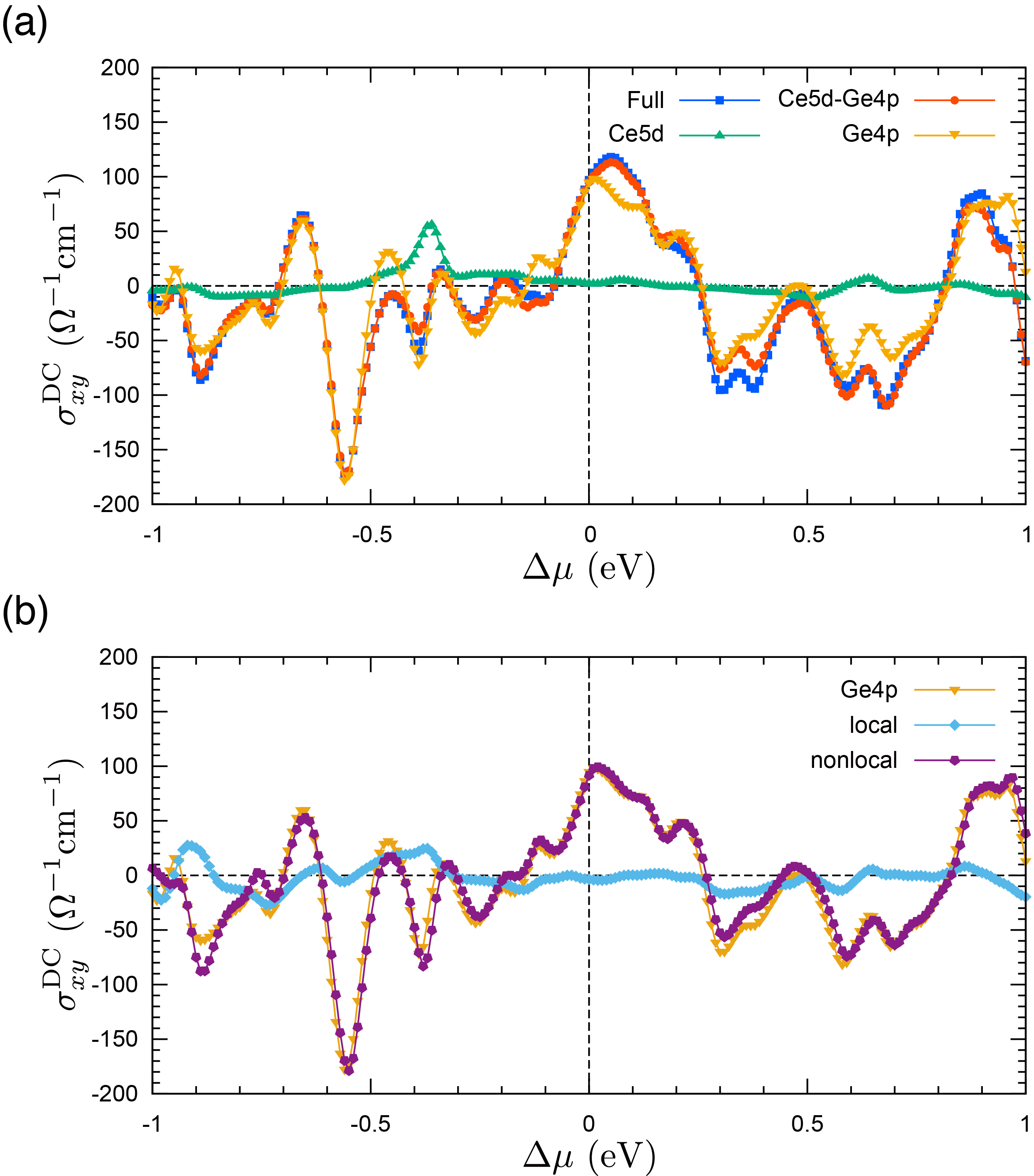
Figure 4: Intrinsic AHC 64 versus chemical potential; dominant Ge 65/nonlocal-hopping contributions demonstrated.
Berry Curvature and Path-Resolved Analysis
A detailed mapping of the Berry curvature within the Brillouin zone shows hot spots co-located with spin-split regions generated by the nonlocal Kondo-exchange mechanism.
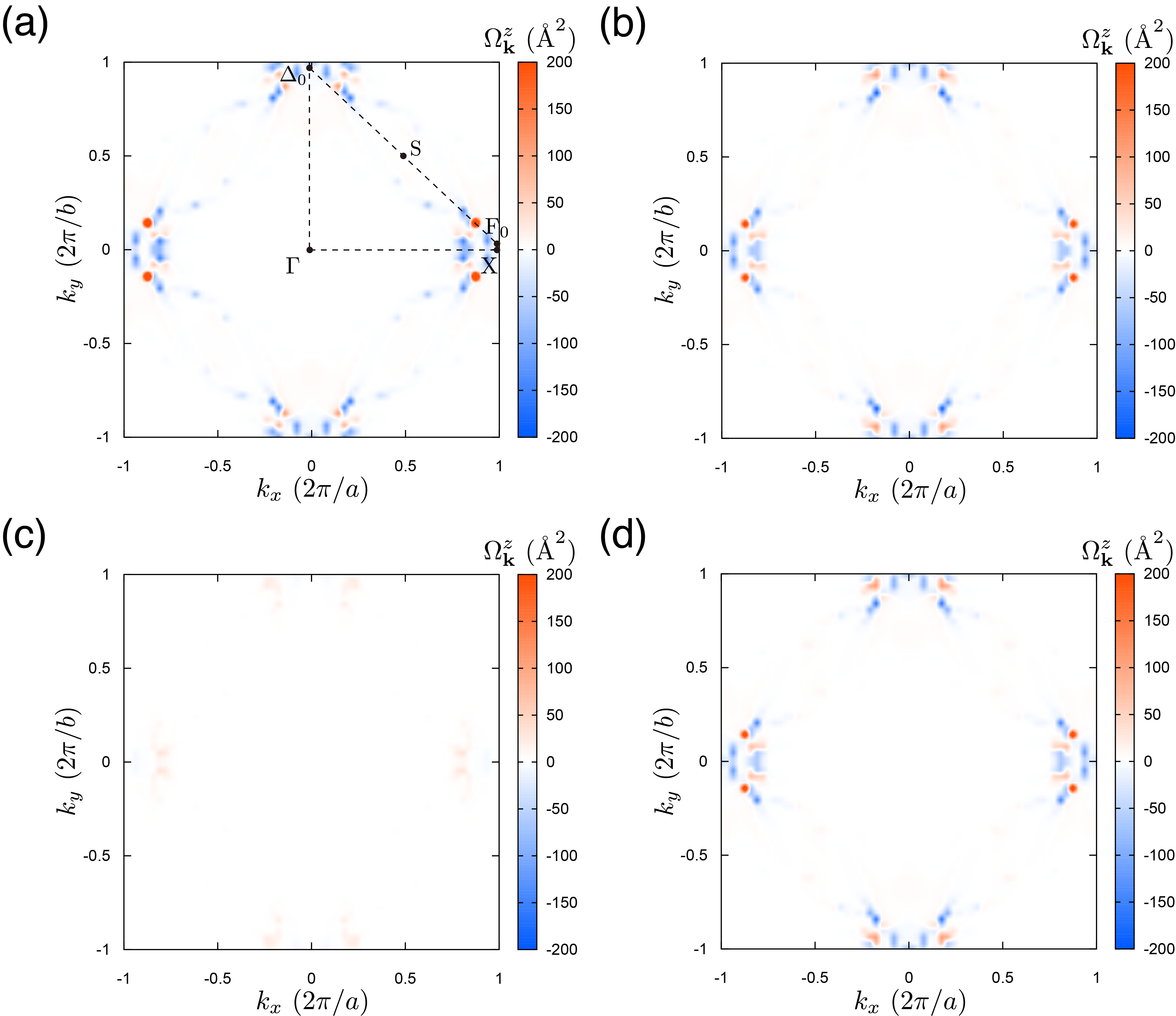
Figure 5: Berry-curvature distribution at 66 displays concentration near spin-polarized hotspots in the Brillouin zone.
Further path-resolved analysis establishes that three-dimensional networks of Ge sites, mediated by Ce 67 moments, underlie the nonlocal, spin-dependent hoppings that drive the AHE, with both bilayer and chain-like Ge motifs contributing.
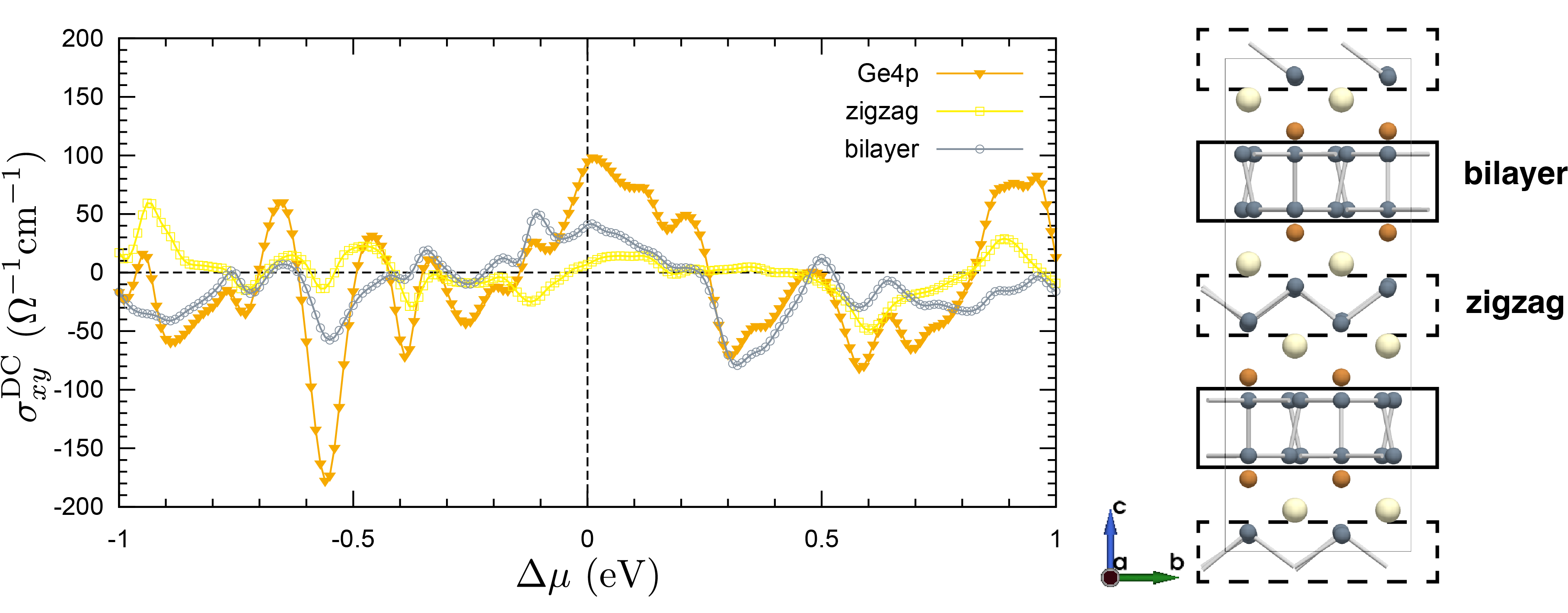
Figure 6: Path-dependence of the intrinsic AHC from distinct Ge–Ge hopping geometries in the unit cell.
Implications and Prospects
The results unambiguously establish that nonlocal Kondo-exchange coupling—i.e., second-order virtual 68–69 hybridization yielding bond-resolved, spin-dependent intersite tunneling—can endow conduction-electron bands with substantial Berry curvature even in the absence of itinerant f0-electron character or net magnetization. This finding compels a re-examination of Berry-phase-mediated transport in a wide class of f1-electron AFM metals and lays the groundwork for interpreting anomalous and nonlinear electronic responses in related compounds, such as HoAgGe and NdRuf2Alf3, where symmetry considerations admit such effects but the microscopic mechanisms have remained nebulous.
From a theoretical perspective, the methodology generalizes straightforwardly to more complex correlation models (e.g., incorporating dynamical fluctuations or more intricate orbital structures). Practically, these insights provide predictive principles for discovering or engineering materials exhibiting exceedingly large AHE, nonlinear Hall, or nonreciprocal transport effects, especially in systems with strongly localized magnetism coupled to itinerant bands via symmetry-permitted hybridizations.
Conclusion
This work presents a rigorous and quantitative theory of the intrinsic anomalous Hall effect in AFM metals with localized f4 magnetism, underpinned by the identification of nonlocal spin-dependent hopping generated via Kondo-exchange as the key microscopic mechanism. The framework not only resolves longstanding questions about the origin of large Berry curvature and Hall conductivities in such systems but also points to general avenues for understanding and controlling Berry-phase effects in a broad array of correlated magnetic materials.