- The paper develops a machine learning-based surrogate (RTFAST2) to emulate non-linear relativistic X-ray reflection with percent-level accuracy.
- It employs innovative operator-learning with Fourier feature embedding and FiLM conditioning to capture intricate spectral features.
- RTFAST2 significantly accelerates Bayesian inference in high-energy astrophysics while ensuring minimal bias in parameter recovery.
Emulation of Non-linear 1D Spectral Models in Relativistic X-ray Reflection
Introduction and Motivation
High-fidelity modeling of astrophysical X-ray spectra, particularly those arising from relativistically smeared emission near compact objects, poses severe computational challenges due to the inherent complexity of radiative transfer and general relativistic ray-tracing. The reltrans model, widely used for interpreting X-ray reverberation and reflection in accreting black hole systems, exemplifies these difficulties. Each evaluation involves numerically intensive convolution of reflection spectra with relativistic kernels, often necessitating hundreds of thousands to millions of model runs for Bayesian inference applications. This computational barrier hampers detailed physical interpretation and fast feedback from new observations.
The study develops a high-precision, machine learning-based surrogate—RTFAST2—specifically targeting the most expensive component of reltrans, the relativistically convolved reflection spectrum. This work offers a methodological advance over previous emulation attempts by adopting a modular, operator-learning approach and introducing modern conditioning and regularization techniques. Consequently, it delivers both substantial acceleration and percent-level accuracy critical for robust inference in high-energy astrophysics.
The reltrans Model and Spectral Complexity
reltrans synthesizes the time-averaged X-ray spectra from a geometrically thin, optically thick accretion disk illuminated by a lamppost corona situated above a black hole. Both the direct and reflected emission are affected by complex physical effects including general relativistic ray-tracing, anisotropic illumination, disk ionization stratification, and Doppler/gravitational shifts. The resulting typical spectrum includes a soft excess, the Fe Kα emission complex, and a Compton hump, all substantially blurred and shifted by relativistic effects [Fabian et al. 1989, Garcia et al. 2013].
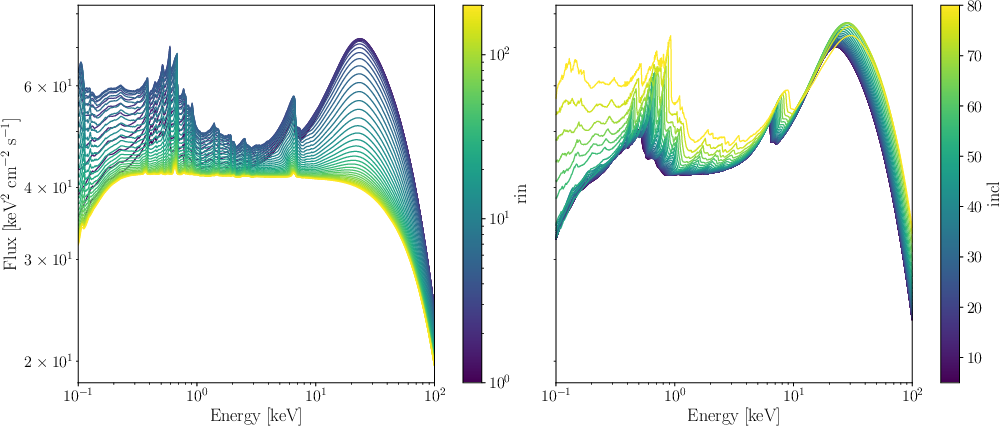
Figure 1: Reflection spectral evolution illustrating the impact of the inner disk truncation (left) and disk inclination (right) on overall spectral morphology under relativistic convolution.
Spectral variability due to parameters such as disk inner radius and inclination is highly non-linear. For instance, decreasing the inner radius enhances relativistic blurring, broadening features such as the iron line, while increasing inclination preferentially blue-shifts the Compton and iron features (Figure 1). These effects pose a major challenge to conventional, grid-based interpolation or analytic approximation strategies, particularly as the spectrum's high-frequency features are sensitive to small parameter changes.
Emulation Strategy: Methods and Architectural Advances
Operator-learning Framework
Instead of regressing the full spectrum as a fixed-length vector, RTFAST2 approaches spectral emulation as an operator-learning problem: it directly models the spectrum as a function f(E;θ) of energy conditioned on physical parameters. This formulation facilitates interpolation across arbitrary energy grids, enabling the surrogate to generalize to spectra at any required instrument resolution.
- Fourier Feature Embedding: The energy coordinate is embedded using random Fourier features (RFF), improving the network’s ability to represent high-frequency (sharp, localized) as well as low-frequency (smooth, global) spectral structure. This directly counteracts the well-known spectral bias of MLPs toward smooth, slowly-varying functions.
- Feature-wise Linear Modulation (FiLM): Non-linear conditioning on physical parameters is achieved using FiLM layers, permitting dynamic modulation of activations and capturing intricate dependencies between parameter combinations and spectral morphology.
Trend-Head and Regularization
The architecture employs an energy-dependent “trend head” to efficiently capture global spectral behavior (akin to a log-space power-law), allowing the deeper residual blocks to focus on the local, non-linear structure (e.g., Fe line asymmetry).
A Sobolev-style regularization term penalizes spurious, high-frequency, non-physical oscillations by directly encouraging the emulator's derivatives to match those of the target functional spectrum.
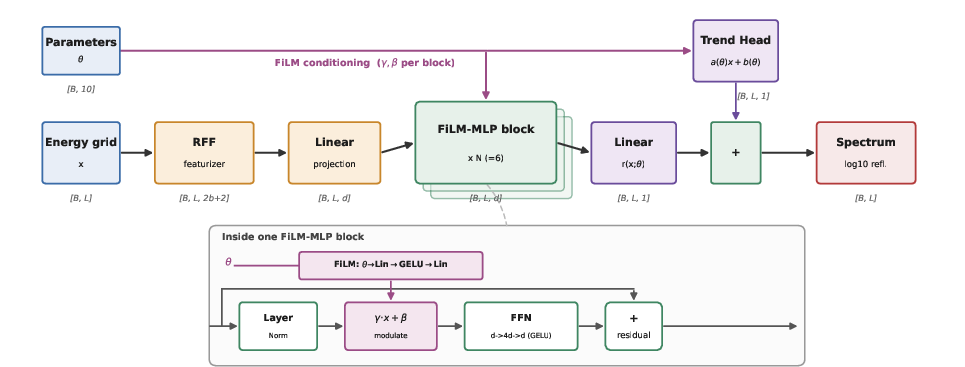
Figure 2: RTFAST2 neural architecture with colored blocks highlighting the modular embedding, FiLM conditioning, trend-head, and output synthesis.
The combination of architectural design choices and loss formulation is empirically validated via ablation studies, demonstrating the critical importance of FiLM conditioning and Fourier feature embeddings for reaching sub-percent accuracy in strict error-threshold metrics.
Quantitative comparisons across a variety of metrics establish that RTFAST2 achieves <1% average relative error for 85% of test spectra and <10% error for >99.9% of samples. Increasing model capacity from 16K to 8M parameters improves strict accuracy from ~50% to over 85%, with diminishing returns beyond this scale. Augmenting training set size similarly yields logarithmic improvements in generalization.
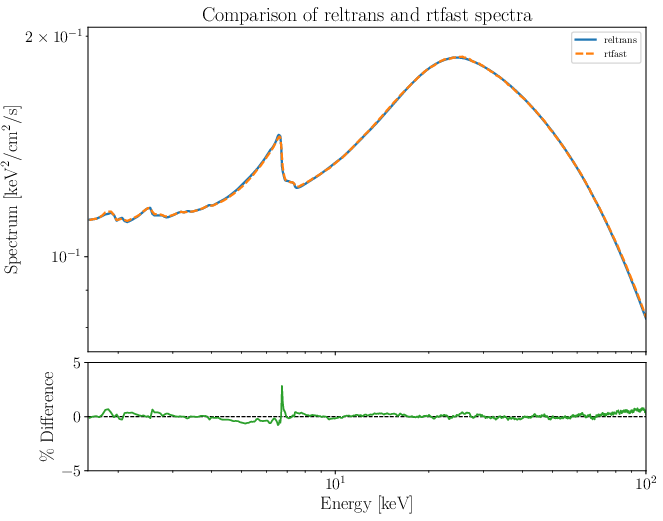
Figure 3: Comparison of reltrans (ground truth) and RTFAST2 spectra in the 0.1–100 keV band, with fractional residuals mostly below 1% throughout.
The distribution of residuals reveals that maximal discrepancies occur near sharply varying features (e.g., just above and below 6.4 keV in the Fe K line) and at high energies (>60 keV), where negligible emission reduces practical significance.
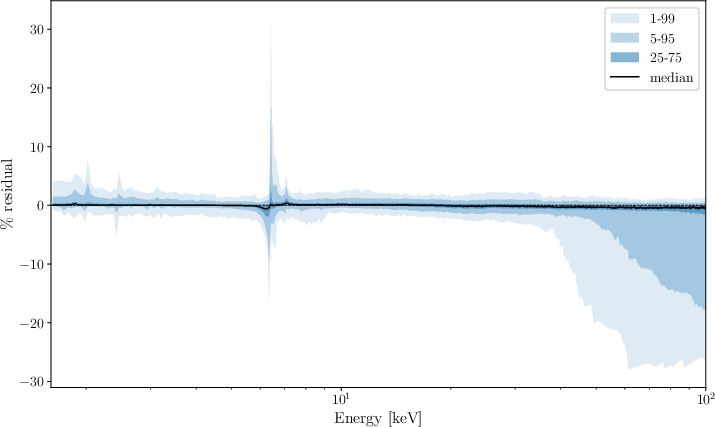
Figure 4: Distribution of percentage residuals between RTFAST2 and reltrans across energies, with 25–99% percentile bands indicating tight performance clustering.
Astrophysical Inference and Bias Analysis
To assess practical utility, RTFAST2 was embedded in a Bayesian inference pipeline for parameter recovery on simulated "fake" data. Posterior distributions drawn via MCMC sampling demonstrate negligible bias compared to the original model, with the true parameters consistently recovered within the credible intervals—except in degenerate cases such as black hole spin, where inherent spectral insensitivity limits constraint precision.
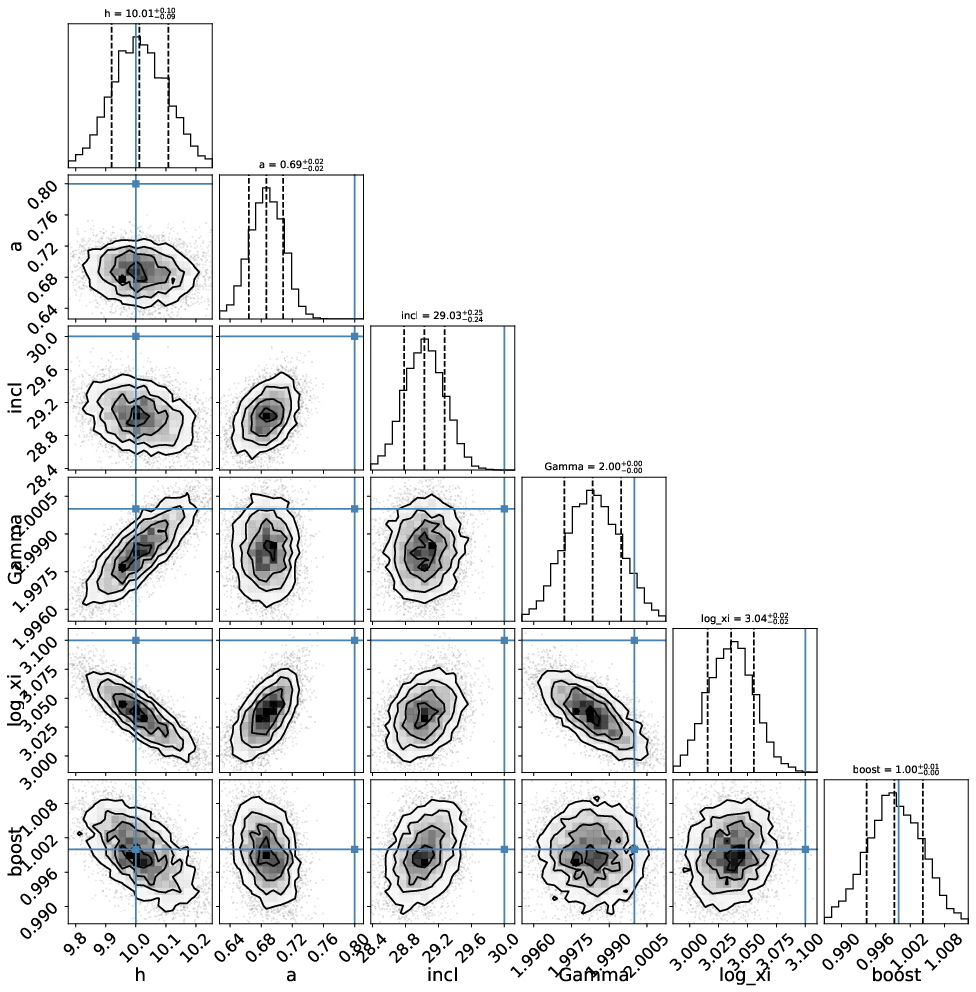
Figure 5: Posterior corner plot for multi-parameter inference on simulated data; true values indicated by blue lines, 1σ regions by dashed lines.
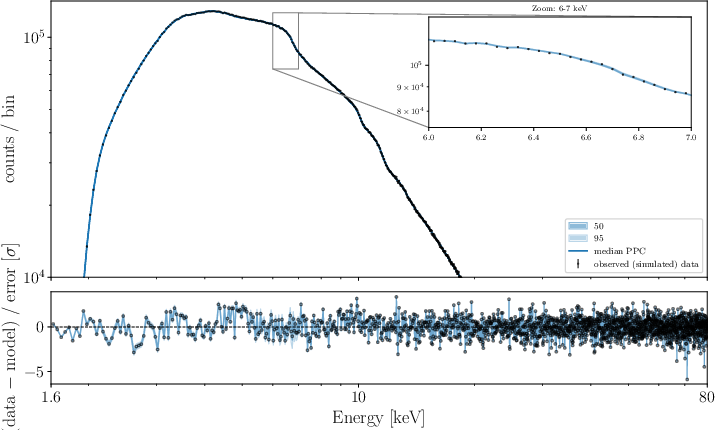
Figure 6: Top—Posterior predictive draws versus simulated data, including high-resolution zoom around the Fe-K region. Bottom—Residual distributions as a function of energy, showing minimal systematic bias.
Further analysis finds that the emulator does not shift the location of the minimum χ2 in narrow parameter scans, confirming minimal systematic offset in physical parameter inference when using RTFAST2 as a surrogate for reltrans.
Discussion and Theoretical Implications
Modularity and Emulation Scope
One of the central claims of the study is the superiority of modular, physically-motivated emulation strategies over monolithic, agnostic surrogates when striving for high precision on complex models. By restricting emulation to the reflection component—responsible for 1–10% of the total flux and dominant in parameter sensitivity—the approach enables both improved accuracy and easier generalization across energy resolutions and instruments.
The possibility of further decomposing the model (e.g., directly emulating relativistic kernels) is explored. However, due to the relative computational cost distribution within reltrans, current choices yield maximal returns for inference acceleration.
Lessons for Emulators in Physical Sciences
The findings highlight that emulator generalizability is limited; no neural architecture is universally optimal across physically distinct regimes. Accurate, trustworthy surrogates require systematic, data-driven investigation of the structure (e.g., via PCA, wavelets, or auto-encoders) and careful modularization. The success of operator-learning paradigms, advanced conditioning layers, and explicit loss alignment with fractional error metrics illustrates the necessity of bridging domain knowledge with ML methodology for scientific modeling.
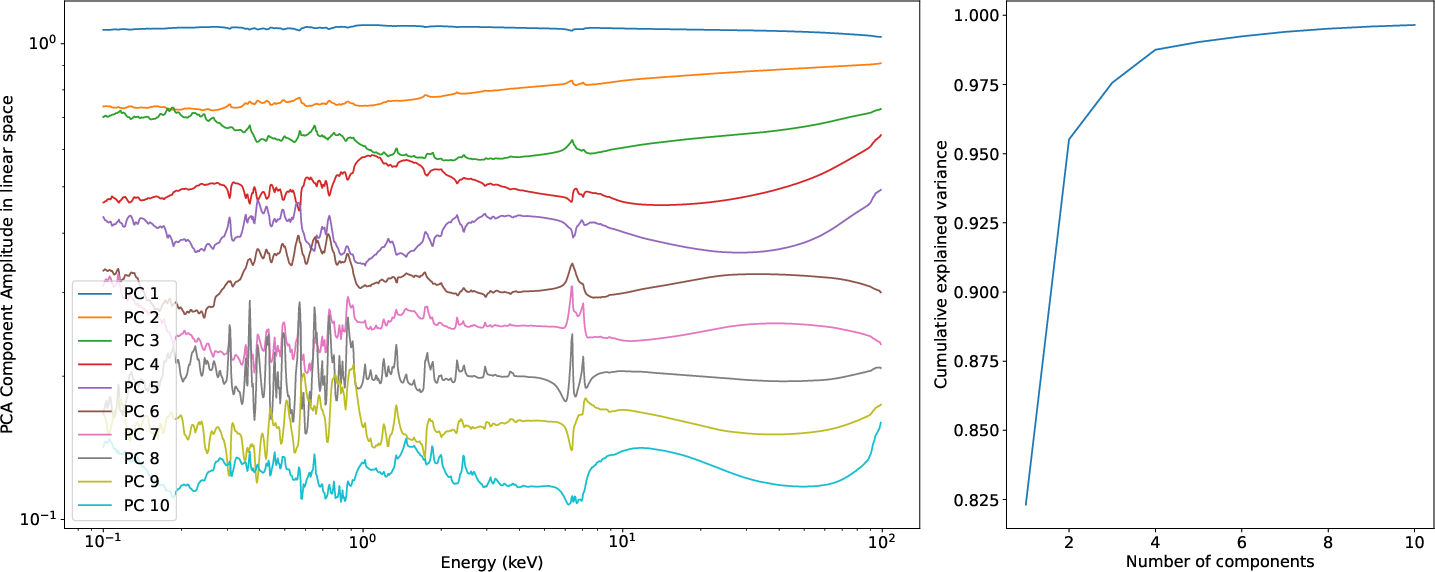
Figure 7: Principal components from the PCA decomposition and cumulative explained variance for reltrans spectra, demonstrating the complexity and dimensionality requirements for accurate spectral reconstruction.
Conclusion
RTFAST2 sets a new standard for surrogate modeling of non-linear, high-dimensional spectral models in astrophysics, achieving percent-level accuracy and robust performance in physically relevant inference tasks with significant acceleration relative to direct numerical evaluation. The operator-learning, FiLM-conditioned, and Fourier-embedded architecture provides both flexibility and domain-specific expressivity. The modular approach—focusing on the expensive, parameter-sensitive component—enables greater precision than full-model emulation while facilitating application across diverse instruments and use cases.
This methodology will likely inform future emulator development not only in high-energy astrophysics but also in broader domains where complex, physically-motivated simulation models bottleneck scientific inference. The work cautions against universal emulation recipes, instead advocating for detailed characterization and tailored architecture reflecting the subtleties of the specific physical model.
Reference:
"Emulation of non-linear 1D spectral models: relativistic X-ray reflection" (2607.04785)