- The paper identifies minimum distance bounds for 5G NR QC-LDPC codes using advanced algebraic and combinatorial techniques.
- It shows that low minimum distances in both high-rate and low-rate BG1 configurations contribute to error floors and increased undetected errors.
- The study introduces an efficient early termination strategy in LDPC decoders, reducing hardware complexity while maintaining performance.
Minimum Distances of LDPC Codes in the 5G Standard
Introduction and Context
This paper conducts a systematic investigation into the minimum Hamming distance properties of quasi-cyclic (QC) LDPC codes specified in the 5G New Radio (NR) standard, with particular focus on high-rate and low-rate base graph 1 (BG1) codes, such as the [9984,8448] and [25344,8448] codes. The minimum distance is a fundamental parameter determining the error correction capability and undetected error probability in hardware implementations and retransmission schemes. Since computing minimum distance for arbitrary linear codes is NP-hard, the study focuses on efficiently bounding these distances for long QC-LDPC codes using advanced combinatorial and algebraic techniques.
The distinctive block structure of 5G LDPC parity-check matrices—optimized for computationally efficient encoding, but featuring sparse regions and weight-1 columns—elicits potential concerns regarding minimum distance and consequent decoder performance, notably error floors and undetected errors. These concerns are validated empirically, and the investigation leverages theoretical and computational approaches to clarify the minimum distance landscape, both for their practical implications and for guiding future code designs.
5G LDPC Code Construction, Syndrome, and Error Rates
5G NR LDPC codes are constructed via base graphs (BG1 and BG2) and a matrix modular lifting technique, where each integer exponent specifies a circulant permutation matrix. The codes feature puncturing and a prominent block decomposition, crucial for both efficient hardware realization and theoretical analysis (see Figure 1).
(Figure 1)
Figure 1: The structure of the BG1 and BG2 exponent matrices, showing densely populated first columns and the lower-right identity block, affecting minimum distance and encoding efficiency.
The information block error rate (IBLER) and undetected information block error rate (UIBLER) are measured for 5G LDPC codes and compared against random LDPC constructions with analogous block lengths and rates. Empirical results (see Figure 2 and Figure 3) highlight a noticeable error floor in 5G codes not present in random codes, a consequence of their small minimum distance, especially in high-rate configurations.
(Figure 2)
Figure 2: Information block error rate for 5G LDPC code versus random code, illustrating the error floor arising in 5G code due to short minimum distance.
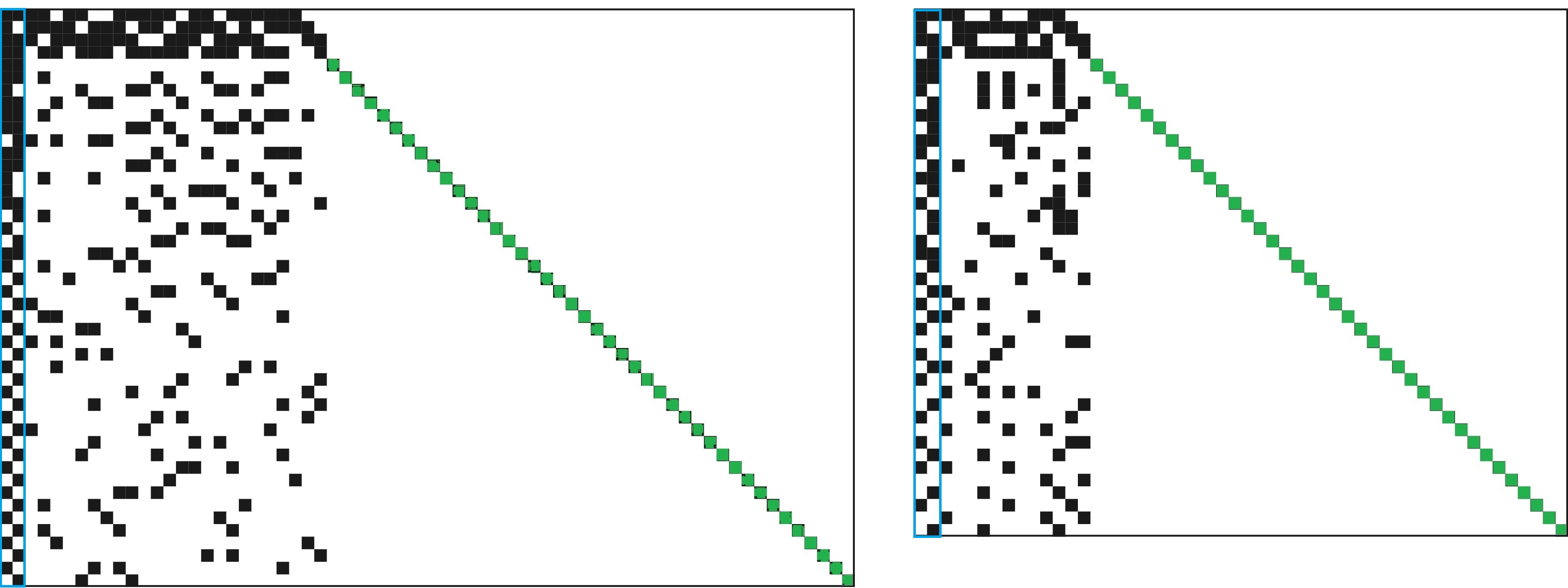
Figure 3: Average number of decoding iterations as a function of SNR for 5G and random codes. 5G codes show higher iteration counts at medium and high SNR due to error floor behavior.
Minimum Distance Bounds: Algebraic, Combinatorial, and Algorithmic Approaches
Vontobel–Smarandache Construction
Upper bounds on minimum distance are obtained via the Vontobel–Smarandache polynomial determinant construction. The all-layer codes are computationally intractable for direct determinant enumeration; however, the 4-layer subcodes admit tractable analysis due to reduced matrix dimension, leveraging the block decomposition. Each low-weight codeword in the 4-layer code is extended to the all-layer code by appending parity bits dictated by the sparse lower blocks, yielding explicit minimum distance upper bounds for various layer depths.
The computed bounds for BG1, circulant size q=384, are:
- High-rate 6-layer code [9984,8448]: minimum distance between 8 and 14.
- Low-rate code [25344,8448]: minimum distance between 22 and 57.
The weight distribution for constructed codewords demonstrates the prevalence of low-weight structures with explicit block supports.
(Figure 4)
Figure 4: Weight distribution of low-weight codewords from the Vontobel–Smarandache construction applied to 5G BG1 LDPC codes.
Modular Reduction and Lower Bounds
Lower bounds are derived via modular reduction arguments, exploiting the quasi-cyclic structure and code families induced by different circulant sizes. The process entails:
- Certification of minimum distance for smaller circulant (q), and
- Carrying forward these results to codes with larger circulant size (q=2kq), based on the relationships in block supports and codewords.
Parallel implementations of the Brouwer–Zimmermann algorithm facilitate lower bound certification for codes up to moderate block sizes. For larger codes, the approach relies on block support filtering and combinatorial enumeration, reducing computational complexity by substantial margins.
Empirical lower bounds (from Table data and algorithms) confirm the predicted minimum distances for q=48,96,192,384 in both punctured and nonpunctured BG1 5G codes.
Decoder Design: Early Termination Based on Circulant Modular Reduction
An engineering contribution of the paper is a novel early termination scheme for LDPC decoders in 5G hardware. Traditional syndrome calculation requires significant area due to the large variety and weight of circulant shifts in 5G matrices. The proposed approach calculates the syndrome modulo a small divisor (q′ of q), drastically reducing the computational complexity.
The early termination criteria (e.g., 4-layer syndrome, reduced 2-layer syndrome) are shown to preserve information block error rate efficacy, with negligible degradation relative to full syndrome termination. UIBLER analysis (see Figure 5 and Figure 6) demonstrates that undetected errors, while present in 5G codes due to short minimum distance, are adequately mitigated by CRC checking and the HARQ retransmission protocol.
(Figure 5)
Figure 5: IBLER for 5G and random codes under different early termination criteria, showing comparable performance for reduced early termination in 5G codes.
(Figure 6)
Figure 6: UIBLER for 5G and random codes, revealing undetected errors for 5G codes and nearly zero UIBLER for random codes due to larger minimum distance.
Practical and Theoretical Implications
The results have multifaceted implications:
- 5G NR and OCT Standards: Minimum distances are sufficiently low to trigger error floors and undetected error events when using low-complexity approximate decoders; however, the protocols (HARQ and CRC-inclusive block designs) robustly address these issues.
- Code Design Philosophy: The block decomposition and matrix construction in 5G codes provide a trade-off between encoder/decoder hardware complexity and minimum distance, favoring fast encoding at the cost of slightly increased error floors.
- Algorithmic Certification: The methodology for bounding minimum distance via algebraic, combinatorial, and algorithmic reductions constitutes a blueprint for analyzing large QC-LDPC codes in future standards.
- Decoder Hardware Optimization: Modular reduction for early termination offers a principled path for reducing area, complexity, and power consumption in LDPC decoder implementations, especially for standards requiring support for a wide range of circulant sizes.
Conclusion
This paper bridges the gap between rigorous minimum distance analysis and practical decoder design for 5G NR QC-LDPC codes, establishing tight upper and lower bounds on minimum distance for key code families and proposing efficient syndrome calculation techniques for early termination. The interplay between code structure, decoder behavior, and protocol-level mitigation measures is clarified, guiding both standard development and hardware implementation strategies. The modular reduction approach and combinatorial bounding schemes are extensible to future LDPC code designs and standards.