- The paper introduces a canonical decomposition of k-tensors into piecewise symmetric and alternating subspaces, generalizing classical matrix decomposition.
- It provides explicit constructions, dimension formulas, and projection operators through combinatorial techniques and symmetric group representations.
- The work establishes strong connections to signature tensors in rough path theory, with direct applications in stochastic analysis and data science.
Piecewise Symmetric Tensors: Structure, Decomposition, and Applications
Introduction and Context
The decomposition of matrices into symmetric and skew-symmetric parts is classical—a square matrix is uniquely the sum of a symmetric and a skew-symmetric matrix. The paper "Piecewise Symmetric Tensors" (2607.04712) generalizes this fundamental fact to higher-order tensors by introducing a parameterized family of tensor subspaces—piecewise symmetric and piecewise alternating tensors—governed by blockwise direct sums of symmetric and skew-symmetric components indexed by integer compositions.
The formalism is motivated and underpinned by algebraic, combinatorial, and representation-theoretic analysis, and is informed by direct connections to signature tensors arising from rough paths and stochastic analysis. The central claims establish canonical and orthogonal decompositions of tensor spaces, yield combinatorial dimension formulae, and delineate the precise relationship to signature tensors of piecewise-linear paths. These constructions yield insight into the structure of polynomial relations among iterated-integral signatures used in stochastic analysis and data science.
Definitions and Main Theoretical Results
Let V=Kd, and T=V⊗k the space of k-tensors. For each 1≤m≤k, the paper defines:
- m-piecewise symmetric tensors:
PwSmk(V)=α∈Co(k,≤m)∑Symα(V)
where Co(k,≤m) is the set of compositions (α1,…,αℓ), ∑αi=k, ℓ≤m, and T=V⊗k0.
- T=V⊗k1-piecewise alternating tensors T=V⊗k2 are defined analogously using blockwise skew-symmetrization.
The main theorem states:
- For all T=V⊗k3,
T=V⊗k4
where the two spaces are orthogonal with respect to the standard tensor inner product, and the decomposition is canonical.
This result generalizes the T=V⊗k5 case for matrices.
Explicit Constructions, Bases, and Projections
The authors provide constructive procedures to build bases and projectors for T=V⊗k6 and T=V⊗k7. The key ingredients are:
- Descent compositions: Given a word T=V⊗k8, the descent set T=V⊗k9 partitions its indices into maximal weakly increasing subsequences, generating a composition k0. The non-descent composition k1 arises from maximal strictly decreasing subsequences. There is a bijection between subsets of k2 and integer compositions of k3.
- Symmetrizers and antisymmetrizers: For each composition k4, symmetrization is achieved via the action of k5—a Young subgroup—on tensor indices.
The explicit automorphism k6 maps standard basis tensors to their symmetrized or antisymmetrized representatives depending on the number of descents, yielding a basis and an explicit splitting.
Dimensional Analysis and Combinatorial Enumeration
A strong numerical result in the paper is the explicit formula for the dimension of k7: k8
which counts length-k9 sequences in 1≤m≤k0 with at most 1≤m≤k1 descents. The dimension of 1≤m≤k2 is the count with at least 1≤m≤k3 descents. These formulas precisely capture the growth and transition of the piecewise symmetric tensor spaces.
Subspace Arrangements and Representation Theory
The structure of the subspaces 1≤m≤k4 and 1≤m≤k5 is further refined. Each such subspace is realized as a direct sum over finer compositions, inheriting a poset structure.
Through Schur-Weyl duality and explicit use of the Solomon descent algebra, the paper identifies how 1≤m≤k6 and related spaces decompose into irreducible 1≤m≤k7-modules, corresponding to ribbon (descent) representations of the symmetric group. The key point is the alignment between pieces indexed by compositions and the combinatorial ribbon tableaux, providing a bridge from polynomial invariants to explicit algebraic combinatorics.
Connections to Path Signature Tensors
A fundamental motivation and application arises from rough path theory and path signatures, specifically the level-1≤m≤k8 signature tensor 1≤m≤k9 of a piecewise-linear path m0. The main correspondence established is: m1
and
m2
where m3 is the space of piecewise linear paths in m4 with at most m5 segments. This identifies all linear relations satisfied by signature tensors of piecewise-linear paths via the above decomposition.
A geometric and combinatorial description is given for these relations: concatenations and interlacings of signed volume tensors encode the linear annihilators.
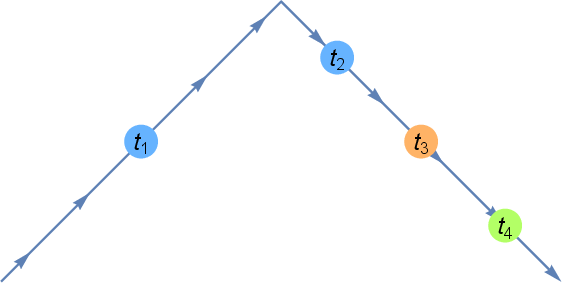
Figure 1: It is not possible to find m6 with m7 and m8 on a two-segment path.
This figure illustrates a prohibited configuration in the context of signature tensor relations for two-segment paths, encoding the impossibility of certain tensor combinations contributing nontrivially, thereby clarifying the vanishing of specific signature components.
Algebraic Ideal Structures
The study extends to the graded algebraic structure of the annihilator ideals. The ideal of all polynomial relations is shown to be generated by the piecewise alternating tensors, forming a two-sided ideal under the tensor algebra, and more strongly, a letter-insertion ideal. This ideal structure is stable under left and right half-shuffles and the shuffle product, endowing the annihilator with strong combinatorial and algebraic properties. Explicit generators are provided for these ideals, and an upper bound for the degree needed for generation (m9) is established for PwSmk(V)=α∈Co(k,≤m)∑Symα(V)0.
Implications and Future Directions
The combination of tensor-decomposition theory, signature theory, and combinatorics produces a potent toolkit for the analysis of signature varieties, with immediate implications for:
- Algebraic geometry of signature tensors: The results define the Zariski closure, vanishing ideals, and linear span for path signature tensors, paving the way for further study of their secant and join varieties.
- Polynomial invariants and identifiability: The precise knowledge of all linear and higher-degree relations amongst signature tensors is critical for inverse problems in rough path theory and stochastic analysis.
- Algorithmic tensor decomposition: The explicit formulas, projections, and bases enable efficient algorithmic computation of partially symmetric decompositions, with implications for computational algebra and data-analytic applications where tensor ranks and symmetries are critical.
Possible directions include the determination of nonlinear relations, exploration of further geometric and combinatorial invariants, and investigation of the generating sets for annihilator ideals beyond the established degree bounds.
Conclusion
The paper "Piecewise Symmetric Tensors" (2607.04712) substantially advances the structure theory of tensor decompositions, parameterized by blockwise symmetries governed by integer compositions. It synthesizes linear algebraic, combinatorial, and representation-theoretic tools to generalize the matrix symmetric/skew-symmetric decomposition and makes explicit connections to nonlinear algebra arising from stochastic analysis and rough path theory. The canonical orthogonal decomposition of tensors, dimension formulas, basis constructions, and their algebraic-geometry implications collectively form a robust foundation for further research in both pure mathematics and applied settings where tensorial invariants and path signatures play a central role.