- The paper demonstrates that a vanishing mutual information between boundary regions alongside a divergent island–radiation correlation recovers the late-time Page curve, ensuring quantum unitarity.
- It employs JT gravity coupled with conformal field theory to calculate bipartite and tripartite mutual information, rigorously analyzing the entanglement structure in black hole models.
- The study reveals negative tripartite information, highlighting monogamy and superextensivity of quantum correlations and the nonlocal encoding of black hole information.
Mutual Information and the Page Curve in the Island Paradigm
The study addresses fundamental questions in black hole physics, examining the black hole information paradox through the lens of quantum information and the entanglement structure of spacetime. The paradox arises from the observation that Hawking radiation, when treated semi-classically, leads to a non-unitary, monotonic increase in von Neumann entropy for the Hawking radiation, apparently violating quantum unitarity [Hawking:1975vcx]. The Page curve, which depicts the expected unitary behavior of this entropy (initial rise, plateau at the Page time tP, then a decrease to zero), serves as a diagnostic for proposed resolutions.
Recent advances leveraging holography, entanglement wedge reconstruction, and the "island formula" have changed the understanding of entropy in gravitational systems, introducing the notion of an "island"—a region inside the black hole contributing to the fine-grained entropy of radiation [Penington:2019kki, Almheiri:2019qdq].
The analysis is situated in the context of Jackiw-Teitelboim (JT) gravity, where a two-dimensional dilaton gravity system is coupled to a flat auxiliary thermal bath, entirely filled with conformal field theory degrees of freedom. The black hole solution in this setup is used as a computational vehicle for entanglement entropy and mutual information.
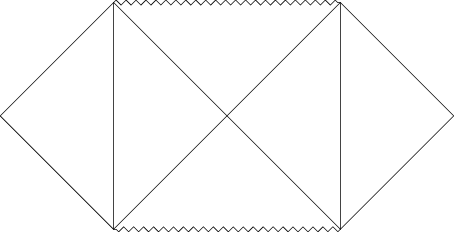
Figure 1: Penrose diagram of an eternal black hole in JT gravity with a flat auxiliary thermal bath system.
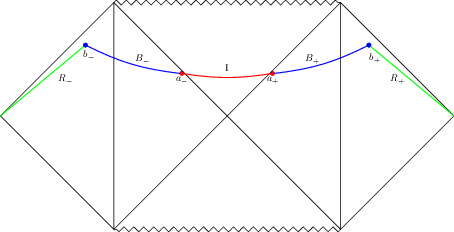
Figure 2: Penrose diagram illustrating region assignments (R±, B±, and the island I) on a Cauchy slice for mutual information computations in JT gravity.
The region structure set up for the calculation consists of the radiation regions R±, the island region I, and boundary regions B±, demarcated on a single Cauchy slice.
Mutual Information in the After-Page-Time Regime
A major finding is the precise correlation among the mutual information values between different sets of regions after the Page time. Specifically, the analysis demonstrates:
- The mutual information I(B+:B−) between boundary regions vanishes at the scrambling time tScr=ta−tb=∣r∗(a)−r∗(b)∣, indicating that B+ and R±0 become completely uncorrelated.
- Under these same conditions, the mutual information between the island and the total radiation, R±1, diverges, i.e., R±2. This indicates that the entanglement wedge for R±3 remains in a deeply connected, maximally entangled phase in the post-Page-time regime.
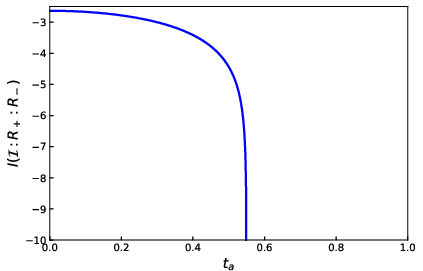
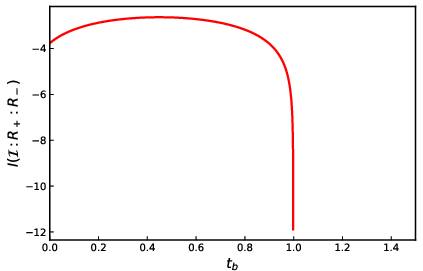
Figure 3: R±4 as a function of Cauchy slice parameters, diverging precisely when R±5.
This strong result implies a form of "conservation" for geometric entanglement: as the correlation between R±6 disappears, it is redistributed into an infinite correlation between the island and radiation. The correct late-time Page curve can be derived equivalently from either the vanishing of R±7 or the divergence of R±8. The implication is that for consistent unitarity, the entanglement must be demographically restructured across the Cauchy slice: complete decoupling of R±9 or maximal coupling between the island and radiation suffices.
The paper further introduces a construction to compute the tripartite mutual information B±0 among the island and the two separated radiation sectors, B±1 and B±2. This quantity, while elusive to direct calculation, is derived using algebraic manipulation of bipartite entropies on a shared Cauchy slice:
B±3
Numerical evaluation across parameter space reveals that B±4 is strictly negative for all relevant values of the island and observer times considered.
(Figure 4)
Figure 4: B±5 as a function of island time B±6 (left) and observer time B±7 (right), illustrating persistent negativity.
This persistent negativity is interpreted as a manifestation of monogamy and superextensivity of quantum mutual information in this context. The monogamy implies that quantum correlations are not shareable: information about B±8 encoded in B±9 cannot be redundantly shared with I0. Superextensivity means that the joint information content is broader than the sum of its pairwise parts, an inherently quantum phenomenon.
Implications and Outlook
The theoretical consequences are multifaceted:
- Alternative Page Curve Criteria: Either the complete decorrelation of boundary regions I1 or an infinite correlation between island and radiation I2 is sufficient to recover the Page curve's late-time plateau. This presents a duality of interpretational routes within the island paradigm.
- Nonlocal Encoding: Negative tripartite information signifies that reconstructing island degrees of freedom requires access to the entire radiation system, underpinning a nontrivial multipartite encoding that aligns with expectations from quantum error correction in holographic codes.
- Future Directions: These mutual information-based criteria may not only clarify eternal black hole entropy dynamics but, if generalized, could inform approaches to evaporating black holes and dynamical settings with nontrivial causal structures.
Conclusion
The work rigorously establishes links between mutual information patterns and the structure of the Page curve within JT gravity coupled to a thermal bath. By demonstrating the equivalence of boundary region decorrelation and divergent island–radiation correlation as sufficient conditions for Page curve reproduction, it reframes aspects of the quantum information paradox. The derived framework for tripartite mutual information further elucidates the multipartite nature of geometric entanglement and its implications for quantum information storage across black hole horizons. The persistence of monogamy and superextensivity in this context highlights the fundamentally non-classical mode of information encoding at play in gravitational entropy computations.
Reference:
"New insights on mutual information in the island approach to the Page curve" (2607.04706)