- The paper introduces a novel minimal d-decomposition framework that ensures exact local modeling and collapsibility for Bayesian networks.
- It presents a parallel algorithm for parameter estimation and local inference, achieving up to 2.7x speed-up compared to global methods.
- Experimental results demonstrate rapid convergence in model accuracy, validating the approach against classical junction-tree paradigms.
Decomposition Frameworks for Bayesian Networks: Local and Parallel Inference
Introduction and Structural Foundations
The paper "Decomposition for Bayesian Networks: Local and Parallel Inference" (2607.04650) presents a principled graph-theoretic framework for decomposing Bayesian networks (BNs), efficiently enabling parallelized probabilistic inference and parameter estimation in high-dimensional directed acyclic graphs (DAGs). The authors introduce the minimal d-decomposition tree as an alternative to classical junction-tree constructions, leveraging directed convex subgraphs as the basis for valid network partitions. The central property is collapsibility: each sub-model obtained from the decomposition can reproduce the marginal distribution of the original network over that subset, without spurious conditional independences.
The graph-theoretic characterization of valid decomposers (d-decomposers) relies on directed convexity. A subset S⊆V is a d-decomposer if it is a directed convex d-separator, guaranteeing collapsibility and exact local modeling. This approach differs fundamentally from the junction tree paradigm, which often requires global parameter initialization and introduces additional edges during moralization and triangulation. The minimal d-decomposition tree organizes the network into structurally irreducible clusters, each separated by minimal directed convex separators.
Decomposition Algorithm and Minimal d-Decomposition Trees
The authors formalize an efficient decomposition algorithm. Starting from a minimal d-separator tree, intersections between adjacent clusters are iteratively merged if they are not convex, yielding a minimal d-decomposition tree. The explicit construction algorithm guarantees that each separator in the tree is a minimal d-decomposer, and each cluster is irreducible with respect to further d-convex decomposition.
The core theoretical result is Theorem 1, which provides the induced factorization of the joint distribution: $P(x_V)\, P_{\mathcal{G}_S}(x_S) = P_{\mathcal{G}_{A \cup S}(x_{A \cup S})\,P_{\mathcal{G}_{B \cup S}(x_{B \cup S})}$
for any proper decomposition (A,B,S). Iterating this factorization along the tree yields the global joint as a quotient of marginal distributions over clusters and their pairwise intersections, a result formalized in Corollary 1.
Parallel Parameter Estimation and Local Inference
Building on the decomposition structure, the paper introduces parallel algorithms for parameter estimation and local inference. Parameter learning proceeds independently on each cluster and their intersections, with maximum likelihood or Bayesian estimation applied to local subsets of the data. These local models are combined using the factorization from the minimal d-decomposition tree.
For probabilistic inference, a pruning rule is presented: leaf nodes in the decomposition tree can be recursively removed as long as all query and evidence variables are retained in the remaining clusters. This ensures that computation is confined to relevant subgraphs, substantially reducing the cost of inference for low-dimensional queries.
Experimental Evaluation
Parameter Estimation Efficiency
Empirical studies include large-scale simulations on both discrete and Gaussian BNs, leveraging benchmark datasets (Child, Alarm, Hailfinder, Hepar2, Win95pts, Pigs for discrete; ecoli70, magic-niab, magic-irri, arth150 for Gaussian). Significant speed-ups in parameter estimation are observed for large networks using the decomposition method, with parallel estimation on sub-models yielding up to 2.7x acceleration compared to global estimation. The serial component of the computation is less than 20% across all tested networks.
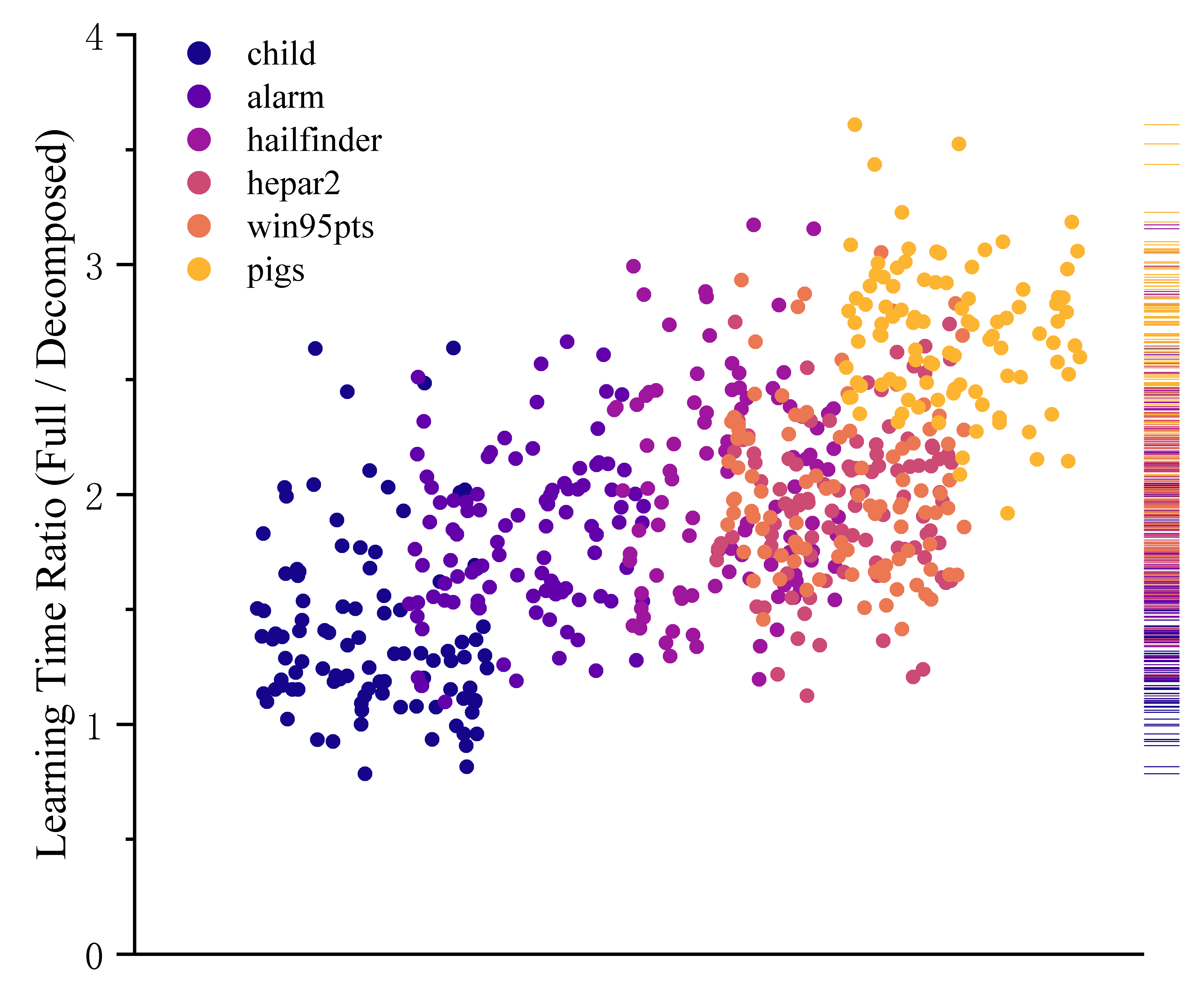
Figure 1: Efficiency of parameter estimation for global learning and parallel decomposition.
Model Accuracy
The learned decomposition models are quantitatively validated against the original networks using Kullback-Leibler divergence, Hellinger distance, Bhattacharyya distance for discrete BNs, and Wasserstein-2 for Gaussians. All metrics demonstrate rapid convergence to zero as sample size increases, confirming distributional fidelity and preserving statistical structure (means, covariances).
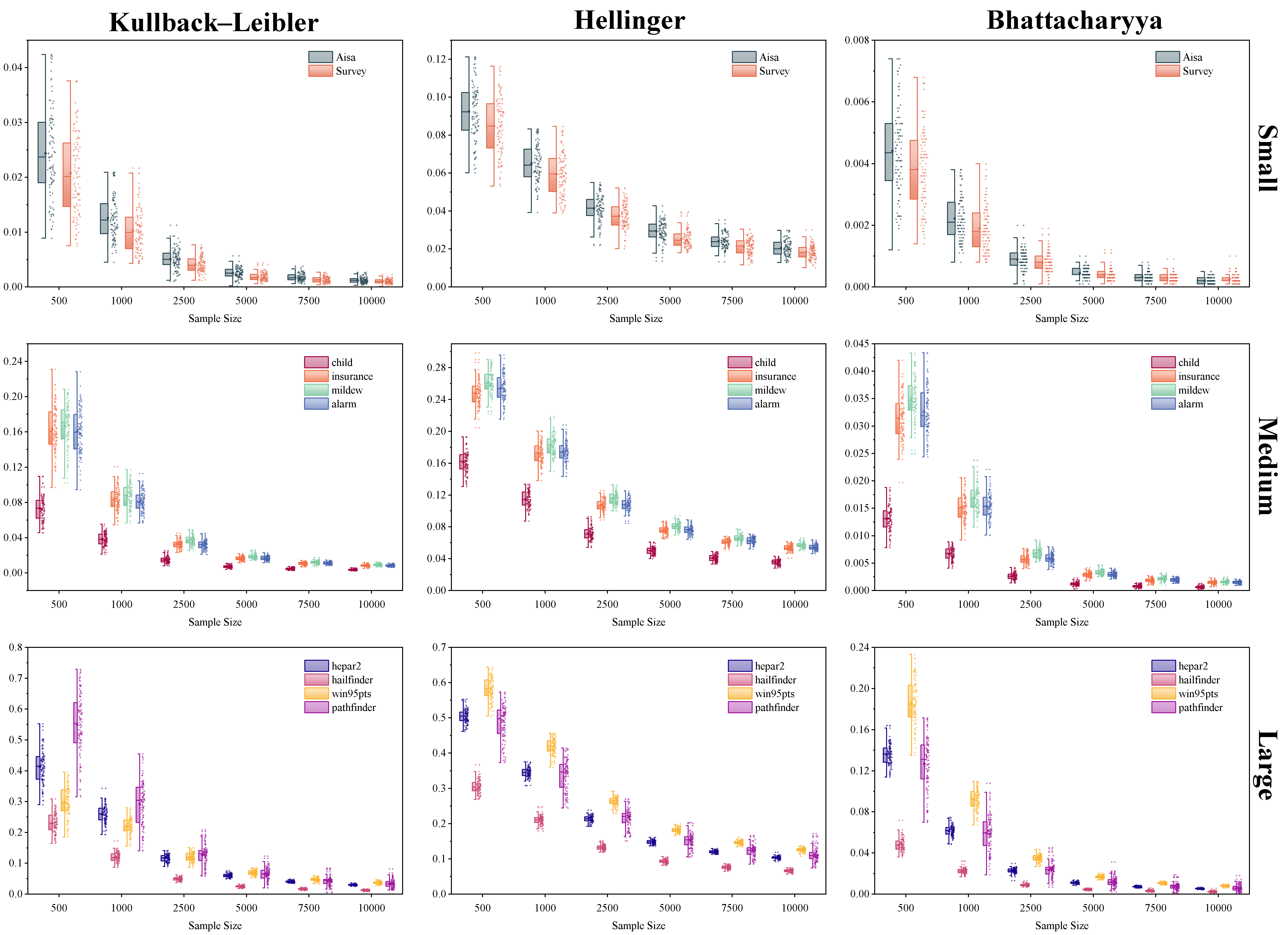
Figure 2: Box plots of distributional distances between the original and parallelized-learning models.
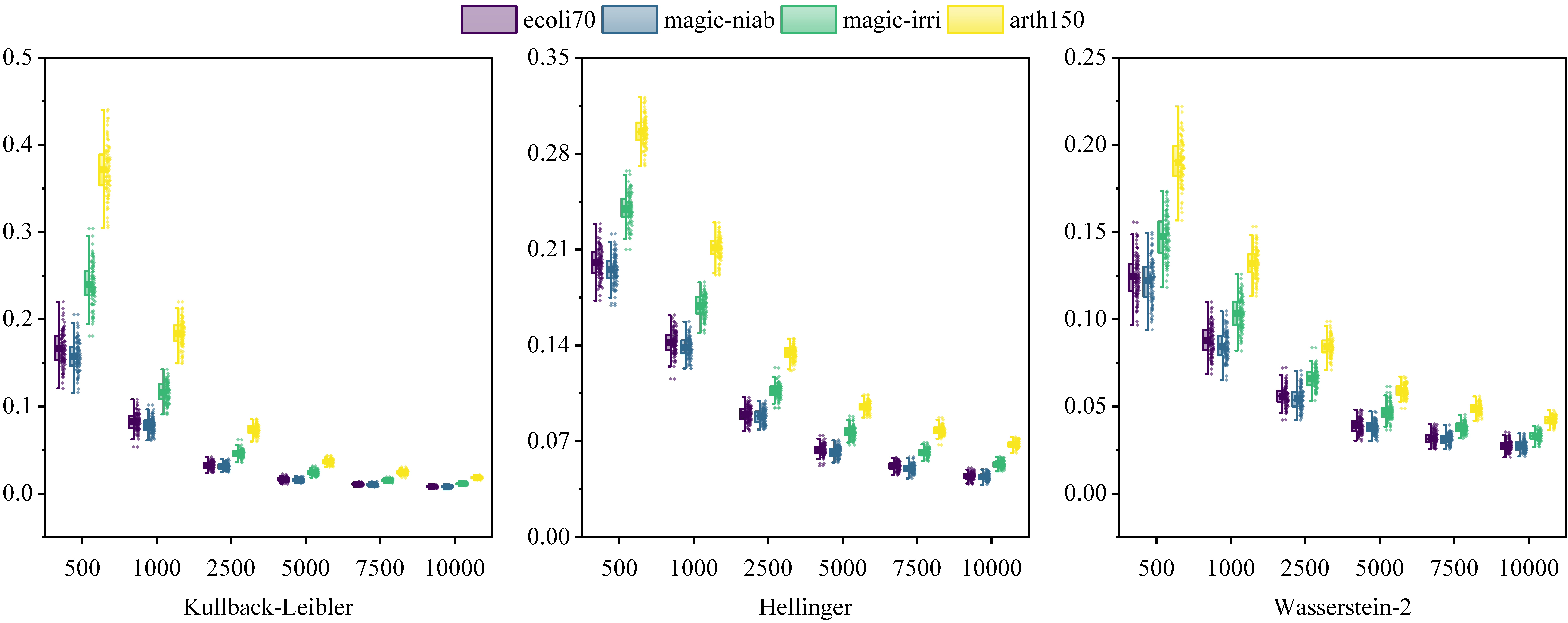
Figure 3: Box plots of distributional distances between the original model M(G) and the learned model M′(G) (Gaussian case).
Local Inference
For inference cost, the pruning-enabled decomposition tree method outperforms lossless decomposition and conventional junction-tree belief propagation, especially for small query dimensions. For the Pathfinder network, inference time remains substantially lower for the proposed method compared to alternatives, with exact recovery of target probabilities.
Structural Analysis
Supplementary studies detail normalized clique size distributions post-decomposition. Over 90% of cliques are small, with normalized size <0.1, confirming suitability for efficient local computation.
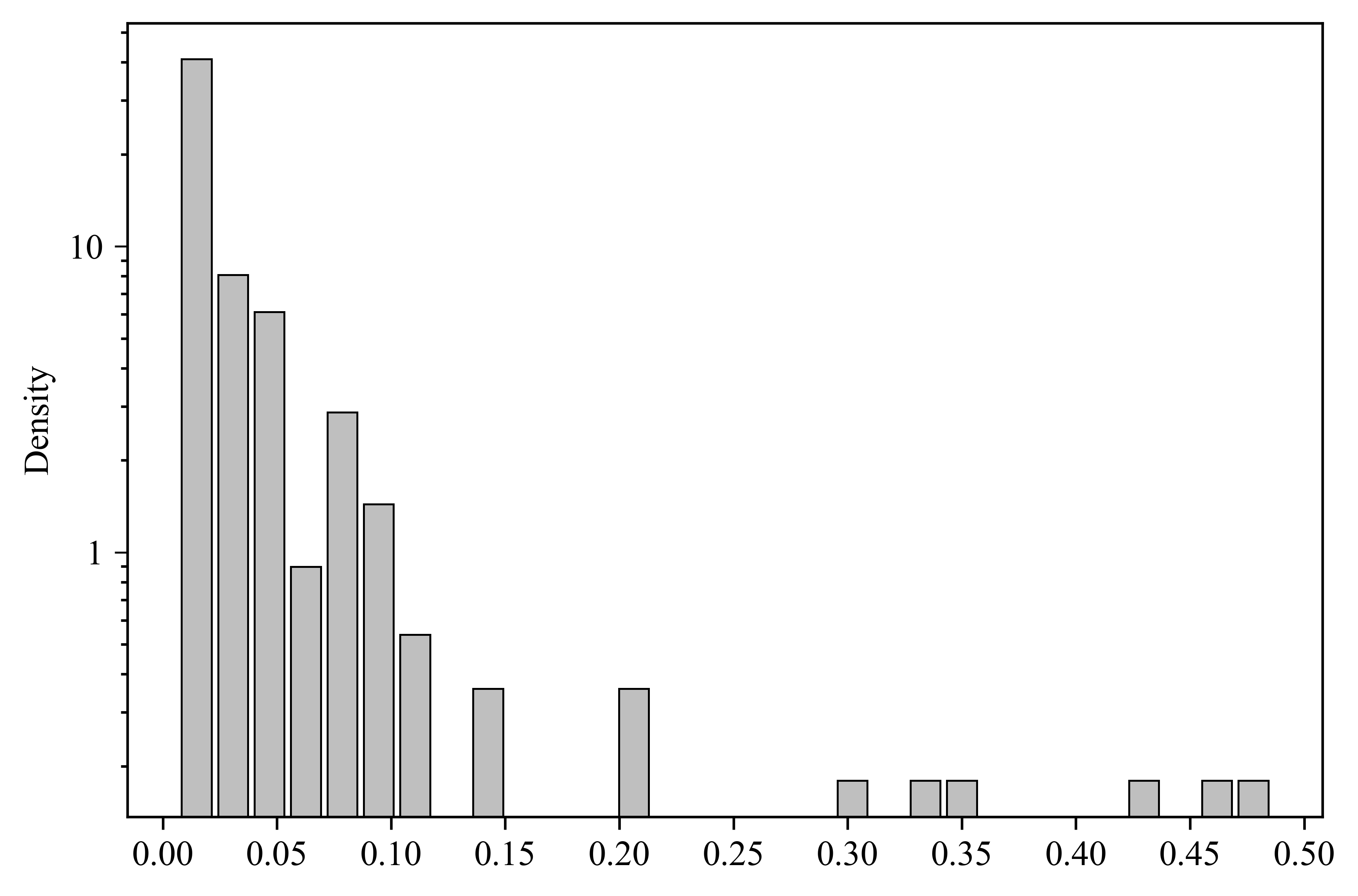
Figure 4: Histogram of normalized clique sizes ∣C∣/∣V∣ across the six networks. The density axis is on a logarithmic scale to better illustrate the tail behaviour.
Implications and Prospective Developments
From both practical and theoretical perspectives, the decomposition methodology fundamentally enhances scalability for learning and inference in BNs. Parameter estimation and inference can be performed in parallel and locally, leveraging structural decomposability. This is particularly valuable for high-dimensional DAGs with sparse substructures, where junction-tree methods become computationally prohibitive. The framework is rigorously justified via directed convexity and collapsibility, precluding spurious independencies in reconstructed models.
Potential future directions include optimal selection of decomposition trees to minimize computational cost, possibly incorporating nested d-decomposition trees for dense or high-dimensional clusters. Application to structure learning, integration with recently developed generative flow networks for Bayesian structure learning, and automated decomposition for distributed systems are promising extensions.
Conclusion
The paper delivers a comprehensive framework for decomposing BNs using minimal d-decomposition trees, enabling precise, efficient parallelized parameter estimation and local inference. The method achieves strict locality in modeling and avoids additional structural complexity, outperforming junction-tree approaches in relevant high-dimensional scenarios. For AI research, structurally principled decomposition supports scalable learning and inference, facilitating deployment on distributed architectures and large datasets. Limitations persist for dense graphs and large queries, motivating further investigation into nested and hybrid decomposition strategies.