- The paper demonstrates a two-stage orbital-selective Mott transition driven by lattice compression and sublattice differentiation.
- It employs determinant quantum Monte Carlo to uncover the interplay of geometric frustration, electronic compressibility, and antiferromagnetic correlations.
- Findings reveal anisotropic charge responses and a comprehensive phase diagram, offering insights for engineered quantum simulators.
Orbital-Selective Mott and Antiferromagnetic Phases in the Diagonally Compressed Kagome Lattice
Introduction
This paper, "Orbital-Selective Mott and Antiferromagnetic Phases in Diagonally Compressed Kagome Lattice" (2607.04621), uses determinant quantum Monte Carlo (DQMC) to study the half-filled Hubbard model on the kagome lattice under diagonal compression. By introducing an exponential decay in long-range hopping as a function of bond length, the model accurately captures the effect of geometric deformations, departing from previous works that rely primarily on bond-anisotropic hopping or artificially constructed interpolations between Lieb and kagome lattices.
The study systematically explores the interplay among geometric frustration, strong correlations, and magnetic ordering. The continuous compression parameter, represented by the angle θ, controls both the degree of frustration and the relative strengths of different hopping channels. The consequences of this subtle network restructuring are evaluated in terms of sublattice-resolved double occupancy, electronic compressibility, and real/momentum-space spin correlation functions, providing a microscopic understanding of orbital-selective Mott transitions and the emergence of antiferromagnetic order along specific lattice directions.
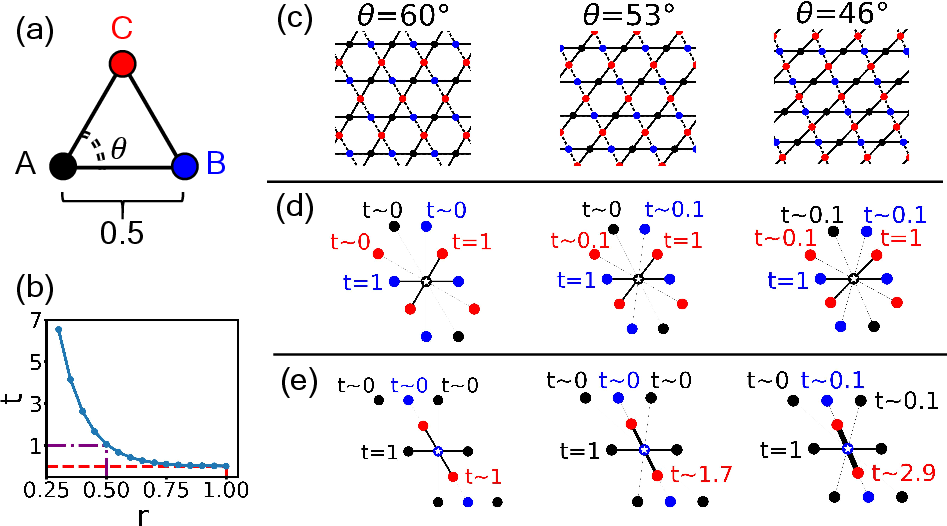
Figure 1: (a) Schematic of the kagome lattice before and after compression; (b) exponential decay of hopping strength with distance; (c) change in geometry with θ; (d, e) sublattice-resolved hopping profiles.
The model consists of the Hubbard Hamiltonian on the kagome lattice with onsite repulsion U and exponentially decaying hopping t(r)=t0e−r/r0. The key geometric parameter, θ, denotes the angle between the two primitive vectors. Reducing θ from 60∘ compresses the lattice diagonally, shortening the BC bonds while the AB and AC bonds are held fixed. As a result, the model interpolates between an isotropic kagome lattice and a regime where θ0-chain character dominates, generating strong sublattice differentiation and an anisotropic network of kinetic and interaction terms.
DQMC provides finite-temperature access to thermodynamic, charge, and spin observables. The simulations are performed at half-filling by numerically imposing the chemical potential to satisfy θ1, compensating for the loss of strict particle-hole symmetry due to complex hopping patterns. System sizes up to θ2 are explored, and a multi-parameter sweep over θ3 and θ4 is conducted for sublattice-resolved analysis.
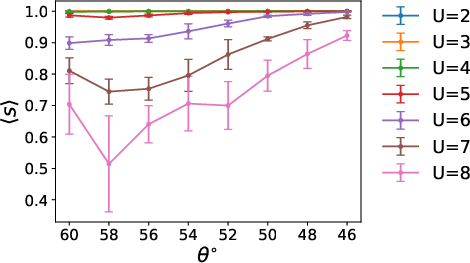
Figure 2: Average sign θ5 at θ6 as a function of compression angle θ7 for different θ8, showing that compression generally alleviates the sign problem.
Electronic Structure Evolution and Sublattice Differentiation
The non-interacting electronic spectrum exhibits a remarkable transformation under compression. At θ9, the band structure features the characteristic kagome flat band and Dirac point. As U0 decreases and U1 hopping is enhanced, the flat band acquires significant dispersion and the bandwidth increases, leading to strong differentiation between sublattice U2 (with increased long-range hopping) and sublattices U3 (experiencing dominant short-range kinetic processes).
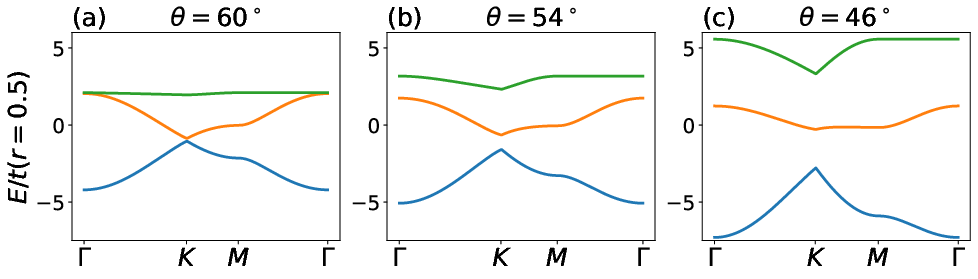
Figure 3: Band structures for U4, and U5; decreasing U6 drives the flat band dispersive and enhances bandwidth/differentiation.
This geometry-induced inequivalence is already visible at the level of sublattice occupation numbers, and becomes more pronounced at low temperatures and intermediate interactions, with U7 maximized for small U8 and large compression.
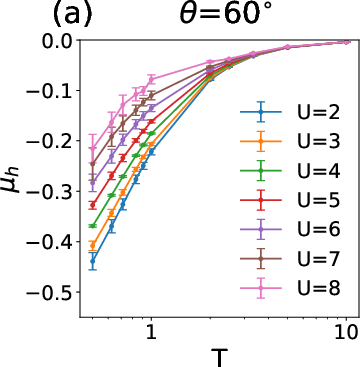
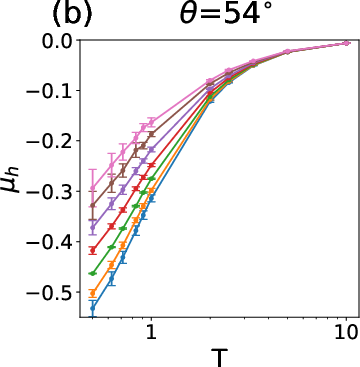
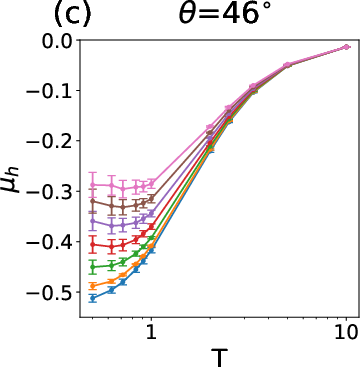
Figure 4: Temperature dependence of the chemical potential U9 required to achieve half-filling, showing strong t(r)=t0e−r/r00 and t(r)=t0e−r/r01 dependencies.
Double occupancy and compressibility are analyzed both globally and per sublattice. The temperature dependence of t(r)=t0e−r/r02 and t(r)=t0e−r/r03 (and their suppression with t(r)=t0e−r/r04) are consistent with Mott physics, but display marked sublattice sensitivity due to the geometry-driven bandwidth and effective-coupling rearrangements.
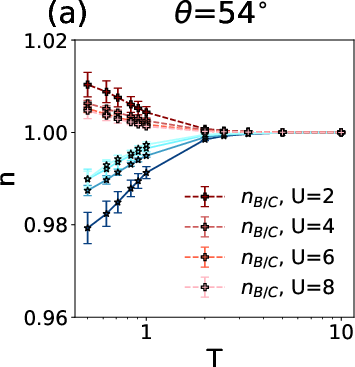
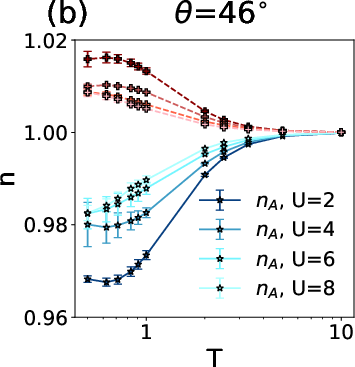
Figure 5: Average particle occupation per sublattice upon compression, illustrating anisotropic charge response.
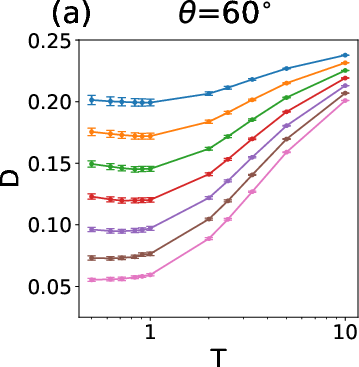
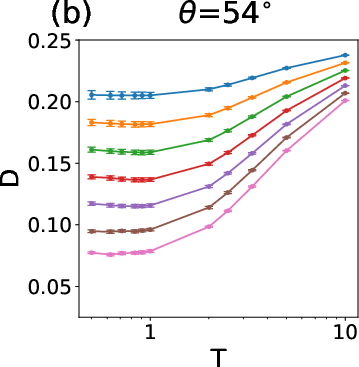
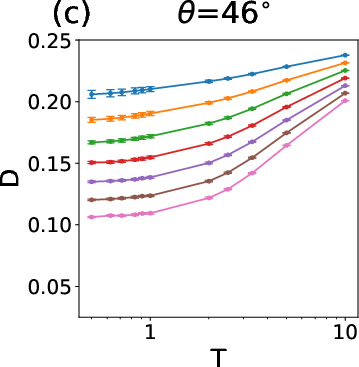
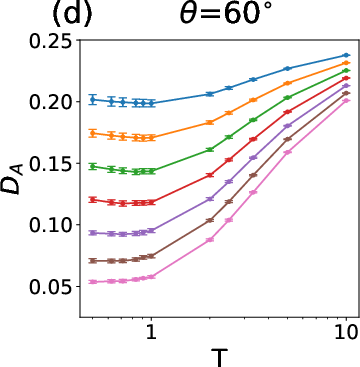
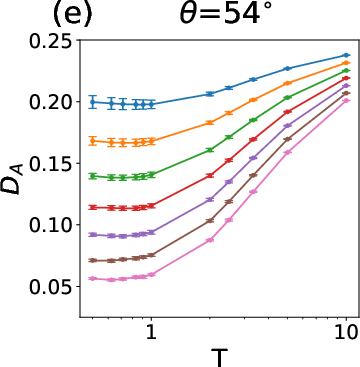
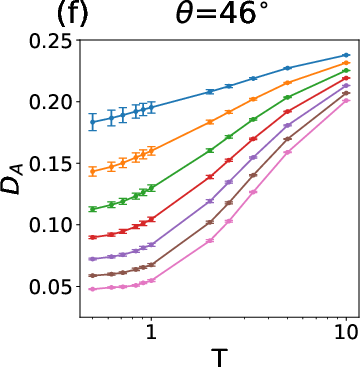
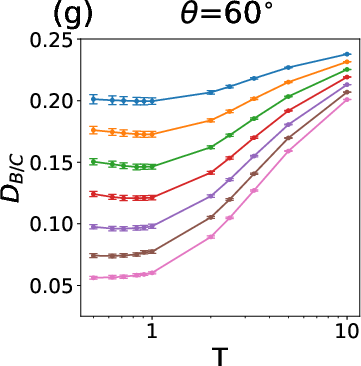
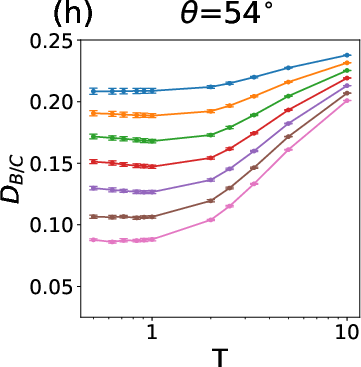
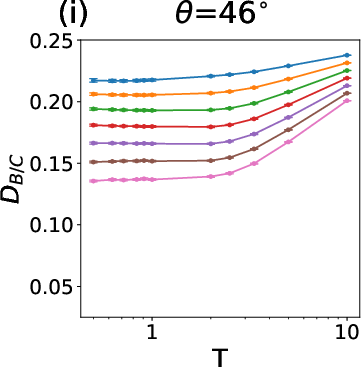
Figure 6: Double occupancy t(r)=t0e−r/r05 vs temperature for (a-c) whole lattice, (d-f) t(r)=t0e−r/r06 sublattice, (g-i) t(r)=t0e−r/r07 sublattices, at representative t(r)=t0e−r/r08 and t(r)=t0e−r/r09.
Electronic compressibility θ0 is used to extract an effective charge activation gap via low-temperature fits (θ1). The sign change of θ2 is used to identify the Mott transition point. Notably, the critical interaction strength θ3 differs significantly between sublattices as a function of θ4, yielding a two-stage, orbital-selective Mott transition: for weak compression, θ5; for strong compression, the ordering reverses, θ6.
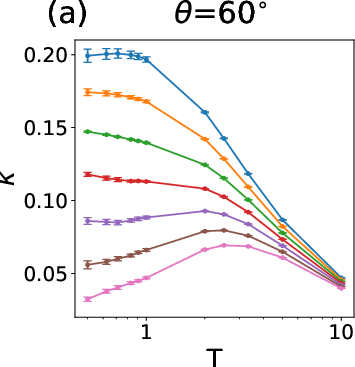
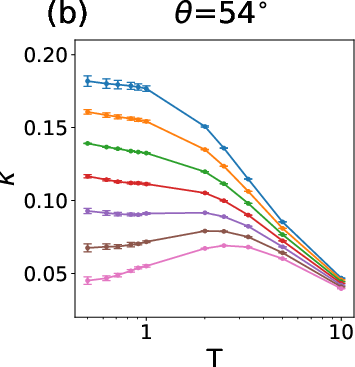
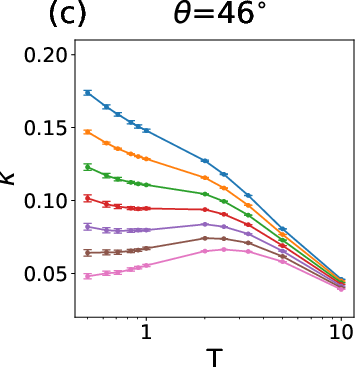
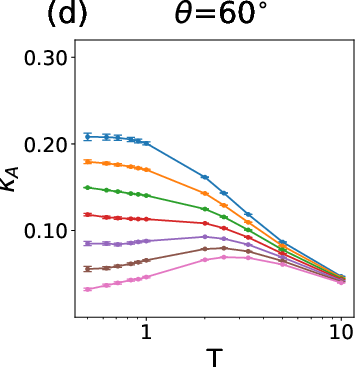
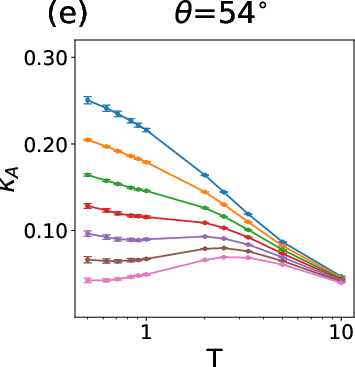
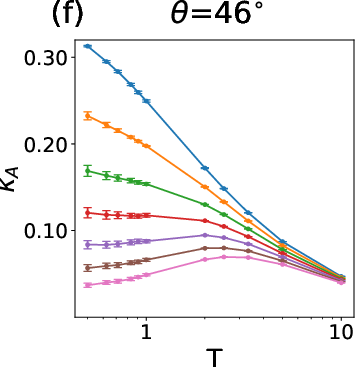
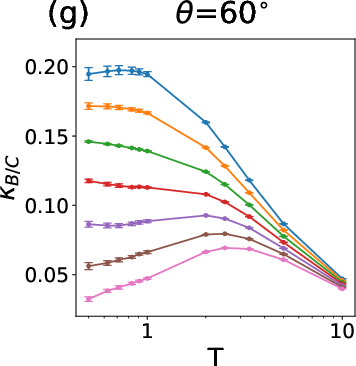
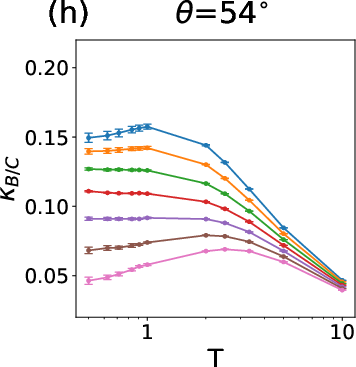
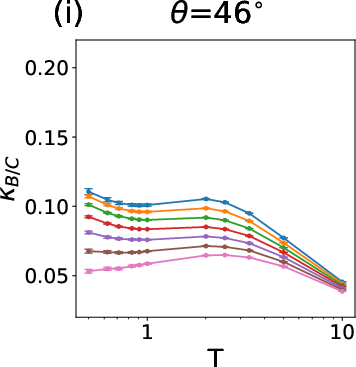
Figure 7: Temperature dependence of θ7 for whole lattice, θ8, and θ9 sublattices.
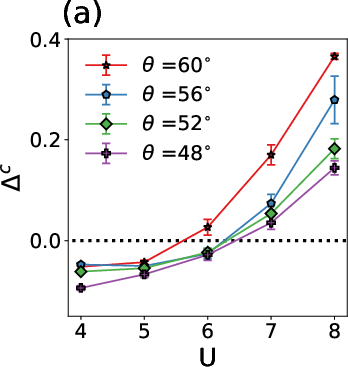
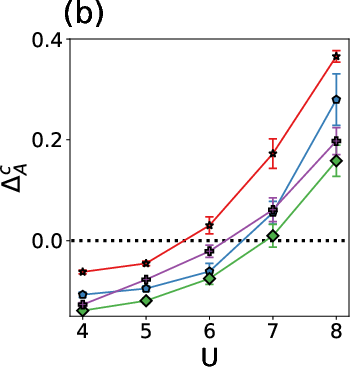
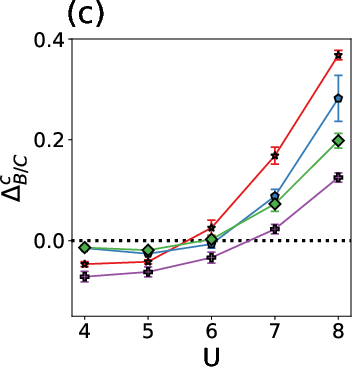
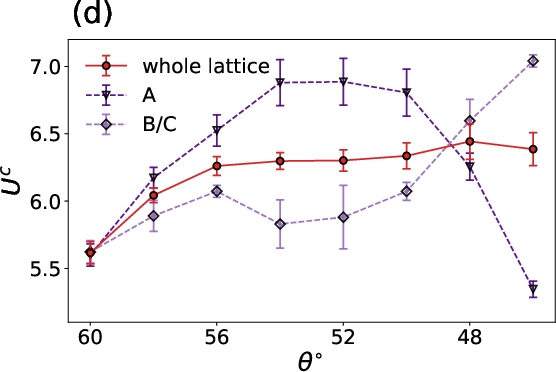
Figure 8: Extracted charge activation scale θ0 for the whole lattice, θ1, and θ2 sublattices as a function of θ3 and θ4, showing a dramatic crossover in θ5.
Magnetism: Real- and Momentum-Space Signatures
The study computes both longitudinal (θ6) and transverse (θ7) spin correlation functions. θ8 is preferred due to superior statistical properties in DQMC. Along the θ9 path, correlations are always short-ranged, indicating persistent paramagnetic character. However, for strong compression and large 60∘0, the 60∘1 path develops long-ranged, alternating (antiferromagnetic) spin correlations, as seen both in real space and in enhanced 60∘2 peaks in the momentum-resolved spin structure factor.
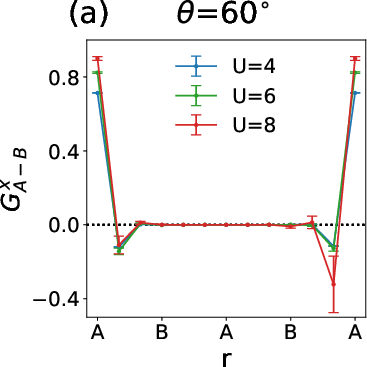
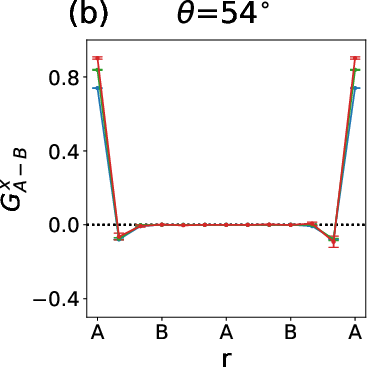
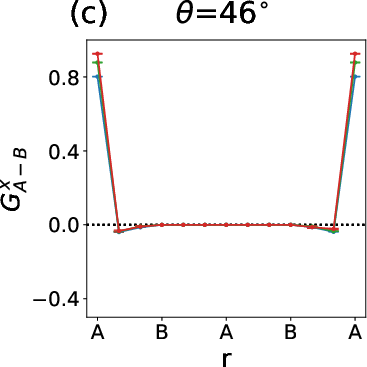
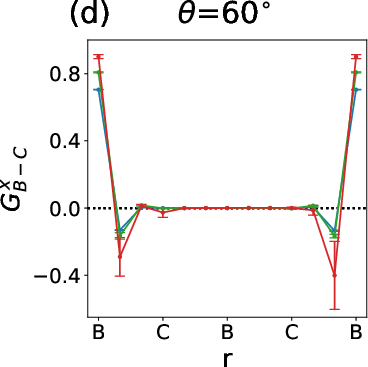
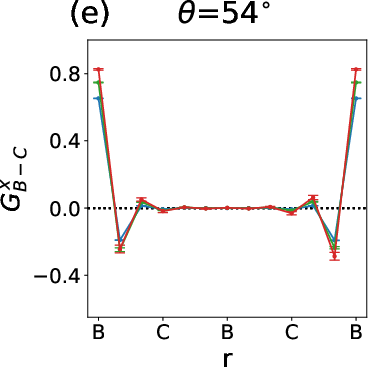
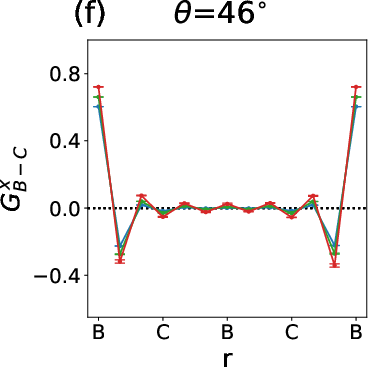
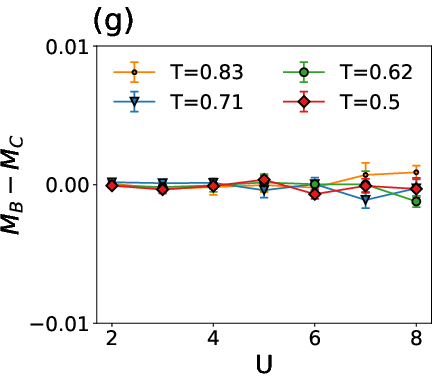
Figure 9: (a–c) 60∘3 along 60∘4; (d–f) along 60∘5; (g) difference in sublattice (B vs C) local moments vs 60∘6.
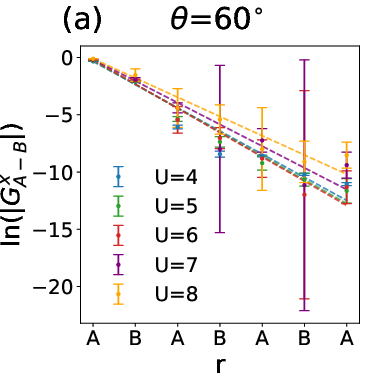
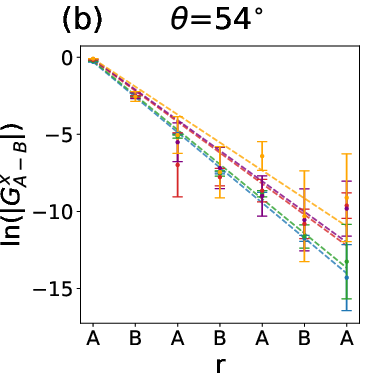
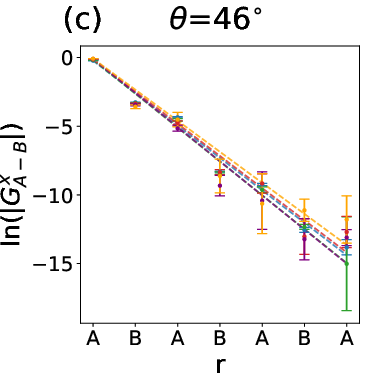
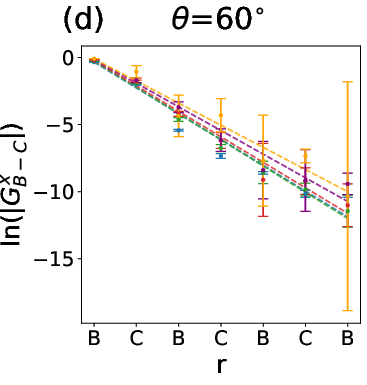
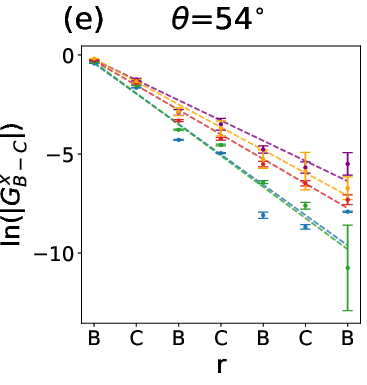
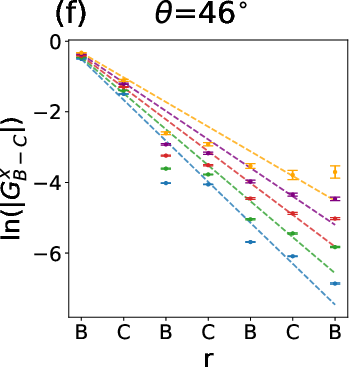
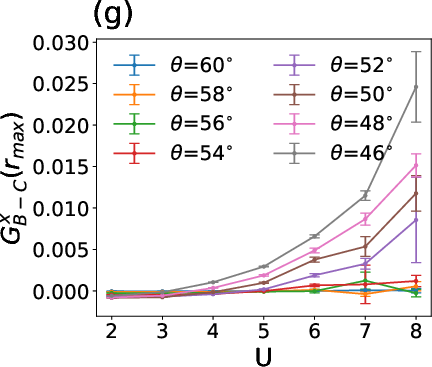
Figure 10: Logarithmic decay of 60∘7 for 60∘8 and 60∘9—only the BC0 path in the strongly-compressed, high-BC1 regime develops persistent long-range correlations.
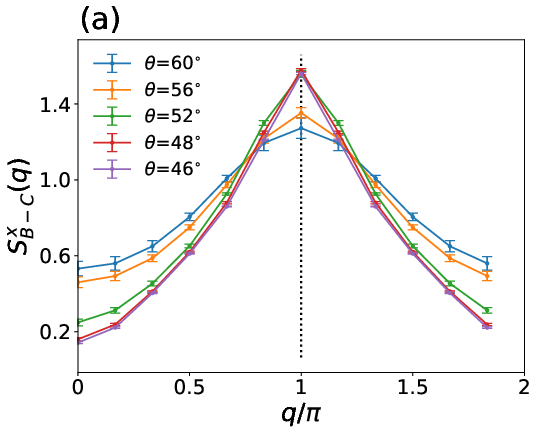
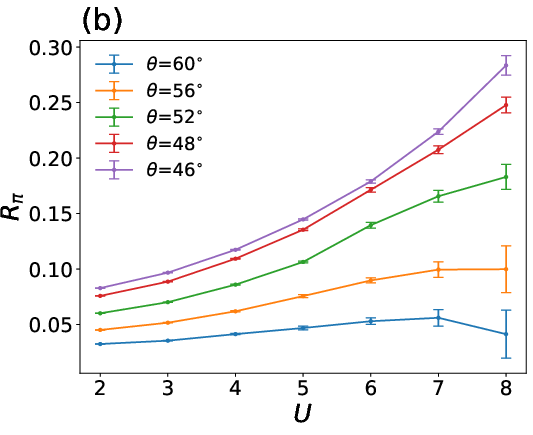
Figure 11: (a) BC2 at BC3 for various BC4; (b) correlation ratio BC5 vs BC6 for different BC7, highlighting the AFM transition.
Comprehensive Phase Diagram and Physical Interpretation
The extracted global phase diagram shows four regions: paramagnetic metal, paramagnetic Mott insulator, antiferromagnetic metal, and antiferromagnetic Mott insulator. The metal-insulator boundary is set by the charge gap, whereas the magnetic boundary is operationally determined by the onset of statistically significant long-distance AFM correlations on the BC8 path. The boundaries do not generally coincide, leading to intermediate metallic regimes with substantial AFM correlations.
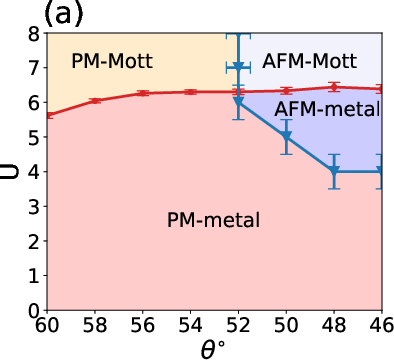
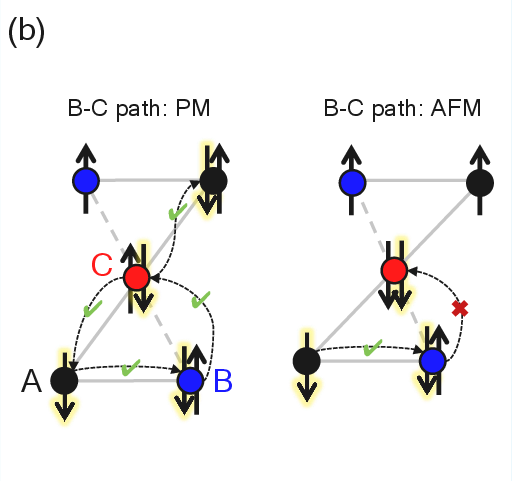
Figure 12: Phase diagram in the (BC9) plane, with metal-Mott and AFM boundaries distinguished, revealing orbital-selective transitions.
The phase structure results from the competition between kinetic delocalization (bandwidth-controlled), interaction-induced localization, and frustration-driven suppression of long-range magnetic order. For strong frustration (large AB0), the system remains paramagnetic even deep into the Mott regime, while for reduced AB1, the suppression of AB2 hopping pathways by AFM order on the AB3 chains generates a rapid drop in AB4 and cooperatively generates orbital-selective and magnetically ordered phases.
Implications and Future Directions
The study demonstrates the potential for geometry-driven engineering of orbital-selective Mott phenomena and anisotropic magnetism in frustrated 2D lattices. The mechanism—based on the manipulation of hopping strengths via lattice compression—directly translates to experimental platforms such as moiré superlattices and cold-atom optical lattices, where tuning of tunneling amplitudes is feasible. The two-stage nature of the Mott transition and the emergence of AFM correlations localized to certain lattice directions provide a microscopic blueprint for emergent orbital/magnetically selective behaviors in materials with tunable frustration.
Further work is needed to address thermodynamic-limit extrapolations, the possibility of true phase transitions as opposed to sharp crossovers, and to explore doping and finite-temperature phase structures. Extensions to multi-orbital real-material models and time-dependent control offer routes to designer quantum simulators and new strongly correlated phases.
Conclusion
This paper provides a comprehensive DQMC study of the half-filled Hubbard model on a diagonally compressed kagome lattice with distance-dependent hopping, revealing rich orbital-selective Mott physics and frustration-driven AFM ordering. The key results include the identification of a two-stage sublattice-resolved Mott transition, the quantification of the AFM boundary as a function of geometry and AB5, and a complete (AB6, AB7) phase diagram capturing the interplay of strong correlations and geometric frustration. The findings have direct relevance for synthetic quantum-matter platforms and lay the groundwork for theoretical and experimental advances in frustrated correlated systems.