- The paper introduces a residual-service evaluation mechanism that tracks per-edge FIFO scheduling to ensure full object delivery within deadlines.
- It demonstrates that streaming-centric metrics can undercount completion times by up to 154 seconds under shared-contact contention.
- Bounded two-way striping is shown to improve the feasible delivery frontier, achieving up to 1.8 Gbit payload gains and 42-second deadline savings.
Residual-Service-Aware Finite-Object Delivery in Intermittent LEO Networks
Motivation and Problem Statement
Emerging LEO relay networks are central to time-sensitive delivery of finite payloads—ranging from telemetry aggregates, sensing tiles, checkpoint objects, to model updates—in non-terrestrial environments characterized by intermittent, mobile connectivity. Delivery effectiveness hinges not only on transmission completion but on deadline-bound object-level guarantees: partial delivery is irrelevant if the full object misses its deadline. Notably, splitting objects across multiple paths or contact windows induces complex service-accounting: naïve path-private evaluation can double-count shared contact resources, misestimating feasible completion.
The paper develops a deadline-aware service layer immediately after contact-plan route generation. Its central premise is residual-service-consistent evaluation: service consumption on each path is tracked for per-edge FIFO scheduling, preventing double counting and ensuring chunk-level concurrency is accounted for correctly.
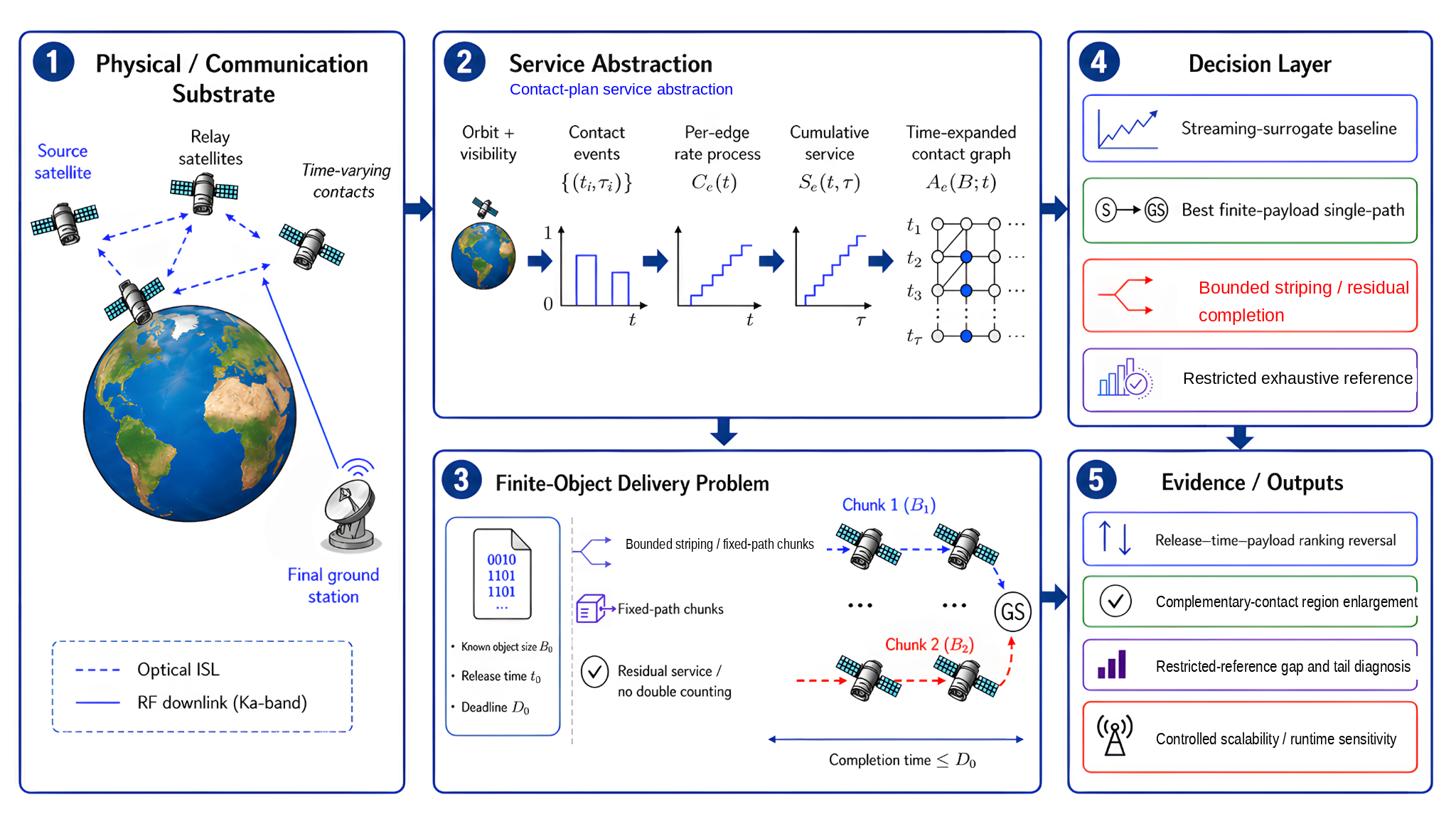
Figure 1: Residual-service-aware finite-object delivery over intermittent LEO contact plans.
Residual-Service Accounting and Contention Model
The per-edge FIFO residual service discipline is formulated to address two major intricacies in LEO relay networks:
- Shared-contact contention: Multiple transmissions—either chunks from the same object or background competing objects—often share a contact window. Path-private metrics erroneously credit each transmission with full contact service, resulting in underestimated completion times or false deadline feasibility. The residual evaluator tracks per-edge service reservations within the candidate plan, enforcing strict sequential consumption.
- Edge-disjoint complementary contacts: When path chunks traverse edge-disjoint contacts, no per-edge contention exists; residual evaluation reduces to classic path analysis.
Numerical diagnostics reveal two important properties: under controlled contention, path-private evaluation systematically under-counts completion times by up to 154 s, risking incorrect feasibility claims. In payload-stress scenarios, path-private evaluation may report finite completion for plans where no residual-service-complete plan exists.
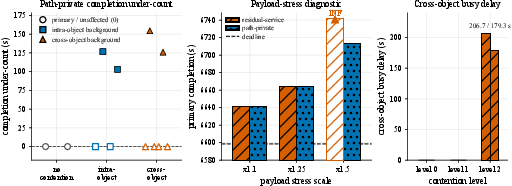
Figure 2: Residual-service accounting under shared-contact contention.
Delivery plans are defined for single fixed objects with bounded striping degree (typically Kmax=2 for tractability). Objects are decomposed into chunks, each assigned a path and launch time. Chunk-level completion depends on residual per-edge service, and the aggregate object completion time is determined by the latest chunk arrival plus overheads (header, setup, reassembly). Deadline feasibility is rigorously checked against object release and specified budget.
Per the model, the residual-service-consistent plan χ must satisfy:
- Object conservation: sum chunk sizes equals object size.
- Time-respecting path assignments.
- Shared service constraints via residual accounting on each edge.
Failure of Streaming-Centric Path Ranking
The paper analytically demonstrates that steady-state metrics (average rate, bottleneck throughput) are insufficient for finite-payload deadline-bound delivery. There exist release-time–payload regimes where the streaming-preferred path delivers later than a path with lower throughput but earlier available service.
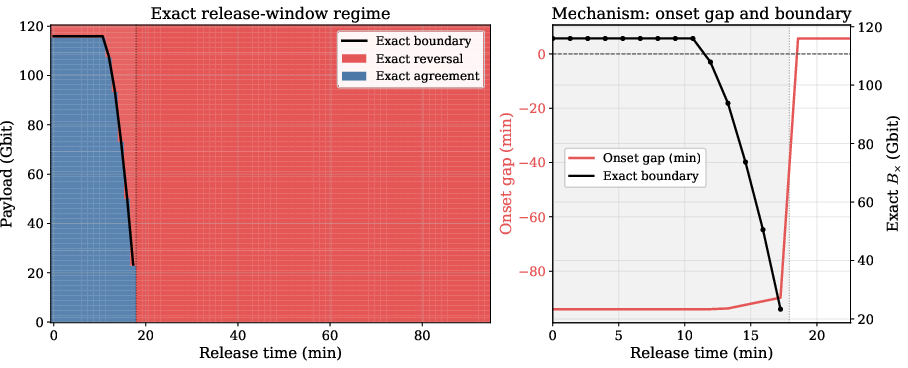
Figure 3: Release-time--payload regime in which streaming-centric path ranking reverses finite-payload earliest arrival.
This motivates the cumulative-service earliest-arrival evaluation, rejecting streaming-based heuristics for deadline-bound workloads.
A sufficient condition is derived under which two-way striping (splitting payload across edge-disjoint paths) strictly enlarges the candidate family’s deadline-feasible region compared to single-path delivery. The gain manifests only when the sum of per-path deadline service budgets exceeds the single-path budget after accounting for overhead.
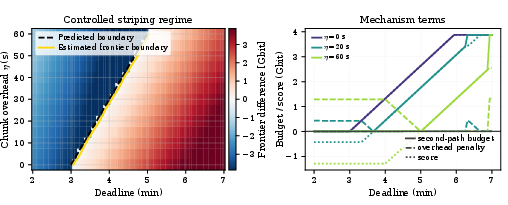
Figure 4: Controlled deadline service-budget criterion for identifying when two-way striping enlarges the feasible frontier.
Verification in a procedural Walker-like contact scenario confirms strict expansion: for representative releases, the frontier is enlarged with up to 1.8 Gbit improvement in payload and about 42 s deadline saving.
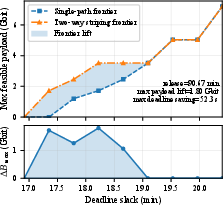
Figure 5: Dense feasible-region frontier for the selected release in the complementary-contact source context of the procedural Walker-like contact model.
Restricted Reference, Completion Gap, and Scalability
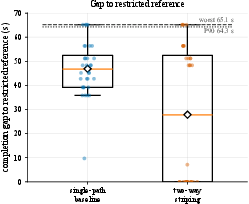
An exhaustive reference is constructed via full enumeration over a discretized K=2 plan family. Comparison yields decisive findings:
Scalability characterization establishes tractable runtimes for the residual-service delivery layer in procedural Walker-like models (with 20–180 satellites), with fallback boundaries exposed by greedy policies at larger constellation sizes.
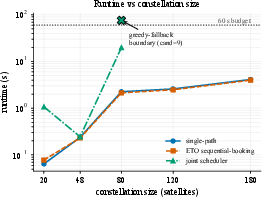
Figure 7: Runtime scalability of the delivery layer under the procedural Walker-like contact model.
Event-grid discretization induces a mild optimistic bias (≤15 s), well within operational tolerances for deadline-bound objects.
Implications and Future Directions
Residual-service-aware object delivery addresses the central bottleneck in DTN routing for deadline-sensitive workloads: it enables protocol-agnostic, service-consistent feasibility guarantees post-route generation, essential for telemetry, AI model updates, and control-layer object dissemination in non-terrestrial networks. The distinction between residual correctness and complementary-contact striping gain enables rigorous system design, avoiding silent failures and optimizing feasible delivery frontiers in complex space-ground networks.
Practically, this layer can integrate with standard DTN route generators (e.g., CGR, SABR), augmenting deadline-aware scheduling for finite objects with strict service-consistent guarantees. The scalability findings support deployment in contemporary LEO mega-constellations and future orbital edge infrastructures.
Theoretically, the structural separation between streaming-throughput and cumulative finite-payload regime reframes path ranking and evaluation logic. The findings motivate further research on multi-object scheduling, node-level resource coupling, striping degrees >2, and SGP4/TLE-driven dynamic ephemeris models. Integrated optimization with federated and split learning workloads, where deadlines may include round-trip model-inference requirements, appears promising.
Conclusion
This paper establishes a residual-service-aware delivery layer for finite-object deadline-bound delivery in intermittent LEO contact plans. It rigorously demonstrates that path-private evaluation can silently under-count completion under shared-edge contention, whereas residual-service-accrued evaluation maintains correctness. Complementary-contact striping expands the feasible frontier under analytically characterized conditions. Against an exhaustive reference, bounded two-way striping achieves notable mean and median gap reductions. The approach is tractable for constellations of contemporary scale, and the theoretical separation from streaming-centric metrics sets a new standard for deadline-aware object delivery in space-based DTN settings (2607.04405).