- The paper presents a zigzag extension of the Kitaev chain by coupling two chains with asymmetric diagonal hopping to enable tunable Majorana zero modes.
- It employs Bogoliubov-de Gennes formalism and momentum-space winding numbers to analytically determine phase transitions marked by spectral gap closings.
- The work lays the groundwork for experimental realizations of minimal tetron qubit architectures critical to advances in topological quantum computing.
Topological Properties and Majorana Multiplicity in the Zigzag Kitaev Chain
Introduction
This paper conducts a rigorous analysis of a zigzag extension of the Kitaev chain, realized by coupling two parallel Kitaev chains through diagonal inter-chain hopping. The investigation is motivated by the need for minimal, tunable platforms supporting multiple Majorana zero modes (MZMs) per edge—critical ingredients for topological quantum computation. The work combines Bogoliubov-de Gennes (BdG) formalism, spectral analyses, and momentum-space topological invariants to elucidate the rich phase structure emergent in this geometry.
Model Construction and Hamiltonian Structure
The zigzag Kitaev chain is modeled as two parallel one-dimensional Kitaev chains coupled via asymmetric diagonal hopping amplitudes (Jh, Jh′), in addition to standard intra-chain p-wave superconducting pairing and chemical potential terms. When Jh=Jh′=0, the system reduces to decoupled Kitaev chains, each exhibiting a topological phase transition at ∣μ∣=2J. The inclusion of diagonal couplings introduces new hybridization pathways, resulting in additional regimes supporting higher numbers of MZMs and an enriched phase diagram.
Energy Spectra and Majorana Zero Modes
Detailed spectral analysis reveals the influence of diagonal couplings on the energy bands and localized modes. For ϕ=0 superconducting phase difference, the spectrum shows clear bulk gap closings at analytically predicted values μ=±2J±(Jh+Jh′), with stepwise increases in the number of zero-energy modes signaling transitions among phases supporting four, two, or zero MZMs:
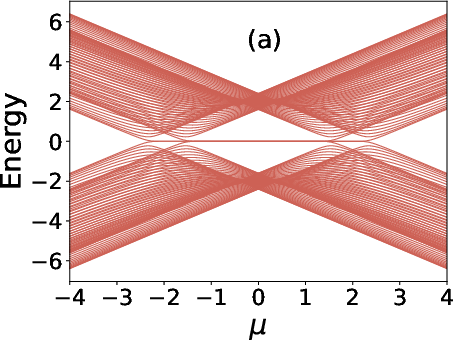
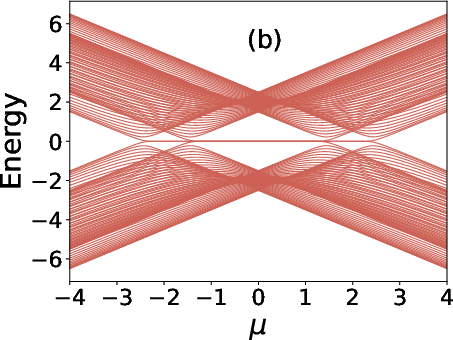
Figure 2: Energy spectrum of the zigzag Kitaev chain, demonstrating topological phase transitions with increasing μ for fixed J=Δ=1.0 and ϕ=0 with asymmetric and symmetric inter-chain couplings.
For Jh′0, the degeneracy of MZMs is partially lifted, with notable differences in the number and robustness of low-energy modes:
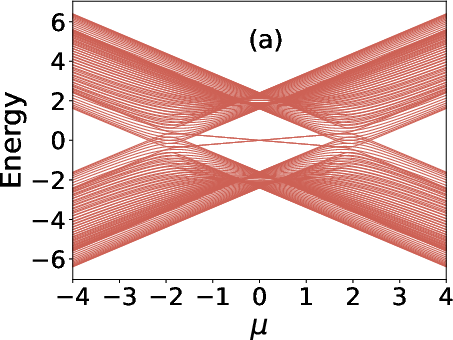
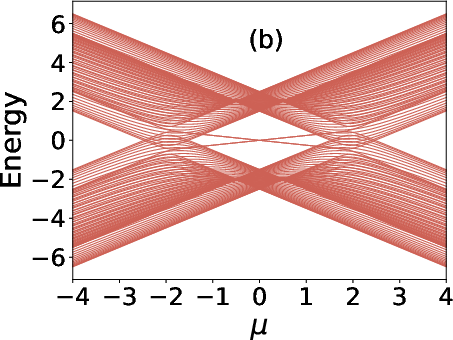
Figure 1: Energy spectrum for phase difference Jh′1, showing partial lifting of MZM degeneracy due to pairing interference.
Eigenstate analyses confirm the expected spatial localization of MZMs at chain edges in topological phases. In region I (most topological), four well-separated MZMs are observed, while in region II only two persist before all are eliminated as the system becomes trivial:
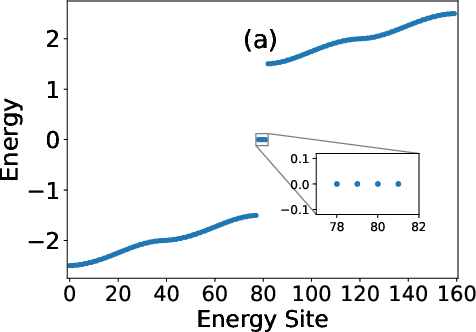
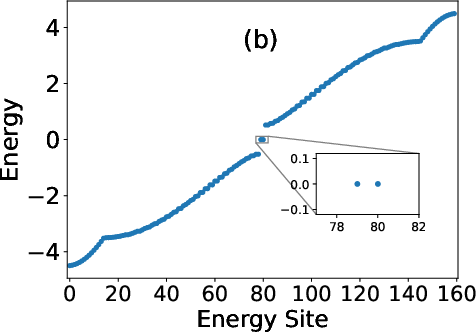
Figure 3: Eigenvalue spectrum reveals the presence and spatial localization of MZMs for representative values of Jh′2 and coupling strengths.
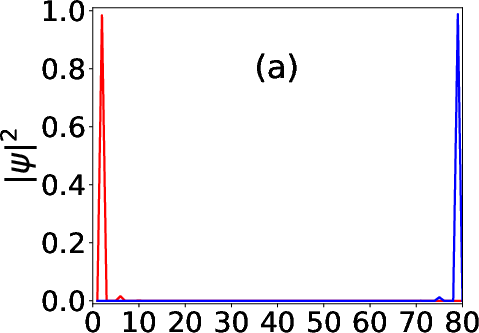
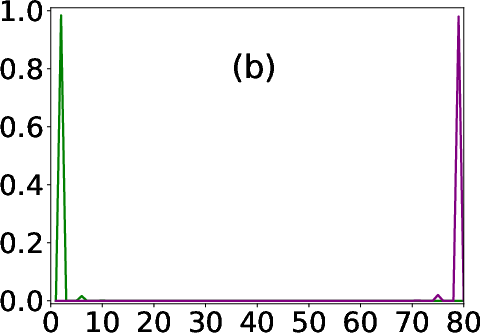
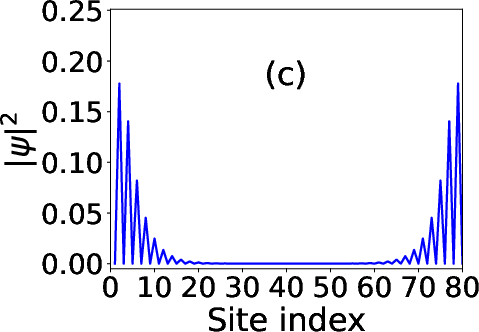
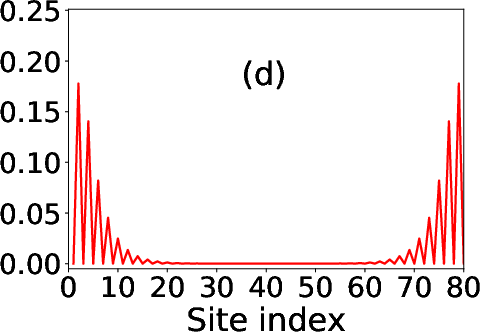
Figure 4: Probability distributions for four MZMs in region I, highlighting their localization at opposing chain ends.
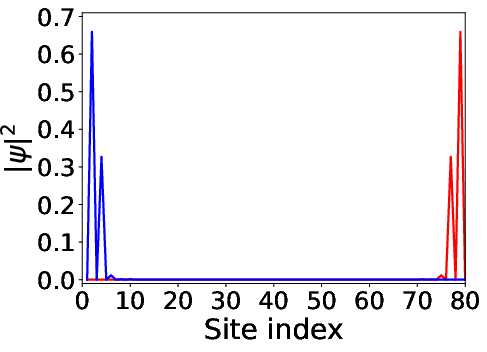
Figure 5: Spatial distribution of two MZMs for asymmetric coupling; edge localization persists until hybridization with the bulk occurs.
This explicit control of zero-mode multiplicity via diagonal coupling is a principal result, facilitating regimes with higher-order topological properties and supporting the implementation of minimal Majorana qubit encodings.
Topological Invariants and Bulk-Boundary Correspondence
To establish a rigorous classification, the paper computes the momentum-space winding number Jh′3, utilizing the off-diagonal BdG block structure inherent in chiral symmetric systems. For symmetric coupling Jh′4, Jh′5 achieves integer values (0, 1, 2), corresponding, respectively, to trivial, two-MZM, and four-MZM phases. The critical phase boundaries extracted from this invariant coincide exactly with spectral gap closings:
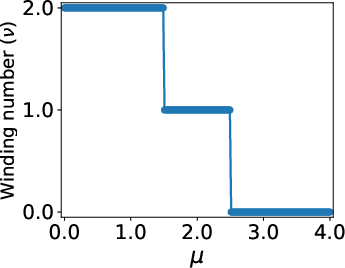
Figure 6: Winding number Jh′6 as a function of chemical potential, corroborating stepwise topological phase transitions at analytically predicted values.
Comprehensive phase diagrams in Jh′7 space show three regimes (trivial, two-MZM, four-MZM), with boundaries following Jh′8. Asymmetric couplings deform and shift these phase regions, illustrating tunability:
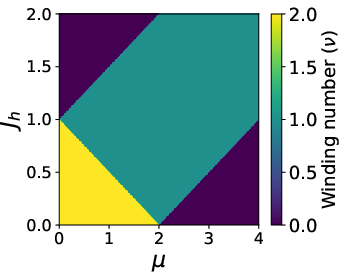
Figure 9: Phase diagram for symmetric inter-chain coupling, elucidating the domains of distinct MZM multiplicities.
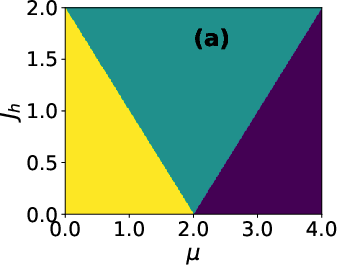
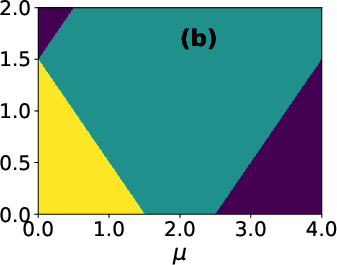
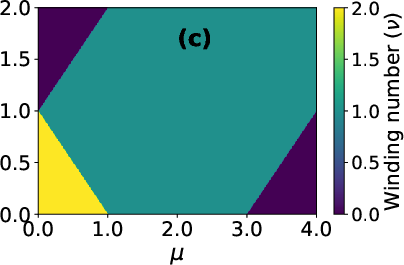
Figure 7: Phase diagram with varying asymmetry Jh′9, illustrating deformation and control of topological domains.
Quasiparticle Dispersion and Bulk Gaps
Momentum-resolved BdG diagonalization yields analytical expressions for the four-band structure, with explicit dependencies on diagonal couplings and pairing phase difference. The closing and reopening of bulk gaps at high-symmetry momenta are shown to underlie topological transitions, providing quantitative agreement with transition points obtained from both the spectral and topological invariant analyses:
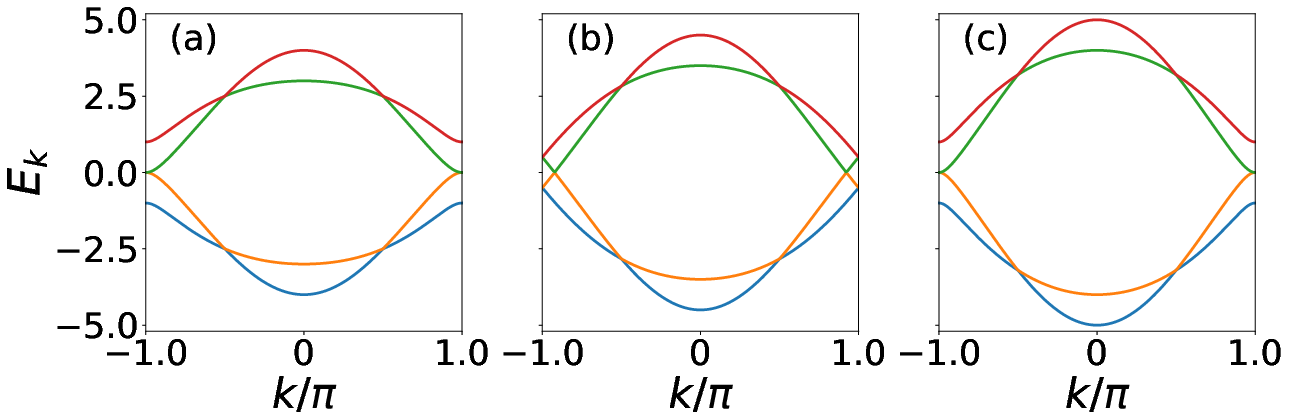
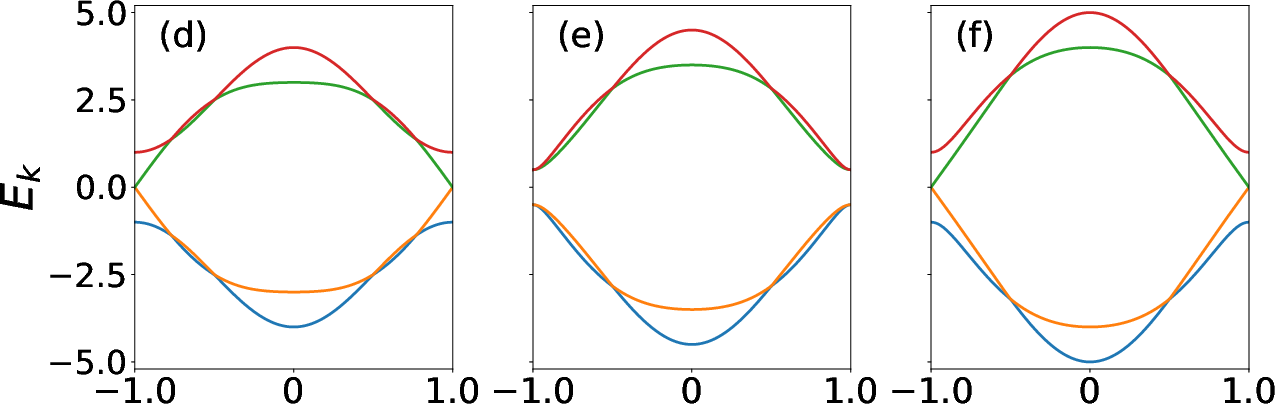
Figure 8: Quasiparticle dispersion relations at select values of p0, illustrating regime-dependent gap closing events corresponding to phase transition points.
Implications for Majorana-Based Quantum Computing
The demonstration of regimes supporting four spatially separated MZMs under controlled symmetry and hybridization provides a minimal realization of a tetron qubit structure, as employed in topological quantum computing proposals. Selective tuning of p1, p2, and p3 enables control over MZM interactions, degeneracies, and robustness. The architecture presented offers experimental accessibility in quantum-dot arrays, superconducting circuit platforms, and engineered nanowires, with robust signatures in local density of states and tunneling conductance.
The tractability of the model with respect to disorder, non-Hermiticity, and longer-range couplings, as well as the possibility to generalize to ladder or network geometries, positions the zigzag Kitaev chain as a prototype for exploring the fundamental and applied aspects of topological phases, protected edge state engineering, and fault-tolerant qubit architectures.
Conclusion
This work establishes the zigzag Kitaev chain as a minimal, analytically tractable model supporting multiple, tunable MZMs per edge. The bulk-boundary correspondence is confirmed via agreement between spectral band closings, topological winding number computations, and explicit MZM localization. The demonstrated ability to control topological sectors and zero-mode multiplicity by tuning diagonal couplings and pairing phase is directly relevant for quantum information applications. Future research may extend this platform to probe the impact of disorder, long-range or nonlocal pairing, Floquet engineering, and multi-leg geometries, supporting ongoing development of robust, scalable topological quantum hardware.
Reference: "Topological properties and Majorana Multiplicity in Zigzag Kitaev Chain" (2607.04399)