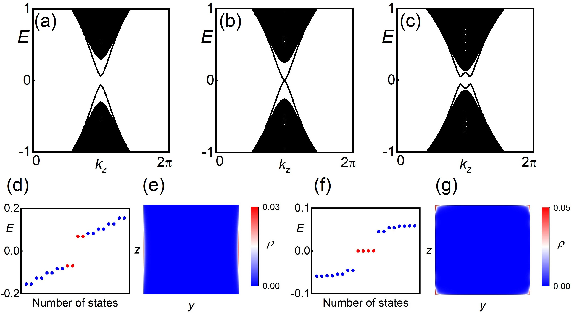
- The paper presents a theoretical model showing that finite-size hybridization of chiral hinge states in a HOTI yields spatially separated Majorana zero modes.
- The method employs numerical diagonalization under s-wave superconductivity to reveal a robust second-order topological superconducting phase with four localized zero modes.
- The study demonstrates the spectral isolation and moderate disorder resilience of the MZMs, underscoring their potential for scalable topological quantum computing.
Quasi-Two-Dimensional Majorana Zero Modes from Finite-Size-Coupled Chiral Hinge States
Overview
This paper presents a theoretical construction for realizing spatially separated Majorana zero modes (MZMs) in a quasi-2D geometry by leveraging finite-size-coupled chiral hinge states of a higher-order topological insulator (HOTI) proximitized by a conventional s-wave superconductor. The realized system exhibits a rich interplay between finite-size hybridization and superconducting pairing, enabling robust second-order topological superconductivity and corner-localized MZMs. The model elucidates the spectral, spatial, and disorder-properties of these emergent MZMs and establishes parameter regimes supporting their existence.
Model and Mechanism
The primary structure comprises a HOTI slab, thin along x, extended along y, and finite along z, in proximity to an s-wave superconductor.
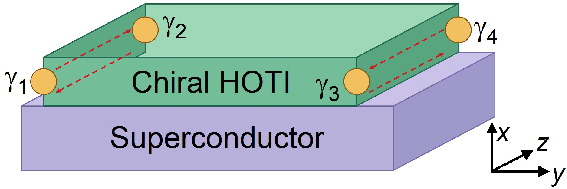
Figure 1: Schematic of the quasi-two-dimensional HOTI-superconductor geometry, showing the formation of hinge states and their hybridization across the thin x direction.
The normal-state HOTI is captured by a four-band Dirac model with an additional anisotropic mass term that gaps the conventional surface Dirac cones while enforcing mass domain walls at the hinges, producing chiral z-propagating hinge states. The key technical element is the symmetry-protected mass configuration, governed by combined C4zT symmetry, generating a mass contrast between adjacent facets.
Numerical diagonalization in a z-periodic geometry reveals that the hinge states are spectrally isolated from the bulk and strictly localized to system corners in the x-x0 plane.
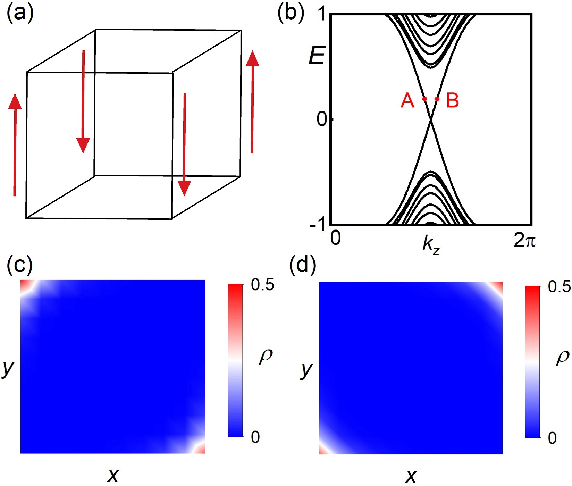
Figure 2: Spectrum and probability densities show diagonal hinge localization for states marked A and B, emphasizing the HOTI boundary structure.
Upon application of x1-wave superconductivity, the induced pairing gaps the x2 surface, retaining the chiral Majorana modes on side hinges, which are robust due to their topological origin and remain delocalized (propagating), as dictated by the unpaired chiral structure:
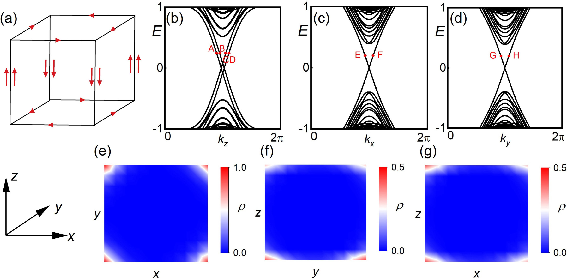
Figure 3: Spectrum of the BdG Hamiltonian illustrating chiral Majorana hinge states in the proximitized geometry.
Finite-Size Hybridization and Majorana Localization
The pivotal step is reduction of the slab thickness along x3. When x4 is decreased to a few lattice constants, the x5-oriented hinge modes, originally spatially separated, hybridize via finite-size tunneling. This hybridization reconstructs the low-energy boundary spectrum, yielding two spatially separated helical channels—each localized near one of the x6-edges.
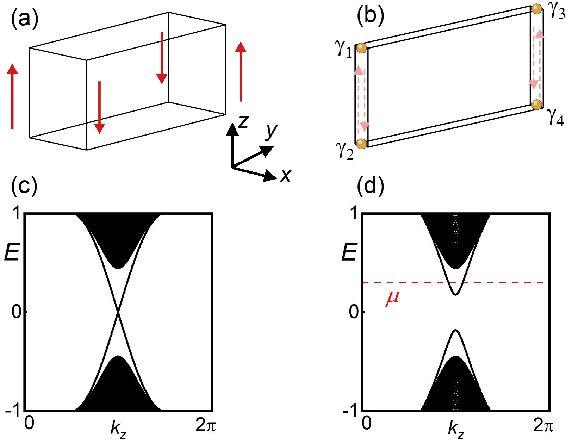
Figure 4: Evolution from decoupled chiral hinge states in the thick limit to helical channel formation via finite-size-coupling, underpinning the emergence of spatially separated MZMs.
Superconducting pairing projected onto these quasi-1D helical channels induces an effective x7-wave gap, analogous to the Kitaev chain. For open x8 boundaries, four MZMs emerge, each localized at a channel endpoint (corners of the x9-y0 plane), thus realizing second-order topological superconductivity.
Spectral Evolution, Phase Diagram, and Corner Localization
A systematic scan of chemical potential y1 and pairing amplitude y2 elucidates the topological phase boundaries:
The phase diagram in the y8 plane indicates a broad region supporting four robust MZMs.
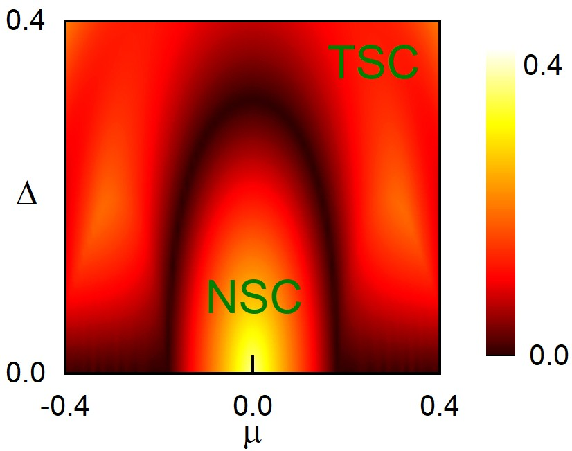
Figure 6: TSC phase occupies a finite area in parameter space; gap-closing lines indicate transition boundaries to the nontopological SC regime.
Unlike conventional 1D or simple QAHC-based platforms, this HOTI construction inherently realizes four spatially non-overlapping MZMs, relevant for braiding and topological quantum computation.
Robustness to Disorder
Disorder resilience is crucial for practical applications. The study incorporates nonmagnetic onsite potential and orbital-mass disorder (random local chemical potential and band inversion strength) and analyzes their impact on the open-boundary spectra:
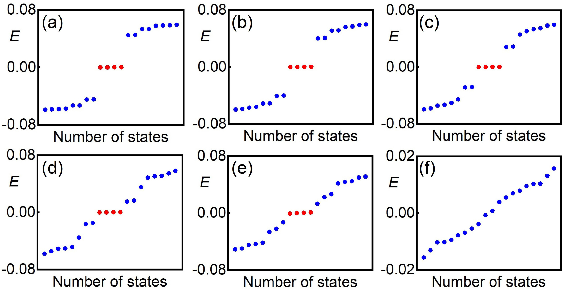
Figure 7: Representative low-energy spectra under increasing disorder strength; the MZMs persist and remain spectrally isolated for moderate disorder, with eventual collapse only at high disorder.
The results demonstrate that, as long as the excitation gap does not close, the MZMs are reasonably immune to both classes of disorder, a feature stemming from their topological and spatial separation.
Implications and Outlook
This construction leverages crystalline HOTI materials and conventional superconducting proximity—both accessible with current experimental resources (e.g., magnetically-doped topological insulators, axion insulators, and y9-wave superconductors). The modular architecture, yielding four robust and physically separated MZMs in a quasi-2D platform, presents several practical and theoretical implications:
- Spectroscopic signatures: Localized zero-bias peaks at the corners should be directly accessible via STM.
- Scalable architectures: The design admits generalizations to arrays and networked qubit geometries.
- Robustness to imperfections: Disorder tolerance and geometric flexibility facilitate device-level implementation.
- Analogy and beyond QAHC approaches: While reminiscent of narrow QAHC strips, the higher-order boundary structure delivers enhanced phase stability and multichannel MZMs, opening broader parameter windows than QAHC/standard TIs.
- Future directions: Further exploration is warranted on braiding protocols for the four-cornered MZMs, multi-terminal transport, and generalizations to interacting or multi-orbital HOTI platforms.
Conclusion
The paper establishes a concrete model for engineering quasi-2D, spatially isolated Majorana zero modes by exploiting finite-size-coupled chiral hinge states in a higher-order topological insulator with superconducting proximity. The approach synthesizes crystalline-symmetry-protected topology, finite-size spectral engineering, and conventional superconductivity to generate robust, disorder-resistant MZMs with direct implications for topological quantum computation architectures.
Reference: "Quasi-two-dimensional Majorana zero modes from finite-size-coupled chiral hinge states" (2607.04358)