- The paper's primary contribution is the design of strategyproof mechanisms for optimal bridge placement, ensuring incentive-compatible and efficient outcomes.
- It presents both deterministic and randomized approaches that achieve 1-3 approximations for maximum and social cost objectives under various strategyproof frameworks.
- The mechanisms rely on simple agent-count thresholds and spatial partitioning, offering practical insights for urban planning and network design.
Mechanism Design for Locating a Bridge Between Regions with Prelocated Facilities
This paper addresses the facility location problem in a two-region spatial setting by introducing a novel model where each region is equipped with a prelocated facility, and the central design question is the placement of a bridge connecting these regions to optimize agent accessibility. Each agent, distributed along either parallel region, possesses private location information. After the bridge is constructed, each agent is allowed to autonomously select the nearest facility, possibly crossing the bridge, incurring cost equal to their travel distance to the chosen facility. Importantly, the bridge is considered to have zero crossing cost and is perpendicular to the parallel regions.
This model departs from previous literature by enabling dynamic, proximity-based facility choices and by focusing on the mechanism design aspects: guaranteeing (strong) group-strategyproofness (SGSP, GSP), resistance to coalitional deviations, and providing approximation guarantees for objectives of minimizing maximum cost (makespan) and total social cost. The study is not only motivated by theoretical curiosity but also by urban planning applications where bridging infrastructure can substantially reconfigure agent-facility relationships and improve welfare.
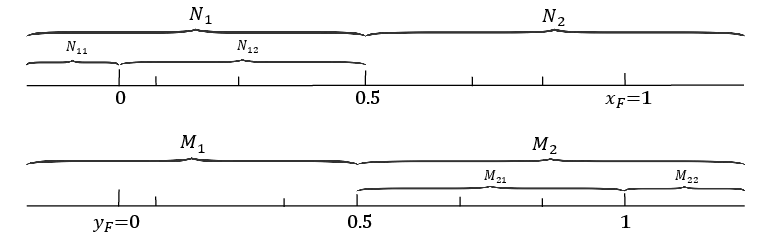
Figure 1: Partition of sets N and M based on (x,y).
Figure 1 visualizes the spatial partitioning relevant to mechanism design and proofs; specifically, agents are classified based on their proximity to midpoints and opposite facilities.
Let L1,L2 represent two parallel lines, each with a prelocated facility at xF (L1) and yF (L2). Agents in L1 (set N) have private locations M0, while those in M1 (set M2) have M3. Bridge construction location is M4. Each agent M5 can either access their local facility directly or cross the bridge to the other facility, choosing whichever minimizes their travel distance.
A deterministic mechanism is a mapping M6 that outputs the bridge location based on reported agent positions. Randomized mechanisms assign a probability distribution over possible bridge locations.
Agents' costs are defined as:
- M7 for agents on M8.
- M9 for agents on (x,y)0.
Anonymity, strategyproofness (SP), group-strategyproofness (GSP), and strong group-strategyproofness (SGSP) are precisely formalized, with respective requirements that discourage profitable misreporting by individuals or coalitions.
The social objectives are:
- Maximum cost: the highest individual cost over all agents.
- Social cost: the sum of all individual costs.
Main Results
Maximum Cost Objective
Characterization and Incentive Constraints:
The optimal maximum cost solution is characterized by simple checks against agent extrema; however, this solution is not SP. The authors design a deterministic GSP mechanism (Mechanism 1) with output based on symmetric, extremal agent positions, provably achieving optimal maximum cost. Notably, no deterministic SGSP mechanism achieves exact optimality: a 3-approximation is optimal for SGSP, with a lower bound of 2 for any deterministic SGSP mechanism. Randomization tightens the gap with a 2-approximation under SGSP.
- Deterministic GSP mechanism: Optimal (approximation ratio 1)
- Deterministic SGSP mechanism: 3-approximation; lower bound is 2
- Randomized SGSP mechanism: 2-approximation
Social Cost Objective
Deterministic and Randomized Mechanisms under GSP and SGSP:
For social cost minimization, the pivotal mechanisms exploit partitions of agents into subgroups (x,y)1 (agents on either side of 0.5/midpoint and relative to the opposing facility). The deterministic GSP mechanism that selects the bridge location according to the larger of (x,y)2 or (x,y)3 achieves a tight 3-approximation. Randomization affords a 2-approximation. No deterministic SP mechanism improves upon a 2-approximation, with a lower bound of 2. SGSP mechanisms necessarily lose efficiency: the best possible deterministic bound is (x,y)4, with the lower bound of (x,y)5 tight.
- Deterministic GSP mechanism: 3-approximation
- Randomized GSP mechanism: 2-approximation
- Deterministic SGSP mechanism: (x,y)6-approximation; lower bound (x,y)7
- Randomized SGSP mechanism: upper bound (x,y)8; lower bound 1.1
Summary Table:
Let (x,y)9.
| Mechanism Class |
Maximum Cost |
Social Cost |
| SP / GSP (Det.) |
1 |
[2, 3] |
| SP / GSP (Rand.) |
1 |
[1.1, 2] |
| SGSP (Det.) |
[2, 3] |
L1,L20 |
| SGSP (Rand.) |
[1, 2] |
L1,L21 |
Key Techniques and Mechanistic Structure
The analysis relies on careful partition of agents relative to facilities and the region midpoints, yielding clear sufficient statistics for outputting anonymous, strategyproof mechanisms. Proofs of group and strong group-strategyproof properties verify that no coalition can beneficially manipulate the mechanism, even under intricate agent configurations.
Approximation tightness is demonstrated via explicit adversarial agent placements; these confront the limits of purely information-based (SP) mechanisms absent monetary transfers. The mechanisms’ decision logic is distilled to simple thresholds on counts of agents’ positions within regions, which underscores their practical feasibility and interpretability.
Implications and Future Directions
The results provide an upper bound on the possible welfare loss—quantified by explicit approximation ratios—that must be incurred for incentive compatibility in bridge location problems with agent self-selection of facilities. The characterizations of worst-case efficiency losses under GSP and SGSP set out exact tradeoffs that planners must face in the absence of monetary transfers.
Theoretically, the work extends the literature on approximate mechanism design without money by explicitly integrating the interplay between connectivity infrastructure, prelocated facilities, and agent strategy, contributing new optimality and inapproximability results.
For practical mechanism design, the mechanisms’ reliance on agent counts rather than the full profile reduces their complexity and information demands.
Promising future directions include:
- Narrowing the limits on achievable approximation under SGSP, especially for social cost
- Incorporating bridge tolls or nonzero crossing costs, which more realistically models urban situations and introduces additional design complexity
- Handling heterogeneous facilities (e.g., quality, accessibility) or agent preferences
- Extending the spatial model to complex topologies, e.g., graphs, arbitrary metric spaces, or network facilities
Conclusion
This paper systematically develops the theory and practice of strategyproof mechanisms for bridge location between regions with prelocated facilities, achieving tight approximation ratios under individual and coalitional incentive constraints. The work advances both the technical and conceptual frontiers of facility location under informational asymmetry and network redesign, and it delineates a concrete set of questions for subsequent research on spatial mechanism design in artificial intelligence.