- The paper introduces a depth-conditioned diffusion pipeline that synthesizes photorealistic underwater stereo pairs while preserving geometric consistency.
- It employs cross-domain self-distillation to align geometric features between terrestrial and underwater modalities, significantly reducing mismatch errors.
- A perception-enhanced matching network fuses global semantic cues with learnable temporal frames, boosting disparity accuracy in challenging aquatic environments.
AquaStereo: Perception-Enhanced Underwater Stereo Matching via Diffusion Synthesis and Geometry Self-Distillation
Introduction and Motivation
Stereo correspondence under underwater imaging constraints remains an unresolved problem due to pervasive feature degradation—caused by attenuation, scattering, and backscatter—and limited availability of realistic, supervised underwater stereo datasets. The paper "AquaStereo: Enabling Underwater Stereo Matching via Depth-Conditioned Diffusion and Geometry Self-Distillation" (2607.04303) presents a holistic solution to these challenges by proposing a unified framework that synthesizes physically meaningful underwater stereo pairs, enforces geometric consistency during data generation, and leverages cross-domain self-distillation as well as robust, perception-enhanced matching modules for effective disparity estimation in adverse aquatic environments.
The key premise is to address both the domain gap (between available terrestrial and needed underwater data) and in-situ feature corruption via: (1) a diffusion model pipeline for data synthesis respecting underwater physics, (2) a lightweight yet effective left-right coherence enforcement mechanism, (3) student-teacher self-distillation transferring geometric structure from clean to underwater data, and (4) a matcher with learnable perception frames and fused semantic features to increase resilience against underwater-specific degradations.
Underwater Data Generation and Stereo Simulation
The authors argue that existing synthetic and real underwater stereo datasets are either costly, sparse, or fail on photorealism and domain realism. To bridge this critical data gap, AquaStereo introduces a depth-conditioned diffusion generation pipeline that converts terrestrial stereo pairs, along with monocular depth maps, into geometry-preserving, photorealistic underwater pairs, parameterized by physics-inspired prompts describing varying underwater conditions. The pipeline aggregates textual scene descriptors via CLIP and LLM curation, modeling degradation factors such as wavelength-dependent attenuation and scattering.
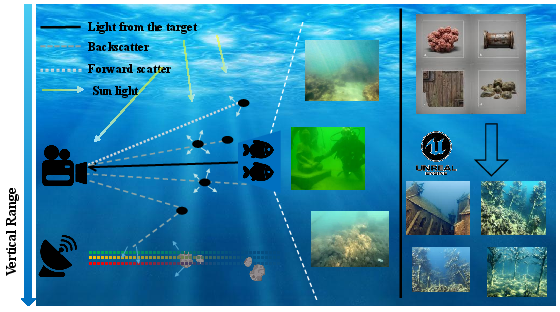
Figure 1: Principles of underwater data acquisition, comparing real sensor paradigms with CG-based rendering—a motivation for physics-driven generative synthesis.
A ControlNet-guided Stable Diffusion module receives both the underwater scene prompt and depth map as control signals, enabling the generation of underwater stereo pairs with spatially and contextually plausible degradations. Critically, a lightweight left-right consistency module is integrated during generation, explicitly scoring and enforcing coherence along epipolar lines using disparity and feature similarity priors, significantly improving binocular geometry preservation essential for stereo cost volume construction.
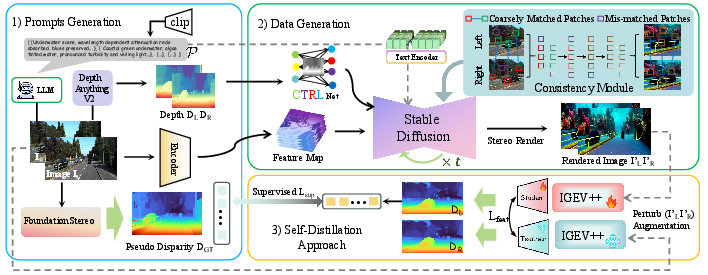
Figure 2: AquaStereo framework overview: prompt and depth extraction, depth-conditioned diffusion-based synthetic data generation with LR-coherence, and the cross-domain self-distillation training pipeline.
Empirical analysis across datasets demonstrates that unlike prior strategies based on style transfer or simple augmentations, the diffusion pipeline produces data that both enhances domain realism and ensures the geometric correspondence crucial for stereo learning tasks.
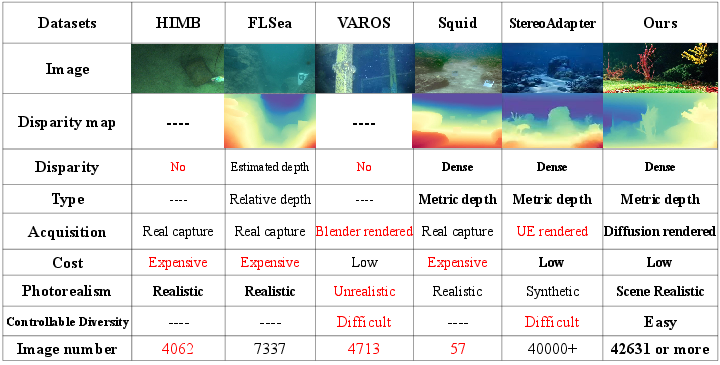
Figure 3: Dataset landscape, highlighting the scarcity and limitations of existing underwater stereo datasets relative to AquaStereo's generated corpus.
Cross-Domain Geometry Self-Distillation
AquaStereo leverages self-distillation to further align geometric representations between terrestrial and underwater domains. A frozen teacher, trained on clean, ground-truth terrestrial stereo, supervises a student model learning from the generated underwater (and perturbed) pairs, exploiting a shared geometry target for both modalities. The supervision is twofold: an ℓ1-norm feature alignment loss, enforcing multi-scale geometric feature concordance, and a supervised disparity regression loss with shared pseudo targets to counteract scale drift.
Perturbations applied to the student branch mimic underwater degradations—amplified turbidity, color shifts, compression noise—enhancing robustness to domain shifts, with the training objective alternately minimizing both geometric feature misalignment and disparity estimation error across perturbed and unperturbed data variants.
Perception-Enhanced Stereo Matching Network
At the network level, AquaStereo proposes a perception-enhanced matching backbone that increases feature stability and robustness for underwater scenes. The core innovation is the learnable perception frames: two additional, trainable frames concatenated with the original stereo pair, processed via a video backbone (such as Change3D) to capture “pseudo-temporal” cross-view and degradation-aware dependencies. This enhances context propagation and captures degradation priors, particularly in low-texture or highly degraded regions.
The output features are fused with global semantics extracted by a foundation model such as DINOv2, exploiting high-level scene cues less susceptible to local photometric corruption. The final disparity regression is achieved via an iterative, geometry-aware refinement head (as in IGEV++), ensuring boundary fidelity and outlier suppression.

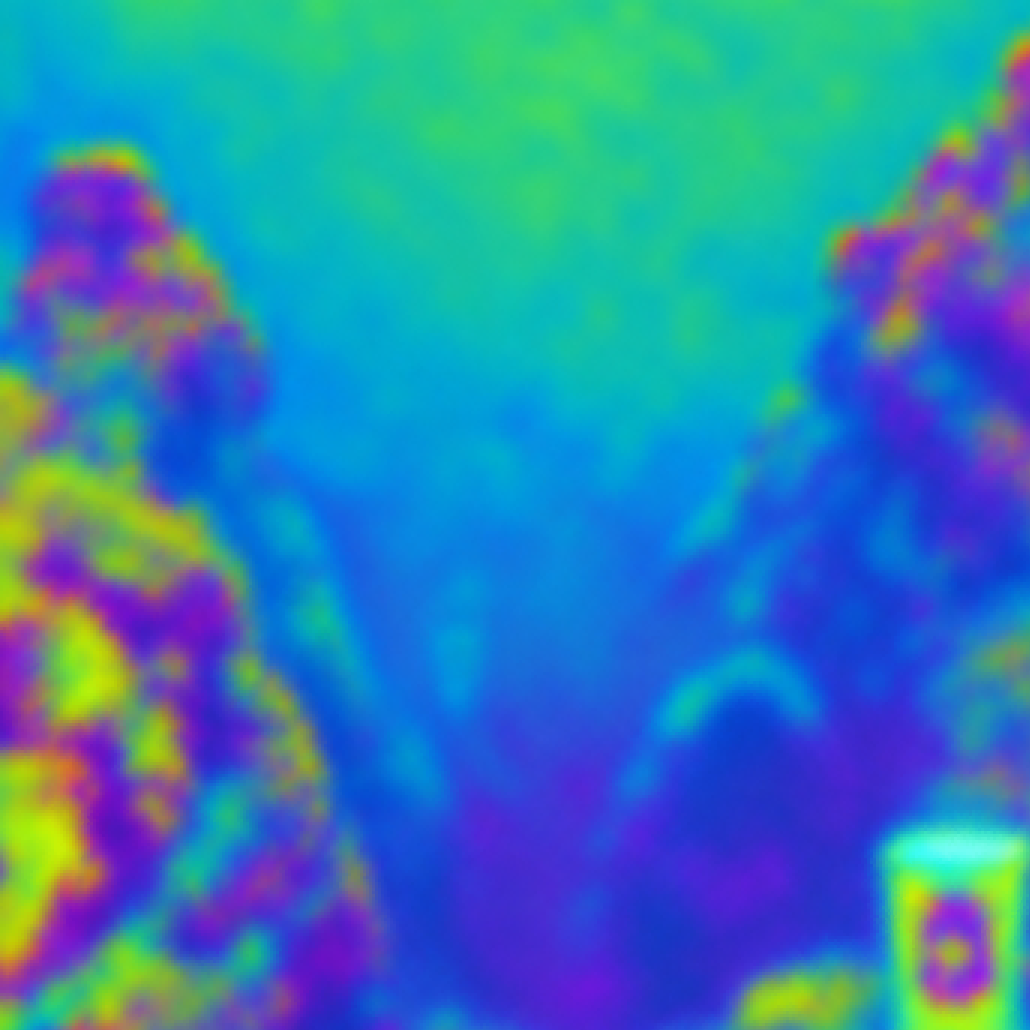
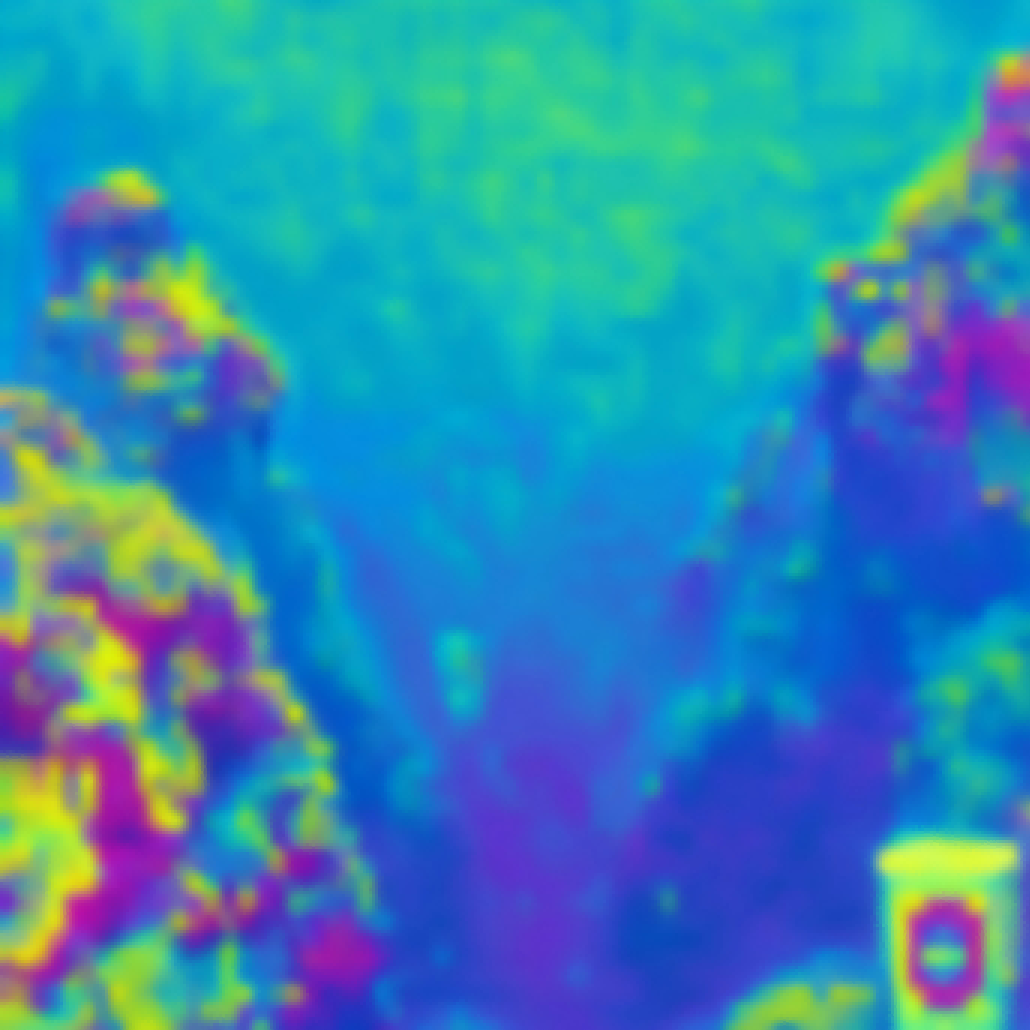
Figure 4: Attention visualization with and without perception frames; perception-enhanced modules produce more structure-aware attention maps, improving feature robustness in degraded settings.
Empirical Results and Ablation Analysis
Quantitative benchmarks across UWStereo, FLSea, Squid, and TartanAir confirm substantial accuracy boosts: on UWStereo, AquaStereo delivers an EPE/D1 of 0.59/2.61, outperforming previous state-of-the-art terrestrial and underwater-trained models, including zero-shot and dataset-mixed LLM backbones. These improvements are robust across domain splits—Coral, Industry, Ship—reflecting strong generalization.
Ablation studies validate the individual contributions:
- The left-right consistency module reduces cross-view inconsistencies by 66%.
- Cross-domain self-distillation delivers lower EPE/D1 compared to architectural weight sharing or ℓ2 regularization approaches, highlighting the importance of explicit geometry alignment and dual-branch supervision.
- The perception-enhanced encoder outperforms alternative vision transformer or CNN-based feature extractors, emphasizing the benefit of pre-fusion global semantics and degradation-adaptive perceptual cues.
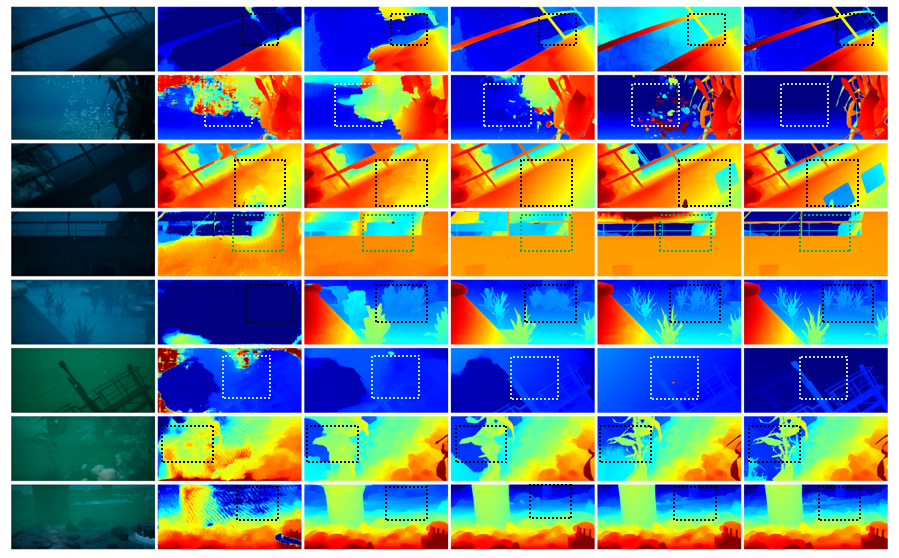
Figure 5: Qualitative disparity comparisons; AquaStereo preserves sharper object boundaries and finer details under severe underwater degradations, outperforming all baselines.
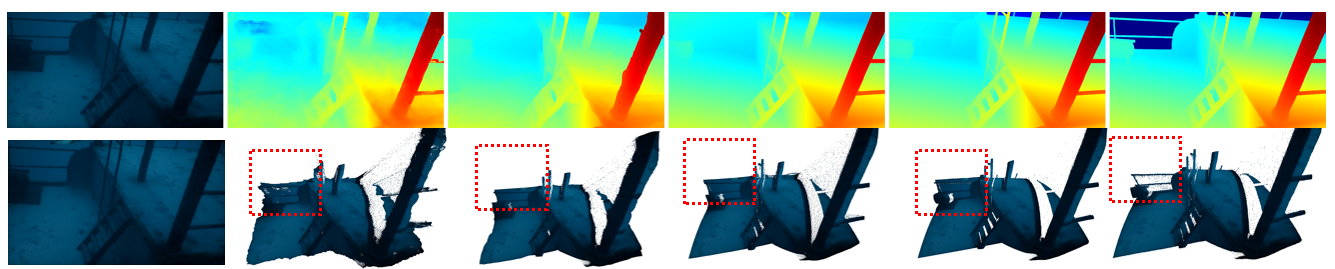
Figure 6: Point-cloud reconstructions; AquaStereo yields denser, cleaner, and more contiguous geometry with fewer outliers and artifacts.
Further analysis using attention visualizations and per-pixel heatmaps demonstrates that perception frames and self-distillation, respectively, improve spatial focus on matchable structures and refine ambiguous depth regions.
Practical and Theoretical Implications
AquaStereo’s contributions are twofold. Practically, its data synthesis and modeling strategies enable robust underwater stereo depth perception with minimal dependence on costly real-world data collection, providing a scalable solution for robotics, navigation, mapping, and inspection in aquatic environments. Its synthesis pipeline can be adapted to simulate other challenging domains with strong physics-driven degradation, not limited to underwater vision.
Theoretically, the results indicate that joint diffusion-based synthesis and self-distillation can close substantial domain gaps, preserving metric geometry and robust matching under severe degradations. The fusion of learnable temporal context and foundation model semantics for feature construction establishes a strong direction for future hybrid stereo architectures.
Future Directions
While AquaStereo marks significant progress, several avenues remain:
- Integration of online/onboard adaptation for dynamic environmental conditions;
- Extension to real-time diffusion-based data augmentation during deployment;
- Broader adoption of physically grounded prompt engineering and generalization to other sensing modalities.
Conclusion
AquaStereo delivers a comprehensive, systematically validated pipeline for underwater stereo matching, incorporating diffusion-based, depth-conditioned data synthesis, geometric self-distillation, and perception-enhanced feature encoding to collectively overcome the underwater domain gap and feature degradation. The approach sets new baselines in accuracy and robustness, and its modular design invites further innovation in domain-adaptive vision for both underwater robotics and other challenging modalities.