- The paper delivers a quantitative analysis of particle confinement, demonstrating that MMM-induced inward transport significantly suppresses axial losses under strong scattering conditions.
- The study employs single-particle kinetic simulations and a Maxwell-consistent field model to reveal critical regimes, including Fermi acceleration and velocity-dependent loss-cone expansion.
- The findings underscore that robust MMM performance requires additional turbulence or RF-induced scattering to counteract loss-cone enlargement at finite mirror speeds.
Particle Dynamics and Confinement in Moving Multi-Mirror Systems
Introduction
The paper "Particle dynamics and confinement in moving multi-mirror" (2607.04267) systematically investigates the particle confinement properties and loss mechanisms in the moving multi-mirror (MMM) concept for open magnetic mirrors, an approach originally intended to overcome fundamental limitations of static and dynamical end-plugging methods in linear fusion devices. By combining single-particle kinetic simulations with a modified rate-equation model incorporating velocity-dependent loss-cone effects and MMM-induced transport, the authors deliver a quantitative and mechanistic analysis of confinement enhancement and clarify the microscopic processes regulating end losses in MMM systems.
Field Configuration and Particle Trajectories
The MMM scheme employs electromagnetically driven multi-mirror sections propagating inward toward the central trap, dynamically transporting trapped particles back towards the central cell and mitigating axial losses. The authors develop a Maxwell-consistent field model coupling a static central mirror region with moving MMM sections. This field realization facilitates detailed single-particle simulations of both centrally-trapped and MMM-trapped ions for realistic parameters (e.g., Rm=6, U=0.1vth).
The simulations reveal two critical dynamical regimes. Particles originating in the central cell experience repeated Fermi-type acceleration due to reflection from inward-moving mirrors, leading to systematic energy gain and eventual escape through the (moving) loss cones. In contrast, particles initially trapped in the MMM sections are efficiently transported inward, maintaining their energy in the moving frame, but suffer rapid acceleration and loss upon transitioning into the central region.
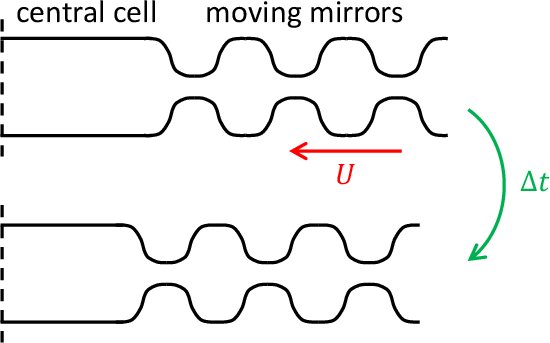
Figure 1: An illustration of an MMM system showing MMM sections propagating inward and reshaping the field structure over time.
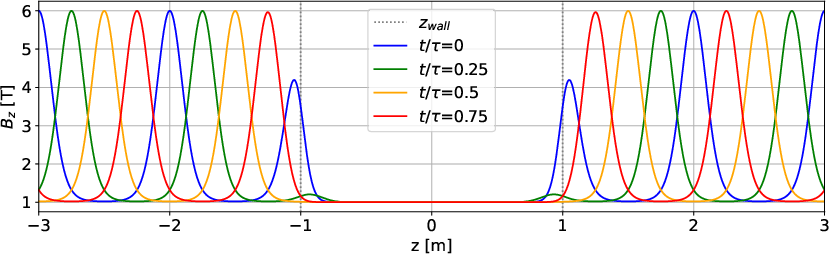
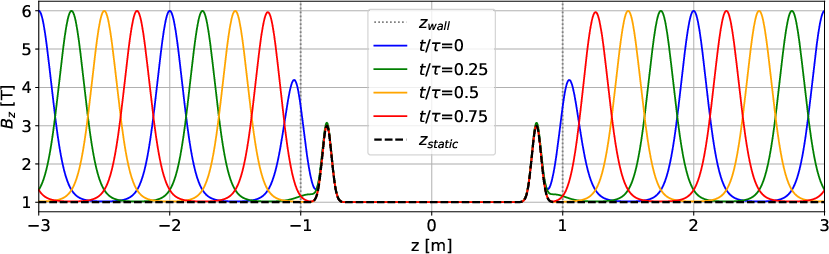
Figure 2: Spatiotemporal evolution of the axial magnetic field including central cell and moving MMM sections, with and without an additional static central-cell field.
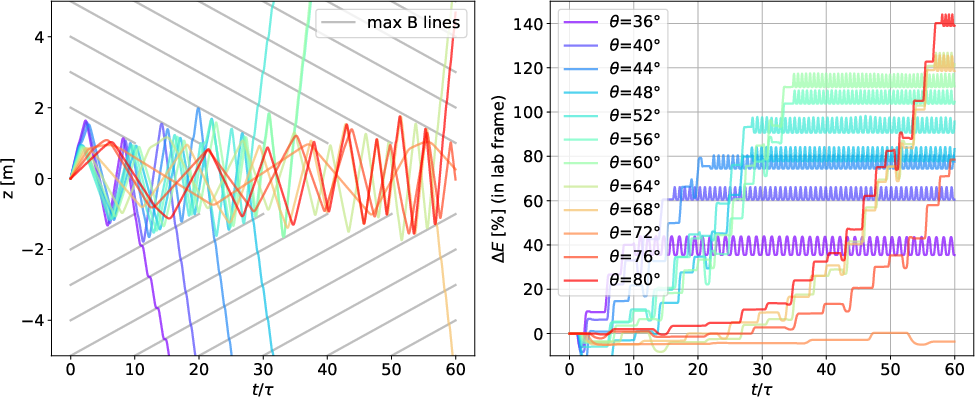
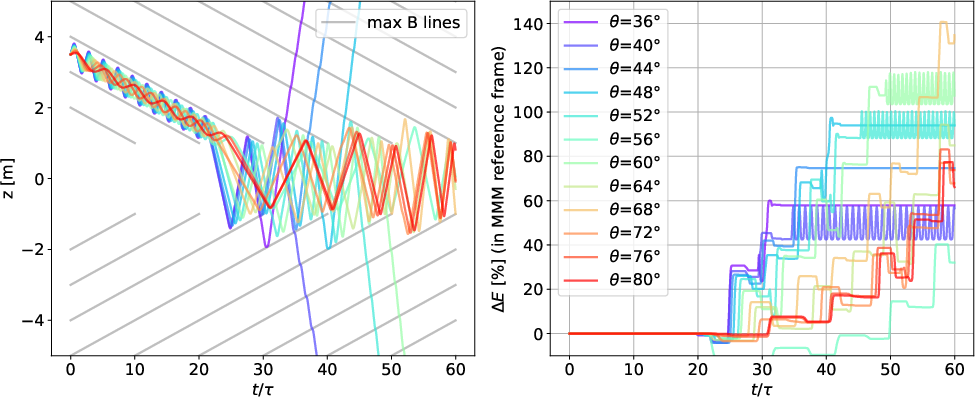
Figure 3: Single-particle trajectories and corresponding energy evolution for ions initialized in the central cell and in the MMM section under dynamic fields.
To address this, the authors introduce a superimposed static magnetic barrier at each end of the central mirror, partially suppressing Fermi acceleration for centrally-confined particles and restoring conventional trapping. However, this configuration does not completely solve the problem: particles swept into the central region by MMM dynamics remain subject to Fermi acceleration, emphasizing a persistent stitching challenge at the interface and indicating the necessity for additional scattering processes.
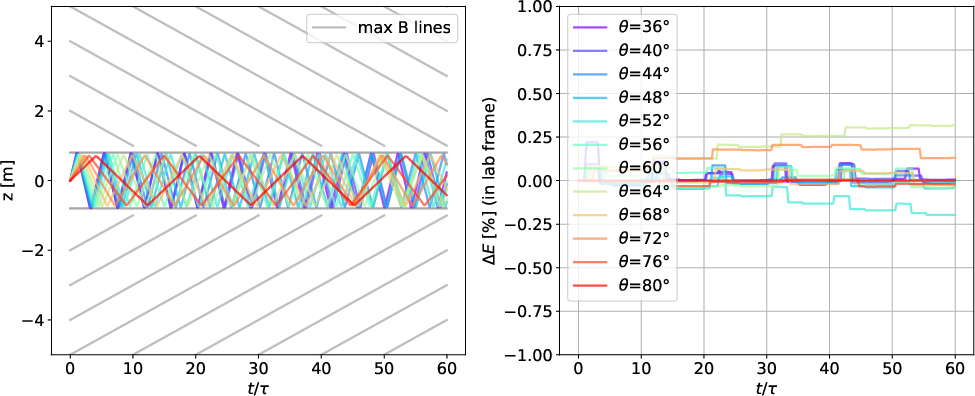
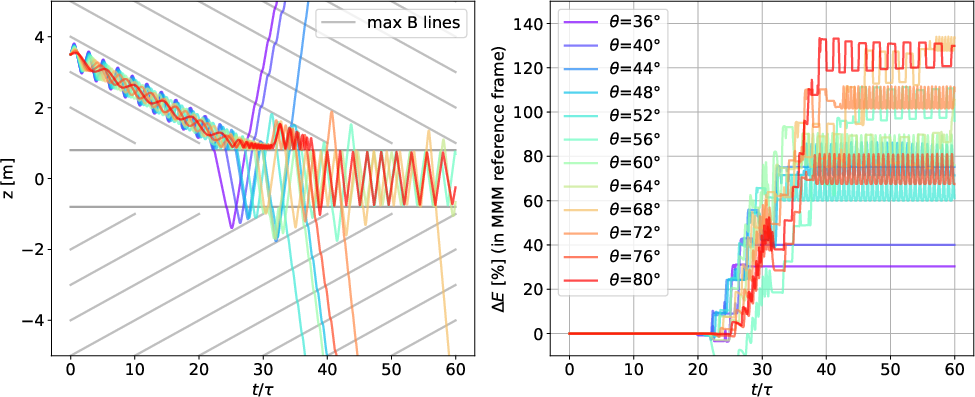
Figure 4: Single-particle trajectories with a static field barrier showing limited energy change for centrally trapped particles but continued axial acceleration for incoming MMM-trapped particles.
Loss-Cone Modification in Moving Mirrors
A core finding is the velocity-dependent deformation of the loss-cone boundaries due to mirror motion. In the lab frame, the moving multi-mirror structure renders the loss cone asymmetric: for leftward-propagating mirrors, the right-going (escaping) loss cone solid angle increases while the left-going cone shrinks. This effect directly counteracts the intended plugging—higher mirror speeds (U/vth) enlarge the loss cone through which particles can escape, an intrinsically kinetic penalty not captured by fluid or diffusive models.
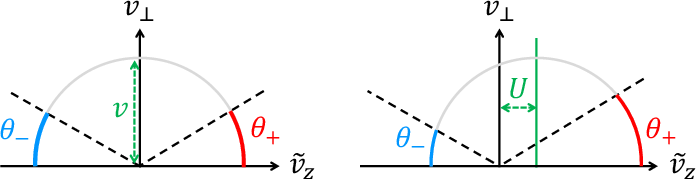
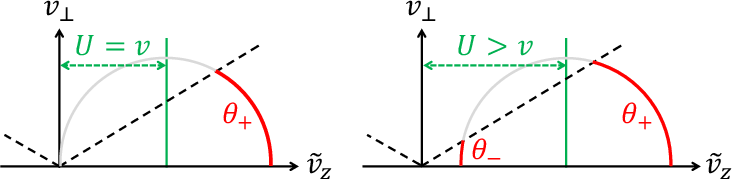
Figure 5: Schematic illustration of lab-frame loss cones in the presence of a moving mirror, showing the evolution of loss-cone solid angles with increasing mirror velocity U.
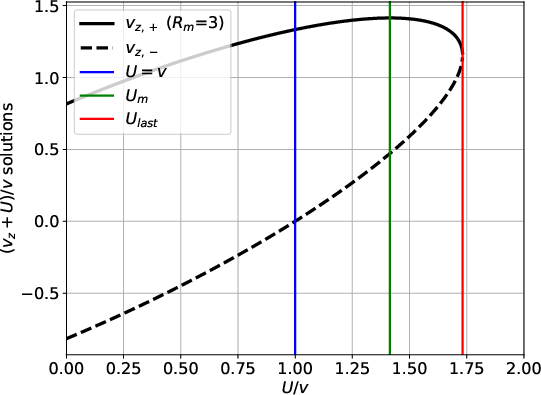
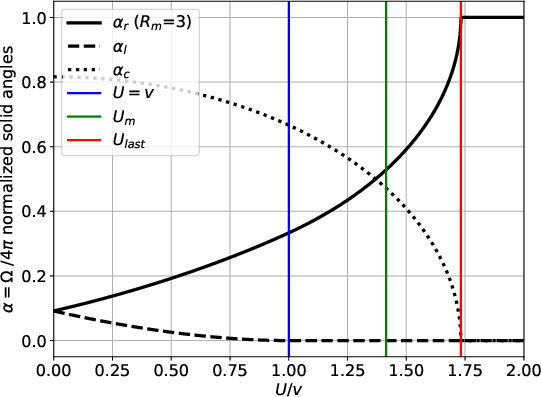
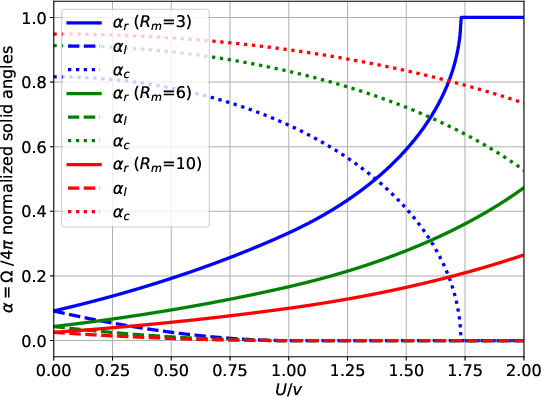
Figure 6: Quantitative analysis of the modified loss cones: loss-cone limiting velocities (left), populations' solid angle fractions vs. U (center and right) for varying Rm.
Rate-Equation Modeling and Confinement Enhancement
The authors extend a semi-kinetic rate-equation model to incorporate both the MMM-induced inward transport and the modified, velocity-dependent loss-cone geometry. The model distinguishes between three ion populations in each cell (confined, right-loss-cone, left-loss-cone), mixing via (enhanced) scattering and streaming via both the dynamic and static cell boundaries.
In the strong scattering regime (λ∼l), achievable only through effective (non-collisional) mechanisms, the steady-state simulations demonstrate that MMM pumping can suppress the outgoing flux by several orders of magnitude over a practical number of mirror cells, dramatically exceeding levels required to satisfy the Lawson criterion for fusion conditions. The improvement is robust for a wide range of mirror ratios and mirror velocities, provided efficient phase-space mixing is sustained.
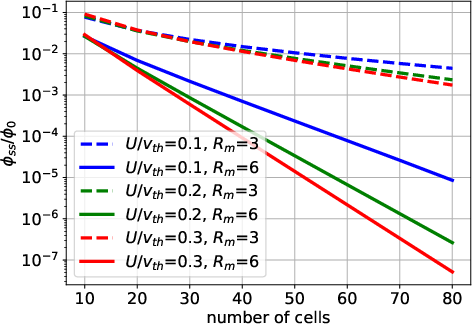
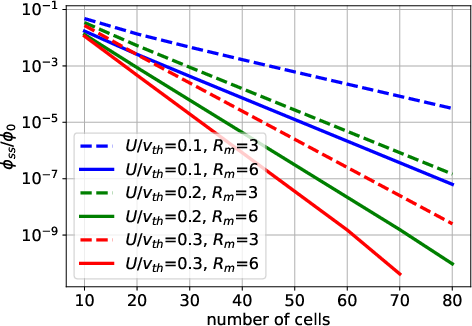
Figure 7: Steady-state normalized axial flux ϕss/ϕ0 vs. number of MMM cells for varying Rm and U, under both single- and double-peaked velocity distribution assumptions.


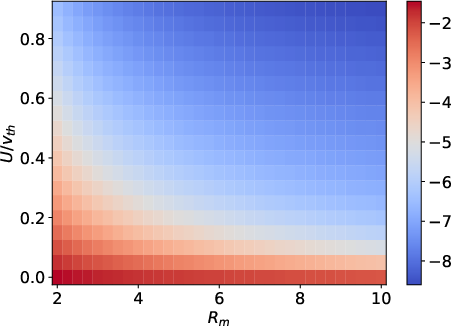
Figure 8: Contour maps of steady-state normalized flux as a function of U=0.1vth0 and U=0.1vth1 for U=0.1vth2 and U=0.1vth3 cells, and both velocity-distribution models.
The model also uncovers new qualitative behavior: under certain conditions (low U=0.1vth4, double-peaked velocity distribution), increasing the mirror velocity U=0.1vth5 paradoxically worsens confinement due to the dominant effect of the expanding loss cone, despite faster inward pumping. This underscores the importance of accurate kinetic modeling.
Implications and Future Directions
The results imply that MMM-based plugging is fundamentally a kinetic process, highly sensitive to the presence of efficient, possibly turbulence- or RF-induced scattering, in both the moving and central mirror regions. For the weakly collisional plasmas pertinent to fusion applications, the MMM concept alone cannot guarantee sustainable confinement without such phase-space mixing. Moreover, the deformation of the loss cone with increasing U=0.1vth6 represents a key limitation on the maximum effective plugging achievable.
On the engineering side, the voltage and current requirements for MMM operation remain within achievable ranges, and the potential for multi-order-of-magnitude improvement in axial flux loss is significant, motivating near-term experimental tests. Nevertheless, self-consistent modeling of ambipolar fields, collective drifts, micro-instabilities, and finite-Larmor-radius effects are necessary to complete the theoretical picture.
Future research should focus on explicitly quantifying turbulence-generated and RF-induced scattering in realistic device geometries [see, e.g., (Arroba et al., 2024, Li et al., 2024)]. Implementing self-consistent kinetic models, validating with laboratory data, and optimizing field configurations against Fermi acceleration and loss-cone enlargement will determine the true viability of MMM plugging for reactor-scale fusion.
Conclusion
This study presents a rigorous kinetic foundation for the moving multi-mirror concept, clarifying both its potential for major confinement enhancement and its intrinsic limitations. While MMM pumping can, under strong scattering conditions, provide exponential suppression of axial losses, robust performance requires effective phase-space mixing throughout the entire system. The kinetic consequences of loss-cone deformation at finite mirror velocities must be considered in any design. Future theoretical and experimental work addressing these kinetic and transport challenges is essential to realize the promise of MMM-based end plugging for linear fusion devices.