- The paper demonstrates that photon-induced dimension-8 contact terms can dominate at high invariant masses, challenging the EFT truncation at dimension-6.
- It uses SMEFT analysis combining q̄q and γγ channels with NLL jet veto resummation to predict anomalous TGC contributions.
- Numerical results highlight that rigorous EFT validity checks and optimal factorization scale choices are essential for reliable constraints on Wilson coefficients.
Anomalous Triple Gauge Couplings and the Role of Dimension-8 Operators in W+W− Production
Overview and Motivation
The production of W+W− pairs at the LHC is a critical probe for electroweak gauge structure, sensitive to deviations from Standard Model (SM) gauge couplings due to Beyond Standard Model (BSM) physics. Adopting the framework of the Standard Model Effective Field Theory (SMEFT), this analysis focuses on the interplay between dimension-6 and dimension-8 bosonic operators—specifically, their impact on anomalous triple (aTGC) and quadruple gauge couplings in both qqˉ (quark-antiquark initiated) and γγ (photon-photon initiated) channels.
Key motivations include:
- Disentangling the relative importance of dimension-8 effects—especially for operators unique to γγ, such as direct γγWW contact terms absent at lower operator dimension.
- Assessing the practical validity of the EFT expansion by quantifying the regimes where dimension-8 contributions become sizable relative to dimension-6, potentially invalidating a truncated SMEFT description.
- Providing NLL-accurate predictions for aTGCs in the presence of jet-vetoes, enabled by implementing operator-matching in MCFM-RE and appropriately treating the factorization scale for MadGraph γγ simulations.
SMEFT Operator Structure and Mapping to Physical Processes
The EFT analysis identifies four CP-even bosonic dimension-6 operators and twenty dimension-8 operators relevant for diboson production. Dimension-6 operators, in the Warsaw basis, include OHW, OHB, OHWB, and W+W−0. Of these, all but W+W−1 contribute to both W+W−2 and W+W−3 channels, while W+W−4 exclusively induces W+W−5 contributions.
At dimension-8, only a subset directly modifies the W+W−6 channel; most notably, many induce W+W−7 four-point vertices that are absent in the SM and dimension-6. This leads to energy-scaling enhancements for W+W−8 initiated effects at high invariant mass.
The mappings from EFT coefficients to anomalous TGCs and QGCs, following standardized conventions (Lagrangian formalisms in MCFM-RE), enable direct implementation in event generators for both precision SM and BSM predictions. The paper provides explicit conversion formulae, distinguishing unique Lorentz structures for certain operators, notably W+W−9, which produces a hermitian (rather than imaginary) modification to the TGC vertex.
Impact of Jet Vetoes and Factorization Scale in qqˉ0 Initiated Processes
Jets from QCD radiation play a major role in background suppression for qqˉ1 production, making jet vetoes an experimental necessity. However, such vetoes introduce large logarithmic corrections in QCD, especially for qqˉ2 and qqˉ3 initial states, necessitating resummation (at NLL/NNLL) in theoretical predictions. The qqˉ4 channel, being colorless, does not radiate gluons and is affected mainly through its PDF evolution. The optimal factorization scale (qqˉ5) for qqˉ6 is set to the jet-veto scale, efficiently resumming all collinear emissions below this threshold.
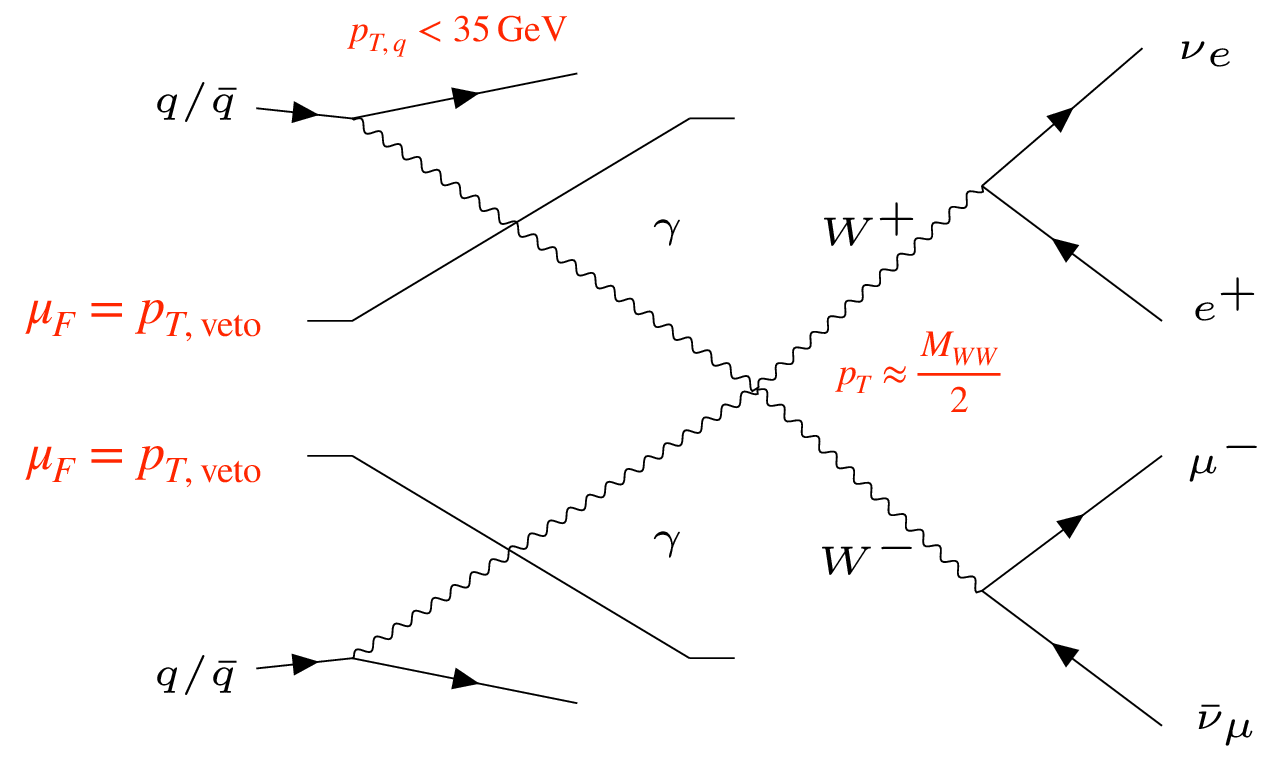
Figure 2: Pictorial representation of the PDF factorization and radiation structure in event generator predictions, with hard-process scale set to qqˉ7 in the presence of a jet veto.
Comparison of LO and NLO predictions in the qqˉ8 channel demonstrates significantly better perturbative convergence when qqˉ9 is taken at the jet-veto threshold (see Figure 3). This method robustly incorporates jet-veto effects into photon-induced processes.
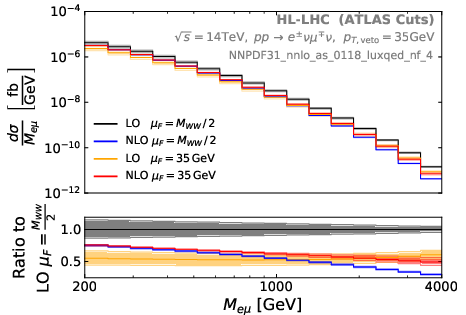
Figure 4: Convergence between LO and NLO for the SM photon-induced contribution at HL-LHC (14 TeV), highlighting the importance of setting γγ0 for improved stability in the presence of jet vetoes.
Suppression effects are channel-dependent: while the gluon-induced contributions are most strongly suppressed by the jet veto (due to largest color charge), the photon channel also experiences noticeable suppression when appropriate account of PDF evolution and factorization is included.
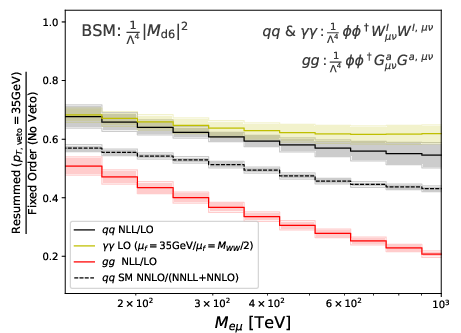
Figure 1: Jet-veto effects on different channels: gluon (red), quark (black), and photon (yellow), for relevant operators; BSM and SM suppression compared.
Numerical Results and Relative Importance of Higher-Dimensional Operators
Dimension-6 Effects
Interference and squared contributions of dimension-6 operators can be sizable in both γγ1 and γγ2 channels. Notably, for some operators (e.g., γγ3), the photon-initiated interference and squared terms can reach up to 60% and 40% (respectively) of the γγ4 contribution at high γγ5, far exceeding naive expectations based on SM cross-section ratios.
(Figure 6), (Figure 7)
Figure 3: Comparisons of dimension-6 interference and squared contributions for γγ6 (left) and γγ7 (right) channels at γγ8 TeV, showing competitiveness of the photon channel for certain operators.
Dimension-8 Effects and EFT Validity
Although dimension-8 γγ9 contributions are parametrically suppressed, the dimension-8 γγ0-induced operators, particularly contact terms, show a rapid energy scaling. At high invariant masses, the squared contribution from these photon-induced operators can become comparable to or even exceed the dimension-6 γγ1 squared contributions.
(Figure 8), (Figure 9)
Figure 5: SM interference and squared contributions for bosonic dimension-8 operators in γγ2 and γγ3 at γγ4 TeV; photon-induced contact terms dominate at high γγ5.
The truncation of EFT at dimension-6 becomes questionable if dimension-8 effects reach similar magnitudes. The analysis quantifies a bin-wise minimum allowed value of γγ6 (γγ7) required to ensure a valid EFT expansion in each region of γγ8.
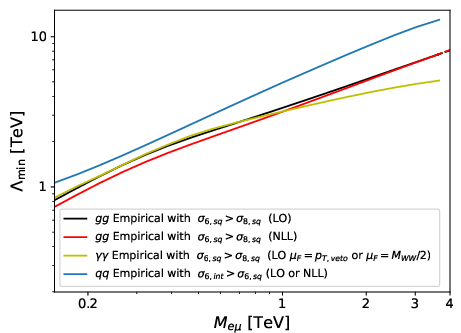
Figure 6: Minimum EFT validity scale γγ9 as a function of γγWW0 for γγWW1 and γγWW2 channels, demonstrating the region where dimension-6 dominance is preserved.
Constraints, Sensitivity Studies, and Uncertainties
Current Experimental Constraints
Using ATLAS 2019 data, the study derives exclusion contours on the Wilson coefficients of dimension-6 operators, carefully respecting EFT validity by restricting fits to kinematic regions where dimension-8 effects remain subdominant. The strongest constraints are set on γγWW3 and γγWW4, while γγWW5 and especially γγWW6 are much weaker (the latter being only relevant for the subleading γγWW7 channel).
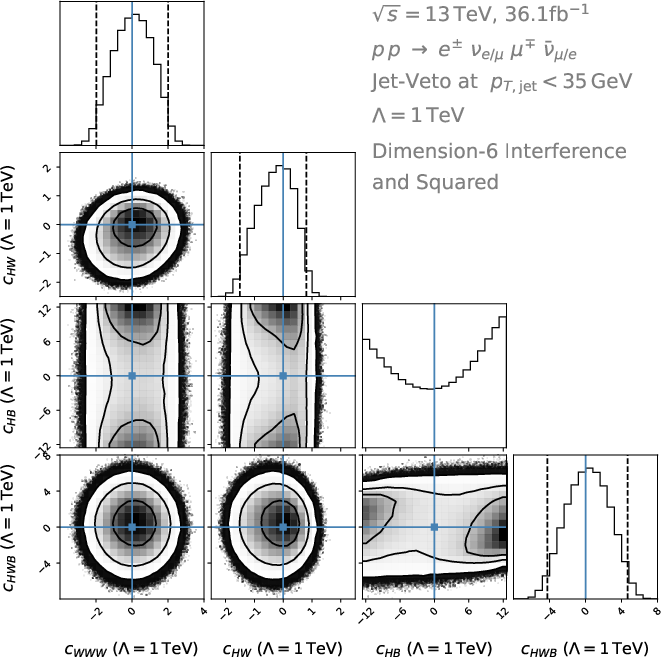
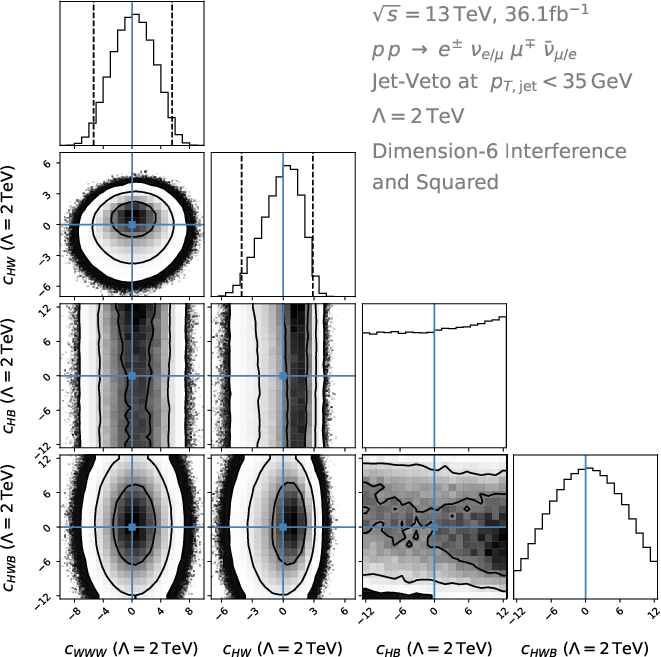
Figure 7: 2D sensitivity contours for γγWW8 at γγWW9 TeV using ATLAS 2019 γγ0 data with jet veto.
HL-LHC Projections and the Role of Jet Veto
HL-LHC projections highlight that, after imposition of EFT validity, constraints improve only mildly due to large theoretical (QCD and EW) and systematic uncertainties, especially at higher γγ1. Jet-veto effects do not significantly improve sensitivity for these channels, unlike in γγ2-initiated processes.
(Figure 12), (Figure 13)
Figure 14: Projected sensitivity at HL-LHC, including interference and squared contributions, systematically analyzed as functions of γγ3.
Theoretical and Experimental Uncertainties
Electroweak Sudakov logs and missing QCD-EW mixed terms introduce significant uncertainties in high-γγ4 tails. The difference between multiplicative and additive schemes for combining QCD and EW corrections is used as an estimate, with errors at the γγ5 level depending on bin and jet-veto presence.
(Figure 15), (Figure 16)
Figure 17: Comparison of predictions with/without EW corrections, and breakdown of QCD and QCD-EW uncertainty contributions across γγ6 bins.
Systematic uncertainties remain competitive or dominant below γγ7 TeV in γγ8. The constraints on Wilson coefficients are thus determined by a complex interplay of available fitting bins, theoretical errors, and the requirements for EFT reliability.
Implications and Future Directions
The analysis demonstrates:
- Neglecting photon-induced dimension-8 effects leads to underestimation of EFT breakdown; in several kinematic regions, γγ9 contact terms set the lowest valid scale for a reliable SMEFT expansion even though the SM OHW0 background is subdominant.
- ATGC fits for OHW1 production must include both OHW2 and OHW3 channels at dimension-6 and dimension-8 to avoid biased or overly optimistic constraints.
- The need for precision in EW corrections (including Sudakov resummation) is acute as sensitivity at HL-LHC will be ultimately systematics-limited in much of the accessible phase space.
- Validity-driven bin selection is essential: global fits using high-energy bins must explicitly verify the parametric suppression of higher-order EFT terms if SMEFT truncation is to be justified.
- The complementarity of multiple diboson channels and the inclusion of additional SMEFT vertices in event generators are clear avenues for improving global new-physics searches.
Conclusion
This work rigorously quantifies the contributions of bosonic dimension-6 and dimension-8 SMEFT operators to OHW4 production at the LHC, with a comprehensive treatment of photon-fusion effects, jet-veto, and theoretical uncertainties. It provides a blueprint for robust SMEFT analyses, emphasizing the nuanced impact of dimension-8 contact operators and arguing for their systematic inclusion in future ATGC studies. The results underscore the importance of EFT validity checks and motivate enhanced theoretical and experimental precision—particularly for setups aiming to leverage high-mass tails at the HL-LHC.

