- The paper introduces a joint optimization of sensing, communication, computing, and control (SC3) by coordinating RF power transfer, bandwidth, and computational resources.
- It develops a sequential convex approximation algorithm to tackle non-convex constraints, yielding significant improvements in LQR cost metrics through simulation.
- The research offers actionable insights into resource balancing, capacity scalability, and the integration of control-theoretic and communication strategies for 6G systems.
Wireless-Powered Orchestration for 6G Closed-Loop Controls: Joint Optimization of SC3 via Satellite Energy Transfer
System Overview and Architectural Innovations
This paper formulates and addresses the intricate coordination of wireless communication, edge computing, and wireless power transfer (WPT) for sixth-generation ($6$G) closed-loop control systems termed SC3 (sensing–communication–computing–control). The architecture orchestrates a non-terrestrial energy supply, with satellites beaming RF energy to both field sensors and a UAV-mounted edge information hub (EIH), which acts as the “neural center” for closed-loop control:
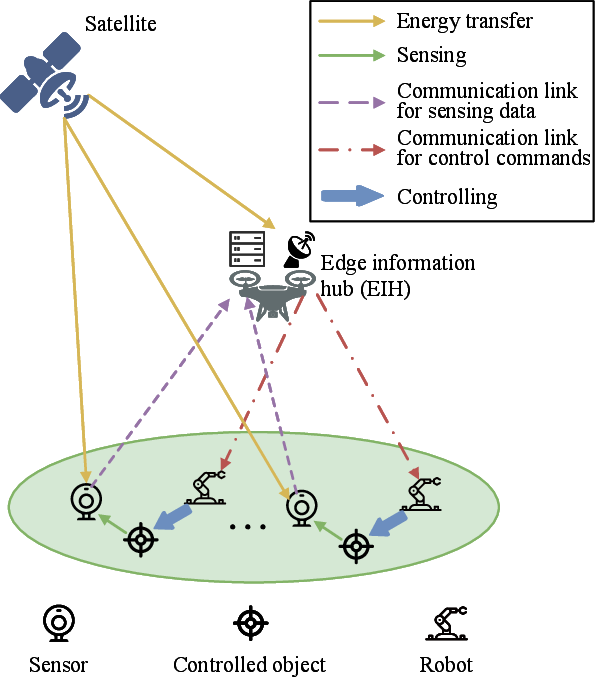
Figure 1: A wireless-powered SC3 system with satellite-based RF energy provision, UAV-based edge information hub, and interconnected robots, sensors, and field actuators.
This configuration notably addresses the operational limitations due to battery scarcity, common in remote or disaster-stricken environments where conventional terrestrial networking is infeasible.
The major contribution is a holistic optimization framework integrating all major resource and process couplings in SC3 loops:
- Bandwidth allocation for bi-directional (uplink/downlink) communication between sensors and EIH.
- Computational resource scheduling at the UAV-based EIH.
- Power allocation for uplink, downlink, and edge computing, sourced from harvested RF energy.
- Wireless power transfer splitting between sensors and EIH nodes.
- Cycle-wise time assignment for data acquisition, transmission, computation, and actuation.
The objective function is the sum of Linear Quadratic Regulator (LQR) costs across all loops, a principled control-theoretic metric reflecting system stability and energy expenditure. The formulated problem incorporates intricate dependencies, including uplink/downlink SNRs, computation energy models, and harvested energy constraints, resulting in a highly non-convex constrained optimization.
Algorithmic Approach: Sequential Convex Approximation with Joint Variable Substitution
To address the non-convexity, the authors develop an algorithm based on sequential convex approximation (SCA). Key transformations include:
- Slack variable introduction for bilinear constraints.
- Substitution of powers and CPU frequencies via energy-time decompositions.
- Iterative convexification of log-domain couplings, ensuring tractable per-iteration optimizations.
The rigorous convexity analysis guarantees monotonic convergence to a locally optimal solution. Furthermore, for the single-loop (i.e., K=1) scenario, a semi-closed-form solution is derived based on Lagrange duality, revealing that system-wide resource allocation reduces to solving a single scalar equation parameterized by an energy-time tradeoff variable ξ.
Simulation results validate the theoretical framework, focusing on both multi-loop and single-loop systems. Key findings include:
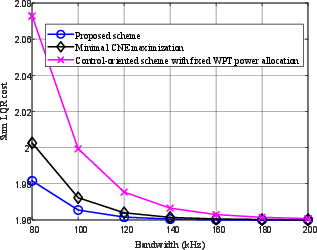
Figure 2: LQR cost versus total available bandwidth; joint optimization outperforms baseline methods throughout the operating range.
- Bandwidth increases consistently lower LQR cost under all schemes, but holistic co-optimization achieves substantial gains over simple minimum-CNE or fixed-WPT-allocation baselines.
- When cycle time is reduced, the baseline methods quickly become unstable (i.e., diverging LQR cost), while the holistic strategy maintains closed-loop stability across more aggressive system regimes.
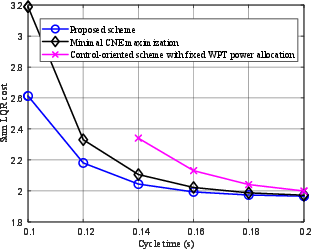
Figure 3: LQR cost dependency on control cycle time, highlighting stability limits under various schemes.
- Elevating WPT power saturates LQR performance: When the system becomes energy-abundant, all methodologies approach the ideal communication-limited lower bound for LQR cost.
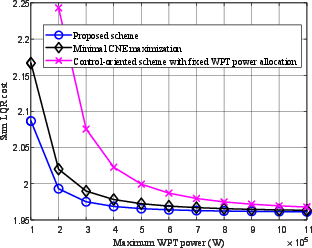
Figure 4: LQR cost as a function of maximum satellite WPT power, demonstrating transition to the energy-unconstrained regime.
- Single-loop analysis matches semi-analytical predictions: Time and energy allocations in the low-SNR (energy-limited) regime align with theoretical ratios derived in the limit, confirming the validity of asymptotic optimality characterizations.
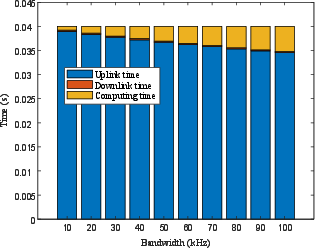
Figure 5: Computation, uplink, and downlink time allocation as a function of communication bandwidth for a single loop, indicating bottleneck transitions.
Resource Allocation Insights and Structural Results
Analytical derivations reveal strong structural properties:
- Resource balancing: System performance is maximized when information throughputs for sensing, uplink, computing, and downlink are matched, precluding bottlenecks due to overprovisioning any single component.
- Low-SNR regime: Optimal energy and time split between uplink and downlink transmissions is dictated by both channel gains and WPT efficiencies, with closed-form expressions for their ratios.
- Marginal tradeoff parameter: All optimal allocations are functions of a single scalar ξ (reflecting the marginal value of energy versus time), reducing complexity and simplifying parameter tuning in practical deployments.
As the bandwidth and WPT power increase, communication time allocations decrease, and optimization shifts towards computation-limited regimes.
Power and Time Allocation Adaptivity
Resource allocation is highly sensitive to environmental and system parameters:
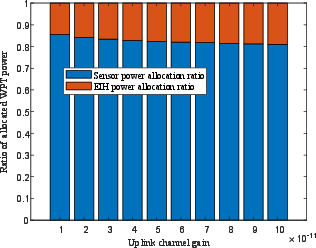
Figure 6: Energy allocation to sensors decreases as uplink channel improves, reflecting criticality-adaptive fairness under total WPT constraints.
- Weaker communication links warrant greater WPT allocation, upholding control loop stability and evenness of CNE (Closed-Loop Negentropy) delivery across varying channel conditions.
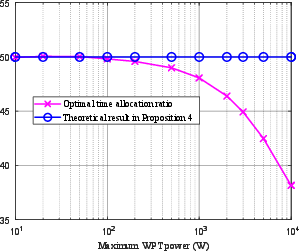
Figure 7: Uplink/downlink time allocation ratio versus WPT power—uplink dominates in limited-power scenarios due to raw data redundancy.
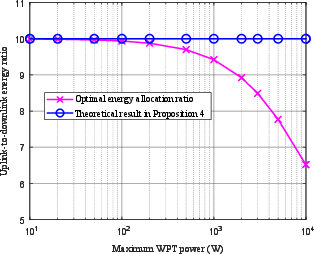
Figure 8: Uplink/downlink energy allocation ratio versus WPT power, confirming low-SNR regime analytical predictions.
Theoretical and Practical Implications
The presented framework provides a tractable and analytically grounded benchmark for future 6G mission-critical systems that merge non-terrestrial networking, edge intelligence, and power beaming. The implications are multi-fold:
- System-level tradeoff quantification: The results enable explicit performance-cost evaluation and scenario-dependent resource tuning for extended autonomous operations.
- Guidelines for infrastructure: Insights on how link quality, energy transfer efficiency, and computational scalability interact will inform hardware deployment (e.g., sizing of satellite aperture, edge node capabilities).
- Control-centric optimization: Direct use of LQR in resource allocation closes the gap between communication-theoretic and control-theoretic perspectives, encouraging stronger co-design in wireless automation.
- Algorithmic tractability: The derived SCA algorithm and single-scalar reduction for single loops make real-time or near-real-time deployment feasible for moderate-scale SC3 systems.
Future Directions
Practical adoption requires addressing open challenges:
- Channel state uncertainty: The current analysis assumes perfect CSI, which is often unavailable or expensive to track in dynamic, mobile scenarios. Robust, sample-efficient methods for resource allocation under estimation errors remain to be developed.
- Scalability and distributed methods: Fully centralized optimization will not scale to large SC3 deployments. Distributed, possibly LLM-enabled, architectures should be explored for tractable, cooperative control of multi-agent, multi-loop environments.
- Experimental demonstration: While high-power satellite WPT is maturing, real-world end-to-end $6$0 field validation remains a crucial next step.
Conclusion
The paper delivers a comprehensive, analytically rigorous framework for end-to-end optimization of wireless-powered, satellite-assisted 6G closed-loop control systems. By tightly coupling communication, edge computing, and wireless energy transfer within a unified control-theoretic optimization, the proposed approach yields substantial performance gains, system insights, and practical allocation strategies. It serves as a foundational reference for further theoretical exploration, system prototyping, and technology convergence in non-terrestrial, energy-autonomous control networks (2607.04225).