There and back again: the quasi-interstellar objects
Abstract: A population of interstellar objects (ISOs) exist that originate from the Solar System, rather than from other stars. Such a foreground could challenge straightforward analysis of the ISO sample expected to be gathered by upcoming sky surveys. We assess whether small bodies unbound from the Solar System can experience dynamical evolution in the Galactic potential that places them on re-encounter trajectories. We find that these 'quasi-interstellar objects' (quasi-ISOs) primarily depart the Solar System through erosion of the outer Oort cloud in the past few hundred Myr, excluding the most recent ~10 Myr. After orbiting in the Milky Way potential nearby the Sun but beyond the tidal radius, those ejected on certain orbits can re-encounter the Solar System. Meanwhile, the larger population of ISOs produced by the Solar System early in its life will be too spread-out in the Galaxy to contribute significantly to the observed sample. We predict that quasi-ISOs will be intrinsically rare and have values of order 0.1 km s, easily distinguishable from ISOs from other stars, meaning that the observed ISO sample will be truly Galactic. The detection of a quasi-ISO would imply larger-than-expected losses from the Oort cloud, or a particularly catastrophic erosion event 10-300 Myr ago that would not be detectable any other way.
Paper Prompts
Sign up for free to create and run prompts on this paper.
Top Community Prompts
Explain it Like I'm 14
Explaining “There and back again: the quasi-interstellar objects”
What is this paper about?
This paper asks a fun “boomerang” question: can tiny space rocks that were thrown out of our Solar System long ago ever come back and pass by the Sun again? The authors call these returning visitors “quasi-interstellar objects” (quasi-ISOs). They study how often this could happen, how fast these objects would be moving, and how we could tell them apart from true interstellar objects that were born around other stars.
What questions are the researchers trying to answer?
In simple terms, they want to know:
- Do any objects that the Solar System flings out into the Galaxy ever come back for another pass?
- If so, when are they most likely to return, how fast would they be moving, and from which directions would they appear in the sky?
- Could these Solar-System-born returners confuse future surveys that aim to study interstellar objects from other star systems?
How did they study the problem?
The team used computer simulations and simple physical models. Here’s the idea in everyday language:
- The setting: Far beyond the planets lies the Oort cloud, a huge, distant shell of icy objects surrounding the Solar System. Sometimes, other stars passing by or gentle “tides” from the Milky Way’s gravity nudge these objects, so a few escape into the Galaxy.
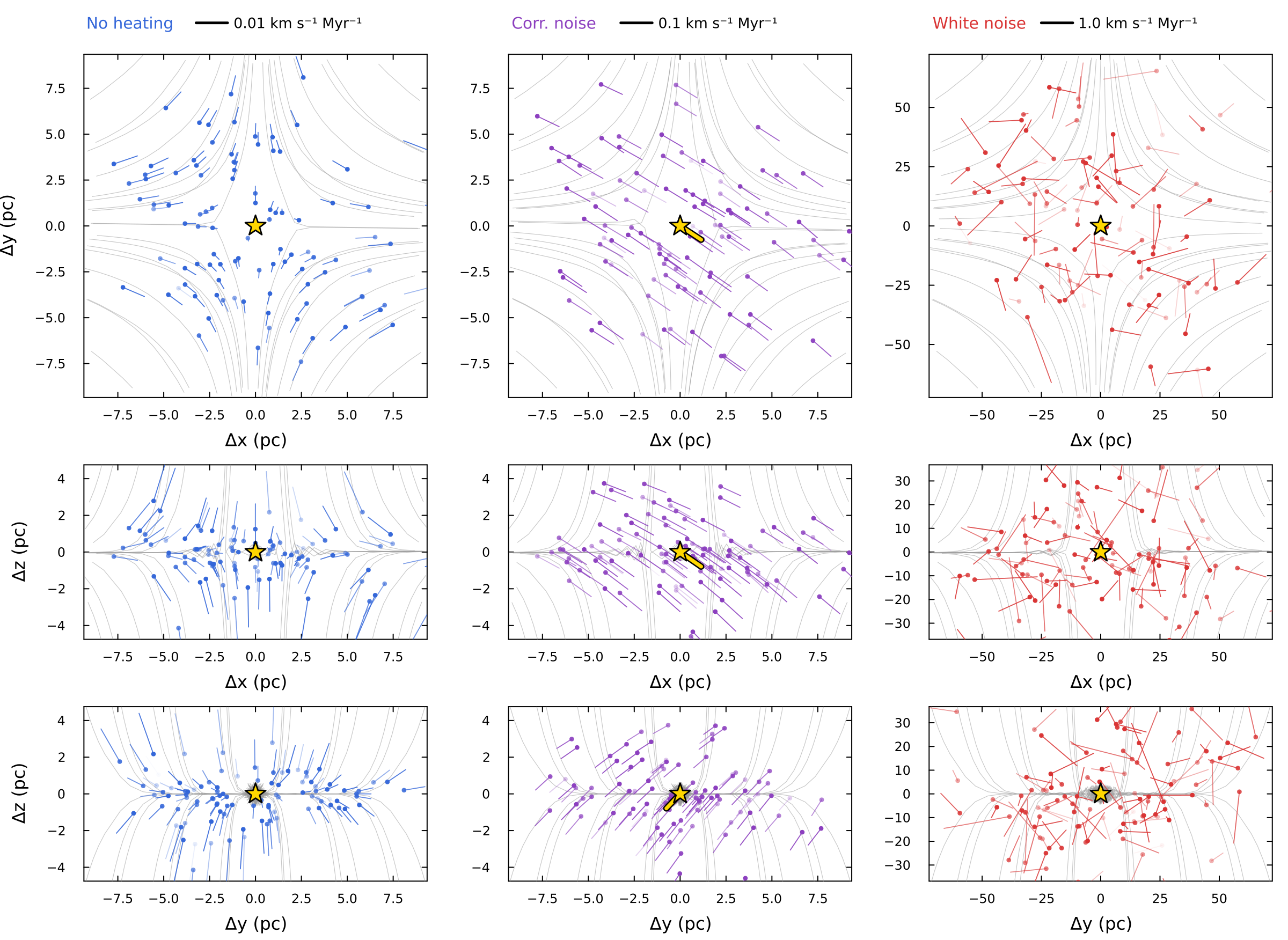
- The “galactic ocean”: Once an object leaves the Sun’s pull, it doesn’t just fly straight forever. The Milky Way’s gravity acts like a slow, giant tide, and gas clouds and passing stars give little “kicks” that stir objects’ speeds and paths. Astronomers call this stirring “dynamical heating.”
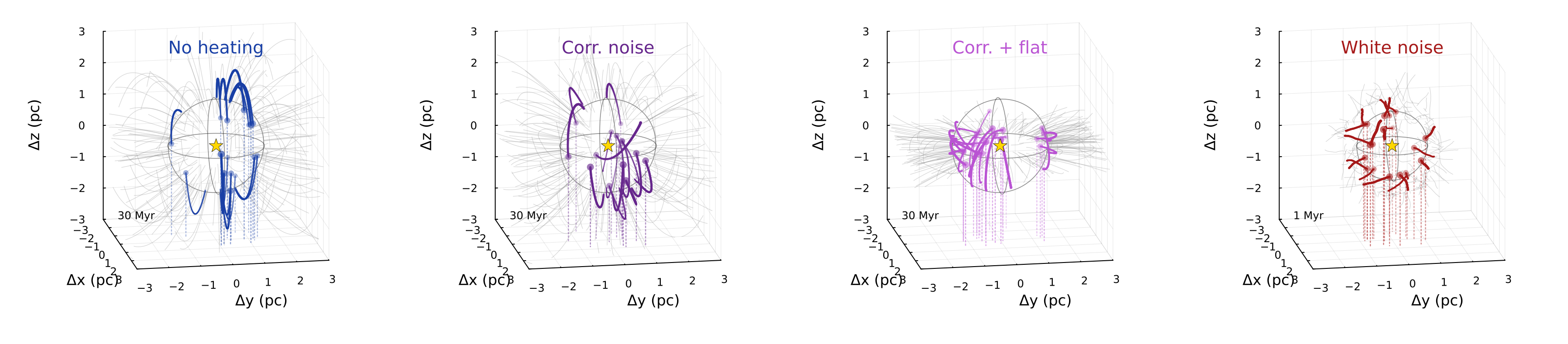
- The experiment: The authors “released” swarms of pretend objects (test particles) from near the edge of the Sun’s influence at different times in the past (from 1 to 800 million years ago). They gave the objects small push-off speeds (like 0.1 or 1 km/s) and let them travel under:
- No extra stirring (just smooth Milky Way gravity),
- Random short kicks (“white noise”),
- Longer-lasting, locally similar kicks (“correlated noise,” like passing through clumpy gas where nearby objects share similar nudges).
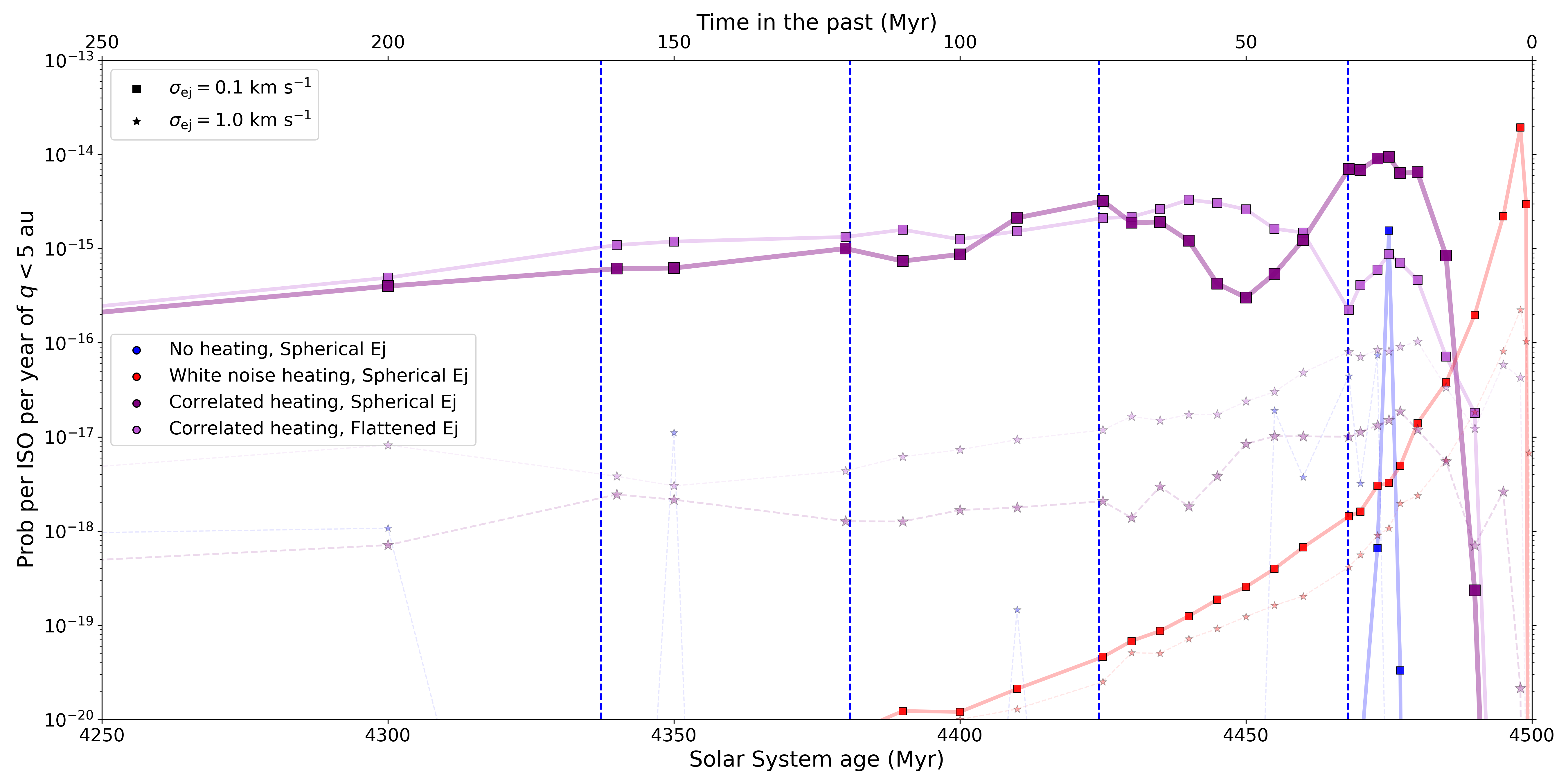
- Checking for returns: They asked, after all this motion, how many objects would come back near the Sun and dive within 5 astronomical units (au) of it (inside Jupiter’s orbit)? They also tracked the “excess speed” far from the Sun, called (think: the object’s speed “in the long run,” unaffected by the Sun’s pull).
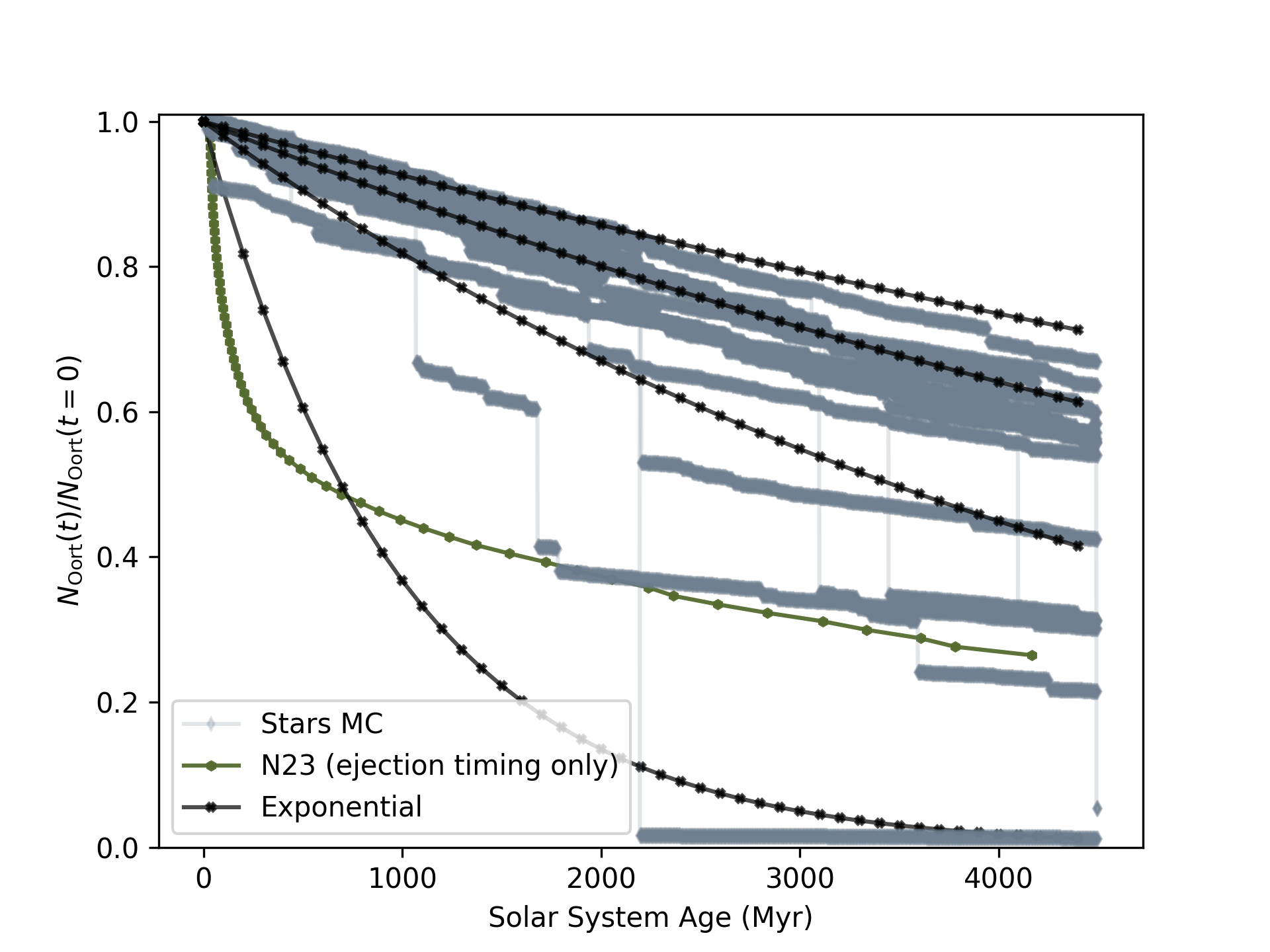
- How many are available to fling out? They combined the return probabilities with different histories of how the Oort cloud loses objects:
- A smooth, slow fade (exponential loss over billions of years),
- A detailed Solar System simulation (Nesvorný et al. 2023),
- A Monte Carlo model of random close passes by other stars that can yank objects free in bursts.
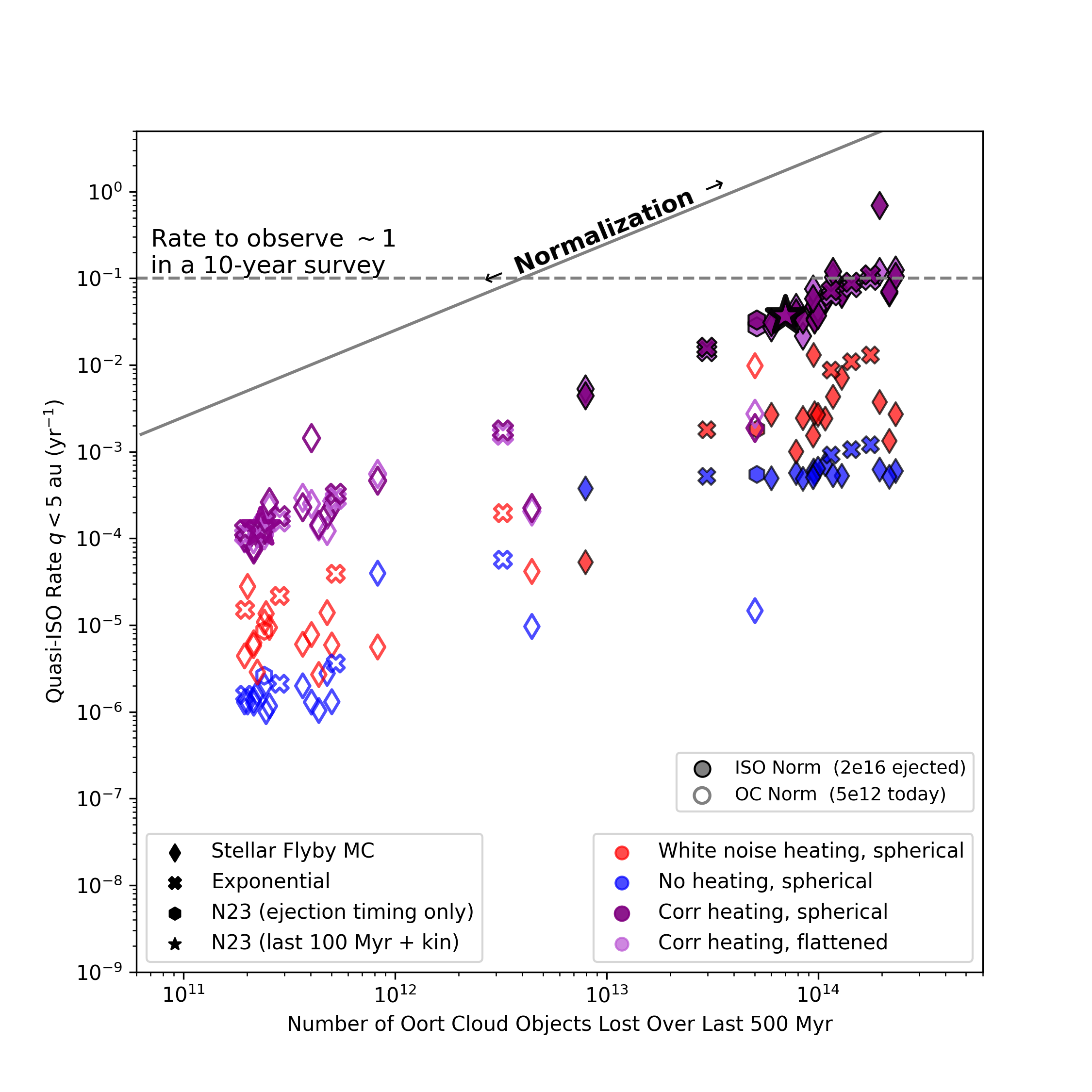
Because no one knows the exact number of Oort cloud objects, they tried two normalizations: - Based on current comet discoveries (suggesting ~5×10¹² objects the size of ‘Oumuamua or bigger are still in the Oort cloud today), - Based on the number of interstellar objects implied by discoveries like ‘Oumuamua (which suggests the Oort cloud started with many more and has lost ~99% over time).
What did they find, and why does it matter?
- Quasi-ISOs are rare. For each object flung out, the chance per year that it returns is tiny (about 1 in 100 trillion per year per object). To see one in, say, a decade, the Oort cloud must have lost a very large number of objects relatively recently (hundreds of billions to trillions within the last few hundred million years).
- Timing matters. In the most realistic models, returning objects typically come back 30–100 million years after they left. That’s because the Sun and the objects “bob” up and down through the Milky Way’s disk (like a slow spring motion), and their paths line up for re-encounters during these cycles.
- Early losses don’t help. The huge number of objects thrown out very early in the Solar System’s history are now spread too thin across the Galaxy to return in noticeable numbers.
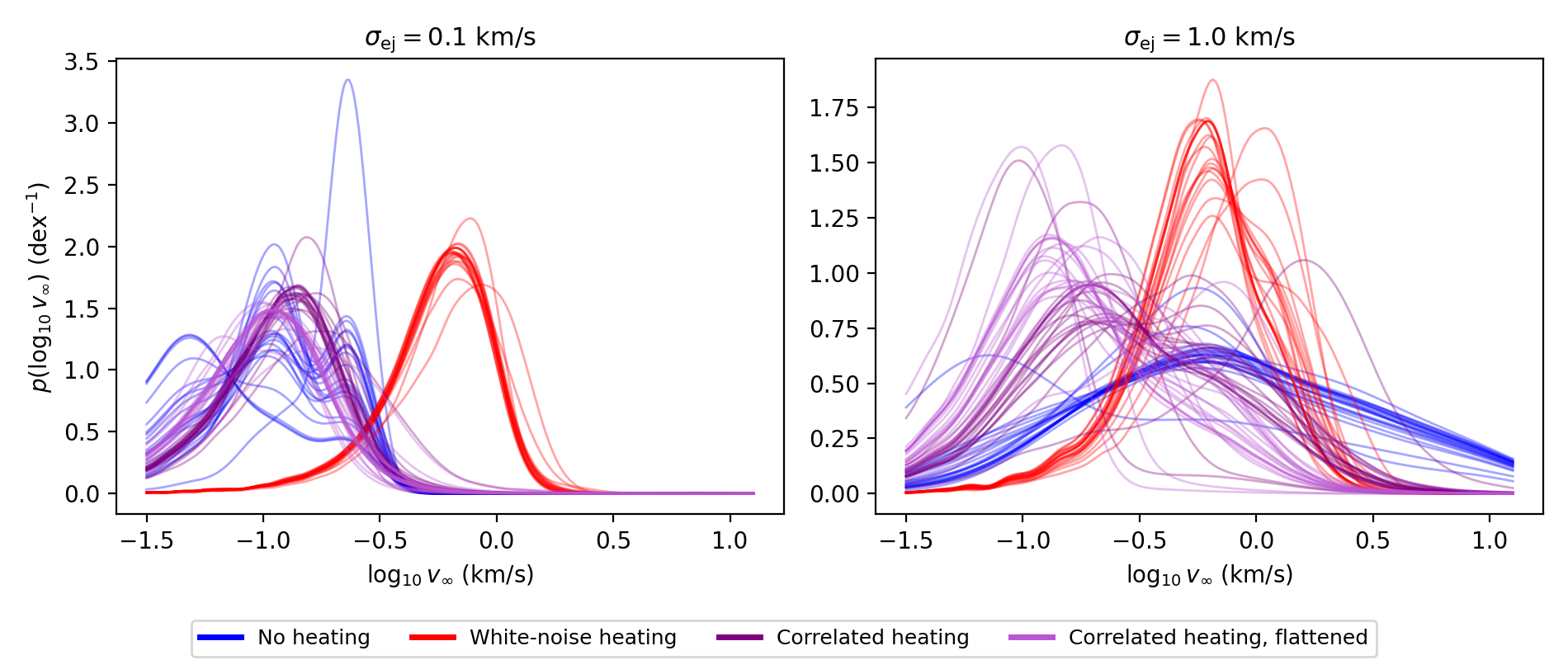
- Their speeds give them away. Quasi-ISOs would have very low —around 0.1 to 0.3 km/s. That’s much slower than the speeds of known interstellar objects from other stars (like ‘Oumuamua), which arrive several times faster. This makes quasi-ISOs easy to spot in principle: they’d look like extremely slow “interstellar” visitors.
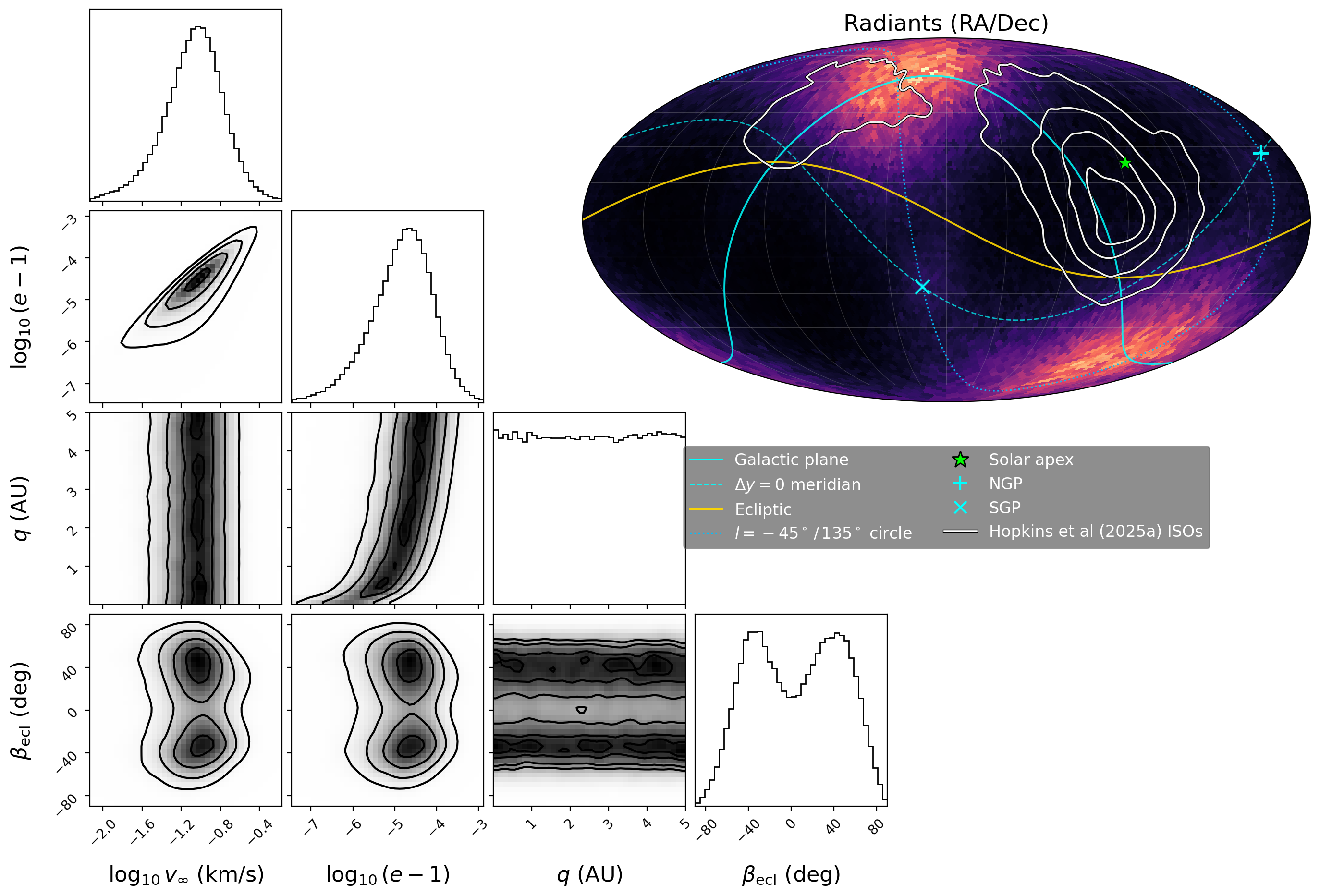
- Sky directions are special. The models predict that quasi-ISOs would tend to arrive from particular parts of the sky linked to the Milky Way’s midplane and the Sun’s motion around the Galaxy. This pattern is different from true interstellar objects, which usually appear to come from the Sun’s “apex” direction (the way the Sun moves through the local stars).
- Bottom line for surveys: Because quasi-ISOs are so rare and so slow, future sky surveys should not be “fooled” by them. The interstellar objects we find will mostly be genuine visitors from other stars. That’s good news for using ISOs to learn about how other solar systems form.
- A twist: If we do find a quasi-ISO, it’s a clue. It would hint that the Oort cloud has been losing more material than expected recently, or that a particularly strong event—like an unusually close, slow pass of another star—shook the Oort cloud 10–300 million years ago. That’s the kind of past “cosmic accident” that would be hard to detect in any other way.
What’s the impact of this research?
- It reassures astronomers that upcoming discoveries of interstellar objects will mostly reflect the true Galactic population, not a confusing “local foreground” of our own boomerangs.
- It provides a clear signature to identify quasi-ISOs: very low excess speeds ( km/s) and specific arrival directions. This helps observers quickly tell them apart from true interstellar visitors.
- It opens a new window into the Solar System’s past. Finding even one quasi-ISO would reveal that something big happened to the Oort cloud in the last few hundred million years—information we can’t easily get any other way.
In short, “There and back again” shows that Solar-System-born returners are possible but rare, easy to recognize, and scientifically valuable if we catch one. That means future interstellar discoveries will mostly teach us about other planetary systems—while a rare quasi-ISO would tell a surprising story about our own.
Knowledge Gaps
Below is a single, focused list of the paper’s unresolved knowledge gaps, limitations, and open questions. Each point highlights a concrete area where additional work could improve or test the conclusions.
- Quantify sensitivity of quasi-ISO rates to the assumed dynamical heating prescription (white noise vs. OU), including variations in the correlation time τ, correlation length rcorr, and overall heating amplitude, rather than adopting a single fiducial set.
- Incorporate time-dependent, non-axisymmetric Galactic structure (spiral arms, bar, GMC clustering along arms, bending waves) into the heating and orbital integration, instead of a static, smooth MilkyWay2014 potential with stochastic surrogates.
- Include spatially correlated perturbations among ISOs when far from the Sun (not just Sun–ISO correlations), to capture coherent impulses (e.g., from GMC passages) that could alter re-encounter probabilities.
- Assess the impact of rare, strong perturbations (e.g., close GMC passages, massive cluster encounters) explicitly, beyond their representation via smooth heating terms, on both stream dispersion and return trajectories.
- Explore alternative/backward-integration strategies for the Sun that avoid the ad hoc selection of low non-circular energy OU realizations (10th percentile), and quantify any bias this introduces in re-encounter predictions.
- Replace the simplified ejection setup (particles launched from a fixed 1.5 pc shell, radial direction, Gaussian speeds) with initial conditions drawn from self-consistent Oort cloud escape dynamics (e.g., distributions in position, velocity, and direction at exit from the Hill sphere).
- Allow the Solar tidal (Hill) radius to vary with Galactic position and time (due to vertical oscillations and possible radial migration) rather than fixing the ejection shell at 1.5 pc for all epochs.
- Expand beyond two discrete ejection velocity dispersions (σej = 0.1 and 1 km s⁻¹) to a physically motivated, continuous distribution informed by scattering dynamics, Galactic tide evolution, and flyby statistics.
- Test whether modestly higher ejection speeds (still ≤ a few km s⁻¹) truly cannot contribute to quasi-ISO returns; provide quantitative thresholds where re-encounters become negligible.
- Validate the “flattened ejection” model (v_z artificially reduced by ×10) with first-principles simulations or broader sets of N-body outputs beyond the single Nesvorný et al. (2023) case.
- Systematically explore how quasi-ISO rates depend on the choice of qmax (here 5 au) and the encounter sphere radius (here 0.1 pc), including convergence tests and scaling relationships.
- Provide convergence and error analysis for the 6D KDE and importance sampling used to estimate encounter rates (choice of kernels, nearest-neighbor numbers, bandwidths) and demonstrate robustness at the low-v tail that dominates the quasi-ISO signal.
- Revisit the use of small-angle approximations (θc ≪ 1) in the encounter flux calculation and quantify their impact on rate estimates across the sampled v∞ distribution.
- Improve the Oort cloud erosion models by coupling stellar flyby and Galactic tide effects self-consistently (rather than multiplicative products of independent flyby losses), including phase-dependent susceptibility and longer-term dynamical memory.
- Update the stellar flyby Monte Carlo with Gaia-based, time-dependent encounter rates and kinematics (anisotropic velocity ellipsoids, binaries, clusters), and propagate uncertainties in the Hanse et al. (2018) loss law beyond an ad hoc scatter term.
- Incorporate the Sun’s possible radial migration history and time-varying local density/velocity dispersion into both the erosion history and the ISO stream dispersion/return dynamics.
- Resolve the normalization tension between Oort cloud population estimates from long-period comet rates (~5×10¹² ≥1I-sized objects today) and ISO number densities (~10¹⁶ ≥1I-sized objects per star), and quantify how each normalization changes the expected quasi-ISO detection yield.
- Translate encounter rates into realistic discovery expectations by convolving with survey selection functions (e.g., LSST-like cadence, limiting magnitude, sky coverage), size–albedo distributions, and activity/brightness models.
- Assess the detectability of v∞ ~ 0.1–0.3 km s⁻¹ in practice, including orbit-fitting uncertainties, nongravitational accelerations (outgassing, radiation pressure), and systematic biases that can spuriously produce slightly hyperbolic solutions for comets.
- Develop and test additional observational discriminants beyond v∞ (e.g., radiant clustering near predicted great circles/poles, near-unity eccentricity and pericenter distributions) to distinguish quasi-ISOs from both bona fide ISOs and slightly hyperbolic comets.
- Quantify how Earth-based viewing geometry and survey systematics (e.g., solar elongation, ecliptic latitude coverage) imprint on the predicted radiant anisotropies and whether predicted sky patterns remain statistically robust.
- Examine the role of size-dependent physics (e.g., activity-driven non-gravitational forces) on the trajectories and inferred v∞ distributions of quasi-ISOs versus comets, and its implications for classification.
- Evaluate the probability and consequences of quasi-ISOs being captured by or ejected through interactions with other stars en route, which are not explicitly modeled in the current heating framework.
- Characterize how early cluster-phase dynamics (delayed escape, resonant encounters) might affect the Solar stream’s phase-space compactness and the feasibility of re-encounters, rather than assuming early-ejected ISOs are always too dispersed.
- Explore how different internal architectures and histories of the Oort cloud (inner vs. outer Oort fractions, evolving semimajor-axis and inclination distributions) alter return probabilities and v∞ predictions.
- Quantify the rates and plausible signatures of the “catastrophic erosion events” (10–300 Myr ago) implied by a detectable quasi-ISO, and identify astrophysical causes (slow stellar encounters, GMC crossings) consistent with required losses.
- Provide a parameter-space map (heating, erosion rate, ejection speed/geometry, normalizations) that delineates where quasi-ISO rates exceed thresholds (e.g., ≥10⁻² yr⁻¹) to guide targeted observational strategies.
- Compare predicted quasi-ISO distributions with potential contaminants (e.g., captured ISOs or comets rendered hyperbolic by planetary/nongrav forces) in a unified classification framework that can be applied to survey detections.
Practical Applications
Immediate Applications
Below are actionable uses that can be deployed now or with minimal development, organized by sector. Each item includes potential tools/workflows and the key assumptions/dependencies affecting feasibility.
- Astronomy software and survey operations
- Quasi-ISO classifier in alert brokers and MPC pipelines
- Use case: Flag incoming hyperbolic candidates with v_inf < 1 km s-1 (especially ~0.1–0.3 km s-1) as “quasi-ISO” to separate Solar-system-returners from true Galactic ISOs.
- Tools/workflow: Add a velocity feature to existing brokers (e.g., ANTARES, Fink, Lasair) and MPC submission filters; compute v_inf from preliminary orbit fits; apply a threshold (e.g., v_inf < 1 km s-1) and low-eccentricity offset (e ≳ 1 with small excess); optionally score by radiant proximity to predicted bands (see below).
- Assumptions/dependencies: Reliable early orbit solutions; handling of non-gravitational accelerations; survey depth/cadence sufficient to constrain v_inf; telescope astrometry systematics controlled to < few mas.
- Follow-up triage and observing strategy for low-v_inf hyperbolic objects
- Use case: Prioritize spectroscopy/photometry for low-v_inf hyperbolic candidates to test Solar-system-like composition and constrain Oort cloud loss history.
- Tools/workflow: Target-of-opportunity (ToO) triggers keyed to v_inf and radiant; queue scheduling at facilities (e.g., Gemini, VLT, IRTF); standard compositional indices (e.g., carbon depletion).
- Assumptions/dependencies: Rapid dissemination of v_inf; community ToO access; weather/airmass constraints.
- Cadence and pointing heuristics for slow hyperbolic arrivals
- Use case: Slightly increase attention to sky regions where quasi-ISO radiants cluster: near the Galactic midplane where it intersects the ℓ ≈ −45°/+135° meridian (for flattened ejection, correlated-heating models), and near the Galactic poles for more isotropic ejection scenarios.
- Tools/workflow: Add radiant-weighted survey footprint heuristics; incorporate into Rubin survey strategy experiments (e.g., via rubin_sim).
- Assumptions/dependencies: Model-dependent sky patterns (heating/ejection geometry); survey constraints (sun avoidance, seasonal visibility).
- Foreground control in ISO population inference
- Use case: Exclude quasi-ISOs (by v_inf, radiant patterns, near-constant-in-q cross-section) to avoid biasing estimates of Galactic ISO number density and composition.
- Tools/workflow: Add a “quasi-ISO mask” during population modeling; hierarchical Bayesian models with a foreground component informed by this paper’s priors (e.g., v_inf distribution peaked at ~0.2 km s-1).
- Assumptions/dependencies: Accurate selection functions; robust modeling of small-number statistics.
- Academic research and data analysis
- Rate and upper-limit calculator for Oort cloud erosion
- Use case: Convert detections/non-detections of quasi-ISOs into constraints on Oort cloud loss in the last 10–300 Myr.
- Tools/workflow: Implement the paper’s convolution framework (Equation analogues for encounter-rate integration) with selectable erosion histories (exponential, simulation-based, flyby-driven) to output posterior on recent loss fraction.
- Assumptions/dependencies: Oort cloud normalization ambiguity (LPC-based vs ISO-based); choice of Galactic potential and heating parameters (τ ~ 17 Myr, r_corr ~ 170 pc).
- Gaia-based stellar flyby reweighting of near-term expectations
- Use case: Use Gaia DR3/DR4 stellar encounter catalogs to update the time-dependent quasi-ISO expectation (identify any recent/ongoing slow, massive flybys that elevate the rate).
- Tools/workflow: Monte Carlo flyby sampler (mass, b, v) tied to Gaia-derived encounter posteriors; apply Hanse et al. (2018) loss-law with uncertainty inflation; recompute encounter-rate weighting.
- Assumptions/dependencies: Completeness of nearby flyby catalog; uncertainties in loss-law scatter; neglect of Sun’s migration and spiral structure remains acceptable at current precision.
- Reproducible modeling toolkit for stream evolution and encounter estimation
- Use case: Package the SDE-based correlated-heating integrator (OU process), importance-sampled boundary-flux estimator, and KDE components for community use in related small-body dynamics problems.
- Tools/workflow: Julia package leveraging DifferentialEquations.jl; Python bindings; examples reproducing the v_inf and radiant distributions.
- Assumptions/dependencies: Community uptake; modest HPC resources for large ensembles.
- Citizen science and education
- Public quasi-ISO hunt and outreach
- Use case: Engage volunteers to vet slow hyperbolic candidates and help spot low-v_inf alerts; explain difference between ISOs and quasi-ISOs and why it matters for planetary formation.
- Tools/workflow: Zooniverse project (author overlap suggests fit); classroom modules on Galactic dynamics and Oort cloud.
- Assumptions/dependencies: Stream of candidate alerts; curated training data; moderation and expert feedback loops.
- Science policy and communications
- Communication templates and nomenclature guidance
- Use case: Avoid mislabeling quasi-ISOs as “interstellar visitors” in press releases; propose adoption of “quasi-ISO” as a distinct class with a working threshold (e.g., v_inf < 1 km s-1).
- Tools/workflow: Draft guidelines with MPC/IAU working groups; include recommended reporting metrics (v_inf, radiant coordinates in Galactic frame, q distribution).
- Assumptions/dependencies: Community consensus; evolving definitions as data accrue.
Long-Term Applications
These require additional research, scaling, or development but could produce significant scientific and technological returns.
- Aerospace and mission design
- Low–delta-v intercept/rendezvous missions to quasi-ISOs
- Opportunity: v_inf ~ 0.1–0.3 km s-1 relative to the Sun implies substantially easier access than typical ISOs, enabling flyby, rendezvous, or even sample-return missions to Oort-cloud-like material.
- Potential products: Mission concept studies (trajectory design, launch windows keyed to predicted radiant bands and constant-in-q cross-sections); small rapid-response spacecraft architectures; on-board volatile-preserving sampling systems.
- Assumptions/dependencies: Sufficient discovery lead time; robust early v_inf confirmation; space-agency prioritization; technology maturity for fast turnaround.
- Observatory and survey design
- Cadence and instrument optimization for slow hyperbolic objects
- Opportunity: Tailor future surveys (Rubin extensions, NEO Surveyor ops modes, next-gen wide-field IR) to enhance completeness for v_inf < 1 km s-1 interlopers near the Galactic plane and at small solar elongations.
- Potential products: Survey strategy figures-of-merit incorporating quasi-ISO yield; twilight survey modes; improved moving-object linking for slow, weakly hyperbolic orbits.
- Assumptions/dependencies: Competing survey goals; limits from scattered light and confusion in dense star fields.
- Advanced Galactic-environment inference from quasi-ISO detections
- Inverse modeling of erosion events and Solar neighborhood history
- Opportunity: Use a set of quasi-ISO detections (or strong upper limits) to infer the magnitude and timing of past Oort cloud erosion, including signatures of catastrophic events 10–300 Myr ago, and to constrain local GMC-driven heating.
- Potential products: Bayesian inversion frameworks coupling detection statistics to time-resolved erosion models; joint fits with stellar flyby and GMC catalogs.
- Assumptions/dependencies: Multiple detections to overcome small-number statistics; improved models of spiral structure, GMC distribution, and Sun’s migration.
- Standards and classification policy
- Formal adoption of a “quasi-ISO” class in small-body catalogs
- Opportunity: Clarify archival and real-time handling of hyperbolic objects by introducing a sustained taxonomy and reporting standards (e.g., v_inf thresholds, radiant diagnostics, e − 1 significance).
- Potential products: MPC/IAU Circulars and data schema updates; public dashboards of quasi-ISO candidates and posteriors.
- Assumptions/dependencies: Community agreement on thresholds; evolution as models refine.
- Cross-domain methods transfer
- Correlated-noise SDE frameworks and boundary-flux estimators
- Opportunity: Apply the paper’s OU-based correlated heating and importance-sampled flux across a surface to other domains that track particle ensembles under stochastic forcing.
- Potential products/sectors:
- Space situational awareness: Modeling debris clouds with correlated perturbations (e.g., atmospheric drag variability).
- Climate/earth sciences: Lagrangian transport with spatially correlated stochastic winds.
- Finance: Time-correlated noise modeling for portfolio stress testing (methodological transfer).
- Assumptions/dependencies: Problem-specific calibration of correlation time/length scales; validation data.
- Materials and planetary science
- Comparative planetology with quasi-ISO samples
- Opportunity: If quasi-ISOs are detected and characterized (or sampled), compare their volatiles and organics to long-period comets to study Oort-cloud processing and Solar System chemical gradients.
- Potential products: Laboratory analysis protocols; cryogenic curation similar to comet sample-return missions.
- Assumptions/dependencies: Successful detection and access; preservation of pristine material.
- Community software and HPC
- High-fidelity Galactic-dynamics simulators for small bodies
- Opportunity: Incorporate spiral arms, time-varying GMC distributions, and Sun’s migration into open tools that evolve ISO streams and predict quasi-ISO radiants and rates.
- Potential products: Scalable GPU-accelerated integrators; public cloud-hosted simulation services; interfaces to GaiaNIR-era catalogs.
- Assumptions/dependencies: Data on the Milky Way potential and ISM structure; funding for sustained software maintenance.
Key Assumptions and Dependencies (global)
- Normalization of the Oort cloud population is uncertain by orders of magnitude (LPC-based vs ISO-based), directly scaling expected quasi-ISO rates.
- Heating model parameters (e.g., τ ≈ 17 Myr, r_corr ≈ 170 pc) and the adopted Galactic potential affect predicted timing and radiant patterns.
- Ejection velocity distributions and geometry (isotropic vs Galactic-plane–flattened) impact sky signatures and rates.
- Accurate orbit determination and treatment of non-gravitational forces are essential to reliably measure v_inf at <1 km s-1.
- Survey completeness, alert latency, and follow-up capacity determine the practical yield of quasi-ISO candidates.
These applications leverage the paper’s core findings that quasi-ISOs are intrinsically rare but dynamically distinctive: they have very low excess velocities (order 0.1–0.3 km s-1), characteristic radiant concentrations tied to Galactic dynamics, and a rate that is highly informative about recent Oort cloud erosion.
Glossary
- Age–velocity dispersion relation (AVR): Empirical relation linking a stellar population’s age to its velocity dispersion in the Galaxy. "to model a constant heating rate () that accounts for the majority of the observed age-velocity dispersion relation (AVR) in local stars"
- Birth cluster: The stellar cluster in which a star (and its planetesimals) formed, affecting early dynamical histories. "may be delayed yet again by orbiting in the birth cluster of its parent star"
- Correlated heating: A dynamical-heating model where nearby objects experience similar, time-correlated velocity kicks. "In the correlated heating case, we do include random kicks to the Sun's velocities"
- Damped random walk: A stochastic process with finite correlation time used to model time-correlated perturbations (the OU process). "we employ a damped random walk (Ornstein-Uhlenbech, or OU) process"
- Differential rotation: Variation of circular speed with Galactocentric radius that shears and stretches structures. "the Galaxy's differential rotation"
- Dynamical heating: Random gravitational perturbations that increase orbital energy/velocity dispersion over time. "The velocity dispersion of the stream will increase over time due to dynamical heating"
- Equipotential surface: A surface of constant gravitational potential; its shape is altered by external tides. "the Galactic tide, which deforms the equipotential surface around the Sun"
- Escape velocity: The minimum speed required to become unbound from a gravitating body at a given distance. "by adding in quadrature the escape velocity from the Sun at 1.5 pc"
- Epicyclic frequency: The natural frequency κ of small radial oscillations about circular Galactic orbits. "where is the epicyclic frequency"
- Epicyclic motion: Small oscillations in a star’s (or object’s) orbit around a guiding center in a disk potential. "their in-Galactic-plane epicyclic motion as the Sun"
- Excess velocity (): The asymptotic speed at infinity for a hyperbolic trajectory relative to the Sun. "We predict that quasi-ISOs will be intrinsically rare and have values of order 0.1 km s"
- Galactic meridian: A great circle on the sky defined relative to Galactic coordinates, akin to longitude lines. "the Galactic meridian"
- Galactic midplane: The plane of the Milky Way’s disk where stellar and gas densities are highest. "a preference for arrival near the Galactic midplane"
- Galactic potential: The large-scale gravitational potential of the Milky Way that governs orbital dynamics. "dynamical evolution in the Galactic potential"
- Galactic tide: The large-scale tidal field of the Galaxy that perturbs distant Solar System orbits. "Because the Galactic tide rotates the orbital elements of Oort cloud comets"
- Giant molecular clouds: Massive, cold gas clouds that gravitationally perturb stellar and small-body orbits. "if heating arises from encounters with giant molecular clouds"
- Gravitational focusing: Enhancement of encounter cross-sections due to gravitational attraction deflecting trajectories. "a gravitational focusing dominated cross-section"
- Guiding center radius: The radius of a circular orbit with the same angular momentum as a given orbit. "where is the guiding center radius of the orbit"
- HEALPix: A hierarchical equal-area pixelization scheme for all-sky data and maps. "then plotted using a simple KDE or healpix histogram respectively"
- Hill radius (Hill sphere): The region where a body’s gravity dominates over the Galaxy’s tidal forces. "Here "
- Hyperbolic orbit: An unbound trajectory with positive orbital energy relative to the Sun. "They are distinguished by their hyperbolic orbits with orbital energies unambiguously positive"
- Impact parameter: The perpendicular offset at infinity that determines closest approach in a hyperbolic encounter. "The impact parameter and the particle's pericenter, , are related via"
- Interstellar medium (ISM): The gas and dust between stars that contributes to dynamical perturbations. "This is an approximation to the full density structure of the interstellar medium"
- Interstellar object (ISO): A small body unbound to the Sun, entering the Solar System from interstellar space. "Interstellar objects (ISOs), theorized for decades"
- Kernel density estimator (KDE): A nonparametric method to estimate probability density from samples. "Each simulation's phase space density is estimated via an adaptive cross-validated kernel density estimator"
- MilkyWay2014 potential: A specific analytic model of the Milky Way’s gravitational potential. "For the smooth term we use the MilkyWay2014 potential from \citet{bovy2015}"
- N-body simulation: A computational model that directly integrates the gravitational interactions of many bodies. "the \citet{nesvorny2023} N-body simulation"
- Ornstein–Uhlenbeck process (OU): A mean-reverting stochastic process used to model temporally correlated noise. "we employ a damped random walk (Ornstein-Uhlenbech, or OU) process"
- Oort cloud: A distant reservoir of cometary bodies surrounding the Solar System. "objects originating in the Oort cloud"
- Pericenter: The closest approach distance to the Sun on an orbit. "We set the maximum pericenter distance to au"
- Phase-space density: The density of objects in the combined space of positions and velocities. "The density being integrated is , the phase space density of ISOs"
- Power spectral density: The distribution of variance as a function of frequency for a stochastic process. "the variance per unit frequency (the power spectral density)"
- Quasi-interstellar object (quasi-ISO): An object ejected from the Solar System that later re-encounters it after Galactic orbiting. "We term these
quasi-interstellar objects', orquasi-ISOs', in common with quasi-satellites." - Radiant: The apparent direction on the sky from which an object appears to arrive. "their incoming radiants on the sky"
- Rotation curve: The circular speed of stars/gas as a function of Galactocentric radius. " is the local powerlaw index of the rotation curve."
- Solar apex: The direction of the Sun’s motion relative to nearby stars. "ISOs, shown in the white contours, preferentially arrive from the Solar apex"
- Solar circle: The radius in the Galaxy at which the Sun orbits. "randomly distributed throughout the Solar circle"
- Stellar flyby: A close passage of another star that perturbs Solar System bodies. "The potentially far larger source of Oort cloud erosion is stellar flybys"
- Tidal radius: The boundary beyond which Galactic tides exceed a body’s gravitational hold. "beyond the tidal radius"
- Tidal stream: A sheared, elongated distribution of objects unbound from a progenitor due to tides. "The ISOs from any given progenitor will form a tidal stream"
- Vertical oscillation frequency: The frequency ν of small vertical motions through the Galactic midplane. "vertical oscillations occur with frequency "
- White noise: A stochastic process with uncorrelated, constant spectral-density perturbations. "The simplest heating prescription is to include a white noise term in the equations of motion"