- The paper derives an explicit Onsager–Machlup functional for degenerate SDEs with time-dependent fractional noise, addressing coupling and memory effects in complex systems.
- It employs degenerate Girsanov transformations and infinite-dimensional Gaussian correlation inequalities to manage multidimensional noise and implicit history-dependent interactions.
- Numerical experiments on systems like the stochastic pendulum and Duffing oscillator validate that most probable paths often coincide with deterministic noise-free solutions.
Onsager–Machlup Functionals for Generalized Newtonian Equations of Motion with Time-Varying Fractional Noise
The paper "Onsager--Machlup Functionals for Generalized Newtonian Equations of Motion with Time-Varying Fractional Noise" (2607.04193) addresses the derivation and analysis of Onsager–Machlup (OM) functionals for a large class of degenerate stochastic differential equations (SDEs) on Rm+n, subject to n-dimensional fractional Brownian motion (fBm) with time-dependent diffusion coefficients, for Hurst parameter H∈(1/4,1). The primary motivation is modeling complex systems—such as viscoelastic media and protein dynamics—where stochastic forcing acts only on a subset of variables (degeneracy) and exhibits both temporal correlations and time-varying intensity.
The OM functional provides a path-space action that characterizes the relative likelihood of rare noise-driven transitions between metastable states. In the context of SDEs perturbed by fBm, especially with time inhomogeneity and degeneracy, such quantitative characterizations are analytically challenging due to strong coupling and memory effects.
Main Results: Explicit Formulation of the OM Functional
The main contribution is a rigorous derivation of an explicit OM functional for degenerate SDEs of the form
{dXt=at(Xt,Yt)dt, dYt=bt(Xt,Yt)dt+σtdBtH,
where σt is a time-dependent, non-degenerate diagonal diffusion matrix and BtH is n-dimensional fBm with H∈(1/4,1). The coupling between position Xt and velocity Yt generates nontrivial dependencies, as noise acts only on n0 but propagates throughout the system via the deterministic flow.
The OM functional n1 associated to a reference path n2 in n3 and the corresponding deterministic flow n4 in n5 is given in terms of the inverse of a n6-weighted fractional Volterra operator n7:
n8
with explicit formulas for n9 in regimes H∈(1/4,1)0, H∈(1/4,1)1, and H∈(1/4,1)2. Here H∈(1/4,1)3 is a universal constant depending on H∈(1/4,1)4.
Analytical Techniques and Decoupling Mechanisms
Two core technical difficulties are overcome:
- Degeneracy-induced coupling: The drift H∈(1/4,1)5 couples H∈(1/4,1)6 into H∈(1/4,1)7, and H∈(1/4,1)8 itself evolves via a deterministic equation driven by H∈(1/4,1)9. This leads to implicit, history-dependent interactions that cannot be treated by standard (non-degenerate) Girsanov transformations.
- Multidimensional noise coupling: The multidimensionality of fBm yields nontrivial cross-correlation terms not representable by deterministic kernels or reducible to independent components.
To manage these, the analysis deploys:
- Degenerate Girsanov transformation: Shifts only the noise-affected ({dXt=at(Xt,Yt)dt, dYt=bt(Xt,Yt)dt+σtdBtH, 0) subspace, reconstructing {dXt=at(Xt,Yt)dt, dYt=bt(Xt,Yt)dt+σtdBtH, 1 via deterministic coupling.
- Gaussian Correlation Inequality (GCI): Extends the classical GCI from finite to infinite-dimensional Gaussian measures, permitting reduction of pathwise conditional exponential moments to unconditional Gaussian expectations under Hölder small-ball conditioning.
- Sharp regularity and Gronwall estimates: Establishes that under small-noise constraints, the deviations of the degenerate components scale optimally, allowing vanishing of higher-order coupling in the OM functional.
The OM functional is computed in full generality for {dXt=at(Xt,Yt)dt, dYt=bt(Xt,Yt)dt+σtdBtH, 2 (fractional) and {dXt=at(Xt,Yt)dt, dYt=bt(Xt,Yt)dt+σtdBtH, 3 (classical Brownian) regimes:
{dXt=at(Xt,Yt)dt, dYt=bt(Xt,Yt)dt+σtdBtH, 4
where {dXt=at(Xt,Yt)dt, dYt=bt(Xt,Yt)dt+σtdBtH, 5, and fractional integrals/derivatives are defined in the Riemann–Liouville sense.
Most Probable Paths and Euler–Lagrange Theory
Minimizers of {dXt=at(Xt,Yt)dt, dYt=bt(Xt,Yt)dt+σtdBtH, 6 under fixed endpoints yield the most probable transition paths. The paper obtains the necessary Euler–Lagrange equations for these minimizers, both in the classical and fractional setting, under the additional constraint that {dXt=at(Xt,Yt)dt, dYt=bt(Xt,Yt)dt+σtdBtH, 7 is coupled to {dXt=at(Xt,Yt)dt, dYt=bt(Xt,Yt)dt+σtdBtH, 8:
- The system yields a set of coupled forward-backward ordinary/integro-differential equations for {dXt=at(Xt,Yt)dt, dYt=bt(Xt,Yt)dt+σtdBtH, 9 (with σt0 the adjoint Lagrange multiplier), sharply characterizing optimal paths in the degenerate fBm-driven setting.
- For certain systems (e.g., classical mechanics and Hamiltonian flows with constant divergence in velocity), the most probable paths coincide with deterministic noise-free solutions—a phenomenon termed path-preservation. This is demonstrated to arise when the divergence term in the OM functional is path-independent.
Numerical Experiments
The theoretical predictions are substantiated with numerical integration of representative degenerate SDEs, specifically:
- Stochastic pendulum equation: Simulations demonstrate that the deterministic solution coincides with the most probable path and empirical mean, invariant under changes in σt1 and time-modulated noise amplitude.
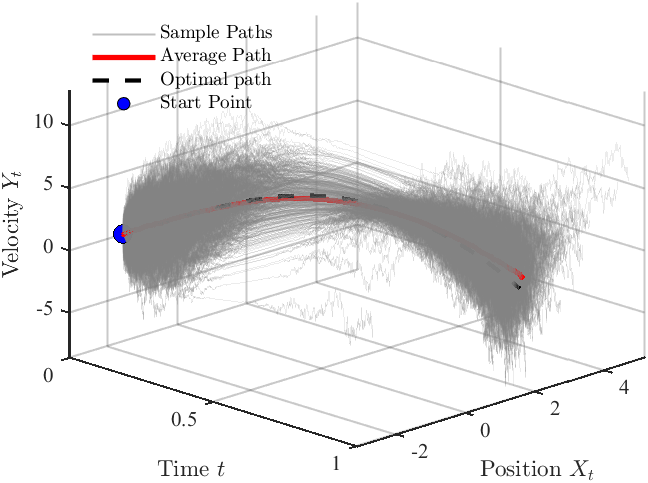
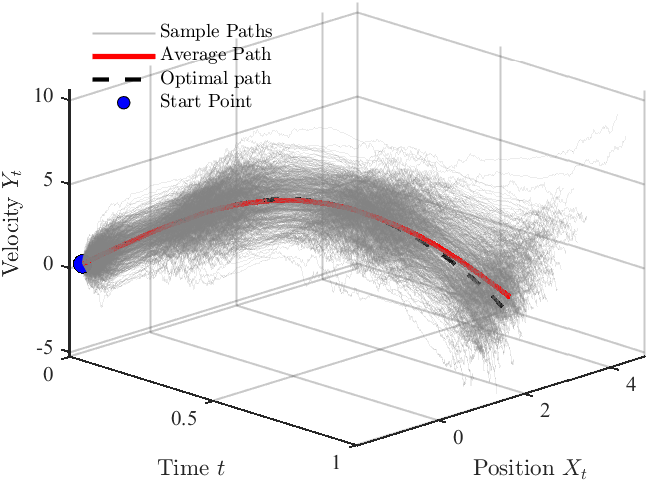
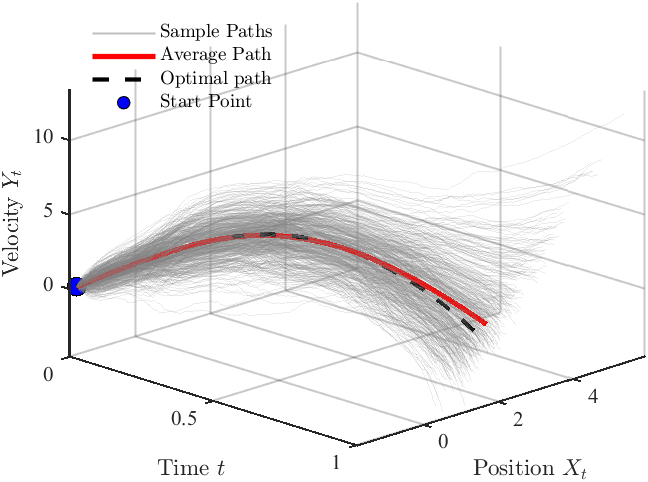
Figure 1: Simulation of the most probable path for σt2, σt3, σt4, and σt5.
- Stochastic Duffing oscillator: For both autonomous and time-inhomogeneous noise, OM functional minimization yields transition paths consistent with averaged sample paths. For σt6, nonlocal effects of fractional noise manifest in altered path morphology, directly influenced by the noise history and time-dependent signal.
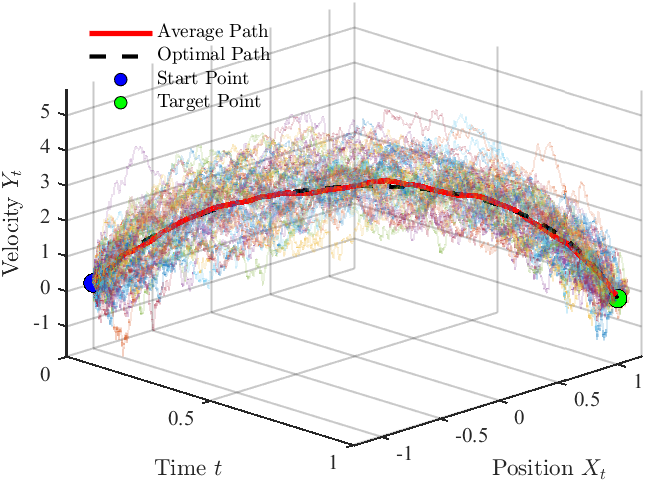
Figure 2: The average path and the optimal path for the Duffing system (Equation 2) in the classical case.
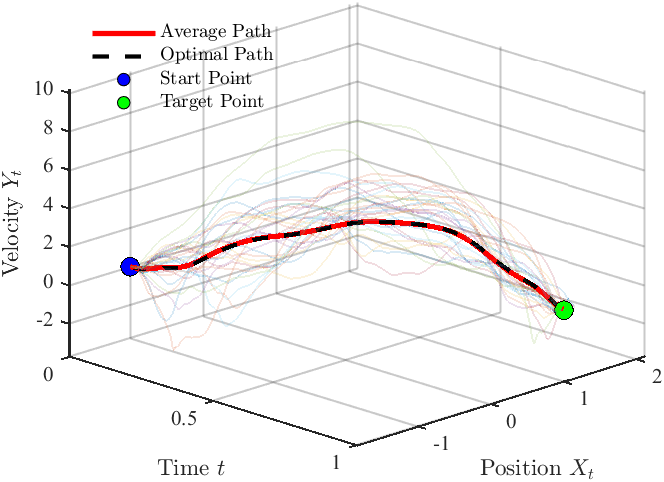
Figure 3: The average path and the optimal path for Equation 2 with σt7 and rapidly time-varying σt8.
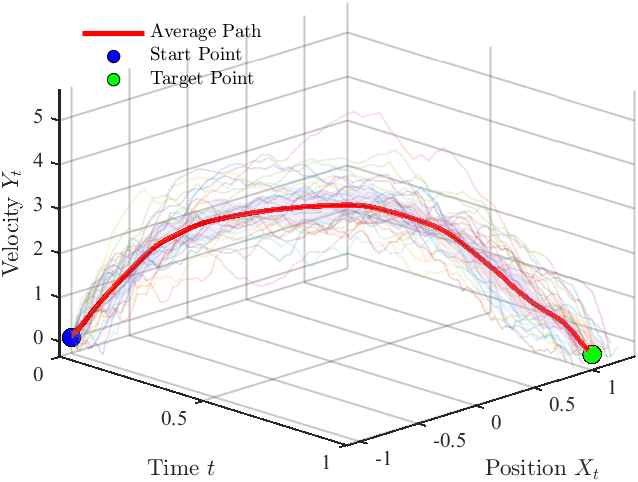
Figure 4: The average path for Equation 2 with σt9 and periodic variation in BtH0.
Implications and Future Outlook
The derivation of explicit Onsager–Machlup action for degenerate SDEs with time-dependent, multidimensional fractional Brownian forcing fills a significant theoretical gap. From a practical standpoint, this greatly expands the range of physical, biological, and engineered systems—especially those with subspace-restricted noise and history dependence—for which transition statistics and rare-event pathways can be quantitatively evaluated.
The decoupling arguments, especially those leveraging infinite-dimensional Gaussian correlation, should see further application in the study of stochastic PDEs, nonequilibrium statistical mechanics, and inference for rough-path–driven models. The analytical techniques developed here may provide a blueprint for future work on path-space large deviation theory and optimal control under degenerate fractional noise.
Exciting directions include extending these results to:
Conclusion
This work rigorously establishes the Onsager–Machlup functional for a broad class of degenerate stochastic systems with time-varying, multidimensional fractional noise, resolving core analytical obstacles posed by coupling and memory effects. It yields explicit analytical and computational tools for evaluating most probable noise-induced transitions and characterizes the geometry of optimal paths in such strongly non-Markovian systems, with both theoretical and practical ramifications for stochastic dynamics under complex noise.
Reference:
"Onsager--Machlup Functionals for Generalized Newtonian Equations of Motion with Time-Varying Fractional Noise" (2607.04193)